haggard
Members
-
Joined
-
Last visited
Everything posted by haggard
-
2-pc works well for the truck. If you want it even more accessible, a 6'0 4-pc can fit in an everyday carry messenger/laptop bag, with you at all times - work, friend's place, etc. No need to go to the truck. I got a StC 6'0 L/F 4-pc (with 1000 size reel) for those ultra portable situations. I chose L/F for panfish through bass, as long as the bass aren't too big. Which is fine for me since I can't seem to catch big bass. StC has higher power options on a 4-pc if you don't need the panfish. I'm looking forward to that day when we have a fire drill at work and instead of waiting in the parking lot for 30 minutes I go fishing in the fire pond. Rumor has it there are bass in there. If security doesn't kick you out. One of the ponds has a sign "no swimming, wading or ice skating" - but it doesn't say no fishing
-
Congrats! Sorry about the lip thing. Still waiting on catching my first fish with a jig. Just hasn't happened yet.
-
#1 is Surefire Lumamax LX2 flashlight. Others are first aid kit, zippo and one cigar, one refreshing beverage, like the idea of the .38 spl but haven't found the need yet and need to lose 20 lb before carrying, and when aforementioned beverage is involved, the other is not
-
Agreed, if you're most often in shallow rivers, paddle wins over pedal, at least in terms of draft alone (that is, not taking into account the convenience of not having to store the rod to pick up the paddle) If you must have pedals, Hobie fins let you get extremely shallow without having to pull up the drive system. You can peg the fins against the hull, and pedal that way with very small movements. With propeller drive you have to pull up the drive and grab the paddle. On my (only two so far) outings in the PA, I navigated very shallow water, I'd guess 1 to 1.5 feet deep, with Mirage fin drive. Now I wish I had taken a moment to measure the actual water depth, and also wonder how deep the PA draft is. I'll do that next time and will follow up on the forum. As far as hitting unexpected river obstacles is concerned, if you're in real shallow, you're seeing the bottom (and obstacles) long before running into them unexpectedly. That said, if you're spending time in the shallows, a short nimble paddle-drive yak wins. Disclaimer: I'm a Hobie fin fan. Tried both systems, initially didn't like the fins, ended up with fins.
-
First thing to consider is whether you want a pedal vs paddle drive. This is a tradeoff in price vs. convenience. Paddle will be infinitely more reliable than pedal, but pedal opens up opportunities than paddle cannot match: maneuvering the boat without having to put down the rod; much more control over the boat when the wind tries to change your direction. Every part or feature you add will add convenience but also wear and maintenance. If you want pedal, your choices are propeller (say Native) vs fins (say Hobie). I've used both, but not long enough to know about long term reliability. Main choices between prop vs fins: Props have fewer moving parts, fewer wear items, more gears and fewer cables which means fewer adjustments; props have instant reverse by changing the direction of your pedaling. Fins are less likely to get wrapped in weeds; are lighter; put legs/feet at a lower more comfortable angle; can clear shallows by pegging the fins to the hull (instead of pulling up the drive system). I started out favoring simpler prop drive but ended up buying fin drive. If you can't decide between features vs complexity, consider buying two yaks: a prop/pedal yak with some features, plus a dirt cheap "last resort" paddle yak that simply gets you on the water (mine was $185 at Walmart).
-
Different frequencies is what might actually keep them from interfering with one another. Interference usually occurs when transmitters/receivers are operating within the same band. One of the biggest disadvantages to mixing brands or sizes is having to learn two different setups (menus, configs). On the other hand it lets you try two different setups, and you may find one works best for the console, the other for the bow. If your boat is small enough and you're on a tight budget don't rule using a single unit at the console for both the console and bow operation. I mounted a 4" finder at the console on a 14' jon, on a pivot, so when I'm at the bow, I just turn it towards me. Haven't tried it yet.... we'll see how it goes.
-
I'm with you on the sun thing. I think it's one of the best features of any fishing boat. And look at all the room under there! It will let you fish longer. Now if only it got you longer fish.... one can wish...
-
What would be very helpful to know before we answer is what types of water (based on your region) you'll be fishing most of the time. Region dictates water type; water type (and to a certain extent cover type) dictates species; species dictates rod selection and to a certain extent reel selection.
-
Yes that's surprising based on the quality of the rest of the boat. I think they beefed up the cables between the previous and current generation drives. I was thinking maybe replace them with metal threaded cables, metal against plastic might wear faster. Looks like there are some other spots on the levers where you could attach a more durable cable or even rope. Thanks for the tip. I'll give it a try - thanks. Holy mackerel, I'd be so happy if I landed that.
-
Yes, if those are what I think they are (3/4 inch diameter pin at the end of the post), you have a good selection of posts, base plates and seats available, which gives you many configurations. I've seen post heights come in 6, 10, 12+ inches. There's a base plate between the post and the seat. You typically mount the base plate to the seat with 4 bolts, then plug the seat into the post. Just get a separate base plate for each seat, then all you do is pop the entire seat/plate assembly out and replace it with another. Base plates also come in different flavors: springs (for a little cushion) or springless. Also be aware that base plates may or may not have the post at a slight pitch, and there are various pitches. This lets you have a slight recline to the seat (say 6 degrees) but can feel very different compared (more relaxed) than a post with no angle. The angled post also lets the seat come to rest in a natural "center" during its swivel travel - this in turn makes it easier for you to keep the seat pointed forward when you want it that way. Key is to mount the plate to the seat in the correct orientation. Most plates have a tiny arrow etched into them which, when plate is mounted, should point to (I can't remember) front or rear of the seat. You'll figure it out after mounting it and trying the seat.
-
Forum member put me on to Cocoon fit-overs (I wear prescription glasses already), green tint on the outside, amber on the inside. Plastic lenses, they work well, and I think I paid $34 on sale. They work in fit-over configuration or even in their own without my regular glasses underneath. Highly recommended. Thanks LM
-
That was going to be my guess. Even with four bars, is it possible that a momentary signal dropout (which you may not observe) triggers a shutdown? Signal strength could vary greatly even within the same lake. Things to try: - get past 1st level support and ask for an engineer, find out if spot lock shuts off with a momentary dropout, or if it attempts to re-acquire signal before bailing - a different lake in a totally different region, to determine whether or not it's signal strength in a specific area - higher gain antenna (obviously may be difficult, but worth asking about) - monitor the battery voltage as the problem occurs - run a meter on the battery (or better yet on the power head if you have access to DC V there). I was going to call BS on support's response saying it was bad batteries, but then you never know. if DC V drops below a threshold, all sorts of screwy things can happen. I don't believe it's bad batteries, but if something else is causing the good batteries' voltage to not get fully delivered to the power head, then screwy things can happen. We're in the same neighborhood so whatever I can do to help just let me know if you need an extra hand for testing etc.
-
I used those same rocker switches on my jon's homebrew steering console. Home Depot has a surprisingly wide range of rubber O rings; you could probably find one to slip over the switch before inserting it into the hole, and crank it down. Nice job on the DIY box.
-
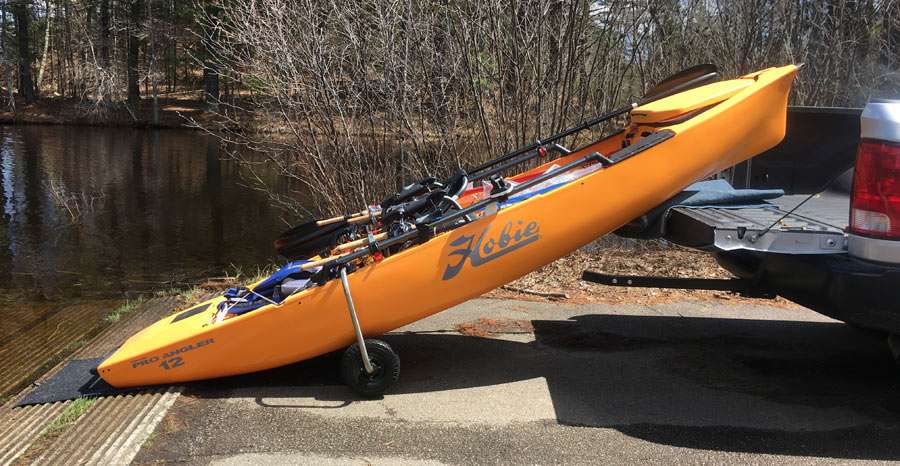
Hobie 2018 PA12 first impressions Got the Hobie PA12 on the water for the first time yesterday. Here's a summary of how it went, with some tips called out for Hobie PA users. TL;DR: I love it. Long version: Configuration (added): - Boonedox Landing Gear (axle mounted to hull, retractable wheels) - Lowrance Hook 4 fish finder (didn't use it today) - H-rail cup holder - H-rail triple rod holder - cooler in rear deck - H-rail pair of G-Holds used as paddle holder - Hobie anchor trolley kit Weight The 2018 PA12 is a heavy beast. I haven't weighed it but Hobie states it's 105 lb hull weight and 128 lb "fully rigged" which likely means with the seat and pedal drive installed and maybe some accessories (rods, crate, etc.) Cost It's almost offensively expensive at $3,400 plus ~$260 shipping. I say "almost" because I don't think it's unreasonable to pay more for getting more; the price seems high compared to most yaks because most yaks don't come with pedal drives, retractable rudders, retractable skeg, a drive system that can be instantly retracted against hull for shallow water access, 500 lb payload capacity, comfortable and fully adjustable seating, dry hatch, paddle, molded-in threaded brass inserts for anchor trolley mounting screws, accessory rails, stand-up stability, 4x rod storage, flush mount molded-in recessed area for transducer with cover plate, through-hull transducer cable plugs, etc. For me the yak and fishing are ways of life, not just another boat or hobby, so I paid. Cry once, buy once. Loading & tie down A neighbor helped me load the boat on the truck bed (6'4") so I didn't try solo loading until I came off the water later. I happened to have a 50 ft rubber garden hose loosely coiled in the bed; it made a good hull cushion and no-slip grip between the boat and the bed. The boat sits stable and with the weight and length there's no tendency for it to pivot down off the tailgate. Tip: You don't need a bed extender if your bed is at least 6'4". This is for the 12' PA. The PA14 might need it. I had already bought a bed extender but there's no need for additional support at the stern (the bed extender is a "T bar" type that plugs into the trailer hitch receiver). Four tie down straps hold the boat securely, using the bow handle, the forward H-rail mount on each side, and the truck's tie down loops at the front of the bed. Tip: Snug the boat up close to the front of the bed, run two tie down straps through the bow handle, one out to the truck bed anchor point on each side. With the other two straps, run one on each side from H-rail to the forward bed anchor points.. The two straps through the handle locate/center the bow and prevent some (but not much) forward/back yak movement. That's what the other two straps are for. On each side, they go forward & outward to the same truck anchors. I tucked a folded carpet under the stern for a little more no-slip cushion. The 4 built-in rod holders are great for transporting the rods (if it's not raining). Use an H-rail rod storage accessory on each side to support and tie down the butts. Unloading "My" lake using has a public ramp with a dock but I just used the ramp. With the Boonedox wheels you don't need a ramp as long as the parking area is somewhat close to the water (no lines, no waiting) but this was my first time out so I played it safe by using the ramp. I deployed the wheels, slid the yak back and lowered the stern to the ground. The angle is such that the stern JUST contacts the ground when the wheels reach the ground. I laid a mat under the stern to protect it (and the rudder and skeg, which are retracted but still somewhat vulnerable). I installed the wheel axle at 1/3 the length of the boat, behind the seat. Drop angle and wheel contact point will vary depending on where you install the axle, and also your truck bed height (mine is light duty 150/1500 class with no lift) but this is far enough back to facilitate load/unload, while far enough forward to give good balance and reduce lifting force required when wheeling the boat around by hand. Tip: When unloading (or loading for that matter) use strap through the bow handle, attached to the forward truck anchor loops, as a safety. After you set the stern down, when walking to the bow to lower that down, the yak could slide off the bed (especially given its weight and the fact that it's now on wheels). Now just grab the front handle, unhook the strap and lower the bow to the ground. The whole process was quick and easy and didn't require much heavy lifting despite the boat's weight. The Boonedox wheels were a major factor and are the best accessory I added to the boat. Launch Wheeled it down the ramp, stern first, to float the bow, and got in. Feet were in only a few inches of water. When you launch shallow, the pedal drive system is not installed in the hole. Tip: Use the Hobie supplied plug to block off the hole when launching. Launch time is when you typically have stuff (phone, sun glasses, keys) sitting in the well that can fall through this gaping hole. The plug easily clips in & out. Paddle into a foot of water, pop out the plug, pop in the pedal drive. First thing I noticed was the turning radius was ridiculously large and I was about to be very disappointed with the purchase. Until I realized I hadn't retracted the wheels. Pulled them up and locked them into place (can be done without turning yourself around in the seat), and off we go! MUCH better. Turning radius, once you get to 1-2 mph, is excellent, nicely tight. Rods I brought four rods (6'6 L/F spinner and three 6'6 M/F baitcasters), kept two in the pair of flush mounted rod holders behind the seat, sticking up like antennas (easy reach without turning yourself around in the seat) and the other two in the starboard and port rod storage sections (tips inserted into tubes in the bow, the rest to each side of the seat). Swapping to a different combo was easy. When not in use, rods in the storage section were strapped down (H-rail holders include bungee style cord which is is quick to strap over the butts). Rods in the flush mount holders were not leashed which wasn't a great idea but fortunately didn't lose anything. This time. Tip: Bring four combos. Six if you must, two if you favor simplicity. Tackle Hobie includes two tackle boxen (ox, oxen. Box, boxen) that slide into a carrier that hides in a hatch just forward of the seat. Open the hatch lid and up come the boxen. I changed lures a few times (but with four combos, didn't need to do that too much) and when I did, the tackle box system made it easy. No reaching, no boxen cluttering the deck. Tip: Bring only as much tackle as will fit in the two supplied Plano boxen. Underway I fished a top water articulating rat lure for a while in ~4 to 10 ft of water close to shore, no action, but really just wanted to get to know the boat. After a while, deployed the skeg (spring loaded pull cord) and pedaled a half mile across a stretch of open water to the main island. It took only a few minutes, with a couple stops for casting. Comfortable cruising speed is 3 mph according to my phone's speedometer app, with 8 mph wind and very mild chop. Got up to 4 mph with some cranking, and just touched 5 mph in brief bursts. Along the way I tried an articulating fast-sink swimbait, TX rigged worm, and when close to shore, very light home made jigs for panfish. No luck. Forward/Reverse Hobie's fin pedal drive is not as convenient, or as instant, as a propeller pedal drive when it comes to switching between forward and reverse. Close to the island I got a chance to try reverse while fishing - I cast towards shore, and the wind was blowing me towards shore, so I pedaled backwards while reeling in slowly. Worked great. Except that I didn't get any bites. When I occasionally had to switch between forward and reverse, it was smooth and simple and was only a minor inconvenience compared to the instant reverse of propeller based pedal drive (which I tried last season). There's a lot of debate about pros/cons of Hobie's Mirage drive (fins) vs Native's (and others') propeller drives. I've tried both. Propeller systems are mechanically simpler and offer instant switching between forward and reverse. Flapping fin systems are lighter, operate in shallower water and are less prone to cavitation and weed snaggage. Tip: When switching between forward and reverse, first position the pedals so they meet at midway position, not pegged at full stop (one foot max forward, one max back). Supposedly this takes less pull effort on the cables. Steering Steering tention is adjustable via a knob on the port side of the hull. I just used the factory setting. Steering was extremely responsive - in fact, almost too tight; when making the long run across open water, or even when slowing down and fishing, I was constantly on the steering controls to keep the boat from wandering off course. I'd rather have tight steering than loose though. And again, it can be adjusted. I saw no reason to change it. Steering is done by moving a lever on port or starboard sides, within easy reach. Can be done easily while holding a rod & fishing. Both controls (port & starboard) are connected together and operate in tandem, I guess like pilot and co-pilot controls - you turn one and the other automatically turns too, even if your hand isn't on the other one. Paddle I've read that this boat isn't paddle-able due to its weight and/or width. It comes with a (230 cm if I remember correctly) paddle which splits in two pieces, and you get a T handle so you can paddle canoe style if desired. I paddled going away from and back to the launch, and it was perfectly paddle-able. The paddles seem well matched to the boat. There are paddle clips on the deck behind the seat, where you can store the two halves. These are very tight (and have leashes) and removing/installing the paddle halves takes some real effort. I think of the paddle as a safety device, much like a length of rope or a throw cushion, so I choose to keep it fully assembled and stored on the accessory rail on the side of the boat (sitting on a pair of G-Hold clips). If I need to use it for stability (wakes), or visibility (hold it up high for other boats to see), or to reach something in the water, it's right there with quick release rubber tie downs (in fact I tie down just one of the two holds to make access even faster). Seating Seat has two heights, and I kept it in the high position all day. Very comfortable sitting position for the feet on the pedals. Prop drive systems may have legs/feet reaching higher, the Hobie system seems like a more natural/comfortable position. Seat has three adjustments: elevation (2 positions), lumbar (I left it alone), front pitch (adjust it to level the seat when going between seating heights). After 3 hours felt a minor discomfort in the tail bone but not enough to make me readjust the seating. Overall, extremely comfortable. Sturdy metal tubular arm rests are handy when you want to stand, move about the boat or just raise your body off the seat for some relief from sitting. Quick release feature makes it easy to release/install the seat, and it makes a good camp chair if you want to remove it and park yourself on an island for a while. Shallow water access Casting a small swimbait at the rip rap, I accidentally bounced it off said rip rap instead of in the water and got it caught in the rocks. Had to bring the yak in close and shallow. Tip: Peg the pedal drive fins up against the hull by pushing one foot max forward, one max back, and reach for the paddle. Yak has a spring loaded pull cord to hold the pedals in this position so you can take your feet off the drive. You might also retract the rudder (and skeg, if deployed) in this situation, though I didn't. It was a little clumsy because I was trying to be very careful to not scratch the hull on rocks but I freed the lure, backed away and moved on. Standing They say this boat is so stable you can stand to cast. I had to try standing. Didn't try casting. At almost 50 y.o., between eyes and age, my balance isn't what it used to be so I'm not really a standing kinda guy. But I stood and it worked well. With the seat as adjustable as it is, I found its elevated position to be perfectly adequate for casting and sight fishing. Good to know the boat has the stability even if I'm not casting from the standing position. Fish landed None. But 3.5 hours on the water was absolutely enjoyable, especially for the first time out in 2018. Off the water Deployed the wheels, pulled the pedal drive (one push button release) and paddled to the dock. Tip: When you pull the drive, plug the hole. Even if it's not with the Hobie supplied clip-in plug, just cover the hole with a simple mat. Your keys, wallet, lures, etc. will thank you. I whacked my Yeti mug with the paddle and watched the lid pop off and sink to the bottom of the cove. Replaceable. Thankfully the mug stayed in the cup holder. Loading I deliberately lugged the boat by hand up the ramp and the slight hardtop incline to the parking area in order to see how much effort it took. Totally doable. Weight was noticeable but for this 50 y.o. old goat it was certainly doable. Drape a rug/cushion over the tailgate. Position the boat at the rear of the truck. Attach safety strap to the front bed anchor loop. Lift the bow onto the lowered tailgate, attach strap through it, tighten it up. This is your safety. Go to stern, lift it up and slide the boat forward, bow almost snug against the front of the truck bed. Attach four tie downs are previously described. Retrospect Loading and unloading is so easy with the wheels that I might consider not backing the truck down to the ramp next time. This is a huge time savings if there's ramp traffic. Keeping it light is good. If you're lugging this heavy yak manually on wheels, your well stocked cooler, crate full of gear, etc. adds weight and makes moving more difficult. However, if all that is kept sternward of the wheels, it could act in your favor in terms of lifting force needed at the bow. However again, it's added mass, and when you're on a a grade it could work against you. Gravity wins. Boonedox (or equivalent) landing gear is by far the most essential option for a boat of this weight. With this gear you literally never need to lift the full hull weight; you minimize hull scrapes; you can solo launch and load; it lets you transport the yak in a truck bed as short as 6'4" with only four tow straps (possibly fewer, but more straps are cheap and offer redundancy). No regrets despite the cost and weight. Especially when coupled with a short, cheap and light "last resort" yak that can live in the truck bed at all times. But if I had only one boat, for now this is it (may change as I get older an less able to handle a big boat). Looking forward to trying inshore saltwater fishing with it this year. Bring less stuff, have fewer choices to make, keep it simple.
-
General purpose baitcaster, assuming you're biased towards bass as I'd recommend something else if you're targeting smaller panfish, trout. St. Croix PC66MF, wide lure range of 1/4 to 3/4 oz, $120 which leaves you $180 for the reel, so make it a Curado 70/71 (just spend the extra $20).
-
Texas rigged 4" green pumpkin soft plastic worm with 1/4 oz bullet weight. Fish it anywhere from mid to bottom.
-
I'm trying to get my wife more interested in fishing, not less. If I used my boat for those, she'd kill me. Welcome to the forum, Austin! I don't know what that boat package is worth but a quick look at what's on it (Lund 16' deep V, 28hp motor, bimini top, tank, trailer, steering console, two trollers) I'm going to take a wild guesstimate, $5K on the used market. That's a beautiful looking boat. Recently saw a fellow forum member's new Lund and the quality is superb.
-
Got three new crankbaits today and as I was about to replace the dual trebles with a single single, thought to myself maybe I'll just stop being so fussy and leave the treble on there. After reading this thread, nope. I have absolutely no problem with needles, drawing blood, etc. but the self hook with barb freaks me out a bit. The lures now have singles, with barbs crushed.
-
Been fishing here only a half season but towards the end of said season decided to ditch all trebles (I find them a pain... for me, not just the fish), crush all barbs, and convert most of my double hook lures to single, regardless of how it affects lure balance or fish catch rate. I expect I'll land fewer fish but I don't see a problem with that; quantity isn't much of a factor here, as long as I don't get totally skunked
-
In my (limited) experience... dialing in the reel's spool tension and brake settings will go a longer way towards less backlashing than the line type. I'm using regular old Trilene XL mono and it will backlash if I don't set spool tension or brakes or thumb properly, and will cast far and smooth if it's all dialed in. I have zero experience with braid or fluoro so take it with a grain of ya know....
-
Thanks for the report and photos. Very happy to see this! Welcome to the new boat.
-
Jim, we're dying for an update here. It's 8pm. I'm hoping you're still on the water enjoying the break-in, or maybe having a celebratory dinner and beverage at The Shed
-
Were the chargers running when they got flooded? From your response it sounds like they were off (good). My money's on if you thoroughly dry the chargers out (leave them in direct hot sun for a day) before trying to use them they'll be okay. Fortunately it's fresh water, not salt. Usually it's the other way around: we forget to install the drain plug. Not that I've been there or anything
-
StC AVS66LF $180 Shim Ultegra 1000 (ULT1000HGFB) $150 Only $30 over budget. I wanted "general purpose light duty" combo in a single rod, to cover panfish and finesse bass techniques, a combo that would pair with a M/F BC for the heavier loads and techniques, when I want to take only two rods. The rod arrived today and I threw the Ultegra on it only because I had it available. I plan to get a CI4+ for this rod (but that would be over your budget). The Ultegra seems to pair very well with it though. The 6'6 rod has a good range 1/16 to 1/4 oz, 4-8# line, uses the SCIII blank and it feels just great. Tried a few casts using 1/16, 3/16 and 1/4 oz weights. VERY happy with this combo and can't wait to use it this weekend. Since I couldn't find the rod in stock locally, I was worried it might be too heavy or not sensitive for panfish or too light for bass, but after handling and casting briefly, it feels just right. I couldn't be happier. Well, unless I actually get a fish on it.
-
Thanks for the info. Maybe I haven't given my MH/F a fair chance and I wrongly assume it will be less sensitive than the M/F. I'm so happy with the M/F's versatility that I admit I rarely use the MH/F and reserve that only for heavier lures. In general I tend to fish slightly on the lighter side of things so that could be a factor.