haggard
Members
-
Joined
-
Last visited
Everything posted by haggard
-
Maybe has more to do with the bearings (sealed?) than the finish on the body. Maybe it's just marketing hype and the salt/fresh reels are truly identical. But I think they'd be figured out and called out on it pretty fast if that was the case. Maybe the advantage of a saltwater rated reel is that it is more forgiving to less frequent maintenance than freshwater reels. Let's face it - we might all know that maintenance should be done but not everybody does it (for whatever reason).
-
I had no idea what you were talking about until I did a search - that's funny! I don't know anything about their products but good for them for doing something different I say. I certainly hope the censorship isn't real though. I agree, odd that the Citica isn't specified as saltwater rated on the mfr site. I found it categorized as such at a retailer site. Doesn't necessarily mean it's right.
-
I've been looking for a reel for the same purpose - split duty between inshore (striper) and freshwater bass - and keep coming back to the Curado K. Only reason I'm holding off is to get more opinions on it for these duties. Capacity seems good enough for what I expect to do with it so I don't see the need for anything bigger or heavier (will use it on a 6'8 MH rod). Citica I also looks similar, slightly cheaper, a little lighter, one less ball bearing.
-
I assumed the OP was asking about wearing a PDF while boating, not while swimming for recreation. If I was swimming shallow and at the shoreline I wouldn't wear the PFD. I think the risks are far less when swimming for recreation than they are while boating. In the yak or boat and not swimming? PFD 100%. It's the accidental swim that I fear. Swimming for recreation in far out water? Not sure what I'd do because I'm not likely to do that.
-
I'd guess that you don't have to worry about the color spooking the fish. Bright color is good for visibility as others mention. However, that has more to do with the sides than the top or bottom. If you're going to paint or cover, I'd suggest considering the inside "well", for eye relief. On a sunny day those bright colors can cause some very real eye strain, even if you don't realize it. My "papaya orange" yak hasn't hit the water yet but I already know I'm going to tone down the top surface (the well only, forward of the seat) by painting or covering. I won't bother with the bow hatch - too far forward to matter. I like the bright color for safety/visibility but the thought of staring at bright orange immediately in front of me for many hours is painful. Consider an adhesive sticker material of some sort. Easier to remove than paint if you ever want to remove it.
-
Aldebaran... so tempting
-
I recently began an all baitcasting quest and quickly ended it when I saw light-lure baitcasting becoming expensive and obsessive. For some, it works. For me, I want it to work. It just hasn't yet.
-
Haven't tried it in years but I bet I could. But I still wear a PFD every outing. As a kid grew I up on the water, swimming all the time. First step to learning it was realizing that if you lay on your back and relax, and gently work the arms and legs, you won't sink. Now I wear PFD without question, every time, yak or powered boat. I'm not a kid anymore, and regardless, when things go wrong they can go wrong fast. Like seat belts, helmets, fire extinguishers, etc. a PFD is cheap insurance. The older I get the more respect (or fear) I have for the power of the water. That is NOT a personal flotation device.
-
Just a guess, maybe because after the lure hits the water, the baitcaster spool (presumably now at rest) presents more resistance than the spinner due to needing to overcome static friction - to get the spool moving again for the drop to the bottom. Maybe the spool tension knob is too tight, but even when set loosey goosey, the spool still needs to make that initial push from rest, which isn't as easy as when it's already rolling. For whatever reason (static friction, wind, current, tension knob set too tight), be it a drop shot or some other technique when I want the lure to get to the bottom, I've definitely needed to guide the baitcaster more often than the spinner. My usual method for guiding a baitcaster lure to the bottom is to disengage the spool into free spool mode, gently rest my thumb on the spooled line and peel off a couple feet of line at a time, repeat. For the spinner, all I think about is keeping a slight tension on the line as it drops, and that's it. Personally I prefer baitcasters in general BTW but for drop shot I can see some advantages with the spinner. Either works fine of course in capable hands.
-
Great photo
-
Ok thanks, this is starting to make more sense. Sounds like it's all about tradeoffs.
-
In retrospect... I could be wrong about moderate action on drop shots. Okay so this is kinda where I'm getting at. Doesn't this rationale apply to any lure type, not just treble hook lures? Wouldn't you want to keep the rod loaded during the fight for every technique and lure type? What is it about treble hook lures that makes it harder to keep the rod loaded than say a TX rig worm or a single hook swimbait? I can't help thinking it all comes down to the hook size, but I can't seem to find any confirmation or explanation.
-
Why is that? Is it because of the small hook size on a drop shot rig?
-
This all sounds right on, based on how the rod handles. Yes, cheap and durable, it will likely be the one I leave in the truck or at camp. I think it will also become my inshore swimbait combo, as it's rugged enough that I don't mind it getting exposed to elements, and moderate action with medium heavyish power with the salt rated cheap reel (Sienna) seems perfect for the application (inshore striper aound the tidal river).
-
I've done a lot of searching on this and from what I read, a moderate/medium action rod is often recommend for treble hook lures (, swim baits, crank baits), maybe even drop shot techniques, because you're less likely to pull the hook out of the fish's mouth. But that's where the explanations typically end. Is this because of the hook size? Typically smaller hooks on a treble or a drop shot rig compared to what you might use on a Texas rig, for example, and the thinner hook is easier to tear the fish? So then if one was to replace the treble with a single, slight larger hook, would the "need" for a moderate action rod be moot? Or if one was to be very careful on the hook set on a drop shot, again, would the moderate action be moot and you could get away with your, say, fast action rod?
-
I can't help you with the other brands but I was new to fishing in 2017 and my first baitcaster happened to be a St. C Premier 6'6" M/F and it has become my favorite all-around rod. Part of that might be due to the fact that St C seems to be a little heavier than their rating, so the M/F is more like a M/F to MH/F, which happens to suit my style for freshwater small/largemouth. I would not use this rod for panfish. There's only so much that an "all around" rod can do. One thing that I really like about it (PC66MF, or PC66MF2 in 2-piece) is that it's rated for a wide range of lure weights: 1/4 oz to 3/4 oz, which helps the versatility factor. Typical price is about $100. I also own the Mojo Bass 6'8" MH/F which is probably my second fave bass rod. Maybe a little stuff for general purpose use; if I had to have just one it would be the 6'6 M/F, but we're getting into "depends on your style" territory here.
-
I frequently hear and read that when you use a drop shot technique, you should reach for the spinning gear. Why is that? Why not a baitcaster? I get that drop shotting is considered a finesse technique and finesse is often associated with lighter lures, which in turn means spinning gear might be better suited for casting those light lures. But there's also a sinker at the end of the line, so it's not like you're casting a weightless worm. One advantage I can see for spinner over a baitcaster is that if you want to cast a short distance out, rather than just drop directly under the boat, a spinning reel will more easily let the rig drop vertically once it hits the water (because the line just falls off the spool), as opposed to pendulum-ing back towards the boat (because the spool tensions the line). Other than that, why wouldn't you reach for a baitcaster?
-
When you say under $150 do you mean just the rod, or the rod-reel combo?
-
Thanks all. I think I had actually seen the "Rod power: Medium" on the manufacturer's site once, then figured they made an error and it should have read "Rod action" because action is what's on the label on the rod itself. This was the first rod I ever bought (with a $30 Sienna 2500 reel) because the combo was cheap (wasn't sure I'd get into fishing... wow was I wrong) and it was described as a workhorse, sounded good to me. I don't think I've ever caught a fish on it, maybe because I rarely use it. Just feels big, heavy and clunky. I guess it's time to take it out and start using it for a change and see what techniques it works best with.
-
-
I got a 1448 Tracker Grizzy jon a couple months ago and I'm in the process of building it out. Basically a duck boat but will use it for bass fishing. I liked that it already has a casting deck, no mods needed. Haven't had it on the water yet but plan to add a trolling motor, been looking at the Minn Kota Edge 45. From everything I've read it looks like that will do the job just fine. Would like to avoid anything larger than the 55 because I think they require a second battery (to get to 24 V) and I'm trying to keep things small and simple and lighter weight and standardize on 12 V. I think the 45 at the bow would be just fine as a troller for your 1448. As for the stern unit, it might work but if you can afford it I'd consider a 15 hp gas motor. It'll get you across the water a little faster (may not be an issue, depending on the size of your most frequently fished water) and will provide an alternate source of power if the bow motor drains the batteries down. Or at least just try out the 45/55 combo since you already have the 55, and see if it works; you can always upgrade later.
-
If you're fishing mostly shallow water, I'd go with the slow sink (falls 1 foot every 4 seconds). If you go with fast in shallow, it'll hit bottom too quickly. With slow, you won't be dragging on the bottom as soon, and you can use the rod tip and retrieve speed to work different depths on the retrieve. If you're in deep water (say 15 feet or more) I'd go with fast sink (falls 1 foot per second) because on or near topwater won't be as effective in deeper water, and if you use the slow sink you're waiting a full 60 seconds just for the lure to get to 15 feet. Fast sink will let you fish more, wait less. In deep water the fast sink can also be an effective search lure because you can cover lots of water both horizontally and vertically in relatively short time. I didn't get the floater because I already have a topwater/floater Spro Rat, and in terms of mimicking live fish, the fish don't usually swim on the surface so I opted for the rat. However a benefit of the floater is that if it breaks off, you can retrieve it more easily (assuming it's not inside a bass ) Slow sink for shallow, fast for deep. I got both because the water I usually fish has both. Another think to think about is what pace you like to fish at. For the fast sinker, you're probably going to be working the rod faster and more actively due to the sink rate - you need to work to keep that lure where you want it in the water column. With the slow, I imagine your retrieve will be a little more relaxed because the lure is a little more stable. Not saying one is better than the other, all depends on how you like to fish. Maybe both. If I had to have only one? Probably the fast sink because if you work the rod enough you should be able to work any depth in shallow, and it will also cover deep easily. And its 1 fps sink rate is easy to count off, whereas 1 foot every 4 seconds on the slow sinker requires some heavy math But the fast sinker is a 1 oz lure which my "go to" rod (M/F) is not rated for, so maybe I'd go with the slow after all... See? Both! Keep in mind I haven't even used these lures yet; I got them after shutting down for the season. I am really looking forward to trying them and learning how to use them effectively. They're already my favorite lures in my small arsenal and that's before even casting one.
-
Spro BBZ Shad 40 (4 in.) and Shad 60 (6 in) Spro BBZ Rat 40 and 50 These are hard plastic baits so they should last a long time. Articulating action is very lifelike. High quality throughout, including paint/color schemes and quality hooks. The Shad 40 comes in floating (3/4 oz), slow sink (7/8 oz) and fast sink (1 oz). The Shad 60 comes in floating (2 oz), slow sink (2 1/4 oz) and fast sink (2 1/2 oz). The rats are topwater floaters but have a lip so will dive if you tip the rod down. I like the Shad 40 for its single hook (comes with a treble, I replaced it with a single barbless). I've always found swimbaits somewhat annoying because dual trebles seemed to hook on everything in the tackle box, boat or myself even before I made a cast. Also the rear treble stands a good chance of deep hooking and that would be a pain to remove. So when I saw the Shad 40 with hook at the center position, with great action and looks, I had to get it. Can't wait to try it for the first time in the 2018 season hoping it will be my go-to swim bait.
-
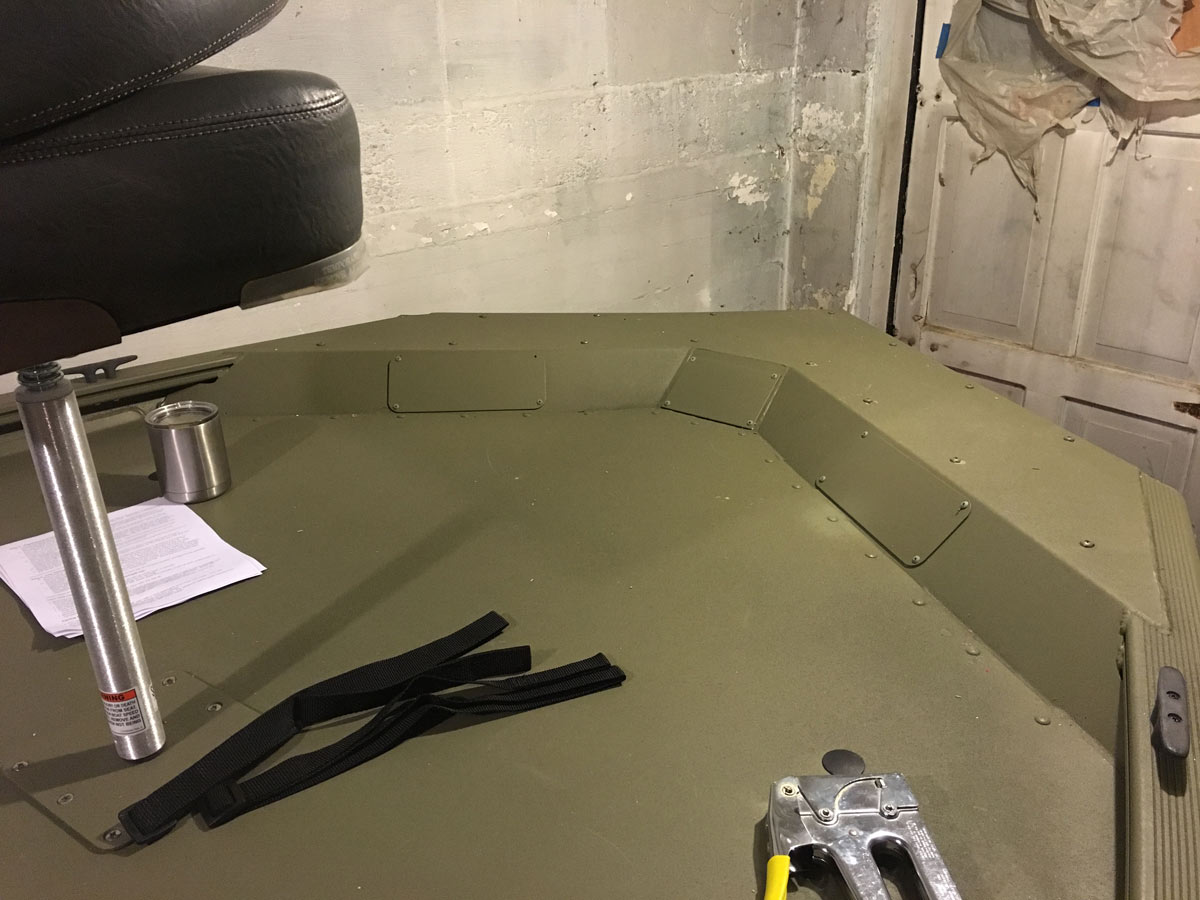
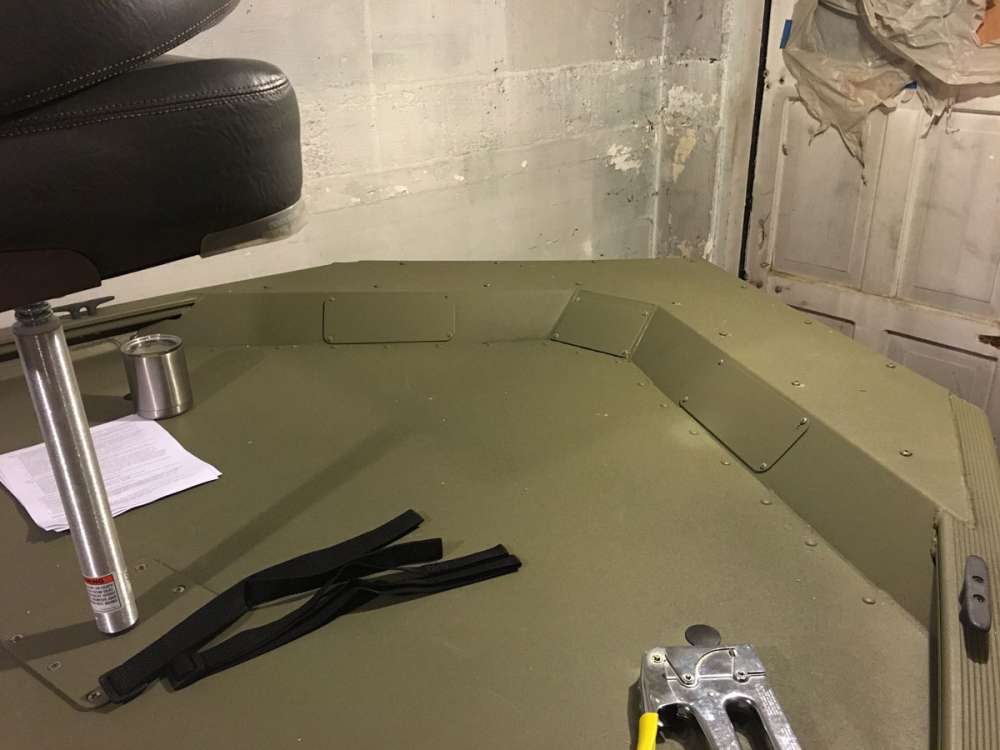
I finally drilled out the rivets and removed the plates. Underneath is empty space, allowing easy access to the underside of the foremost portions of the bow. For example you could mount a trolling motor and and have easy access to the nuts on the underside of the bow. Inside the holes, looking back towards the stern, you can see the expanding foam that was blown in at the factory. From these holes there is a passageway sternward, so you can run wires etc. to the storage cavity just forward of the main "well" at the center of the boat (cavity is directly underneath the pedestal seat mount shown in the pic).
-
What's the purpose of these three blockoff plates at the bow? I haven't removed them yet. Are they just used for accessing the underside of the bow area so you can mount nav lights, a finder or a trolling motor? They're held in with rivets, which I assume would be drilled out and replaced with screws.