Paul Roberts
Super User
-
Joined
-
Last visited
Everything posted by Paul Roberts
-
I think the main reason for stitching -and please correct me, as I haven't read the book lately (it's sitting on my shelf next to me though)- was to overcome the spookiness of fish, and to maintain bottom contact with relatively little weight. He would have been using mono, since that's what there was in the day. And he was using long fiberglass rods -custom made for stitching. I often used a stitch like technique -having fingers on the line- which is very sensitive. However with some of my more sensitive super-light graphite rods, this is less important than it was back in the day with the fiberglass rods I had. I will keep tension or pull slowly on the line, picking up slack by spinning the bail with my little finger.
-
Thanks for the kudos, Operation Eagle. Just to clarify.... Glenn saw my initial post and PM'd me about his YT share policy. AOK to share videos but not if the YT'er is simply here to advertise their site -spam control. I think he'll be OK with me quoting him here: "I'm all for sharing information or fishing trips, even if the channel is monetized. Where I draw the line, is where people post on here soliciting for views/subs. We routinely delete posts like that every week, in fact." I should really let Glenn say these things and I think you can see his policies in the site FAQs. He mentioned something about clarifying/updating his share policy. Bottom line, I think he's trying to maintain quality content here. You can imagine all the spam we'd get if the mods weren't busy behind the scenes keeping the site easy to navigate for quality content. I think they do great job and is one of the main reasons I've been here so long. There also may be the issue of giving site sponsors their due -the opportunity to be seen and recognized here. After all, they pay the lion's share of the costs for running such a quality site. Having fired up my first YT channel I've gotten a glimpse of the spam issue. Every time I post a video I get a run of "comments" that basically say, "Sub me and I'll sub you." I'm really looking for quality comments bc my interests lie in the subject itself -the "invisibilia" that underlies our fishing; that fascination with nature- than in running a YT channel. YT is a means not the end. If it works for me great. If not, I'll find another venue. Great comments, papajoe222. Always appreciate your knowledge. Yes, the forage base is burgeoning in summer. I've read a lot trying to get a handle on whether fish can get "too full to eat" -what's called "satiation". There is some research showing that this can happen, particularly in years with high prey numbers. But, even more research shows that satiation is rarely reached in the wild, esp in small unmanaged waters. The fact that most of the bass cannot reach their growth potential is almost incontrovertible evidence that satiation is pretty rare. There are waters where this is more likely to happen -probably in the south, and in shad based waters perhaps- but... not in my waters, sadly. But I think your description is really good, and much more nuanced than saying the fish become "sated" in summer. This is on the money. Bass are good learners. And the survivors/growers know when to make their move. Its tough for us bc we just can't see what's going on. And each water body, section within water bodies, and groups of fish, are a bit different. At least we are focusing on one species here (mostly), but a very adaptable one. A real challenge. What fun. Yes!, I see this too. However in the smaller waters I fish the groups are smaller, but the tendency is the same. I wanted to show that in my pre-summer/early summer videos this year -when it's especially pronounced- but things didn't set up well to show it, and the waters that have shown it best in the past for me were wiped clean in the big 2013 floods. Small waters do have one big advantage for me in what I'm trying to do -illuminate behavior- in that the bass are right in front of me. I cannot "not find them", or, at least I don't have all that much water to eliminate. I just have to have them, or make them, biters. This is what I am after -not only the catch, but why??? And, I think, more telling is the why not? Why aren't they biters right now? Thanks for the great comments.
-
Stay safe! Let's hope for the best.
-
Thanks, Sword. Yeah, I like fish. And... all critters. People too. I was a veterinary technician, as well as a wildlife researcher, for quite a few years, and have handled a lot of animals. I'd like to do a video on fish handling. Thanks so much for the feedback. And, yes, there were better ways to catch that day. But senile1 has answered for me, and in the process he has won the reading comprehension award -again! That's why I call him "lucid1". He also just goes by Ed. No small task considering how much verbage I can spew. Lotsa good ways to catch bass, yet I suppose there are even more ways to NOT catch them at any given moment. Keeps us busy out there, and buying tackle. In my fishing I do a lot of experimentation, and in my fishing video journals I try to highlight some key aspect of fish behavior usually related to conditions. Often I'm trying to expose certain behaviors elicited by environmental factors. Which may mean if I realize a good catch rate, I may then pursue the flip-side, to show the difference. Like I may catch really well, then come back under different conditions (sometimes the very next day) and try the same thing, and show that it fails. Love to do that kind of thing. Even better, I like to uncover something new that works under certain conditions. Which... can keep us buying tackle. Anyway, thanks again for the feedback. Much appreciated.
-
OK... here's one of my Summer videos. I have three Summer videos up, all shot last year during a string of back-to-back cold fronts following a very hot early summer. My above post will provide more background as to what I believe is going on with the bass during those conditions. The audio and visuals are not up to snuff in my book as these were my very first videos -since rectified with proper microphones. Very watchable though. Feedback appreciated.
-
-
Ask a simple question... Nicely done, Brian. In general, water is stingy with heat, heating and cooling slowly. It takes a lot to make much of a change. Only thing I'll add is what WRB brought up: Seiches/upwellings. When wind blows surface water to one side, water must replace that and it often comes from the layer beneath. If that layer of water is colder, like from deep water, or early in the season, the upwind side can drop in temperature very quickly.
-
-
Apologies for coming off like I'm being secretive or exclusive. FCPhil happens to live close enough to me that those vids are directly relevant. I PM'd because, although Glenn allowed me to share some of my YT videos because my channel is not monetized, and bc I've contributed so much to this site over the years, my channel will be monetized and/or seeking support in the future. I didn't want to trespass on Glenn's good will further. So, here's a more inclusive response to the OP. Summer As I Currently Understand It (via "best information" I can muster): You know, if you fish long enough, and I mean years, you'll come to realize that things come back around year in and year out. And if you peruse the internet fishing sites long enough as well, you'll recognize common themes throughout the country. One theme is the difficulty many anglers have catching bass during mid-summer. In particular, it is weekenders (with limited time and versatility), shoreline and shorebound fisherman and, interestingly, many Florida bass fishers that are most often piping in on this very subject. This latter, the FL thing, is notable to me bc it likely copies what's happening in my waters too, even though the two are distant in both climate and sheer milage. Some pithy things are, apparently, "shared" there. Although there appear to be common themes across the bass's range -indicating shared characteristics within the species- there are regional differences I won't be addressing in this post. That's fodder for book length treatment. So... if you don't see the videos, remember that seeing the movie is not the same as reading the book. Just can't stuff as much into vids, or posts. Also, at the outset, know that every year is not exactly the same in any given water body regardless of location, as there are many factors -many localized- potentially at work. The trick is to identify them, then figure out which are most important in the moment. In order to understand them, I've come to see them in a hierarchical order based on the scientific literature observing/describing the species, and then ground-truthed by direct observation and fishing. At the outset one must have some handle on -if not a measure of- the accuracy of such gleaned information; human limitations and biases being expected. Scientific literature does it's best to provide controls and/or mathematical and statistical measurement, and info often acquired by technology and expertise not readily available to everyone. Angler observation and fishing tends to be quite a bit… looser. This is the playing field. As an attempt at a "control", I used horizontal retrieves in my recent videos not bc they're always the best tack, but bc they provide a rough measure of the bass' "willingness to chase" -how much energy they have to spare for activity. My fishing is done on small heavily vegetated waters in N Colorado and I see my horizontal chuck-n-wind bass fishing takes a nose-dive when water temps surpass 80F, esp so under bright sun. Several things are at work here: Key factors are temperature, prey availability/vulnerability, and lighting. Lighting I’ll start with lighting because it’s more generalized in effect, influencing our fishing regardless of physiological factors at play. In short, bass have an advantage over prey under low lighting. Under high visibility conditions, prey (bluegills at least, by research and my own observations) can see bass coming from a distance and avoid them. Under low lighting bass gain the upper hand. Bass are also safer from predators themselves -especially avian predators- under attenuated lighting and thus more able to turn their attention to hunting rather than watching out for predators. Under high vis conditions, bass tend to move to safer areas such as getting closer to bottom, into dense cover, or into deeper water if available. Attenuated lighting also obscures angler’s lures, making it easier for bass to mistake them for actual prey. Temperature Temperature is critical to cold-blooded creatures. Biologists consider it “the master factor”. But it doesn’t stand alone. And bass in particular are known to be “labile” in their abilities to operate across temperature ranges and changes. Still bass, and apparently all LMB (including floridanus), hit their a metabolic peak (in terms of basic energy-in < > energy-out) in the low to mid 80sF. The bass’s engines are essentially hitting redline at these temperatures. This means that energy-out is peaked, which must be balanced by energy-in: Food! If they can get enough food they can show peak growth at these temperatures. If they can’t get enough food they will begin to lose body weight. In response to high heat and low food, bass will begin to limit their active periods (activity, i.e. swimming, chasing) to the most opportune hunting times: low light of night, dawn/dusk, and deep overcast; and cooler temps of night and, especially, early morning. In larger water bodies, with deep water scenarios available, many bass will drop to deeper, cooler and dimmer waters, or to areas with more food. Which makes a great segue to prey availability/vulnerability… Prey Availability If bass are going to afford to remain active hunters they will need a lot of food to keep their ramped up Summer engines stoked. Thus they will seek out the best food resources. If they can find a motherload of prey they will stay put. If not, they are apt to keep searching. However not all bass find the best places; Many will find what biologists call “false peaks” -areas that may not be the best in the lake but that are enough to attract and hold some bass. Some bass will find inadequate resources and must reduce activity commensurate with food resources. And some bass may find the motherload and remain active, and grow, despite high heat. Prey vulnerability is another piece of the puzzle. Prey is not easy to catch, the result of the evolutionary arms race over time that has resulted in the body forms and capabilities of predators and their prey, alike. Each prey type and species has it’s defensive strategies that shine under certain habitats and conditions. Bluegills and other sunfishes are particularly adept at evading bass in dense cover. Shad are adapted to avoid predators in open water. Bass are both pre-adapted to these and can fine tune their hunting behavior to that prey, habitat, and conditions (i.e. learn). However, although bass have been described (and by those who should know -fish behavioral scientists) as “perfect piscivores”, they too have limitations. Bass are known to hunt best in broken cover, where they can use the element of surprise to get close enough to prey to realize efficient capture rates. Not that bass can’t hunt in denser cover, or more open water, but conditions and individuals must be more "disciplined", if you will, and require more learning, and luck, for sufficient success. Or even better, simply have a LOT of appropriate prey available. My Waters in Summer So, with that background in place, in my mostly shallow heavily vegetated waters, lighting, temperature, prey vulnerability/vegetation density appear to be the primary factors. I fish at least a dozen water bodies and each vary in their make-up of course, so not every one reacts in the exact same way. But those parameters above are pretty basic to all waters. Fishing In general, many bass will move away from shore in summer, even in smaller waters. FCPhil, you are right there. Bluegills will drop away from the surface too as heat penetrates deeper. When shore fishing I may break out a large-spooled long casting rig to reach. However, away from shoreline reach is not all there is to it. You are right there as well. Fishing under high heat in shallow waters often means hitting the darkest and coolest periods. If you suspect high heat affecting bass activity, check for a "first light bite" -the coolest time of the day. And I mean first light -it may be over by the time the sun hits the water. And the fishing can be wild! Keep track of body condition of the bass you catch. Thin bass can indicate the fish are not getting fed well enough to keep up with their metabolism. If you want to fish chuck-n-wind you may need to focus on low light and cool periods. Praying for rain -a good dark cold front- can help. I don't know if you've been out much lately, but that's exactly what we've been getting here in CO the last couple of weeks. Jump on it, man! Otherwise, under heat and sun, you may be better off fishing vertical presentations, and closer to bottom, in your daytime fishing, such as jig-worming ("Shaky") and drop-shot for neutral bass, or flipping in heavy cover. Hopefully this helps you home in on what's important in your waters, or at least gives you some gristle to chew on toward that end. This background will also help viewers make better sense of my vids too, as I try to keep the length of my narrations to a minimum to keep viewers from clicking away from a talking head. However, this is the cool stuff, if you ask me.
-
I hear you. I set up a tripod ahead. Whacked a few shots and that was all. I wasn't looking to "cover" the event. Quality photography is a job in itself. Gotta decide when and where to put your time. "Cosmic orgasm" LOL. After, you are left wondering what all that was about.
-
-
-
Very cool idea.
-
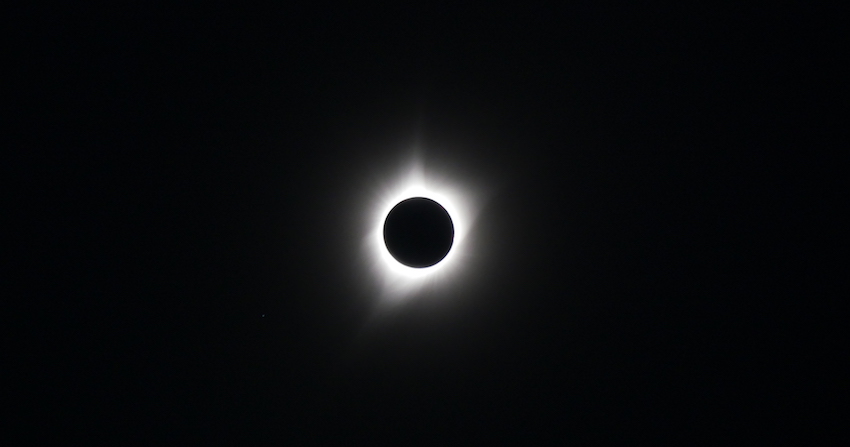
I got to see "totality". But we weren't fishing. My family slept out under the stars on open rangeland in NE with a whole lotta Hereford's, yipping coyotes, and quite a few shooting stars. It was wonderful. Eclipse lighting was... eerie. We looked at each other and asked why it was so... strange, and truly eerie. My son said it was the perfect setting for a zombie apocalypse. We see dusk and dawn and deeply overcast days often; What was so different about this lighting? We decided it was the light quality. It was a “gray” light and we watched as color faded, leaving everything bathed in a “smoky” gray desaturated light. Since this was a mid-day event the shadows weren’t long like you’d see in the morning or evening, but short and faint. At totality -all 2+ minutes of it- things got dark enough to see some stars, and there was a “sunset”. It was a purple-red glow on the horizon but not just on one horizon; It was 360degrees. That was… weird. And very cool. Oh yes, the air got quite a chill to it too, and we put jackets on. I’d read an article that claimed that animals can behave strangely during an eclipse. But the stories were anecdotal, and I was skeptical of many of them. One said that cows were reported to "all lie down”. Well since we were surrounded by Herefords and Angus we thought we’d wait and see. We also had prairie sunflowers around us and if you’ve ever watched them they will turn to face the sun and follow it across the sky as the day progresses. We thought we’d check on them too. Nothing scientific; And I balked at setting up a time-lapse camera set-up. I was just going to enjoy the short-lived event with my family, and add my own anecdotes to the body of anecdotes out there. Problem with all this anecdotal stuff, and the reason I am often skeptical (It’s been beaten into me over the years), is that all too often the observations don’t include what “normal” is, or simply what was happening before the “event”. Here’s what the cattle did: At dawn they filed in to the waterhole, beneath a tall windmill. After tanking up they ran out to graze -literally. They exuberantly and playfully ran, bucked and bounced out into open range. They were really cute. Elk do this too, after being bedded up for a spell and with the early morning air being so cool. Our cattle grazed until late morning, when the sun got hot (brilliant blue day), when they all laid down. Just like elk; Although elk lie down in cover, and the second the sun strikes them. At totality we glanced over and noticed that most of the cattle had stood back up. Cue to head to sleeping quarters, feeling a little “eerie”, or… just needing to stretch? Elk do this too; About late morning to mid-day they often stand up to stretch and feed a bit before lying back down. The cattle were not grazing, just standing there in what could have been taken for “feeling a little eerie”. So… I can’t say much about cattle behavior during total mid-day eclipses. The sunflowers? Well... we noticed they were still facing the eclipsed sun. No surprise since they are not physically all that fast to begin with. Some, we noticed, had their petals a bit folded up. Some flowers close entirely by nightfall. But, we didn’t know if this variety of sunflower did. And, we noticed, only a few were so folded. Kinda like the cattle -not all were standing. Were those flowers so folded before the eclipse happened? We hadn’t really thought to notice what to notice beforehand. All I can say is, it came and went pretty quickly, made us feel a bit “eerie", and then it was over, leaving us to feel like we didn't really have time to appreciate it. Oh yes, it caused my son to get all giddy and start running around wanting us to run too. But then again, he was doing that on and off well before the eclipsing began. In fact, he’s doing it right now! Gimme that foam sword boy and I’ll show you a thing or two!
-
Apparently, temperate FW fish are much less diverse -and kinky lol- in their reproductive "strategies" (i.e. derived over time). The greatest diversity follows the greater diversity in species (speciation) found in tropical waters, esp on coral reefs that offer such diverse habitat and long warm seasons. But, there is some reproductive diversity in our sunfishes -bluegills in particular. But nothing of this magnitude has been found in bass -so far. Here's a good piece on bluegills by the late Dr. David Willis: https://www.sdstate.edu/sites/default/files/nrm/outreach/pond/upload/The-Secret-Life-of-Bluegill-Jul-Aug-2005.pdf
-
More true than many might realize. Intersex fishes including bass are being found and monitored. At first it was thought to be related to hormones, hormone mimicking chemicals, being released into waterways -either flushed down urban toilets or as urban and agricultural runoff. But some are now found in somewhat more remote places -at least away from major urban areas. No answers as yet.
-
No. But bass do begin re-developing gonads in late summer/early falll. But they are still pretty small, even in late fall. Further development is arrested due cold water. Now FL I dunno when they'd start -esp in far S FL. Maybe Roger, or others, will pipe in. I'm guessing its much the same, but that the winter hiatus is simply much shorter.
-
Not all that much. I tend to fish conditions and "experiment" with relatively few choices.
-
Bass can live in weed choked lakes. They must hunt differently as they cannot run down their prey; So must you. Slow down, fish vertical, make a commotion, wait for bites. To do this you'll need to know where there are fish. Mid-summer may be the toughest time to find fish in such a lake. You being in Ontario tells me you have cold winters causing vegetation to die-back. You may have to do your fish-finding/scouting prior to peak vegetation growth. Hard cover pieces, depth changes, substrate changes, vegetation type changes.... changes. Bass will likely still use them when the cover is up. If you really can't get a 1.5oz weight through that canopy then I guess you'll have to wait until it dies back. The cold water periods tend to give up the largest bass just about everywhere. Vegetation die-back is one of the reasons. Good luck. Let us know if you figure something out.
-
Temperature is important, but food and cover can trump it.
-
Sounds like a shallow lake overall. You may not have to fish "deeper water". Sounds like there is plenty of cover for bass and prey. This does not mean that there are no bass in the "deeper" open water. If there are open water prey like shad, or shoals of large sunfishes or tilapia, then mebbe. Either way, it all starts with observation, and it of course helps to know what to look for. If you have sonar you would search out open water prey fish schools and, as WRB mentions, any changes that might serve to attract fish. If you don't have sonar then you could try trolling. I've done this to good effect through open water basin areas in some waters (failed in others). Hit a fish then anchor and cast; Bass are rarely alone. There will be places that hold more prey than others, or where prey is more vulnerable to bass. I always cruise around and identify locations that hold noticeable numbers of prey fishes, and often find the best fishing at those places. Exactly why the prey, or aggressive bass, are there is not always apparent, but often it is: The right weed type, a diversity of change in weeds, hard cover mixed in, or other breaks in the cover that offer running room for bass to hunt effectively. Weed beds with ragged edges can be great. These are often associated with diversity changes, unseen bottom substrate or depth changes. One other thought. If you have been doing well "shallow" until now, then suddenly having a tough time, it could be that water temps have become too high for efficient foraging for many bass. This seems to be esp so for bass in shallow densely vegetated waters. To check this out, try fishing after dark, or checking for a "first-light bite". Also, drops in bass body condition -they becoming thin- can be an indicator of heat stress. Good luck in getting to know your waters.
-
Fish don't have eye-lids, but they can and do sleep. This was only an assumption until recently when researchers used fluorescent markers to observe brain activity in the brains of transparent larval fish. Apparently they do indeed sleep, the function of which is to build and reinforce neuronal trackways in the brain related to learning.
-
Thanks, Tom! The bass here like those nymphs too. Got some video of them hunting them too. Nymphs don't seem to require the energy expenditure that the adult dragons do.
-
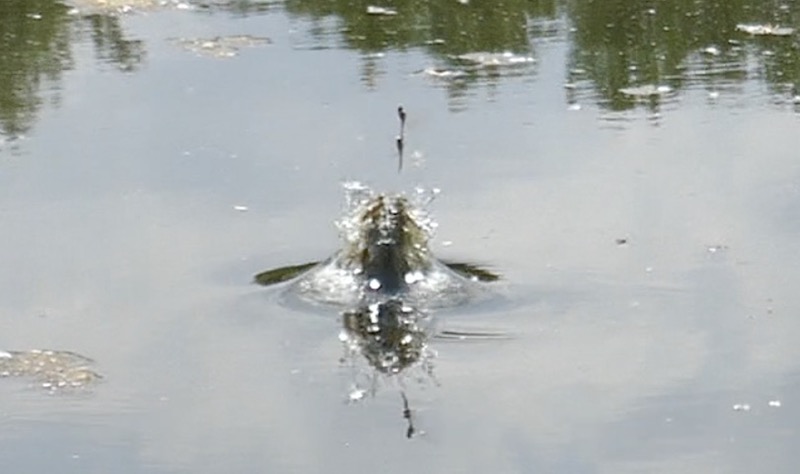
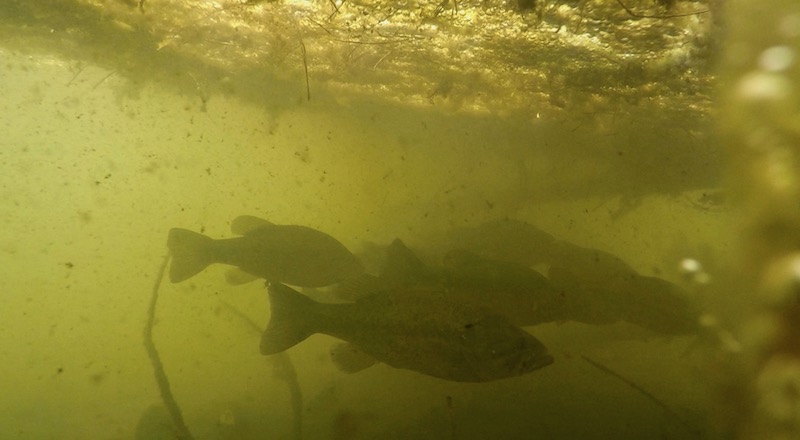
Thought I'd chime in to add some "evidence" illustrating the "one big factor" we'd love to have explain everything vs the little details that nettle us hour by hour through each fishing day. These are the “devils details” that few of us are able to follow closely enough to fathom there effects. The resulting confusion and frustration incites an even more fervent search for the "Big Easy Explanation”, the panacea -a cure-all as Webster's puts it. I've been watching and video recording aerial dragonfly hunting bass. I thought it interesting from an energetics perspective. When they hunt flying dragons is when the dragons are most dense and active -air temperature is critical- but also when water surface conditions allow -when it is flat calm. If a breeze rolls up, which most often appears in the afternoons, the bass quit. What’s interesting is, after a busy morning of attacking dragons aerially -pretty exciting to see, esp in slow-motion- the bass hunker down to rest, likely even sleep, under cover. They can crowd into top cover pieces like cows under a shade tree. If you were closely following celestial prognostications to delineate your fishing times, you’d likely wind up frustrated when the tables didn’t pan out. Burnin' some energy here! There were an even dozen dragonfly hunters hunkered up under this matted deadfall, tightly bunched like cattle -apparently asleep- after a stiff breeze came in.
-
Tough to say without knowing more. To answer the question... I doubt that fish was defending more than one bed. Could be old beds that were within his staked territory. He -if it is a male- most probably had one active bed. However, many things in nature are open to "experimentation". That's what individuality -variabilty- is all about. If it pans out, great! A lot of experimentation doesn't pan out though, so you end up with fixed patterns -the stuff that worked over the long haul. Not a bad understanding of "a species". I have seen males make more than one bed; "Double beds" I called them. This was common one year. It was bc of rapidly falling water levels that left the first bed too shallow, the male responding by making a second bed slightly deeper. Hey, curiosity is a good thing. We wouldn't learn much without it.
- 5 replies
-
- bed
- bass
- indiana
- bedfishing
-
Tagged with: