Paul Roberts
Super User
-
Joined
-
Last visited
Everything posted by Paul Roberts
-
I like the vinyl idea. I did try latex (surgical) tubing and it worked too. The elasticity may help some, but... Senko's are simply fragile things. There are other more durable stick-worms out there too. And they catch bass very well too. Although none I've tried have the sink rate (and action) of a Senko. I suppose the Bizzbaits worm is close in sink rate and action seems to follow sink rate. Softness weighs in too, and that, with all those salt grains, is where the fragility comes from too.
-
I've used both. I am now using shrink tubing. It holds better than an O-ring. However the biggest problem, esp with Senko's, is how easily they crack and break, even with a keeper ring. When one gets a crack I replace it with a fresh one, and Mend-It or superglue the broken ones at home.
-
Dunno exactly, but I can take a few guesses: Bass in spring and into early summer tend to be mobile. They can be well distributed, often relating to shorelines. By early summer they are post-spawn, hungry, and heading to summer locations. Bass tend to move away from shorelines in summer. Depending on food availability, summer bass tend to settle into places where there is food. Feeding activity can be sporadic too, often relegated to prime times -"low light" goes a long way in describing prime times. If temps and/or visibility get really high, the bass may even shift mostly to night hunting. Along these lines, has water clarity changed? I know you said this is a new phenomenon, but have you fished it equal time other years too? And NOT found the same thing? Just in case, you should keep effort in the back of your mind as well as. Another thought... Looking at that water reminds me of a nearly coverless pond/lake that up and quit one summer. One of the guys that fished it asked me about it. So I went with him. We found huge numbers of bass fingerlings -a major hatch year- and so I switched to an UL rig and 2" paddle-tail grubs and started catching. My partner didn't own finesse gear so I set him up with a ML spinning rig and some jigs and... problem solved. I'd seen this before and solved it in a similar way. All that said, the UW video I've been collecting has not shown adult LM's chasing fingerlings -at least until they reach about 4" in length, which occurs in the fall here. So... I'm not sure if my reasoning behind the success of the finesse gear is on target, but it worked. Those bass simply were not interested in the larger -mostly crankbaits and spinnerbaits- the guys usually throw there. Possibly, those fingerling bass in that coverless pond were using open water offshore -I did see many out there- as well as along shorelines. This may have drawn the young bass and perch up and exposed them to the mature bass. And drawing large lures through more open water is often a recipe for failure, esp in higher visibility conditions. In general, know that your bass are feeding. Where and when is the question. Don't be put off; Keep at it. You just have some exploring to do. Or... hit a different water body to help get your mojo back. Good luck with it.
-
Great story. Thanks for the great read. WTG Champ! And your son should take the lesson. You want to be Champ, you gotta put in your dues.
-
Pick one; They're all good. Or make your own.
-
Man, this is an important point. Knowing how, and taking the time, to take the hooks out without undue trauma to mouth parts is a big one for me. Too many mangled jaws in my waters. Doesn't have to happen. If I have to take extra time I'll do this too.
-
Depends on water temp, depth pulled from, and condition of the particular fish. But LMB in particular have been found to be surprisingly anoxia resistant. They can suffer pretty severe 02 deficits and handle it. Of course it's best to handle fish reasonably carefully: keeping them in oxygenated water as much as possible, not compromising the slime layer too much, not squeezing small fish to protect inner organs, not torquing mouth tendons (esp on large fish). Post-spawn is an especially stressful time when fish could be most vulnerable. They only live so long, but I have seen fish I thought were goners turn up the next year fat and healthy. I like my fish and so I'm respectful. Guess that's my bottom line on fish handling -whether I'm going to release them or eat them.
-
Were you using the 'Shroom head with 14lb?
-
Conditions change?
-
The truly naive fish are very rare nowadays, and those that are don't stay that way very long. We are all fishing to "educated" fish. But all is not lost: -Some lures are harder for fish to identify as "not food". -Some conditions make it harder for fish to identify "not food". -Some individual fish are better at discerning "not food" than others. -And some individual fish have a weakness for certain lures. Bottom line... You can enjoy that pond for years to come.
-
Sometimes it's how you fish a bait as much as what you're fishing. If your fish are fished over much, triggering strikes can be pretty important. Here's a recent video that shows some tips on fishing swim jigs and crankbaits, two GoTo's for me in my waters.
-
Wow! Congrats. Beautiful dark water bass. That is a HUGE northern bass, esp from N NY. 23plus inches too. That kind of frame, with a belly full would add another pound in weight. If she makes it through the winter you could just break your PB again. Once upon a time, I caught a 21plus" bass on a crankbait off a small rubble hump in August. She was missing one eye. The next year, my fishing buddy caught her again, on a crankbait on the same little hump in August. She was a good half pound heavier. Don't ever believe that letting a fish go means you'll never see it again. I routinely make re-catches on my waters. Again, congrats on the PB. That's an esp sweet one from my perspective, being a one-time NYer myself.
-
Matzuo made, or did make, a tiny frog. Nice looking bait and with small enough hooks to use with lighter tackle. I didn't buy any bc I tend to use "frogs" (super-weedless topwaters) where it's super-weedy, and thus bigger frogs>hooks>line>rod>reel.
-
Match break strength to hook wire diameter. Point sharpness matters too. Otherwise, you'll be sorry.
-
Media is always looking for writers/photographers (since they often come together). Simply check the "Writer's Guidelines" for the publications you'd like to write for. Pay is low and quality expectations high -esp images (a lot of media is "eye candy". To make money -if that is part of your goal- you will need to be prolific and, therefore, efficient. All Editors are different personality-wise; Nice to find one's you like, and like you. Realize they are busy and you are entering the business as a professional. So, take their time seriously. They will appreciate your professionalism.
-
Maybe... You and WRB are right about the math. However, that is more likely true when the bass are in peak metabolic conditions. Prey is hard to catch and big prey is exponentially harder. In feeding studies it's been found that bass that swallow extra large prey often end up regurgitating it when only partially digested, if they can catch and handle that prey to begin with. Just bc there are bass and trout in that pond doesn't necessarily mean they interact all that much. Likely the trout avoid cover and stay in open and, likely, cooler water. Trout are faster than bass and may be energetically expensive to catch. Esp if the trout are 1/3rd the size of the bass. That's asking a lot of average-sized bass to handle. Now if the pond heats up and the trout are compromised, that may help the bass some. This is not to say that that are no bass eating those trout. There may be some big mama's that have figured that out. Best way to find out is go on a pig hunt. As to taking lures, bass may attack things way too large and I think it has more to do with their misperception of what the lure is. I think, in general, bass (educated ones -pretty all our bass nowadays) take lures due to misperception -just enough appropriate cues to trigger that fish. But if there are BIG bass in there, BIG lures is one way to select for them. Definitely worth a shot.
-
Breaking them off. Hmmmmm. Breaking hooks even! With a 10lb leader? My first thought is that you are using too light a hook, too powerful a rod, and/or hitting too hard. The guys above that are setting the hooks the same regardless of depth are probably not using light stuff. Really important to match line, hook, and hook-set. The last will expose the previous when you change something. As to hook-setting... You may be right that there is some cushion effect through all that water, due to bow in the line. On a short line torque or shock of the line snapping tight really fast may be the problem. Something that amazed me was something I don't see in my bass fishing... Steelhead (fast powerful bruiser of a fish) could break standard wire hooks on 6lb mono! It was what I called "torque" or "shock" from the sheer acceleration of those fish. Leader and knot intact, hook twisted and broken! Your sweep-set may simply be slower, and allowing the rod to bend more as it sweeps beside and on behind you. Possibly, your reefing upwards on a taut line is coming dangerously taut -hitting the rod's powerful butt- very quickly, leading to a shock effect. My biggest problem when moving shallow, esp with slower presentations (jigs, SPLs), and on a short line -and esp to sighted fish- is timing: Pulling the bait from their mouths before they've "handled" the lure.
-
Your in transition between summer and fall. Gonna have to find them. Your biggest challenge is not to get dejected. They are still feeding. WRB has the right tack. Weed die-off is likely underway, or a shift to more light tolerant types. But, #1 is to find the prey fishes. At this time there's probably both shallow and deeper scenarios, so you may need to look shallower and deeper than you had been. Spend some time cruising and looking for concentrations of prey fishes. Sunfishes, perch, shiners,... Let us know what you find. Lures... come after you've got the scenario in front of you.
-
There are a number of possibilities. You'd have to cut the fish open to tell. -Gonadal Development: August is too early for ovaries to be so noticeable. They begin to show here in mid to late fall and are most noticeable in thin fish as a slight bulge similar to what your picture shows. -Fish just ate something. -Parasites. Nematode worms are common, affix to the gut, and can become numerous enough in a fish to show such a bulge. The fact that your fish is SO thin (despite picture distortion) shows it's had a difficult time maintaining body condition, which could make it more prone to infection.
-
-
Two I'm using now most are Daiwa J-Braid-8 and Spiderwire Stealth. Both are soft. I've used the Stealth since it first came out and its the line I use most for high vis conditions in shallow water bc it lands so softly. J-Braid is fine for the same purpose too. I know what you mean about PP, and especially Fireline, being stiff. The only one I've used and stopped using is Fireline. I actually don't understand that stuff. It takes forever to soften.
-
Nicely done! The skunk is off. And you are definitely "on to something". I fish a pond that lacks cover in the main basin. ALL the cover is along the shorelines. In fact, that pond is in my video journal "Bluebird Blue" where I describe how to fish coverless "swimming pool" ponds, and under brilliant blue skies. I don't spend much time talking about it but the key there is shoreline cover. In fact, the CO Warmwater Fisheries Unit sampled that pond earlier this summer, and I was there while they pulled the gill net they'd placed the previous day. They ran it right down the center of that barren basin, and the net was empty except for one crappie. As they pulled the boat out I told them there are indeed a good number of bass in that little 2 acre pond, but that they are glued to the shorelines. I've counted up to 50 mature bass walking the shoreline. And they are there all year round, except in the very dead of winter. One interesting thing that telemetry has shown us about bass behavior is how commonly cover can trump any supposed "preferred" temperature. Bass are known to sit in high temperature water, even though cooler water exists, because the good cover is in hot water. And, usually there is prey associated with such cover too. This last is definitely the case in my little "swimming pool" pond. Those bass you caught are doing well -the second one in particular. Tough to tell by the photo (lens distortion) but it appears to have a small head which can be an indicator of good growth, that bass able to put on some frame length at a relatively young age. Good presentation choices you made too. And the "heavily shaded bank near a small inlet and a small log", and the "fallen tree", are both "complex cover". Such places exist in the larger pond too, but they would require more time to find, especially under all that milfoil. And, very likely a lot of bass are using the main basin, and the cover edges surrounding and throughout it. The best time to really get to know such waters is in early spring after the vegetation has died back. Water clarity is highest then too so you'll have a better chance at figuring out the details of the bottom make-up and any complex cover elements. But I wouldn't write off the big pond, from shore, yet. Be observant, and patient. There are opportunities there you've most likely simply walked past. Some pithy advice: Don't ask the fish to come to you. Take it to them, like you did in the little pond. Don't worry about all the water you can't cover. Focus in on spots with potential and fish them patiently. Running and gunning too often results in a good skunking, unless the bass are running and gunning too, and that tends to require an alignment of conditions and circumstances. Again, well done. Those little ponds will teach you a lot. The same needs, behaviors, conditions and circumstances exist on the little waters too, but in an easier and quicker to discern package.
-
I do. But, believe it or not, I have found that ponds closer to the parking area can be overlooked by the more serious fishers. Many just hoof right on by.
-
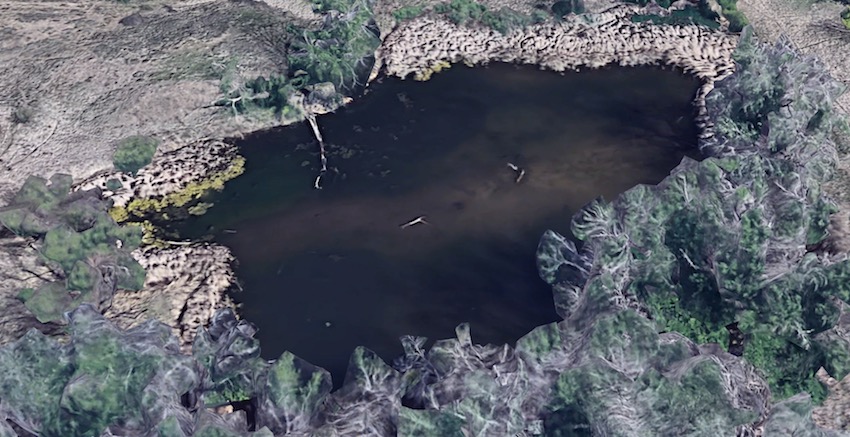
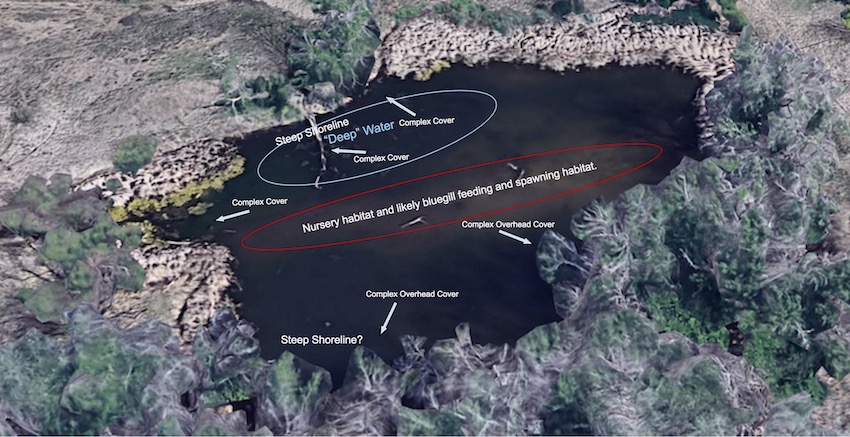
Hmmmm... Worth a shot, always. In fact, I'll share a quick story. I was invited to fish a pond. Got there and it turned out to be tiny -I mean I could throw a rock across with ease. The owner told me he'd put five bass in it the previous year. I was there so I walked back to it, and counted four 12-14inch bass in the shallows. There was a deep dark pocket at one end however, where I couldn't see bottom. I made a single cast with a grub and found the fifth bass, an 18-incher. I looked at satellite images of your ponds (from your profile) and found this little pond. Maybe this is where you are headed. The whereabouts of the bass is pretty obvious, and reachable, here. Great laboratory to test and hone your approach and presentation skills. All that said, unless the habitat is extremely limited -as in the tiny pond in my story- it may be most important to find the best concentrations of bluegills, even on a small pond. I'll touch on this below. Rarely are there no fish on the shoreline in our small waters here. They're just too small for the shorelines to be entirely ignored by bass. But not all shorelines -even most, by mid-Summer. It's not the shoreline exactly but what shorelines provide, and that's complex cover which promotes the food chain. The worst circumstance might be flat tapering shorelines that exclude fish the size of mature bass, and with little substantial cover. This is nursery water that supports YOY fishes and yearling predators. If much of this exists in your waters, you'll want to find steeper shorelines that offer at least 18" of depth right at the bank. I know a pond that has slow shallow tapered shorelines all the way around except one 100ft stretch of bank bounded by willows where wave erosion has cut the bank. That's a place bass can pin bluegills right against that bank. And they do! It's a great spot. It also helps that there is some small wood (hard cover) -just willow stumps and snags- mixed in with the veges in there too. The other part I think can be the heat and sun. Tough to separate the two in terms of effect on behavior but I think heat plays a role from some things I've seen. Regardless, the bass just seem to disappear under high heat and sun. Usually the two come together, esp here in CO with our 5000ft elevation "thin" air in which heating (and cooling) of the air are rapid. The bass must bury into cover, or drop closer to bottom, making shoreline and upper water column fishing pretty much dead. You'd asked about the topwaters in waist deep water. In my experience, I've found bass unwilling to approach the surface under such bright hot conditions. I think they are too concerned about aerial predators (and the list of them on our CO waters is long), and that the heat/prey vulnerability ratio is not conducive to aggressive hunting activity. These are my best educated guesses at explaining why under such conditions I have all too often wound up “beating a dead horse”. Basically, it seems they won’t move. They won’t chase. They won’t come up 2ft (!) to take a topwater, spinnerbait or swim jig. What to do? -Head for deeper water. Mature bass appreciate deeper water and expanses of it. So a lot of bass wind up away from shore in summer as you suspect. But not all bluegills do so not all bass do. There are almost always shoreline areas that attract bass. If hoof’n, look for reachable deeper water, or get a float tube! I saw a good one at a used sporting goods place here for $50. I have also done well trolling a shallow crankbait through main basins. Hit a fish then stop and cast. Summer bass are rarely alone. Just got to find them. I’ve done this from a float tube and from shore if shoreline that will allow it. -Pray for rain. That is, fish under the darkest coolest conditions if possible. Timing is always key, but especially so in Summer, as papajoe222 wrote about above. (He’s someone to follow, btw.) -Hit dense overhead cover areas. These may or may not be near deep water. (Cover and food can trump everything.) The more complex the cover (wood, rock, depth changes, substrate changes, vegetation changes) the more attractive it will be to bass. Complex cover promotes diversity and surface area for food chain development, creating micro-habitat space for a variety of critters. It also gives bass tactical advantage on hard to catch prey (bluegills) and room to chase. I say “overhead” cover bc solid dense weeds, although may allow bass to sleep, does not provide the best hunting. They need space to move underneath. Dense veggies may or may not be canopied -have a mat on top with some open water beneath. So do some exploring and be choosy about where you spend your time in dense cover. -One important thing I do -before I start flinging lures- is to actively look for concentrations of bluegills. I talk about this a bit in my video “Crankbaits for Fall Bass Fishing in Milfoil”. The bass are where the bluegills are. This almost always pans out. Several spots may look alike, but only one has bluegills, and bass. You’d PM’d me about lures and I’ll respond here (I hope that’s OK) as I don’t have any secrets. I use two presentation types: horizontal and vertical. Horizontal asks bass to chase. Vertical stays in place and catches (or tempts) the non-chasers. If I have a standard GoTo horizontal bait on our weedy waters it’s a swim jig. You’ll see them in many of my vids and I talk about them a bit in my upcoming Late Summer video -uploaded next week I think. I also like crank baits (also in the Late Summer vid) and in Summer, especially, triggering is important, such as crashing and ripping off cover. Spinnerbaits are great bass catchers. I always said, give a kid a spinnerbait and you’d better teach him some good conservation ethics along with it. Many other great baits too… Pick some and learn how to get the bass to bite them. For vertical presentations I tend to use soft plastics, although jigs (killed, shaken,..) are good, and lipless cranks can be fished somewhat vertical (from a boat) when ripping weed edges. I like two soft plastics the most bc they spell FOOD to bass and are unobtrusive and not off-putting. They are stick-worms (Senko types) and smallish slim straight-tail worms. They can be T-rigged, drop-shotted, or jig-wormed (“Shaky”). Another good option is the Ned Rig, which is more horizontal but can work well anyway as it's subtle and unobtrusive Then there's topwaters which tend to work best under dark, light-attenuating conditions. An exception can be weedless "frogs" over dense canopied vegetation. Buzzbaits and wind rippled surfaces go together like...PB&J...in my mind. Summer tackle, since we’re talking lures: With vegetation up you’ll need some power. I shift up to 12 to 20lb lines by midsummer. I also have a finesse rig handy for bright sun. I use 8lb unless there are more veges, (esp Chara), when I go to 10lb. Although in ultra-clear water with little cover I may use 6lb or even 4lb. Hope this helps. This is some of what I do, and it’s always interesting to talk with other fishers to see what they’ve come up with. Let me know how you make out.
-
The decision is actually research based. The north is a different place than the south. Spawning seasons are short and consolidated so bass are particularly vulnerable then. Broods and the successful seasons -where the strong year classes come from that produce the boom years, and maintain the species- are at greater risk in the north. In the south, long spawn seasons, multiple spawn waves, and multiple prey broods create a different risk level to year classes. Growing up in the state of NY, we had the same regs -3rd Sat in June to Nov 30 (essentially ice-up, once upon a time). But they've since relaxed regs to allow C&R outside of the take season. I actually watched our local CO (Conservation Officer) make a bust on Honeoye Lake years ago. He hid in the bushes with binocs and watched a guy catch a limit, stash them in his shed, then go out and do it again. The CO nailed him. He had a lot of bass in a cooler and freezer. This may not make you feel entirely better, but at least you know where the decision came from.