
Team9nine
Super User
-
Joined
-
Last visited
Everything posted by Team9nine
-
Lol - don’t get me started. I don’t know if their tubes are anything special, but apparently their marketing dept. is above average 😎
-
Didn’t realize KVD tubes were anything special. It’s a tube. You can either buy a bunch of different jig heads from a variety of companies in the smallest sizes and test them all out on your Coffee tubes to see which, if any, fit, or buy a few packs of Stupid tubes and matching jig heads to use that you know will pair up, then hope the smaller jig heads (3/0) will also work on your KVDs. It really is just trial and error in the beginning until you get everything dialed in the way you like.
-
You're in luck. BAD was Livingston Lures guy, Hydrowave guy, and a fishery scientist ("3 guys walk into a bar"). Two hours later, maybe they'll convince you to buy one of their many products with their "sound" arguments Haven't watched the full episode - just breezed through some soundbites to get an idea of the subject and discussion points. Very complicated subject that many/most anglers really don't have a good understanding of, so that leaves lots of room for anecdotal experience and personal observation to reign supreme. I have to believe nobody has really figured it out yet, manufacturer or otherwise, based on everything I see and read coming from all areas of the angling world. Oh, yeah - FFS discussion in that episode, too (point that sonar beam at them), in case you haven't heard enough about that subject yet
-
Lol - the reason I refused to give up my paper graphs and flashers for so long. Those early LCG/LCR models were a piece of crap, regardless of manufacturer
-
No idea. We used to throw a tube or two in our pocket when heading to the tackle shops and match them up with the right heads in store. Everyone’s jig/hook sizes are slightly different, as are the tube dimensions (body length/tail length). Ideally, you literally hold one up to the other to see how well the fit is. It’s trial and error. Once you find a good match, buy a bunch and don’t deviate.
-
I’ve got two “like new” and working Lo-K-Tors…one is a collectors item still in the original box, and the other I pull out and fish with from time to time using the old suction mount transducer. Even have an old original Lindy clamp bracket in the collection that was designed to be used with those cylinder-type transducers.
-
I’m skeptical of that theory
-
Their jig heads are matched to their bait…probably by design and intent. I have fished with some of the original local guys who developed this rig before it became popular and known as the “ Stupid Tube,” as well as those responsible for its namesake and popularity later on, and it was always a matter of trying to match jig head to available tube bodies. Always a variety of lengths, thicknesses, and differences in tail to body ratios with tubes. The only thing in common is the tubes used were nearly always bigger tubes in general (length and thickness). A couple local guys even started pouring their own tubes of the right length and thickness to meet the needs of, and match, the available jig heads before everyone (companies) started producing them.
-
Don’t buy any jigging spoons for up there fishing bogs from a canoe - lol. Save your money, or buy a few weed less types like Silver Minnows instead. You’d get much more use out of those. Sometimes you just have to say, “No!” 😉
-
Agree w/above. Either wire or 80-100# fluoro. That’s what most of the northern Spoonpluggers run around pike and musky.
-
My opinion - a barrel swivel won’t help much, and may actually inhibit the spiral action some. Usually you fish a day with the outfit/tube tied direct, then unwind all the twist before the next trip. But wouldn’t hurt to try that setup just to see what happens. Some of this probably depends on your line choices, too.
-
Another ‘milfoil’ vote. Milfoil is often like a handful of wet noodles when lifted out of the water. Coontail stems and leaves hold their shape and stiffness much better. The softer reddish stem of milfoil is sometimes a giveaway. Also, the “leaves” actually look like leaves or even feathers, with a central vein/stem and lots of fronds branching off that, versus more just a central clump of fronds, often splitting into double fronds like a wishbone.
-
Good for Taku - anybody but a Johnston bro for the win works for me
-
Believe I’ve got 50/65# original PP in dark green on the heavy outfit, and 40# 832 on the small frog/open water outfit. Only play with the specialized stuff (YGK) on the finesse outfits.
-
Hoping everything stabilizes quickly and starts heading back in the other direction - and that you’ll be able to get down there soon yourself. Keeping you both in our thoughts.
-
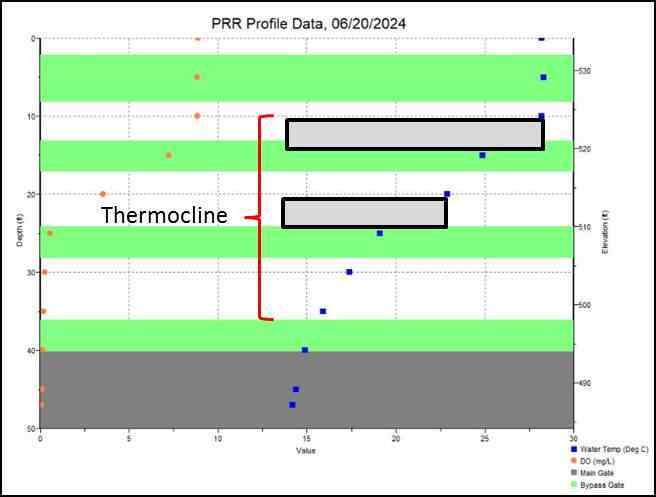
Thermoclines don't have to be just a single small zone of water. Though there are several different ways to define a thermocline, many often referring to just the zone of greatest temp change, but by technical definition, the water (zone) dropping at least 1 deg. C per meter of depth is a requirement. On larger thermoclines, you can have an upper and lower level to that band of falling water temps ('top' and 'bottom' of the thermocline). So you can have a large band of water that meets that technical definition, especially early in the year, like now, when stratification hasn't set up well, yet have certain depth levels within that larger area where you have more dramatic drops than the rest of the overall zone. The chart below from a local reservoir demonstrates this well. The area highlighted by the red band represents the thermocline by the technical definition, yet you can see two smaller depth ranges where there is a significantly greater drop in temp over a shorter range (gray boxes) which might be enough to show on a graph similar to what you posted. That said, and as has been mentioned by others, there are other possibilities that could explain what you saw on your graph depending on exact weather and water anomalies in your area. One thing not mentioned yet since you mentioned "night," is the bottom band could simply be zooplankton or similar making a migration upward in the water column due to a low light situation (referred to as a "diel migration"). This is very common in summer on some of the reservoirs I've fished. So short answer - maybe, maybe not
-
Jighead is the simplest way to accomplish what you want. Just be sure to adjust hook size to the bait being used (typically larger hook for traditional stick worms).
-
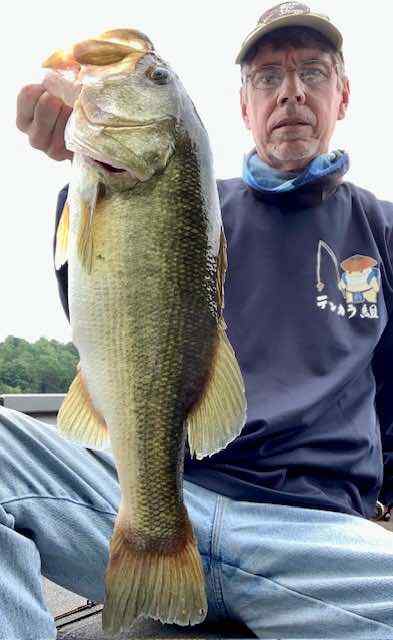
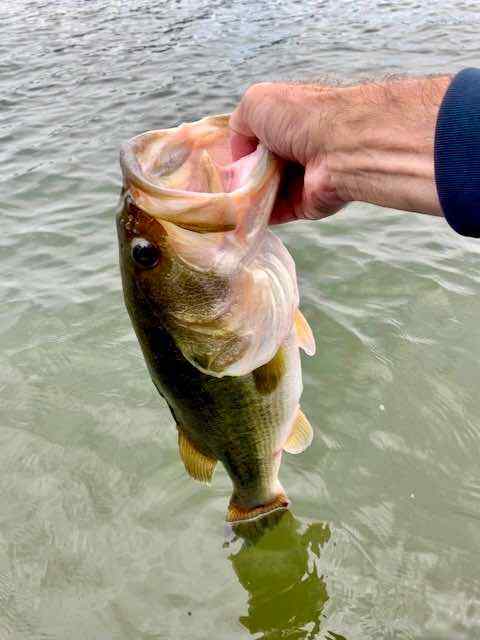
Unexpected change to the weather forecast for the better made me sneak out for about 2.5 hours this afternoon. Very slow bite, but if you’re going to only get one, it’s nice when it turns out to be a good one 😎 Crushed a deep crank.
-
Guessing most anglers might pick spiral, all things being equal. But, you need depth to perform a spiral, and current won’t help, either. Then there is the greater line twist, and avoiding snags on the rocky bottom - all reasons I suggested a lighter glide type rigging in your case.
-
Top - the lighter you can get away with, the better. Will vary with depth, cover and current.
-
They are…just saying they aren’t the only way to rig and fish a tube “weedless.”
-
Basically, what we know as the largemouth bass is now Micropterus nigricans - the equivalent of the northern strain. Existing all-tackle WR (Perry & Kurita) fish are going to be placed in this category. It will likely forever close off those records to being broken. New separate species is the Florida bass, now Micropterus salmoides. The new all-tackle record for that species will have to have genetic testing data to support the record. Other line class records in that category won’t. Alabama bass also becomes a new species, separate from spotted (Kentucky) bass. Also, “hybrid” bass (FL x northern, F1, Fx, etc) will no longer be eligible for all-tackle WR consideration in either category as I understand it. Finally, not all states will follow these guidelines, so each state’s DNR will decide the future path for that state, which might be different from its neighbors - even to the point of possibly not recognizing ‘largemouth’ as two species. You can Google search to find several recent stories that touch on the highlights of the changes, or watch this podcast for an in-depth discussion: https://m.youtube.com/watch?v=EkcOfgFOE
-
In open water, around light cover, or say skipping docks, probably. If you're flipping tubes in heavy brush or weeds, I’d go more traditional TR of some sort.
-
They tend to spiral better with insert heads fished with open hooks, not rigged weedless. Lighter weight heads and lighter wire hooks on lighter line help in that regard. But you'll still get good gliding action with the top heads pictured compared to more head heavy riggings IMO.
-
Should get better glide action out of the top head because more of the weight is transitioned down the shank of the hook and begins just slightly under/behind the eye. Ballheads would be a bit more Texas-rig like - a more direct drop because the weight is all focused right at the top of the head around the eye (more forward) and is spherical.