RoLo
Super User
-
Joined
-
Last visited
Everything posted by RoLo
-
my mistake T-Rig, I should've been more specific. That's how I rig the Gambler Ugly Otter (I've since retired the sweet beaver). With the Ugly Otter I use a Super Line Gamakatsu 5/0 hook: > Faster fall rate than a lighter hook, but slower and more seductive than a weighted otter > A smaller hook weighs less, but the center-of-gravity is slightly more forward so it tends to nose-dive (I prefer a horizontal-most descent). > The 5/0 hook seems to improve the hookup ratio (rigid wire, large gap) > The heavier wire is less apt to slice through the otter than fine-wire In addition to the heavy 5/0 hook, I occasionally add a 1/16 oz bullet sinker and peg it "ahead" of the hook (Carolina style). It's usually more productive though when fished unweighted, which admittedly requires more patience than I have. Roger
-
I've been monitoring this thread ever since FourBizz popped the question (were they released?) On the one hand, it's nice to know that you belong to a group of gracious anglers who are free with their compliments. On the other hand, it's just as nice to know that we're not a group of pushovers, but are observant individuals dialed into detail. I think LBH said it all. We're judged first by our integrity, THEN by the fish we catch. Let's face it, we all live-and-breathe for that double-digit bass, but no bass in the world is worth more than our integrity. Nice work fellows, as always Roger
-
About a year ago the Sweet Beaver got a lot of press in here. I personally prefer the Gambler Ugly Otter whose silhouette seems to have more character. To me the sweet beaver looks like a big sunflower seed with a tail In any case, I don't slit the tail or lobbed feet, because the lure seems to produce more vibration when they're left intact. I fish them unweighted on braided line but use a heavy-wire 5/0 hook for ballast. Roger
-
Balsawood has remarkable buoyancy and unique action, but is not without disadvantages: > Balsawood is expensive, but is worth the price. > Balsawood does not hold up as well as plastic lures when dealing with toothed critters like pike and pickerel. > Since balsa is so light it doesn't cast as far as plastic. TIP The 4 3/8" F-11 Original Rapala weighs only 3/16 oz. The "Jointed" J-11 Floating Rapala weighs 5/16 oz due to the metal hinges (2/3 more in weight). Roger
-
I'm afraid I can't help you with the Ditto worms but your request jogs my memory. Way back when, Larry Nixon touted the Ditto Gatortail so I went out and bought a bunch. As a dropbait though they disappointed me, because anything under 1/4 oz failed to activate that big wide tail, so I gave them the old heave ho... > :-[ Roger
-
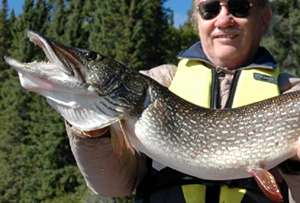
SALTWATER Blue Marlin Kona, Hawaii FRESHWATER Northern Pike God's Lake, Manitoba Roger
-
When the fishing is really good, I'll normally take that opportunity to experiment with different lures and retrieves, usually any lure except my "go-to" lure. But when the fishing is really tough I find myself leaning heavily on "paddletail worms". Lately, other lures have been jumping on the 'paddletail bandwagon' such as senko and basstrix. Roger
-
As mentioned above, Nick Creme introduced the first "rubber worm" around 1950 and dubbed it the "Creme Scoundrel". Although the scoundrel was like a junkyard threaded on a gut leader, it slayed the bass! In its day, the scoundrel quickly became my favorite bass lure, since the first time I used it in Mountain Lake, NJ (long before Mann's Jelly Worm). Back then, a plastic worm was something that bass were not accustomed to seeing, and they seized it with abandon, seemingly oblivious to all that unwieldly hardware . I don't use the Creme Scoundrel anymore because not only have our lures become more sophisticaed, but so have our bass. Roger
-
Welcome aboard John C And thanks for the warning, it sounds like Camp Mack might be a zoo this Sunday
-
There are a few spring-fed waters in central Florida such as Rainbow Springs that maintain year-round water temperature averaging 72 degrees. Remarkably the bass in these waters spawn annually as they do anywhere else. Bass are known to spawn in water between 55 to 75 degrees, therefore temperature is not a major biological trigger but more of a coincidental symptom. It could be that "photoperiod" plays the major role in spawn timing, the same force that triggers reproduction in the vegetable kingdom. Roger
-
I like dingy water best with about 2 to 4 feet visibility. Except in very cold water, I feel that 2-feet offers an ample window for reaction time. On the other hand, I feel that a flawed delivery is increasingly more noticeable as the visibility exceeds 4 feet or so. Most of my deliveries are flawed ;D Roger
-
Using your contour chart to find the widest divergences between the shoreline and 4-ft depth-line is an "excellent" first step! What you're actually doing is isolating the lake's most expansive food-shelves and therefore pinpointing the lake areas with the best forage base and nursery grounds (population dynamics). Your next step would be just the reverse, you'll be looking for depth-line convergences, which I normally call "compression points". For example, spots where the 4 & 8 ft depth-lines nearly touch together (i.e. drop-offs). When a compression point adjoins the perimeter of a broad food-shelf it provides bass with quick access to different depth levels and a year-round site. After all is said and done, "contour" cannot take the place of "cover". Ultimately you'll need to conduct an onsite survey to evaluate the current plant situation. You can't depend on any chart to provide current botanical identification of submergent, surface and emergent vegetation. Just as well, it's fun to identify every plant type you encounter, which can only add to the total fishing experience. Roger
-
Here in Polk County Florida, it was below freezing Wednesday night with a wind-chill factor in the teens! During winter in Florida, a miserable cold-front followed by a warming trend is the best weather you can hope for. If I were going bass fishing this weekend (don't see it happening), I would favor the sunniest shallow flats especially during the afternoon hours between 1pm and sunset after a buildup of solar gain. Anglers Tend To Rush The Seasons: Every year around this time I get the same report from my fishing neighbors on Lake Weohyakapka (Lake Walk-In-Water). They tell me excitedly that "The Cows Are Bedding!". It should be indicated though that there's a big difference between pre-spawn bass that are "basking" in shallow water and spawn-stage bass that are "bedding" in shallow water. Bass seen in shallow water during December and early January are generally basking and not spawning (which is a good thing). For the most part, the spawning ritual in central Florida will not get underway until February and March, often continuing through April. Roger
-
It seems that "winter" is an arbitrary term that's linked to the lowest temperatures that a given lake normally reaches. In other words, "winter" appears to be a relative water temperature. During the winter months in Florida, we have our best luck using a slow delivery in spite of water temperatures that would be considered high for New Jersey, where I've done most of my bass fishing. It probably has everything to do with the inherent differences between bass strains. Florida-strain bass are highly tolerant of warm water, but are very intolerant of cool water (cold fronts are pure murder in Florida). On the other hand, northern-strain bass are more tolerant of cool water but are less tolerant of warm water. Although bass eat less during the winter, it's common to catch a full-bodied bass right behind a thin tapering bass. I believe that both bass are equally healthy and in many cases the racer will put up the better fight. In any case, it keeps us guessing Roger
-
Thanks a bunch Kent, and the same to you and yours HAPPY NEW YEARS! Roger
-
I've noticed that bass from the same water, taken on the same day can vary quite a bit. Some are full-bodied like the bass my wife is holding, yet the next bass from the same place may be all head with a tapering body. Though I've heard several different theories, I really don't know the answer for this variation. Roger
-
Lois & I haven't been on the water for quite some time (shame on us). Today we finally got away, a day that turned out to be unseasonably warm even for Florida. The water temperature was 73 degrees and the action was mainly in shallow water between 1.5 and 4 ft deep (paddletail worms). The highlight of our day was a bald eagle that soared close over our boat as if it were looking for a handout. I was so taken aback that before I thought of the camera it was too late for the shot. The bald cypress pictured below is a typical winter scene in Florida. http://64.226.208.65/scans/bass-lo-12-29-07.jpg http://64.226.208.65/scans/bass-ro-12-29-07.jpg Roger
-
The Rat-L-Trap is so cheap and effective that they make you feel guilty as though you're cheating on the Bait Monkey. It's real easy to pay more for a lipless crankbait, but it's not that easy to find a better one. Just like its predacessor the heddon sonic, the rat-l-trap is a year-round lure (In Florida at least). Every time I try a new lipless crankbait, I keep coming back to the Bill Lewis version. Roger
-
Of course, cold water means slower action, but that's not all it means. Our chances of hooking the biggest fish of the year are exceptionally high during the coldwater period. That's true for all game fish species, both fresh and saltwater. I think Senko77 really boxed it in. During winter, when the metabolism of fish is sharply slowed down they instinctively favor the steepest drop-offs available, whether it's a point, channel, hump, bluff, etc. A steep slope provides easy access to a wide range of depths with a minimum of expended calories Retrieving the lure slowly from different angles is something you don't often hear but is a wise approach during the wintertime. I also agree with starting off in shallow water (anytime of year), because fish in the shallowest water are normally the most aggressive fish and easiest to catch. That failing probe progressively deeper. The shape of a soft-plastic lure (worm, crayfish, minnow) may be less important than it's coldwater suppleness. Some plastics become stiff in coldwater and are best avoided. This is why many anglers prefer Pork Rind over soft-plastics because even in near-freezing temperatures, pork rind remains supple Roger
-
That's A Loaded Question :-? If you're referring to maximal weight (swimming basketballs) then of course you're talking about California (then Texas). If you're referring to numbers of trophy bass, I don't know of any state that rivals Florida. Though it flies in the face of popular belief, if I were looking for sheer numbers of bass I wouldn't choose any of those states. In my experience at least, northeastern United States provided the best action for sheer numbers of bass. I've lived in Georgia for 6 years (92 to 98) and have been living in Florida since 1998. Regardless, the best action fishing I've ever encountered was on northern waters such as Greenwood Lake, NJ, Black Lake, NY, Lake Champlain, VT, St Lawrence River, NY, Rideau Ferry, Ontario and Georgian Bay, Lake Huron (with bass they're loaded) Roger
-
A "dink" is any bass that my wife catches, no matter what it weighs ;D ;D Roger
-
That may be a good thing. Bass eat thousands of species of fish, amphibians, crustaceans, insects etc, and each one had to be eaten for the first time. Our lure doesn't have to look like anything, it only has to elicit a strike. Roger
-
In my view, the right way to select a GPS Unit is to first select the map-maker (cartographer), then purchase a supporting GPS unit, be it handheld or console (I personally dislike combination Sonar / GPS devices, but to each his own). The cartography war between Garmin (Hot Spots) and Navionics (HotMaps) rages on, and although the US military employs Garmin software, it seems that with every passing year Navionics gets more accommodating to the American angler. Anyway, if you like Garmin charts (MapSource) you need to find the "lake list", which I wasn't able to locate. If I'm not mistaken, one of their best freshwater DVDs at this time is "US Inland Lakes v.3" If you'd rather own Navionics software, then you'll need the 'South Region' which embraces Arkansas. By the way, lake names on the list that are bolded are HD lakes (high definition) providing contour lines in 1-ft increments. The lake list below represents: Navionics HotMaps Premium South Region 2008 http://www.navionics.com/Premium08LakeList.asp?RegionID=2 Roger
-
Golden Roach
-
Boy, I can sure relate to that. That reminds me of an incident on the St Lawrence River out of Rockport, Ont. I'm going back about 35 yrs, before catch-&-release and long before B.A.S.S discovered the Thousand Islands. I was in a 12-foot aluminum rowboat without any stringer or livewell. Two large bass that I boated were slid under my seat, they were a press fit between the bottom of the boat and the foam flotation. A boat with two anglers entered the lagoon and idled right up to within 20 feet of my boat. My hackles were high because I happened to know that pre-spawn bass were all around their boat in shallow water. One of the fellow asked, "Doing Any Good?". First I grimaced then I replied, "Well, I could be doing better". They smiled and began to leave, but as they were slowly idling away one of the bass under my seat went berserk, which triggered the other one. It sounded like two wildcats in an aluminum drum, and both fishermen spun around to ogle my boat (What Da?). I kept staring forward as though nothing had happened, but I'm sure my face was fire engine red :-[ Roger