RoLo
Super User
-
Joined
-
Last visited
Everything posted by RoLo
-
-
'Water clarity' is very quick & very easy to appraise without the need for any special device, which probably lends to its disproportionate preoccupation. Secchi depths can range from a few inches to depths of more than 18 feet, but regardless of the water transparency, several other independent factors determine 'available light' and therefore "Underwater Visibility": > SKY CLARITY (cloudless - partly cloudy - heavy overcast) > SUN ANGLE (midday - twilight - midnight) > WAVE ACTION (flat calm - rippled - sharp chop) > LURE DEPTH (surface - 5-ft - 10-ft) > SHADE (open sunlight - stippled shade - under a dock) Roger
-
I’m a little surprised that your twist-lock keeper is picking up weeds. I often use the same setup (6/0 x 1/4oz), the only difference being I use a Gamakatsu hook. In any event, if you're looking for max weedlessness (who isn't?), your screw-in Florida weight is really tough to beat. I do similar, but instead I'll peg a 1/4 oz bullet sinker then skewer the bait on a Mustad Grip-pin Flipping hook (it's a great hook for securing a bait). There are a couple minor drawbacks though, when nose-weighting with a Florida weight or bullet sinker. The bait has a tendency to rollover, especially when bouncing around in cover. Also, when a nose-weighted bait is slow glided it has more nosedive then a keel-weighted hook. Roger
-
There are a slew of methods used to fish iive bait, but my favorite by far is "Free-Lining", which involves no float and no sinker. Any live minnow may be used as bait such as a shiner, shad, sunfish, chub ~ ~ ~ The reel drag should be set as usual to about 30% of breaking strength, but your reel remains in free-spool with your thumb rested lightly on the line spool. You'll have no problem distinguishing the swimming action of your bait from the attack of a bass. In many cases, when your bait sees a prowling bass it will go berserk, which in my opinion is the greatest part of live-bait fishing. On occasion (not all the time), we've had frantic shiners skittering across the surface to escape a bass in tow, only to end in a whitewater explosion! Roger
-
You won't know till you get there
-
My last Abu Garcia was a "Black Max"
-
Wire-core 'Twist Ties' Keep your sandwiches fresh too Roger
-
Over rocky bottom a "football jig" is always a good choice. However, wherever there's a bounty of vegetation I use nothing but "swim jigs", not for swimming, but for weed penetration. In wood (laydowns, stickups, stumps) the Arky head is a big favorite. Roger
-
Bass turn 'off' and 'on', far more often than they move 'in' or 'out' (it's an illusion) Roger
-
You might recall from Science 101 in high school that atmospheric pressure exerts 14.7 lb per sq inch. At sea level, 14.7 lbs of atmospheric pressure forces mercury 29.92 inches upward in a barometric tube. For this reason, 29.92 inHg represents the Baseline Barometric Pressure (one atmosphere). During an average high-pressure system (clockwise weather cell), barometric pressure climbs to an a mean 30.32 inHg, an average rise of 1-1/3% above normal. During an average low-pressure system (counterclockwise cell), barometric pressure falls to around 29.52 inHg, a mean drop of 1-1/3%: Mean High-Pressure System 30.32 inHg Baseline Barometric Pressure 29.92 inHg Mean Low-Pressure System 29.52 inHg Unlike air which is compressible, water is incompressible. Consequently, when a fish swims downward in the water column, the pressure exerted on its body increases rapidly. Inversely, when a fish swims upward in the water column the pressure exerted on its body decreases rapidly. Earth's atmosphere is roughly 300 miles thick, however the air in the upper atmosphere is extremely thin, At sea level, a fish on the surface of the water is subjected ONLY to atmospheric pressure which is 14.7 lbs per sq inch. When that same fish is 34 ft underwater, it is subjected to two atmospheres, because the pressure exerted by 33.8 ft of water is equal to the pressure of our entire atmosphere. Here's the upshot. The weight exerted by 5.4 inches of water is equal to the average change in barometric pressure during a typical weather front (normal to high -or- normal to low). Simply put, when a fish rises a mere 5.4 inches in the water column, it replicates the same pressure drop experienced during an average low pressure system. Conversely, when a fish sinks a mere 5.4 inches in the water column, it duplicates the same pressure rise as the average high pressure system. Furthermore, a fish that changes its depth by 1 foot or more produces a pressure change greater that any meteorological event on earth, including hurricanes and tornadoes. In the final analysis, the only mystery to barometric pressure is separating Cause from Effect. The effect of changes in barometric pressure are invariably accompanied by changes in light level. As it happens, changes in "Light Level" offer an infinitely more credible cause for changing fish behavior than barometric pressure (you might say, it's as clear as night & day) Roger
-
Though I do have a jackplate, I've read somewhere that a jackplate is not necessary, but the motor still has to be unbuttoned (not sure what that means). Roger
-
You're clearly doing something very wrong, because you should be able to cast 30-lb braid for years without any line-burrowing. Below are a few mistakes that can lead to line-burrowing: > Fishing with a 'locked down' drag (A big No-No, because it takes the drag out of the equation!) > Exerting heavy pressure on snagged lures in an attempt to rip them free (phase one of line-burrowing). > Fishing a lightweight lure on a rod rated for heavier lures > Fishing a slack-line delivery (e.g. Senko) and laying loose line coils on your spool. Roger
-
I actually tried answering this question, but the cultural bias prevents me from offering a rationale response. Before I buy anything, I always create a list of desired features. For this reason, I rarely find what I'm looking for and usually end up settling. As a result, unless the price is out of the ballpark, it's rarely a deal-breaker. Roger
-
With respect to freshwater bass, the nature of the cover you're working normally determines the proper line-test to use. I'd personally opt for 30-lb braid and tie it directly to the rat, frog, spoon, plug, spinner, jig, worm (you get the picture) Roger
-
Line versatility from Crappies to Pike is unattainable, unless you're averaging 2-lb crappies and 3-lb pike. Roger
-
That's putting him in a pickle Roger
-
Indeed, the Beetle Spin is a well-known panfish slayer of yore, but in my opinion, it is the not the ideal lure for a toddler. Unlike modern safety-pin spinners that employ an "R" bend eyelet, the Beetle Spin uses the old-fashioned looped wire eyelet. Depending on wind direction, throwing a beetle spin in an adverse breeze can cause the line to wrap around the wire eyelet on every few casts. Just a heads-up. Roger
-
Nice going young man. Days of fond human experience last forever, long after our glory days have paled Roger
-
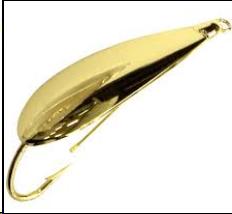
Johnson Silver Minnow > No Hazardous Treble Hooks > Nothing To Rig, Nothing To Fail > Remarkably Weedless > Casts like a bullet > Catches ALL piscivorous fish (Just be sure to sharpen the big single hook before using, which are notoriously dull out of the package) Roger
-
In addition to body chemistry, I believe it depends a lot on the prevalent insects in one's region. Florida has swarms of tiny midges (no-see-ums) that gather on your face, and get in your nose & throat. It seems that the more Picaridin I apply, the more midges swarm my face, but DEET staves them off. The efficacy claims of Picaridin apply mostly to mosquitoes and black flies. Roger
-
When the slot is used to hide the hook-point, the Fluke of course will ride upside-down, but I'm sure that has absolutely no ill-effect at all. Although I hook a Fluke from the bottom-up, I do that for a different reason entirely. In the weedy natural lakes we fish, "weedlessness" is King of the road. Skewering the Fluke from the bottom-up allows me to totally bury the hook-point in plastic. Two things make that feasible: 1) The plastic back of a Fluke is only about 1/8" thick, but the point is already on the verge of breaking out 2) I use braided line Roger
-
"Location" begins at home, by pouring over your hydrographic chart. Roger
-
Since your lake has no significant vegetation, that sharply raises the value of 'bottom contour', which must also serve as cover. If you concentrate your attention on bottom breaks (drops-offs & ridges) then wide area coverage becomes unimportant. As a beginner to bass angling, I would hesitate to place my bet on jigs, but would sooner recommend T-rigged plastic worms and plugs (billed & lipless). Roger
-
For hunting and fishing, I've always used "100% DEET" insect repellent, and with excellent results. Several years ago I tried "Sawyer’s 30% Picaridin’, which is touted to be just as effective as DEET, with the added benefit of no neurotoxicity, no residual odor and non-greasy. Well, it lives up to the secondary claims, but I haven't found Picaridin to be as effective as DEET, in fact, it seems to attract some insects Roger
-
Booyah Popping Pad Crasher - bull frog Soft collapsible plastic offers good hook-ups The flat face is good for popping, a plow-&-pause retrieve and so on. Good leak resistance Spro Bronzeye Popping Frog - green tree The flat face is good for popping, plowing-&-pausing, etc. Good leak resistance Durable Roger