


hawgenvy
Members
-
Joined
-
Last visited
Everything posted by hawgenvy
-
Almost all knots are hard till you get used to them and practice them. Then they're all pretty easy. Like tying your shoelaces, which, if you think about it, requires a moderately complex knot. I'm a surgeon and I can tie a square knot in the dark with my eyes closed using one hand in a quarter second. Now, I do some teaching, and I tell you the medical students these days, who don't practice knots like we used to do, more often than not can't put down a single throw of a simple square knot without getting all confused and all thumbs, and all embarrassed. I'll let them try one knot during surgery and if they can't do it I'll tie the rest of them or we will be there for hours. Inside someone's living body is not the place to practice your knots. Now if the student has any motivation, they'll spend a whole bunch of hours practicing one-handed and two-handed square knots, and next time in surgery they'll get to do a bit more and learn a lot more and enjoy it a whole lot more. My point is that it takes a ton of practice to tie any knot effortlessly and precisely, and for anglers the time to learn a new knot is at home, especially in the winter -- not out on the water where it counts.
-
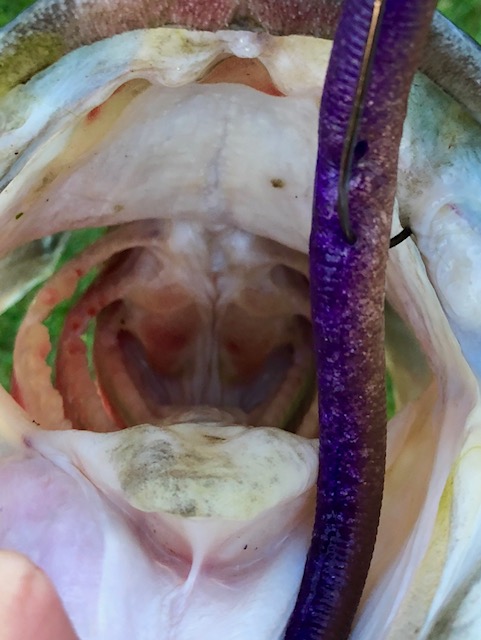
Ran out just before sunset to beat the bank. The color purple ruled the day, with three 3-pounders in quick succession.
-
There will be bass boat access there one of these days, and should be great fishing. https://www.floridatoday.com/story/news/local/environment/2017/03/10/ramp-site-delays-fellsmere-fishing-mecca/98650514/ https://www.tcpalm.com/story/sports/outdoors/fishing/2017/05/11/new-water-man-made-bass-habitat-fellsmere-fun-paddlers/101555140/
-
Bigmouth Forever is an amazing documentary, mostly about the habits and life cycle of LMB, with great underwater footage. Supposedly, the narrator is Rod Serling, The Twilight Zone guy. Everyone should watch it in its entirety. Listen to the sound bass make when they engulf a baitfish.
-
This classic bass fishing documentary from 1973 is very good. After 11:00 it shows underwater footage of undetected bites on crankbait and spinnerbaits.
-
There is practically no way to know how often bass bite and spit out lures undetected. There was an classic documentary, from the 70s maybe, about fishing for bass. It featured a scuba diver filming spinnerbait fishing in a clear lake or river in north Florida. Most of the bites were undetected, and that was with a moving bait! If anyone can find a link to that video, please let us know. It was really excellent
-
I am convinced that there is such a thing as setting the hook too soon. When I started jig fishing a couple of years ago I missed so many fish by jerking a hookset as soon as I felt something, which is what I had read I was supposed to do. I later learned to reel the slack first and set only after I begin to feel the weight of the fish. Then I started catching. Surely I still miss a few but at least I'm not jerking the bait out of their mouth every time.
-
Guide should have everything your dad needs to fish with. Remember that guides are quite accustomed to customers bringing no more than a hat. I would ask the guide what you should bring. 8 extra rods plus 3 anglers in a small boat might be more than the guide is comfortable with.
-
Thanks, man, I was trying to remember that name!
-
What I really meant by "invisible braid" is a tough, no stretch, thin, supple line with braid's properties but fluoro's transparency -- a line of the future, a product merely of my imagination. Computerized, backlash-proof reels actually exist in Japan but are expensive and may lack durability and reliability. I don't really know much more. But I bet they will be the next great thing in casting reels, one of these days. Imagine skipping docks and bushes with that baby! Optimal guide spacing is a compromise between light weight, durability, low friction materials and several other factors. Too few guides may increase resistance due to line slap and angles between guides as rod bend increases. Increasing guides can improve sensitivity by increasing contact points with the line and improves the smooth arc of line as the rod bends, but increases weight. But I'm not an expert and don't know the formulae or the science in any detail. There is actually a website with a bunch of forums on the subject called GuideSpacing.com
-
Will do, Tom, thanks.
-
Why? Because the handle somehow gets in your way when horizontal? Offhand, it seems to me the best position for casting distance would be whatever handle position brings the line guide to the central position on the worm gear, so there is the least extreme angle from the edge of the spool. I can't say I'm sure of that, however.
-
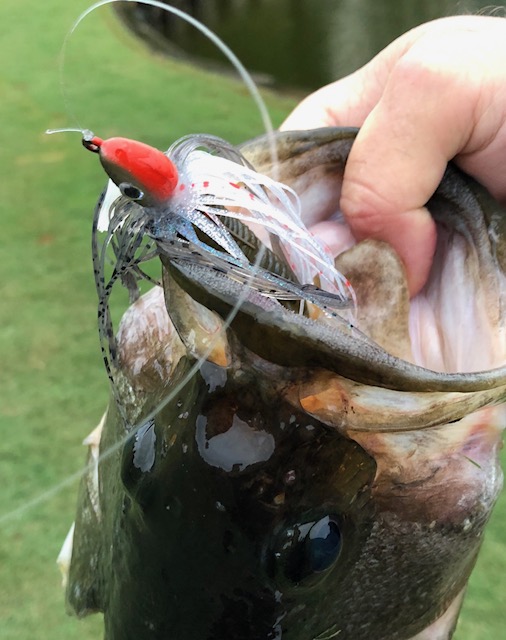
The bass were going nuts chasing this swim jig I was tossing from the bank last evening, as a storm moved in from the west, pelting the water surface and my rain jacket. Just before sunset, the clouds cleared and the red sun lit up the sky, and the bite shut down. I sloshed across the wet grass back to my car, quite satisfied with myself.
-
As rods and line guides get lighter and stronger, guide spacing will decrease, which should increase performance. Personally, I'm looking forward to reels that don't backlash due to computer technology. You could cast much farther with no brakes and no backlash. And eventually there might be braided line that becomes invisible under water, like today's fluorocarbon.
-
That's a freakin' herd of cows! Nice!
-
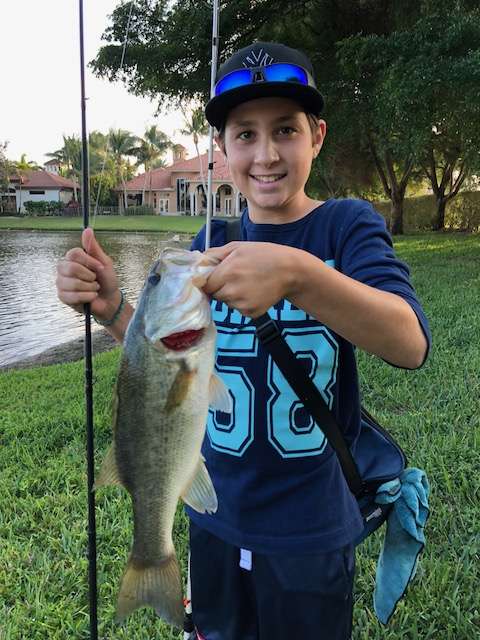
I usually spool up with Seaguar Invisx. I tried Tatsu once and snagged a tree behind me on my first time out with it and the bird's nest was so bad I had to cut out the whole spool. That's $50 for a 200 yard spool of Tatsu. I was stomping and cursing. And, honestly, I can't tell the difference between Tatsu and Invisx. Tatsu is so costly that you can end up worrying about it when you're supposed to be out fishing for fun. Or maybe you'll be reluctant to re-spool it when you should. So I won't buy it again. Same for Gamma Edge and some other super pricey lines. (I always wonder what the cost of manufacturing that stuff is -- probably 10 cents per mile.) Braid is expensive, too, but at least it'll last a couple of seasons.I was out on the lake yesterday (Saturday), windy and cold (by FL standards) with air temps 40s to 50s, water in the low 50s, and 15-20 mph winds from the north. Darn choppy too, especially dangerous if you're trying to go fast. My buddy and I kept our bass boat in moderately protected areas, which were still unpleasant. I can see how you can get tossed out of a little bass boat on a fast run through chop, become unconscious through impact or incapacitated by hypothermia and in either case not be able to swim back over to the boat. And everything that looks like land is a floating island or emergent tall grass. Even where there are trees, they are probably afloat on a thick mat. And if you do find a dry spot in a tree, your clothes are wet and wind chill is in the 30s. Awful to picture any plausible scenario. And, BTW, the fishing was horrid -- we had only 2 bass all day.One slightly off year is not a trend. But I agree it is possible you are beginning to pressure the lake.This week? 1/4 or 3/8 oz Strike King Hack Attack Heavy Cover Swim Jig with Rage Grub trailer, hopped along the bottom. There's something satisfying about the jig bite, especially on braid line. It's the hook set I think, so solid and powerful and definite.Interesting. I'd like to see a slow motion video of that! BTW, has anyone experienced those computerized-braking reels from Japan, the ones that are supposed to be backlash proof? Haven't heard about them for a while now. They are expensive, probably heavy, and perhaps unreliable. But my gut tells me that something akin to that technology will eventually be the standard for high end casting reels. They have a system that won't allow the spool to spin faster than the line flowing out from the reel. There is a sensor monitored by a chip that controls the brakes. Can't recall off the top of my head what it's called, but sounds cool as hell.A relatively wealthy fishing buddy of mine uses cheap rods and reels, and does very well with them. He enjoys fishing and catching fish, as I do. He enjoys, like me, being outdoors. We both love going out and thinking about fishing and nothing else. The problems of work, home, politics, bills and money disappear as we concern ourselves with what bait to throw next and where to throw it. But I have an additional pleasure in fishing that he doesn't have. I'm talking about machine pleasure, the appreciation of refined mechanical function, the beauty of fine fit and finish, the smoothness of a reel, the liveliness of the rod working the bait, its lightness and sensitivity, the sublime way a fine rod bends to a big fish while maintaining confident power and control. My friend doesn't get that at all, just like many people cannot appreciate a superb automobile. To them it's just transportation. Sure, an important aspect of having great equipment has to do with what you can afford. But in most cases it's a matter of priorities. If you can appreciate the beauty and feel of a fine machine, if using a finely crafted $300-400 rod or reel sends shivers of pleasure down your spine, go for it. But if it doesn't matter to you, use cheap but functional stuff. It works nearly as well and you won't even know what you're missing.Incredible, man! Rest your sore arms till the lakes thaw!Might as well start with the nearest pond. Any body of water in FL may have tons of bass, or it may not. Vegetation and cover/structure such as walls and bridges, steep banks are good signs. Also depth and clarity are favorable. Big submerged pipes that connect between bodies of water usually hold bass. Even a solitary stick in the water may have an associated giant bass. Solitary structure in general is a good target. A group of rocks. A shady spot. A little point. Wading birds and ospreys and anhingas are good signs. Places where nobody fishes are usually better. And don't overlook canals, especially canal intersections. Ponds that are close to canals are good spots as they usually connect to the canal with a big old pipe. Look for shopping centers or supermarkets that may have a pond behind the parking lot. Or ponds near office parks where you can go unnoticed after hours or on weekends. Drainage canals along the roads can be good. Residential ponds surrounded by 2 or 3 story rental apartments tend to be more angler friendly than ones surrounded by $5 million homes. BTW, you can tell I've done some local pond fishing!Took my cousin Dax bank fishing today. He caught more fish than I did, using a Texas rigged worm. The best part was watching him set the hook like a pro!


Important Information
We have placed cookies on your device to help make this website better. You can adjust your cookie settings, otherwise we'll assume you're okay to continue.