
FloridaFishinFool
Members - approve posts, limit profile edits
-
Joined
-
Last visited
Everything posted by FloridaFishinFool
-
I agree with ya A-Jay. Mexico has some great fishin' too, but that is one place I will never go to find out. So for me, the best I got is the SJR. Beautiful fish you caught there no doubt! I'd like to point something out. When I say best bass fishing on the planet I am not referring to size of fish caught. I am referring to numbers caught and aggressiveness of the fish being caught. And the great amount action to be had. While its nice to catch fish that large on every cast, I doubt that's the case and more like every once in a while fish that large come in, but its not an every day thing for most of us to ever catch 'em like that daily. But out on the St. Johns river to me is some of the best daily bass fishing on the planet because of the amount of action and strength of that action. When its good, its great! Kind of like this young man stumbled onto it out there. Just listen to his excitement over it too! Size is nice, but amount of action is where my comment is coming from. These bass will wear you out just like they did this young man. Watch this young man hook up on just about every single cast he makes and it does not matter what he throws at them. They hit it all and wear him out. This is "best" bass fishin' to me. A fish on just about every cast.
-
I think younger bass tend to have more fight than older bigger bass. Age may play a role in that as well. Younger bass may tend to move around more like the wolf packs seen in Glenn Lau's films. Larger older bass may tend to set up in one spot and not get the same amount of exercise the young'uns do.
-
I pointed it out this time because I wanted to bring up a point about bass and their environment. Bass who live their entire lives in lakes and ponds with no current, or little to no current do not have to fight the current every day to survive. Those fish tend to get lazy in my opinion. I can catch some lake bass and some of them just do not put up much of a fight. Some roll over and come in like a sled. Just no fight to them. I call them lazy lake bass. And their skin looks kind of loose covering their innerds and they got a big old belly like me. But, out on the St. Johns river South of Lake Harney is a different story. South of Lake Harney the river is narrower and more shallow and has a strong current. Bass in that environment have to fight that current every day of their lives. Those bass get strong and mean. When the LGM bass was given the nickname the brawler, it was referring to those St Johns River bass South of Harney. They are not the same further north where the river widens out and current slows down like where the Elite series does their tournaments in Palatka 100 miles to north. Fat lazy bass up there too. But way down South on that river is where the brawlers live. When you hook into one of those bass the fight is on. Not only are the fish more aggressive and meaner it seems, but you have a strong current to fight along with the fish. If you notice the shape of the bass in my photo above, the skin is tight. No belly on that bass. Straight belly. That bass is the Hulk Hogan of bass. That river makes those fish more muscular. Stronger. Leaner. Meaner. Best bass fishing on the planet. Even old Scott Martin agrees when he recently said the St. Johns river is Florida's best bass fishery. I think the skin on my bass shown above is tighter on the innerds because that fish is more muscular. And out there on that river South of Harney, the fight is not only better, but longer too. Those mean Hulkster bass out there ain't playin'. But be aware, to go out there you gotta have boats that can go real shallow. Most bass boats won't cut it because of sandbars they can't cross. And bring plenty of water, food, and supplies like you were going camping because you will be miles from the nearest roads, nearest houses. Nothing but jungle out there so be prepared if you go. Swamp Girl I think that is what makes the bodies of the bass look so different. Not the genes, but the environment in which they live makes that difference. I could be wrong. Won't be the first time.
-
I'm more or less thinking each fisherman has his own preferred bag of tricks. I don't think any fisherman is excellent at every technique all the time. I think we all tend to focus in on a limited number of techniques more so than trying to do it all. I'm in my 60's now and getting lazier about it. Sometimes when I go fishing it is just one rod and one bag of goodies that fits in my pocket. If I catch fish, then fine. If not that's fine too. I just enjoy the swinging away at it. Catching is nice too. But when money is on the line the guys who have a limited bag of tricks will try and expand out to more while I don't think some of them really want to do that. More or less compelled to do it.
-
Say what? All that fried stuff would clog up my arteries! Nah, this is HOW to photograph fish- halfway to nyotaimori- which if I posted THAT would break a rule or something. SwampGirl you are doing just fine with your photos. Keep 'em coming! I gave up photographing my fish years ago. Can't even recall last time I took a fish photo was for someone else of their fish. I fish to fish, not take time out for photos. Just me though..... it happens when us guys get fat, old and mugly. lol Mine wind up looking like this St Johns River bass... as I am wondering gee, I'm missing out on another bass in that boiling water! Back to fishin'! I'm heading to the sushi bar. -----------ADDED Curious if anyone notices that the bass in my photo here has a different body shape than other bass in this thread?
-
Thanks! You have given me some new hidden history to research. "On July 16, 1999, John F. Kennedy Jr. died when the light aircraft he was piloting crashed into the Atlantic Ocean off Martha's Vineyard, Massachusetts. Kennedy's wife, Carolyn Bessette, and sister-in-law, Lauren Bessette, were also on board and died." They were flying from their private residence on the northern end of Cumberland Island same place they married. "In 1996, Carolyn Bessette-Kennedy and John F. Kennedy Jr. got married outside a peeling white log cabin chapel on Cumberland Island, Georgia. With no paparazzi and no media present, it offered the pair a brief moment of normality before they re-emerged into the world as one of the most famous couples on the planet." Looking up "Watauga treaty" now. Thanks!
-
I'm trying out a new image hosting site... This image shows hidden U.S. history many may have never heard of before. The gutted mansion is called Dungeness and was built on Southern end of Cumberland Island, Georgia by Thomas Carnegie. The empty decaying mansion was burned by arson in 1959. Do you see that small house to the left of Dungeness? That is where Revolutionary war Gen. Nathaniel Greene lived out his life. Its called the Tabby House. This house is significant in U.S. history because a signer of the Declaration of Independence died in there. General Richard Henry Lee was sick and doctors told him to go to the Caribbean islands for more suitable weather. On board ship off coast of Georgia his health took a turn for the worse. The ship turned west and made for shore and landed on Cumberland Island where Gen. Richard Lee was carried to the Tabby house. At that time Dungeness had not been built yet. (That came later because of this site.) General Richard Henry Lee died inside of General Greene's house and was buried on the island originally, but later exhumed to Richmond to lay in state along side his son General Robert E. Lee. As a small boy I was taken to this island by Dr. Hilliard a descendant of the family who owned extensive land on the island and had a house near these ruins we stayed in. He was the man who instituted the golfing merit badge into Boy Scouting. I was in Boy Scouts camping on this island until we were run out of the woods by wild pigs and into his house for remainder of our trip. Back then it was all private land. Today it is federal land and a National park. I dangerously climbed through these ruins of the mansion and have photos of me standing in second floor windows. Today it is fenced off from the public. From these ruins I walked to the beach randomly walking through the woods. No paths. No markers. Just head east. In the woods I came across a small walled in cemetery. Gate was rusted shut and so I jumped the wall to look at tombstones. I was a 14 year old kid out in the middle of nowhere deep in the woods and I came to realize I had stumbled onto a hidden grave of a signer of the Declaration of Independence! I was stunned. An exciting moment for me. I had no idea at the time the second stone in front of his tombstone mentioned the body exhumation and removal. But the original tombstone was still there. I am preparing now to take my own sons camping on this historic island still with wild horses roaming the island. I would read in books decades later that I had followed in the footsteps of General Robert E. Lee who took time out from his efforts at war to go visit his father's grave for his only time. He docked on westside of island and walked literally the same path I did to find the grave. First to Tabby house, and then east to his father's grave. Today's dock is in same location as it was then. Its a strange feeling walking in the footsteps of history. Made a big impression on me as a kid.
-
Good luck.
-
According to a search: -A stranded 8 gauge copper wire has a current capacity of 40 amps in most standard applications" -A 6-gauge stranded copper wire typically has a current capacity (ampacity) ranging from 55 to 65 amps. -A 4-gauge stranded copper wire typically has a current capacity of 85 to 100 amps. -A 2-gauge stranded copper wire typically has a current capacity ranging from 115 to 130 amps -A Minn Kota 55 lb thrust trolling motor typically has a maximum amp draw of 50 amps. This is consistent across several Minn Kota 55 lb thrust models like the PowerDrive, Terrova, Endura Max, and Edge series. A 60 amp circuit breaker is recommended for this motor, according to Minn Kota."
-
Not sure how deep you have gone into reels, but one thing to consider are the brakes. I see suggestions here going in two directions. The shimano reels use centrifugal brakes with no magnets, and the Daiwa mentioned are usually magnetic brakes usually without centrifugal brakes- not sure if any Daiwas now come with centrifugal brakes. I see the Lews mentioned has centrifugal brakes and some reels come with both. They operate differently. The centrifugal brakes are most effective on high speed spin out at top of the cast and they taper down to almost nothing at end of the cast. The magnetic brakes tend be more effective at tail end of cast. If your thumb is already used to one or the other, it may be an issue to consider.
-
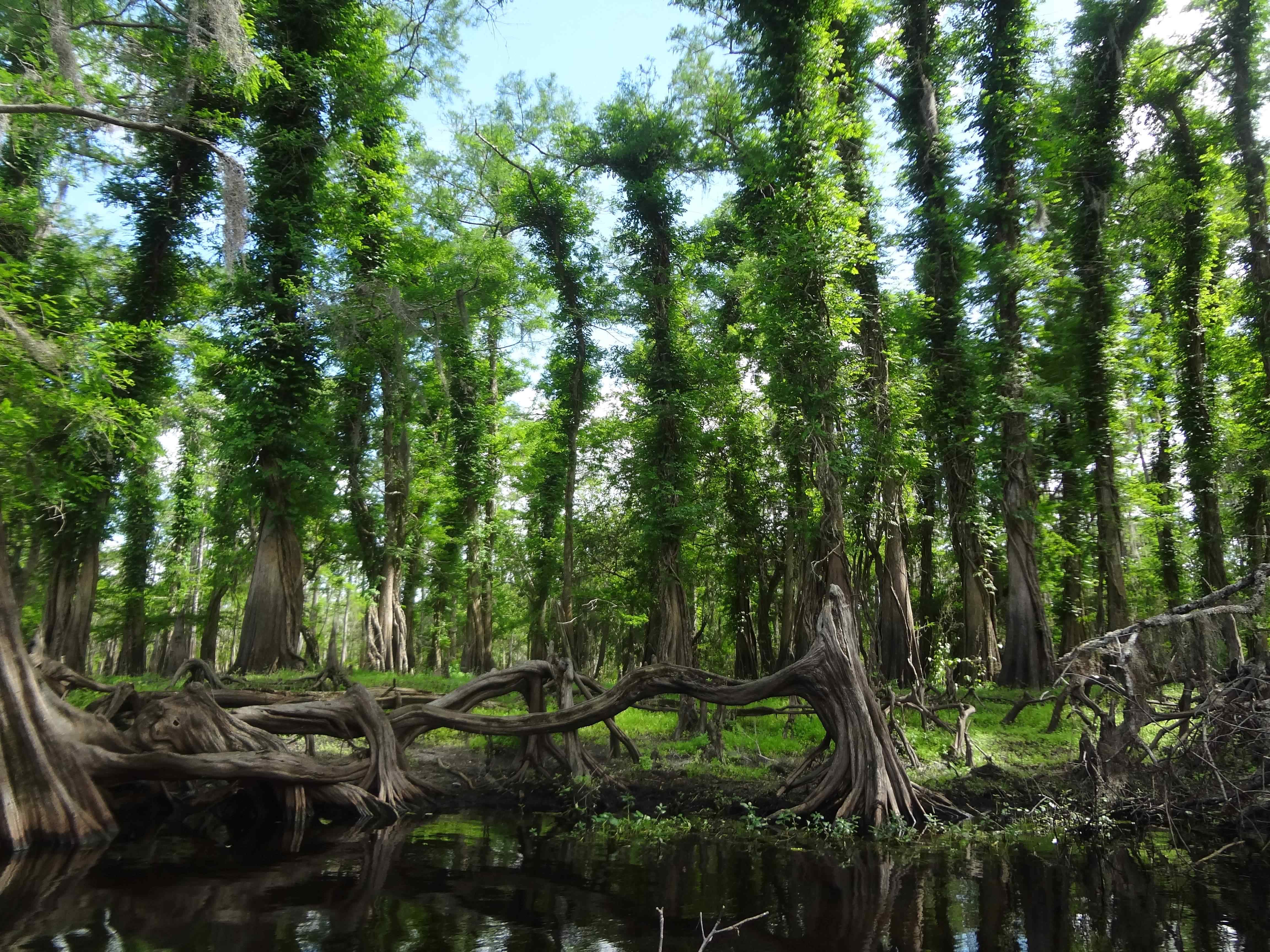
Some great photos! Not sure if I posted this one before, but one of my favorite feeder tributaries to the St. Johns river in central Florida. When the water level is normal bass boats cannot get to this location. It is way back up in the jungle. Jurassic park like jungle, but with white sandy beaches perfect for camping and cookouts where no one will bother you- except the gators. Some big bass back in there! When I am out there fishing and I hear something in the woods, I am reminded of the movie Jurassic Park and kind of half expect to see a T-Rex coming out of the woods for me. Love it out there though... so peaceful.
-
Sometimes these systems can go haywire all because of bad connections throughout wiring harness. Happens a lot in Florida. I try and prevent bad connections at connectors by using an anti-corrosion connection wetting agent. Make sure the product used is safe on plastics. It could be a simple connector fix or, maybe what others have pointed out above. Sometimes just unplugging and replugging connectors a couple times might make a good connection again.
-
You asked for it! No summer slump on lake Winterset! Yeah I guess I can check that lake off the list. This is what the kids do with dad's fishing boats when he's not paying attention. We try and pass fishing down to our kids, but they would rather take the fishing boats and go do this... and believe it or not, this happens all across Florida and getting worse. I won't even try to fish on weekends on certain lakes because of this. And the jet skiis too. Toss those in there. Ah, to be young again with dad's fishing boat! What summer slump? Oh, and if you watch this, Polk county sheriff Grady Judd said all of these boats were confiscated by police. The boats, the trailers, and tow vehicles. Bet dad isn't gonna be happy about that! Hey, where's my boat and truck? I wanna go fishing. Sorry dad the sheriff has them. Gonna cost a couple grand when done. There goes the new FFS
-
That one video right there is the most influential video on bass fishing I have ever watched. Denny has a sixth sense on where fish are and it is on full display in this video. Other fishermen, most, do not have this sixth sense like Denny shows here. Mike Iaconelli would be lost without Denny Brauer showing him where the fish are! Ha! Also, watch Denny land a 6 or 7 pound bass all because some darn plant shook. Amazing skill and super human observation skills. All I can do is shake my head in awe of Denny Brauer. Oh, he has never said publicly where this was shot. Us Florida guys have been trying to figure it out for decades. Best bass fishing video anyone could ever watch.
-
This would depend on motor speed controls. Something a lot of fishermen may not be aware of is a trick trolling motors throw on us. It seems to make sense that in those lower powered motors, that using lower speeds would use less energy right, but what if I told you that is not always the case because of how they are designed? This is a secret most are not told. It revolves around old speed control designs. Older lower end models do not have electronic speed control. They use wire wound resistors down inside the motor. And you can see from the shape of it, it is designed to be inside the motor housing itself down in the water because they use the water to keep it cool. When you switch to slower speeds, excess battery energy is burned off in the speed coil resistors inside the motor. This is wasted battery energy doing nothing but turning into heat and not being used by the motor in any way. Its a trick! So back in mid 1980's Minn Kota contracted out to another company to build their first electronic speed controller. With this device we cut out all the heat losing resistors wasting energy. Cut them completely out of the circuit. Wire directly to motor brushes and take a look at what Minn Kota has to say once the above resistors are removed... also keep in mind what is shown here Minn Kota is comparing to the above but not quite outright saying it, only implying it. I have 3 of these and have been using them for decades. My 40 year old maximizers are still kicking in 2025! I have talked to Minn Kota several times about this device seeking schematics and service info and Minn Kota says it was contracted out for only 2 or 3 years 1984-1986, and they have absolutely nothing on it today. We are on our own. These have not been made in 40 years, and are no longer available except to try and find a used one if you can. I modify mine. I extend the speed control wiring so I can move from front to back of boat rather than the short 3 foot cable it comes with. I also sometimes change the speed control itself to a different taper which has a smoother startup and climb rate. The stock control seems to jump into action and I want a more slow take off. More variation at the slower speeds. The nice thing about this device is I can perfectly dial in my speed. Switches only give you 3 to 5 specific speeds which may be too fast or too slow for conditions. This device adjusts speed perfectly anytime instantly. This same technology is common place today in all high end trolling motors. However, none of them have lasted 40 years like this one has. If you read the article below it makes it clear that when you run the old style motor with speed coils, the battery is constantly draining. Not so with this device. It pulses to the motors. It is using less energy to do same work. Article says it can produce 20,000 pulses per second at full speed and it slows the pulses widening gap between them to slow motor down. Draws less. Uses less. But just take a look at how much the efficiency increases once those heat resistors are cut out. From hours of use to DAYS ad says! Point is, going slow with the old switch-a-roo design and heat resistors does not really save energy. Most do not realize this big old resistor coil in the motor is glowing darn near red hot while you are trolling slowly above not knowing it or even thinking about it while believing you are saving energy with battery on slower speeds. It also is burning up the contacts in the switch as well which begins to slowly melt the plastic housing leading to failure of switch too. Wasted heat energy everywhere! All wasted energy. You can go around this situation very easily. What this old 1980's ad shows is how to do it. I've been doing it like this for decades, but sssshhhhh don't tell anyone the secret. In the first column of description from ad below it says and I quote: "Rheostats slowed motors by burning current in heat" and there it is. Open declaration. Slow speeds on old lower powered motors simply burns off excess energy as heat in the resistor coils inside the motor. It does not save energy and this ad says so! And even provides the solution. Which it does! For 12 volts only that is and motors up to 55lb thrust. I gotta go elsewhere for 24v and 36v. With this device, I can troll for days on one battery charge no problem. It says 3 days here. I never went THAT far. Maybe 8 hours. No issues. Fantastic device! Has not been made in 40 years! Love these! When you use this device virtually all battery energy is used for thrust, and none wasted as excess heat. Well almost none. "Fish DAYS instead of HOURS before recharging!" Where do you think Minn Kota is suggesting all that wasted battery power is going to? Only one place. Resistors hidden inside the motors. Just think about what Minn Kota is telling all of us here. They are saying the difference is just hours on speed coils wasting energy as heat compared to 3 days trolling around on one charge. They are saying the speed coils burn off the difference between hours to Days! That is a HUGE amount of wasted energy just thrown away! All admitted by Minn Kota in this ad.
-
They do. Its just hard to watch them do it. Just a me thing. I have observed a number of them have compensated for it by making the cast with their dominant hand, and just before the lure hits the water the rod is already switched over to their other hand ready to go. I guess that works fine. Just more work, and not for me any more. Like I said I made the correction myself. Just kind of ironic watching pros do it and not even thinking about it. I will say this though, concerning boat positioning, even that has changed. Watch Denny Brauer back in 1986 in his flipping and pitching video and he teaches old school boat positioning. You don't see that much any more. Technology has kind of done away with that and fishermen don't talk much about it any more. Denny is a master at what you just said. A very influential video right here... I think Denny could catch a 10 pounder in a puddle flipping and pitching. https://www.youtube.com/watch?v=BJhbnvjIHSU
-
If you bought top of the line gear all calibrated it could cost thousands. Buy some old used junk NOT calibrated and you can do it for probably around $500+. But keep in mind, NOT calibrated. No one with a phone can invent TNF out of counting tip swings that are not the same. Each with different wavelength and different rate or speed of swing. Each swing has a different frequency so it is not possible to use a phone to measure tip swings to generate something called "true natural frequency" by randomly choosing which variable tip swing to count since all tip swings are a different frequency- as in multiple frequencies. Picking and choosing this one or that one does not cut it. And when people all do it differently the world over, no way any of that data can be compared or deliver any useful information when the data itself is inaccurate and uncalibrated. Science testing must be calibrated. This method is debunked based on that alone. NO ONE can get TNF from tip twanging. Not physically possible. It does NOT produce anything close to a true natural frequency. Not even close! Life is too short and sweet to waste it on useless ideas that are not true. Not about to go that route. It unscientific plain and simple.
-
Welcome to the forum! For me it was back in 1969 fishing a small pond for bream with cane pole and bread and hot dogs. Man I thought I was doing great until one day the little bream I was playing around with in the water on the hook got eaten by a big old bass. I had no idea really what happened. It was an explosion of water right under me. And all I had left was an empty line swinging in the wind. I began scratching my head and the wheels started turning and I began to realize there was something bigger and badder out there. And I was not prepared for it. That was the beginning right there. I went back with a cheap plastic rod and reel and same thing happened. That's when I started to really learn. I hope you will find interest in it and dive in! Lots of fun.
-
I think I can agree with that for the most part. On this point we do agree that a higher TNF can be more effective at transmitting rod tip vibration signals to the hand. At ICAST this year I spent nearly all of my time divided between state of Florida biologists and rod blank designers and builders. I met a Canadian rod blank designer and builder, and as we discussed his blanks he put one in my hand and then put the tip on his throat and talked to me. I could feel his words in my hands. This idea of measuring a rod blank's ability to transmit vibrations can be measured. It is really simple to do.
-
(The following is an excerpt from the article, and does not contain entire article) https://www.foxnews.com/food-drink/im-neurologist-i-never-eat-3-common-foods-can-harm-brain Doctors recommend foods like berries, nuts, fish packed with omega-3 fatty acids and even dark chocolate for neurological health. They also discourage foods high in sugar and saturated fat, which can increase the risk of stroke and dementia. But there are lesser-known foods that can also create a real headache, according to neurologists. "While food-borne illness is often associated with gastrointestinal symptoms, some pathogens and toxins directly affect the nervous system, sometimes with severe or long-term consequences," said Dr. Mary Ann Picone, a neurologist at Holy Name Medical Center in New Jersey. 2. Reef fish Large reef fish like barracudas can contain ciguatoxins that cause ciguatera fish poisoning in humans. (iStock) "I like eating fish, but I try to avoid eating large tropical reef fish like barracuda, grouper and Amberjack because of a neurotoxin called ciguatoxin," Chen said. Ciguatoxin is a neurotoxin produced by certain algae in coral reefs as a defense mechanism. It can travel up the food chain from herbivorous fish to carnivorous fish and eventually humans. The neurological symptoms of ciguatoxin poisoning can include feelings of tingling and numbness, reverse temperature sensations where hot objects feel cold and cold objects feel hot, and vivid nightmares, Chen said. Approximately 50,000 cases of ciguatera poisoning are reported worldwide annually, according to the CDC, but the numbers may be higher because it is often misdiagnosed. The toxin is heat-stable, he added, so cooking the fish won't destroy it. "This doesn't mean you can't eat fish," he said. "Just avoid or limit consumption of large predatory fish, avoid eating certain parts, like the liver or roe, and be aware of endemic areas." Ciguatera is common in the Pacific and Indian Oceans and the Caribbean Sea, according to the CDC.
-
Bingo! We have a winner! Thanks to Chris, Aleks, and- Gary Loomis the world's greatest rod blank builder to ever live! (IMO)
-
Physics: Each tip swing is different. No two tip swings are the same length or rate. Each tip swing presents a different frequency to measure. When everyone is measuring different tip swings there are no calibrated results worthwhile to mean anything of relevant value to a fishing rod. Also be aware where apps are concerned, yes each may base their reading off calibrated crystals to some degree, but it is the software of each app that is where the primary difference in lack of calibration would rest. Again, which tip swing do you count? 1, 50? 100? 3? 10? 12? 9? 32? 27? 2? 5? None of them are the same. So your results are as all over the place as the tip swings are. Science must be calibrated. Tip deflection counting or measuring does not produce TNF. TNF is one frequency. Not many. TNF or true natural frequency is measured with calibrated frequency counters, not various anonymous uncalibrated together apps found all over the world. TNF is measuring a rod's tone. TNF cannot be the endless variety of tip swings to measure. That idea needs to be removed from custom rod building all together. https://podcasts.apple.com/us/podcast/true-natural-frequency-an-additional-tool-for-better/id1692842400?i=1000712671461 It is a shame custom rod building is now confused and cluttered with ideas contrary to performance rod building. Its why I left there. To get away from what I call junk science misinformation. A whole list of them. 57 minutes of it. An hour I can never get back! We need custom rod building to get back onto performance dictated by engineering according to calibrated physics, not unprovable ideas. And you are right. Most can see right through it. As soon as a person realizes how important calibration is to the results each can decide real fast if an idea holds water or not. I did. And I vote no on tip twanging. A waste of time for me and everyone else. Now if you want useful data get a frequency counter and correct transducers and calibrate it. Then you would have something I can agree with.
-
Apps are not calibrated. Another reason why tip deflection counting produces no worthwhile results. I consider physics. Just yours and mine are not the same. I'll let readers decide.
-
I did not make the claim needing proof. Its not on me! There are several claims in this thread I believe do not hold water. Sorry it is you who do not understand. A rod's TNF measured without anything on it does NOT change once guides and handles are added. The rod's physical properties have not changed. If I added guides and handles to a solid metal bell are you going to tell me that the guides and handles can now somehow magically change the bell's physical properties and change its tone? I disagree. Tone remains constant. Ability to vibrate does not. That is the only change. Remember now, TRUE NATURAL FREQUENCY. Tip swings is NOT TNF since every swing of the tip is a different frequency to measure. Don't have that problem with the calibrated method. Counting tip deflections is not true natural frequency. Its not physically possible. Wrong title on wrong method with wrong results. Time for a podcast! Ha! Already got one to further confuse us all.
-
I have. And I am planning on writing one to refute those claims. Also I did not open the door to TNF and CCS and other subjects found here. You brought it up and included it for discussion. When a rod is deflected how many times does it swing back and forth until it comes to a rest? Each rod is different. Physics dictates that as a rod settles down from being deflected, each swing of the rod back and forth are NOT the same. Each is different. Slightly weaker and less than and slower than the one before as it settles down. In other words, each tip swing is a different wavelength and rate of speed or frequency with diminishing energy. So which tip swing does one measure exactly? Number 1? Number 10? 15? 7? 25? 100? 75? 4? 32? You see if everyone in the world mounts an indentical rod exactly the same and starts this tip deflecting measuring, everyone has to do it precisely the same all over the world. And if not, the results are uncalibrated and useless. Meaningless really. You cannot accurately compare identical rods measured differently. Another calibration issue with tip deflecting counting is how a rod is mounted. Every time the mount is changed the ability for a rod to vibrate changes. So if a rod is mounted in USA by first 3 inches of the butt end for this tip deflecting measurement, and some guy in Norway uses the same rod, but now mounts it by using 15 inches of the butt end to mount it, he will get drastically different results. Results cannot be compared or used for anything relevant. No accuracy. Keep moving the rod mount closer to the tip and watch what happens. Tip swing characteristics change with each change of the mount. Am I to believe everyone in the world will do it exactly the same? If not, the results are of no value. Scientific measurements must be calibrated! No exceptions. And since this tip deflecting idea can never be calibrated, what is the point? There are huge calibration issues with trying to measure tip deflections. So I discount this method completely and would suggest it should be removed from custom rod building all together because it is not TNF and it is not accurate in any way, shape, or form. Measuring TNF by way of a digital frequency counter and transducers can be reasonably calibrated globally. Science can be proven. It must be calibrated. Another issue is the unit of measurement chosen is CPM. I spent an entire career in "frequencies" and I measure in hertz. CPM to me is misleading because the results of tip deflection counting places the actual hertz results down into the 5 to 11 hertz range as I recall from debating this same subject elsewhere- an extremely narrow window. By way of upscaling the uncalibrated inaccurate results of tip swing counting it makes the results appear more useful when in truth they are stepping all over each other in a confined area. Spreading out the results does not make inaccurate data any more useful, just deceives the reader somewhat as I see it. There are numerous issues clouding up custom rod building. This is one of them. Once a blank is made and finished and its TNF can be measured with a digital frequency counter, its frequency does not change once guides and handles are added. It remains constant. It remains the same. All those guides and handles do is mute the rod's ability to vibrate to show you its TNF. Same as ringing a bell and then placing your hand on it to quieten it down. My hand muting a bell's vibration is no different than guides and handles on a rod muting its TNF. It does not change.