Way2slow
Super User
-
Joined
-
Last visited
Everything posted by Way2slow
-
Not sure what M-Y your merc is but my 2006 90 have a very simple valve that just connects to the throttle linkage so you might want to see about checking that first. Also understand, if you are getting an alarm for no oil, if yours has the oil tank under the cowling they are bad about the sensors coming loose and causing the alarm, but still be oiling. So, if you are basing the no oil on the engine alarm, let me make a suggesting. Before running it again, premix your gas and oil at a 50:1 ratio in the gas tank. Make sure there is oil in the oil tank and with the motor trimmed down, mark the oil level with a marker. The next time you use it, it's going to smoke a lot more because if the oil injection is working, it's going to be double oiling the motor (not going to hurt anything) and when you are done for the day, check the oil level in the oil tank, it the oil is still at the mark you made on the tank, the oil injection is probably not working. If the oil level is below the mark you made on the tank, the oil injection is working, and you just have a bad sensor. If it's in the tank as mentioned, they can be glued back with a good grade of CA glue (super glue). You might want to do this for the next couple of trips, marking it each time just to make sure it's a faulty sensor. Just remember, premix the gas in the tank before you do anything else. It's a whole lot safer to double oil one while trouble shooting it than taking a chance on it really not be oiling.
-
Many of the props today use and adapter so they can make one prop fit several motors. If the movement is just where it's moving on that adapter, I wouldn't be too concerned. If however, it's the actual prop shaft moving back and forth in the lower unit, then I would be getting concerned. There should be not movement of the prop shaft in the LU other than rotational, unless it was made in China, then all bets are off on how it's made.
-
That's all that motor had new. When OMC first started making detuned motors for the low octane gas, they didn't have the modern electronics today's motors have, they just chopped hell out of the compression. You also have to remember, boat owners are bad about leaving gas in the tanks for months and months and still try to run it, so they had to allow for that junk gas also. The main thing you want to look for is the variation between the highest and lowest reading between cylinders. A warmed up, good motor is going to be no more than 5%. When it starts getting close to 10%, the motor is getting close to the end of its life cycle. Also, a leak down test is a whole lot better and more accurate than a compression test. Doing a compression test, you only want to let it hit six times per cylinder to get a fair assessment, and make sure it's the same number of hits for each or the readings are not going to give you the proper comparison. Just cranking it until it shows the max it will show on the gauge is not a good test either because you are not getting a accurate indication of the blowby it has. That's why a leak down test is better, it measures the blowby, which is the true wear indicator for the rings and cylinders. Also make sure you understand what the GT stood for on OMC engines. GAS THURSTY. There is no such thing as fuel economy with those old cross flows, and at full throttle, they love that stuff. One other note, everybody knows a fisherman won't tell a lie, but I would want to see my own test of the engine just to be sure.
-
Let me just say I apologize for bringing the subject up. I really could care less how you handle your canoe and sorry I suggested something different. After all, who am I to suggest something when my only experience has been fifty years of paddling them and jon boats. I got my canoe when I was 13 and haven't been in it for the past 15 years so that leaves almost 50 years between those two, so I guess there's no way I would have the experience to suggest anything about them. Mine came with a magic paddle, so I that's what I used. They are great fishing vessels, enjoy it.
-
Not talking about using the J stroke. I've never done that either, too much wasted energy. Using the proper size canoe paddle, you just learn the proper angle to hold the paddle as you go through the stroke and maybe give it a little twist at the end. Get it right and you can go left, right or straight without changing sides of the boat. I found it took a lot less effort than switch sides and could paddle almost as one hard stroking side to side. Now, there is a big difference between true canoe paddle and a boat paddle. For non-running water like lake/ponds etc, I always preferred a long blade. Understand, I didn't specify you had to be sitting in the seat, just in the canoe, and no it's not impossible to barrel role one if it will float full of water. You sit in the middle under the center cross brace, raise your legs up and wedge yourself in with your thighs, if you roll over you use the paddle to complete the role and bring it back up. Yes, it will be full of water but you are still in it and can paddle to the bank or bail it out. I learned this trick back when I was a teenager (many, many years ago) from a friend that lived on a section of river that had fast moving and white water we had to go through to get to the better fishing. We strapped everything in the canoe and sat in the bottom, braced in with our thighs to go through that white water section. Out of a couple dozen trips, I actually had to do it twice. It is a lot harder to upright than kayak and takes some pretty good upper body strength.
-
Let's test your canoe paddling skills. Do you paddle from just one side of the canoe most the time and just change sides when in a pinch and need to make a hard move, or do paddle by constantly switching from left to right? If you paddle from just one side, my hats off to you for actually learning how to paddle one. Can you barrel role one while in it. I can but that's something I've a couple of other people be able to do. I guess I should rephrase that, "that's something I could do" when probably 30 years younger. Now, I won't even sit my butt in mine, and it's cargo canoe, bigger and much wider than yours.
-
Before painting the bottom, remember, the fish are in the water looking up at the sky, so darker colors are much more visible to them than lighter colors. Fishing shallow waters, darker colors tend to spook them much more easily than light gray, light blue or white would.
-
Most of how fast you can get a reading depends on proper setup and how fast the processor is in the LCD unit. A skimmer Xducer on the back of the transom set at the perfect depth and angle is a must. If the depth it's cutting the water is wrong, it's going to get aeration (bubbles passing under it). In my Javelin I ran an in dash, Lowrance Gen1 HDS-5 on it's own skimmer Xducer. I could fairly reliably get depth readings (that's depth only) up to approximately 45mph. Faster than that and the processor was too slow. My in dash flasher I had in it before installing the HDS-5 would work at 60 mph. The HDS 5 would read depth at faster speeds but you started getting interruptions in the readout. Even with everything mounted perfect, the processor speed in the unit is the main determining factor. Some units have a flasher mode that processes faster than the chart mode and will read at faster speeds
-
Don't get me wrong, it will make a wonderful fishing platform. If the money is not a problem, get it, you and your kids will thoroughly enjoy it. Ya'll will really appreciate the size. I had an 18'6" before the 20' and it got small really quick with me, my dad and granddaughter fishing from it. I used mine for 15 years and still had to think long and hard about selling it, even after it sat sometimes a year or more between uses for the past few years. At 75, and no fishing partner, fishing trips were just not that enjoyable anymore. I still have my jon boat and it has only been used a couple of times since I sold my bass boat. Someone mentioned a deep sided boat with the kids, I never felt mine was unsafe even in the choppiest water with white caps, it was very stable and rode like a dream in rough water. I will mention, you being a newbie to boats, especially one like that. That will be in the neighborhood of an 80mph boat and can turn deadly really quick. Being new to boats and trying to drive it 80mph ain't nothing like getting in your car and driving 80mph. Think of it like having never driven a race car and then trying to drive an Indy car in a race.
-
Sounds like you are like most of us and want a really nice boat. I guess if you can afford that kind of boat, you are not worried about the operating costs and the fact it takes a full-size pickup to safely tow it. One of the main reasons I sold my 20' with a 225 (that was paid for) was the main lake I liked to fish "Clarks Hill" was 90 miles and between the gas for the boat and truck it was costing me $100+ dollars just for gas. Even if you do one of those near lifetime payment plans where there is no possible way to never not to be upside down on the loan, the payments are not half the cost of actually owning and operating the boat. That's why so many of them get repo'd, the owner can't afford to pay thousands of dollars between its value and what they owe on it, just to get rid of it. The old saying goes, "the bigger the boat, the bigger the hole if makes in the water to throw money in" so if you have any reservations about getting that size boat, you might want to give serious considerations to something smaller.
-
I've used Lexan to make a few but, in most cases, you end up taking them off rather than installing them. If you use most any of the modern sonars, it's very common to mount one on top of the console, and if you do, it usually requires removing the windshield to make room for it. It's either that or using a swing arm off to the side and a lot of times those are in the way. The reason for Lexan and not plexiglass, Lexan won't break when bending it and with a little skill and heat gun you can make it in most any shape you want. Plexiglass will break in a heartbeat if the temp is not right when bending it. Also note a little too much heat will ruin it, makes bubbles and a foggy spot and not enough heat will make ugly bends. To answer your question, for that old of a boat, I would seriously doubt you will find one that doesn't have to be custom made for it.
-
How old of a boat? The main think with buying an older boat is how it has been stored. The thing is, it's not 100% fiberglass and most all the older boats have a lot of wood in them and wood rots it left exposed to the elements. Depending on how old, back in the 80's they were putting open cell flotation foam in them. That stuff would get saturated with water and add a lot of weight and cause more wood rot if the boat is left exposed and it was almost impossible to get it dried out without replacing the foam. There are some good, old boats, but there are a whole lot more junk ones than good ones and you really need to know what to look for. Being a novice boat person, try to find a repair facility or someone very knowledgeable of them and see if you could make arrangements for them to make a quick inspection of one if you brought it in and what they would charge. Trust me, that will probably be some of the best money you could spend, I could list a whole host of things I do to check boats, but I have found most people won't follow them. It seems they think all they have to do is look at one and determine if it's good or not. Some are very obviously junk, but those that are not so obvious can be just as big of a piece of junk. Most repair work is cost prohibitive at today's material cost and labor rates.
-
I don't know much about Mercuries but know a lot about motors. Whether it's safe to do or not is going to depend on the ECM and Mass Air Flow Sensor, if it has one. It's naturally going to increase air flow into the motor, meaning it going to need more fuel to maintain the proper fuel air ratio. If it's basically a dumb system that is preset at the factory and the ECM can't compensate for that increase flow, it's going to make the motor run leaner. This will give it a few more horsepower but will also raise the exhaust gas temperatures, possibly to the point of cause pre detonation (which damages pistons and breaks rings) or even enough to melt the center out of the piston. Neither of which Mercury would cover under warranty because you modified the motor. One cool morning (cool humid air makes more HP) you head out WOT down the lake thinking "man this thing is running good" and suddenly you hear this sickening sound that a melted piston makes, and the motor loses power, it's going to ruin your day. You might think you can just put it back before taking it to the shop, but "ANY" mechanic will know what happened as soon as they pull the head off. With all that said, I'm not saying you can't but without some way of measuring EGT's or fuel air mixture, you are rolling the dice, and you might end up rolling craps. I personally would not want to risk the price of a new power head for a couple more HP.
-
Here's how I would chase this rabbit. The first thing I would do is get my hands on a battery tester, something like one of these. Amazon.com: TOPDON BT100 Car Battery Tester 12V Load Tester, 100-2000 CCA Automotive Alternator Tester Digital Auto Battery Analyzer Charging Cranking System Tester for Car Truck Motorcycle ATV SUV Boat Yacht : Automotive and check each batteries actual capacity/percent of charge. First check them before using them. Then check them again after using them until they are showing the 12.1 VDC. 12.1 VDC is typically about 30% charge, you want to see if that is what the battery is actually testing at. It's not uncommon to have a bad connection that's creating a voltage drop between the battery and the electronics, causing the electronics to show a lower voltage than the battery actually is. If the batteries are actually at approximately 12.1 volts as the electronics is showing, then you have to look at the batteries, because one or both are bad. Connected in parallel, if one is bad, it's going to pull the other battery down with it, so they have to be checked individually, so disconnect them from parallel and only run on one battery at the time. If you have a load tester, you can just load test each one separately, but without one, you just need to run each one individually. I would not think all the electronics combined would be drawing more that 3 - 5 amps, (without live well pumps running) and just one battery should run that for 20 hours or more. Another thing to consider, just because BPS installed them new, does not mean they were new. If they sat on the shelf for months before getting sold, they could very well have been junk, right from the start. If they have the date stickers on them, see what it shows. One thing, if you are going to own a bass boat, a good battery tester is one of those must have devices if you want to save yourself some headaches. I just noticed they advertise that unit as a LOAD TESTER, that's not exactly correct, so don't know how they call it that. A LOAD TESTER places a very heavy amp load on the battery to see how well it will hold its voltage and how quickly it recovers afterwards. That unit is not going to load a battery.
-
I've never owned one or been in one but based on my general boat knowledge, I don't you are going to be happy with the performance. Tracker is notorious for under power boats so the can make the selling price look more attractive. I would almost bet it has a hydrofoil on the motor to help it get on plane. With just one 200lb person in it, it might seem ok, but with a couple 200lb and the live well full, I have a feeling it going to struggle. You definitely would want to take it for a test ride. I tried to do a search on what that boat is rated for, and I guess they keep that a secret, but they claim a 50 is all that's recommend by tracker and bass pro shops. It's sold as an entry level boat so they want to keep the price down as much as possible. So maybe I'm all wet, but don't think so. Like I said, definitely take it for a test ride. Also, as mentioned above we are coming to the end of the boating season, and between now and Christmas you will probably start seeing a number of deals showing up. People get to looking at that payment out there doing nothing and thinking how they are going to pay for Christmas. That boat is usually there first thought. Also, you have to consider what you have to tow it with. The bigger the boat, the bigger the tow vehicle needed.
-
You best bet is to try and find someone that's as knowledgeable about them as I am and have them go with you. There are so many things you need to know and what to look for, it's going to be difficult without a good knowledge base. Age has a lot to do with but there are 20 year old boats out there in better condition overall than some three year old boats. Make and condition of the motor is a major concern when dealing for one and you can't tell that by just looking at it. Years back, a dealer had a 20' Sprint boat with no motor I was looking at buying. He said the guy upgraded to a Stratos and put his motor on it. After checking, he didn't just upgrade, the transom on that Sprint was totally junk and it was cheaper for him to trade it than repair it. However, the dealer was not saying anything about that.
-
I Don't have to worry about that. Being retired military and on social security with medicare, my medications cost me less than $40 a month. It's only that much because of one I take the copay is $36 every two months, but not complaining about that because a two-month prescription for it over the counter is $12,000 (that's not a typo). Add to the fact I have to go to a rheumatologist every 90 days and have blood work done each time, that could all get very expensive but cost me nothing. The other few I take are $12 each for 90-day refill
-
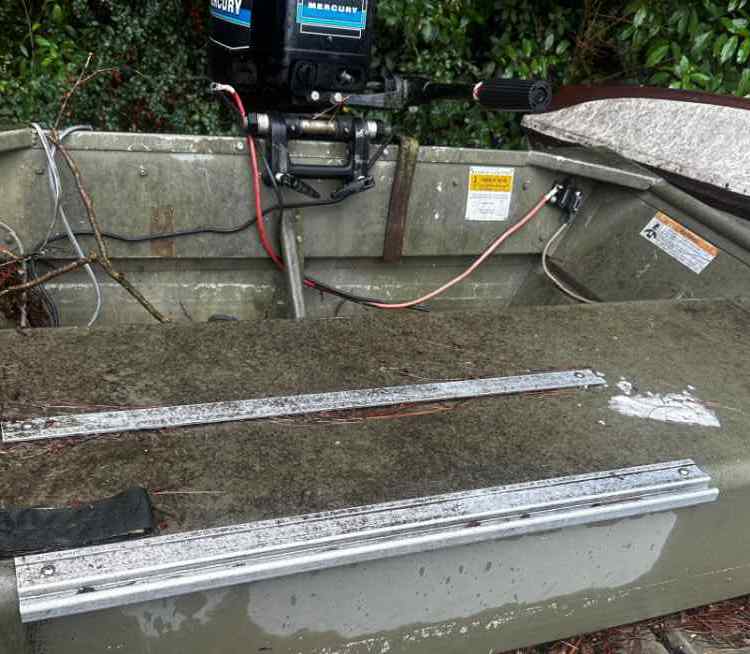
Catt, at least you get to use yours and keep it clean. Mine hasn't been off the trailer in two years, as you can tell from the picture. I used to take the motor off and flip it upside down on the trailer, but both the 9.9 and the 25 seem to have double in weight over the past couple of years, so I quit that. I do take the TM and electronics off and seats out and store them. I run the 25 in the lakes and 9.9 in the rivers and it's a job for this old man to change them these days. Some of the larger creeks and small rivers are so bad for laydowns, I use my 4hp on it for the smaller lower unit and less draft. Done got too old think about using the canoe in them.
-
I have a hard time with the tiller extension idea. First off, by the time you got it to where you wanted it, you would only have a few degrees of turning capability. I use one of these and just move my seat over. I'm 77 and have very limited movement of my neck and back so twisting around to operate the tiller is not an option for me either. Being able to offset the seat works great though. Please note, the one I've referenced is a 33", I don't think you will be happy with the shorter slides that some have. Also get a pivot base so you can turn the seat. Also note, I am left-handed so I offset mine to the right, you may want to go to the other side if you are right handed. Might notice another handy little thing I did. On the transom under the tiller handle you see a flat bar. That's a slide on bracket held by the spring tension in the steel I made to hold the transducer. Keeps from having to make holes below the water line to mount a bracket and keeps your transducer from getting knocked off. Amazon.com : Wise 8WD73 Sure Mount Seat Bracket Kit, 33", Aluminum : Boat Seating Accessories : Sports & Outdoors
-
A couple of things I find helpful. Have the trailer connected to the vehicle, that keeps the tongue from lifting when you don't want it to and the trailer rolling off the jack. Break the lugs loose before jacking it up. Placing the jack under the axle is not always that easy but if you can, that usually works best. Placing it under the frame can sometimes cause problems with being able to get it high enough for the tire to clear the ground. With the trailer connected to the vehicle, you can place the jack on the frame in front of the axle and that helps get a little more height. You can't do that if it's not connected to vehicle. I have never tried one, but on small single axle trailer one of those things you put on the axle that uses a cam action to lift the trailer might be handy. Actually, in over 60 years of hauling boats around, I've never had to jack a trailer up that was not in my yard/driveway, and there I usually try to use my roll around hydraulic floor jack. Sometimes that's not always possible because of where the trailer might be sitting, and that jack is heavy and hard to move around off a hard surface.
-
You have to figure, anyone wanting to steal something like a boat trailer and risk what's it's going to cost them if they got caught, can't overly developed in the brain department anyway. So, if you make it very complicated, they are not going to be able to figure it out or do thousands of dollars' worth of extra damage trying. A few years back, I bought a nice looking Mercedes SLK-230 for $500 scarp price because of how bad someone destroyed the dash trying to steal the radio out of it. A tow truck left it outside a shop (the shop was closed) where he dropped it off to have a no-start problem fixed. Between the cost of what they wanted to repair the no-start problem and the damage they did to the dash (and they still didn't get the radio out), it was twice what the car worth. The owner only had collision insurance, and both the shop and tow truck said they were not responsible.
-
A little tip, if you clean both sets of the threads with brake cleaner and put some Loctite Primer on them before putting on the Loctite Red, it most likely "AIN'T" coming off without some heat.
-
Locks mostly just keep the amateur honest. If a professional thief wants it, he usually has a method to get it. A few years ago, a friend got back to the ramp to find his tandem axle Ranger Trail gone. He had what was supposed to be high security locks on his receiver and the hitch, thinking it was safe. They just took the ball off, he welded the ball on after that.
-
You think you are an old man at "40"! All I can say is you have a hellavalot to learn about really getting to be an "Old Man". I didn't even consider myself getting old until my mid 60's but now my old body is paying me back for the hell I've put it through, "Big Time".
-
That much slow running, idling and fuel problems you were having, it may be getting a little carbon fouling. I suspect if you pull the plugs out and look at them, they are probably heavily carboned. I would suggest you do what's called a plug dump. You do that by running it at wide open throttle (WOT) for a few miles or about five minutes and then on the way back to the ramp cut the switch off at WOT. You want to avoid letting it idle. That's about the only way you can actually tell how the engine is running. Black plugs after a plug dump show things are not good. Now with that said, be careful doing that. It drops the bow of the boat hard into the water and may want to try doing a hard right turn. Make a couple of tests, first at about half throttle, quickly snatch it too neutral. If it does ok there, do it at 3/4 throttle, and if ok there, do that at full throttle. That will give you an idea of how the boat is going to respond, and if it tries to turn hard, you can quickly give it gas to stop it. You can't do that if you kill the engine. If it does not like you doing that, instead of killing the engine, get off plane as quick as you can safely and then cut it off, so it has minimal time to idle. Then before you run the engine again, pull the plugs and see what color they are. If the fuel/air mixture is right and everything is good, the plugs should be somewhat of a paper bag brown to light brown if it was not let idle. It only takes a short period of idling for a two stroke to blacken the plugs By the way, if someone that has a fairly fast boat that gets up on its pad with good bow lift and flies the hull at WOT, DO NOT TRY ANY OF THIS WITH THE MOTOR TRIMMED OUT, trim the motor down first so the hull is fully plowing the water, and still be very careful or you might get introduced to what is called a bat turn.