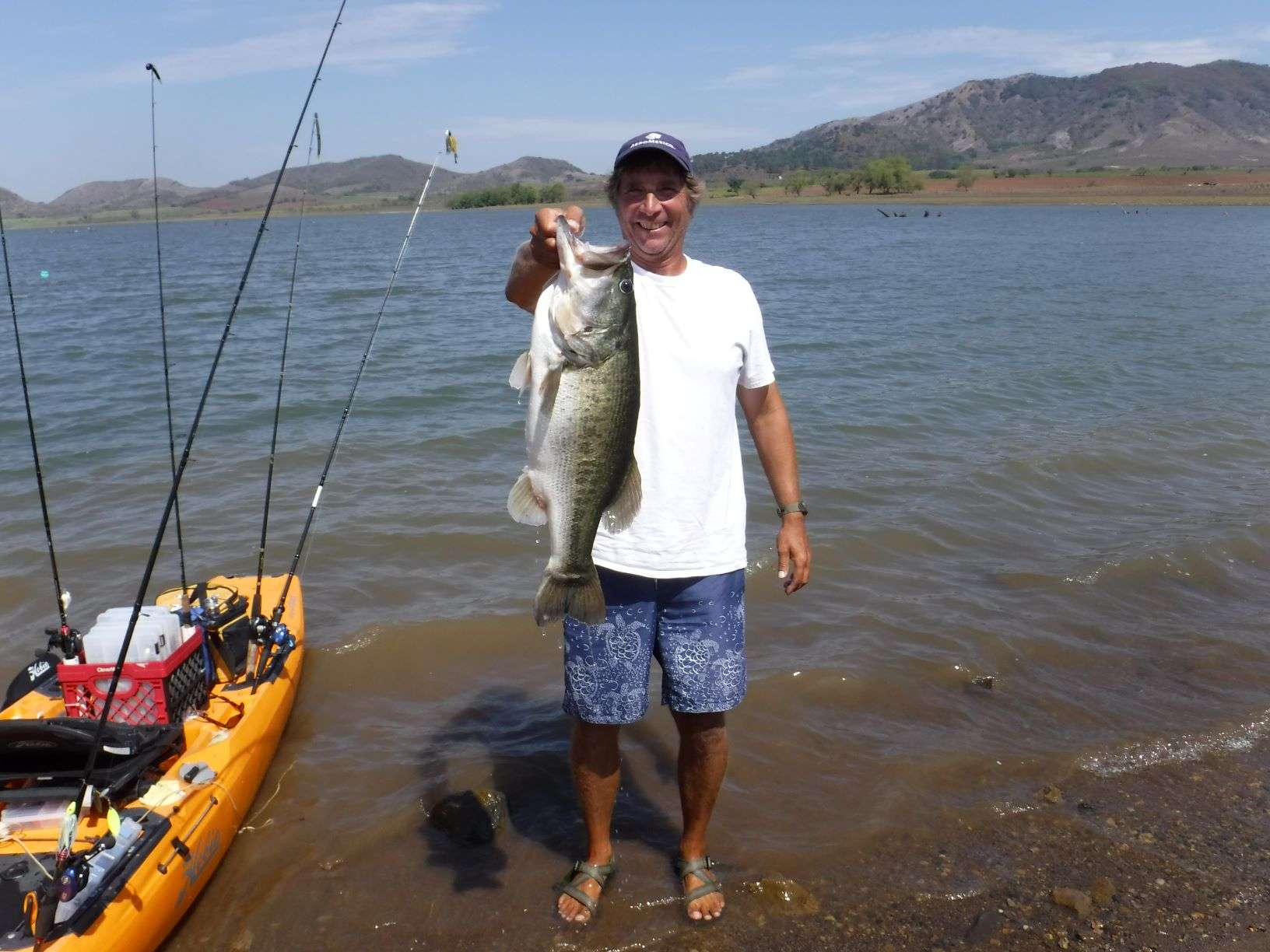

king fisher
Super User
-
Joined
-
Last visited
Everything posted by king fisher
-
I started using Blood Knot for line to line connections in the late 70's. I still do for making tapered fly leaders. Switched to Uni to Uni for braid to leader when super braids came out.. After 20 year using Uni to Uni for braid to leader, I switched to Alberto for light line, FG for heavy line. The Alberto has become as fast an easy for me to tie as Uni, to Uni or blood knot. FG takes more time. They have all worked well, and have all failed me at some time, that's fishing.
-
If you ever want to give Diawa another try, I highly recommend the Coastal 200. I have used mine 3- 5 days a week for almost a year. No Problems. Enough drag to land many different inshore species up to 30#. Should be able to horse the largest bass out of thick cover no problem. Most people can't handle 25 lbs. of drag using stand up gear for tuna.( some can handle 35 pounds, but not your average angler) Anything over 20 pounds most people will opt for using the rail or a chair. I can't imagine needing 20 pounds of drag for any bass fishing. I highly recommend getting a scale and setting a drag at 20 pounds just to see what it feels like. Not saying you are wrong, I haven't fished where you do, Just saying from my experience full drag 10 to 15 pounds has been enough drag for any bass fishing situation I have experienced. Every fisherman and fishery, has different requirements. I may be wrong, it wouldn't be the first time.
-
You are right. Not a Dalton Special. I guessed at Dalton Special, but after taking a closer look incorrect guess. Like you said different hooks, and front. Does any one have any idea on the middle lure? River Runt is different than the one I have, but mine is plastic. The one in the picture looks like an older wooden version. They might have changed the way the bill was attached and started using hook hangers when they changed to plastic.
-
Here is my guess. Top left. Bomber water dog. Similar to a hellbender but has a round lip. bottom left. --- original bomber. Middle top. --- Heddon River Runt knock off. River Runt lip was attached with screws and hooks were attached with hangers. Middle.---- No clue Middle bottom --- Dalton special Right top--- South Bend Nip I Dee- Dee Right Bottom --- Helin Flatfish. I have owned and landed bass on River Runt, Water Dog, Bomber, Nip I Dee-Dee, and Flat fish.
-
#1 Rebel Deep Wee R #2 Rapala DT 10 #3 Norman deep little N
-
At one time spinning reels had the disadvantage of only working with lighter line, and the drags were horrible. Any time you needed to use line over 12 pound test, or needed to fight a fish that made long runs you were at a big disadvantage using spinning gear. Now with excellent reels, and super braid line, there are no reel disadvantages of spinning reels. A skilled angler with a spinning rod can master almost any technique that can be done with a bait caster. I prefer bait casting reels for reasons other than their ability to catch fish. I simply feel more comfortable with a bait caster. I would recommend anglers become proficient with both. Each method does have advantages for each individual angler. Some anglers love to fineness fish with bait casters, and others like to fish crankbaits with spinning gear. You wont know what kind of angler you are if you don't try both. If you really want to make the bait monkey happy, add a fly rod to the mix.
-
I am also interested to hear what members think of the Coastal SV. I can't comment on the Coastal SV, but highly recommend the Coastal 200 it is the best reel I own. I use it for everything, punching, deep cranks, and in shore saltwater. I was going to purchase another Coastal 200 but now am also considering the coastal SV. $175 shipped is a great price. Where?
-
I have fished with bait casters for 40 years, and consider myself relatively proficient. My experience is mostly with older Ambassador 5500 and 6500 reels. I have always used light spool tension on all the my baitcasters. Relying on my thumb to avoid any backlash. Last year I bought my first Diawa, a TAT. CT. I thought I would be able to cast this reel well with the break set at 0 and light spool tension. I experienced some of the worst back lashes of my life. I soon learned that with that reel regardless of experience, I would have to use some of the magnetic brake system. I started with a 3/4 setting, and now usually use somewhere between 1/4 and 1/2 depending on what lure, wind, and how far I want to cast. I leave the spool tension set with a slight amount of play. The difference I have noticed with the TAT. CT. is the real wants to backlash very early in the cast. All of the other B.C. I have used, were prone to backlash from the middle to the end, when the lure starts to slow down. This has been my experience, I don't know if others feel the same. I now own a couple TAT CTs. and a Coastal 200 preferring them to my other reels. When I make long casts I instinctively lightly thumb the spool at the very start of the cast. I normally don't have to use my thumb again until the very end. With the proper break setting and my thumb adjusted to the differences of Diawa mag break system, I can cast longer than any other reels I have owned. Although not a fair comparison to other modern reals. because all my other B.C. are older Ambassadors, and other larger reels. Haven't tried any newer smaller Lews, or Shimanos. I'm sure I would be impressed with their performance too. If you are getting bad backlashes with high break settings, I would suspect something is wrong with the reel. On my reels It is almost impossible to backlash with the break set 3/4 to maximum. High break settings will significantly reduce distance.
-
When I don't catch fish it is because of a bad moon phase. When I catch fish, it is because I'm a great fishermen. A deck hand in Puerto Vallarta taught me that years ago. When I asked him how come one of the other boats did so well on a day when we didn't have catch anything, he laughed and said they must have had a different moon. I replied sounds good to me. The moon does matter, especially in tidal fisheries, but I feel that anytime I'm on the water there are fish willing to bite regardless of moon phase. I'ts my job to to find the fish and present the bait, or lure in the proper manner. When I fail at that task, of course it was because of the moon phase.
-
A general rule I have used for many years when buying or selling used sporting equipment. As long as the item being sold is in good condition, 50% of the cost of buying an item new, is a fair deal for both parties. When I pay more than 50% it is most likely the Bait Monkeys fault.
-
Punching mats with Skinny Dippers is the standard presentation with guides on Lake Chapala Mexico. I was stubborn and stuck to beaver style baits. Being stubborn is not a good personality trait for bass fishing. I learned my lesson, and the bait monkey is happy. I now have many different brands sizes and colors of swimbaits when I fish Chapala. The guides only use Skinny Dippers, and catch more fish than me, but they are not the bait monkeys good friend.
-
I believe pressure has a big effect on fish. 12 years ago I fished a river almost every day one summer that had a small population of small mouth bass. The river was heavily populated with suckers, northern pike minnows, and carp. There were not many bass but the ones that survived to adult hood were large and well fed. The river got extremely low, making it very easy to find the bass. There were only a few holes that were deep enough for the bass to live. Because of limited space to live there were few bass. The visibility was poor, but the best feeding and resting spots were easy to spot. All the land around the river was private, and I was fortunate to have access to most of it. Basically I was the only pressure these fish had. Most people didn't even know there were bass there. Even the land owners were surprised when I would tell them I caught bass. It would take me a few hours to work a section of river fishing from shore. Each section would have three to four fish-able holes. I would always catch 2 to 3 bass from 2 to 6 lbs. each, plus one or two small fish in each section. It was incredible fishing. Some days they preferred one lure over another, but because it was so obvious where the fish would hold, I would eventually find a lure and presentation that worked. If they didn't want one lure I would leave for awhile then come back and try another. If I didn't rest the spot, chances were slim that a different lure was going to work. If I gave it an hours rest, and made a good presentation on the first cast, I would usually get bit. After completely working a section of river over in a day, that section was shot. I would have to rest a hole for at least three days or longer in order to get bit. I tried many times going back after only a day or two, even using completely different lures. No luck. I was the only pressure, but that was enough to shut the fish off due to the limited number of fish and the confines of the water. Luckily I had access to many miles of river so it was easy to rotate the best spots. I wouldn't fish a place more than twice a weak. I can't say what pressure does to fish in other places, but I can say for sure that It had significant effect on the fish in that river in low water conditions. Best lures were inline spinners ( #3 Mepps or Vibrax), floating rapalas, Rebel craw dad, and buck tail jigs. Presentation was more important than what lure. Because of the current and depth, , inline spinners were the most versatile lure for making the best presentation. Inline spinners are good lures for pressured fish, but only good if the fish are just a few feet deep, and work best with current. Buck tail jigs work for me on pressured fish at any depth. As others have said, something different than what the fish have seen can make a big difference. Also matching the hatch is a great place to start. Fish something roughly the same size, shape, and color, with a presentation that imitates what the fish are eating. If that doesn't work try something that you are sure the fish have never seen. Many times something way larger, or way smaller than what others are fishing can work. I would try and fish a pressured pond at night, very early in the morning, or any time when it gets the least amount of pressure.
-
I captain a private boat, for a living. I fish for saltwater sport fish for work. I fish for bass for fun. Like most people, my work seems to get in the way of my fun. I grew up fishing for bass, and even though I didn't catch a bass for 20 years, I always tried to keep informed on techniques, and baits. For some reason I can't explain, bass have always been my favorite fish. I now live where I can fish for bass again, and am very happy.
-
When I was young and single I spent every dime I had on fishing and hunting gear. My car cost $500 and I owned fly rod and reel combos over $600. My home was a cabin with no plumbing, built for $8000 including the land. I had twice that much invested in my duck hunting gear. I fished or hunted almost every day of the year. The bait monkey not only had my phone number on speed dial, he lived with me for weeks at a time. Now I am older and married. I own Tatula CT for reels, and rods that retail around $100. I live in a house with indoor plumbing and the bait monkey only calls on Christmas or my birthday. I still have most of what I collected over the years, but rarely get to use most of it. I let a friend live in the cabin, and another one has adopted my duck hunting boat and gear. I wish I would have taken more pictures, but cherish all the great memories. I have never regretted buying an expensive rod or reel, but have always enjoyed fishing with what ever gear I have. I would never choose nice gear over my families needs, but do sometimes miss the days, when the bait monkey and I would get a six pack and look through the new Cabelas Catalog. No one needs expensive gear to catch fish, but fishing is rarely about what a person needs. I say buy what you want and can afford, and use it as often as you can.
-
You do make a good point about car safety, but not exactly a perfect comparison. You didn't factor in the fact that social distancing will end and life will get back to the same risk level, as before the pandemic. If by driving 15 mph and wearing helmets for a couple months would significantly keep automobile fatalities down even after you start driving 70 mph and quite wearing the helmets. Then it would be an accurate comparison. Social distancing now might help make life normal in the future. Auto restrictions ( helmets roll cages etd.) would only save lives as long as the restrictions were in effect. Once they were lifted and people quit wearing helmets etc. the accident rate would go back to what it was. I'm not saying you are wrong, that life always has risks and people should be free to ***** those risks , just that there is many ways of looking at the situation. I do miss fishing, as well as other hobbies I'm not able to do now, but am looking forward to a future where I can.
-
Straight braid advantages. Extremely strong for diameter, largest capacity for line strength. Last forever ( Cheap in the long run) No stretch, big plus for some applications ( very sensitive) Floats. advantage for some applications. Casts well from spinning reals less tangles.( does not tangle do to line twist). No Memory Straight braid disadvantages. More visible Expensive ( original purchase) Noisy Difficult to break off of snags, can cause line cuts in hands More difficult to untangle, ( my opinion) No line stretch. ( Disadvantage in many situations). Poor abrasion resistance to rocks Can not be cut with teeth or pliers. ( Big disadvantage when in a hurry or helping other anglers) Straight floro advantage Good sensitivity Less visibility Sinks( advantage in many applications) Thinner diameter for lbs. test compared to mono Straight floro disadvantages Expensive Stiff ( does not cast well off of spinning reals, many recommend line conditioner) Will break if previously kinked, or back lashed. ( when you least expect it) Sinks. ( disadvantage depending on technique used) Poor knot strength. Braid to leader advantages. Can get benefits of both line types. Only have to change the last couple of feet when wanting to switch to different line. Braid to leader disadvantages Extra knot ( leading to one more thing to go wrong) Extra knot ( catching in line guide or level wind) Can combine disadvantages of both instead of advantages of both in some situations. I use braid to leader on spinning reels. Straight braid on bait casters when flipping pitching or fishing some top water lures. Straight mono or floro on bait casters most of the time. . Will use mono over floro most of the time with both leaders and main line.
-
Palamar is a great knot, but can be more difficult with large treble hook lures. I use it for hooks, jigs, and small lures. I prefer some form of a uni, over any version of clinch knot. A knot will always be the weakest link, use which ever one you can easily tie to the lure you are using. I have tried every knot that I have been able to learn, from friends, books or videos. I learn new knots whenever I can. I have many favorites for different weights and type of line. I still haven't found one that hasn't failed me at some time. A Polamar or improved clinch tied correctly will most likely land any fish you hook.
-
My apologies, I should proof read my posts. Poor Grammar and confusing content made for a poor question. What I was trying to ask is weather bass prefer a weak injured or wounded bait over a healthy one. I don't know how many times I have read that sport fish eat weaker or injured bait over healthy ones. My experience with other sport fish would seem to suggest the exact opposite. Although most lures look to me like they represent wounded prey,( I can't say how it appears to the fish). When I fish live bait for most sport fish, the strongest healthy baits are the ones that get hit. Slow injured bait have to be changed out for healthy lively bait in order to get strikes. Why don't the fish take advantage of the slower, easier to catch bait? I have not fished live bait for bass and was interested if bass react to live bait in the same way.
-
Does any one here have experience fishing live fish for bass? I have not fished, or plan on fishing live bait fish for bass. I'm curious as to the reaction bass have to live bait fish, and how to present them. I have heard over and over that bass like to eat injured bait fish. Every species of fish that I have fished live bait to seem to be the exact opposite. When a bait stars to get week, slows down, or just looks like it is half dead, most sport fish I have fished for wont hit a bait in poor condition. I have found the most important quality of a good live bait is to be extremely healthy. I can't count the times I have had a bait start to get weak, reel it in replace with a fresh one and get hit. Are bass different? Do you want your bait to swim like it is about to die? Would be interested to hear readers experiences.
-
DT 10 is by far my favorite crankbait. I haven't tried all the other medium diving crankbaits out there, but the list is long. The bills do come off. Every once in awhile I will cast out, then half way back all I have is a bill. I don't slap the lure on the water, or abuse them in any way. I have some that I have crashed in to rocks triggering violent strikes for years with no problems. Others have broken after just a few casts. Luckily I have never lost a fish because the bill came out. I will continue to use them because they catch fish for me. I see they are on the best seller list at Tackle Wharehouse. I guess Rapala doesn't feel they need to make them more durable. I'ts not like they are afraid of changing a good thing, ( Wiggle Warts). Why not try improving the DT?
-
When I was growing up in Eastern WA there was very little bass tackle available. All the tackle shops, had trout and Salmon lures. One tackle shop did stock one spinner bait. It was the Shannon twin spin. Mine had a red buck tail skirt. It didn't cast very well, but caught lots of fish. It worked great with the blades just breaking the surface. When I got my first Bass Pro Shop catalogue I ordered a couple single armed spinner baits after that I didn't use the twin spin very often. I would still use the Shannon on the surface because it would not turn on its side when retrieved fast. Then I bought a Burke Deadly Duddly, my first buzz bait. and the Shannon twin spin was retired. I might still have it somewhere, will have to look for it some time.
-
Clinch knot with line doubled for braid up to 65 lbs. Bimini twist with cats paw for braid over 65 lbs. Alberto for braid to leader when the leader is 40 lbs. or less. Double Uni if braid and leader are close to the same diameter. FG knot for braid to leader when the leader is over 40 lb. Palamar for mono or floro 8lbs. to 20lbs. San Diego Jam for mono or floro 20 lbs. to 100 lbs. Crimp over 100 lbs. Orvis knot for mono or floro under 8 lbs. Double Uni for mono to mono or double nail knot if I have nail knot tool and time Double Uni for braid to braid or double nail knot if I have nail knot tool and time. Splice hollow braid to braid, or hollow braid to leader.
-
I have anchored and fished the steeper drops on the points. The biggest frustration has been catching small bass less than a pound everywhere, with every technique. Deep, shallow, fast or slow, doesn't seem to matter much. The few bass over a pound have all been in random places on different lures with different presentations. I'm sure it isn't random I just don't see the pattern. I'm sure there are others that would easily see the similarities. That is the difference between an average fisherman and a great one. It will be awhile before I can go back. I plan on fishing Hula grubs with either 1/4 ounce ball head jigs, which I have plenty of or Texas rigged if I snag up to much. I fished the Hula grubs the last time I was there, but mostly on the shoreline because of the strong wind. I will start in deeper water in the morning before the wind starts up. The closest thing to a normal bass jig I have is bullet weights with punch skirts, and many different creature baits for trailers. I did try these is deeper water but probably gave up on them to soon. I wont be able to buy any other jigs because of the difficulty in getting things shipped from the states right now. I do have salt water jigs, that I could put a skirt on but will probably get snagged often. I have lots of different styles of spinner baits, and many hard baits, but from the advice I get here I need to slow down and fish jigs. I'm sure it is good advice and what I will do. I did spend a decent amount of time slow rolling different spinner baits which is one of my favorite techniques but only caught baby bass, that will hit anything everywhere. I have lots of large surface and subsurface lures I use in salt water. I thought maybe I should just try them and cover lots of water looking for bigger fish. I will fish slow on the bottom until the wind picks up and then maybe try some of the bigger lures. Once I am able to order from the states again, I am thinking about getting a couple big swim baits and a large Rat or should I just stick with normal size lures and work more on determining where the large fish live? I will eventually get a fish finder for my Kayak but for now All I can do is troll deep diving crank baits to try and find off shore structure. I have found a couple of spots this way but only landed more baby bass. It is exciting to be exploring a fishery with no pressure, and potential for big fish,but frustrating when I have no body to compare notes with. When I no longer have to practice social distancing I will talk to the local Tilapia fisherman. I'm sure they will be a wealth of knowledge. Until then advice here is my best bet. Thanks
-
Thanks, I will have to try and locate some Super Flukes. Was going to fish the lake again tomorrow, but they have new restrictions in place. I'm afraid it will be awhile before I can try again. I'm hoping that when summer comes the bass will not be so spread out, and I will be able to establish a pattern for larger fish.
-
I don't think the line color would matter. The least visible line when looking up is white, or light blue. The darker colored lines are more visible on the surface. I confirmed this theory myself in a swimming pool while testing line visibility to settle a bet. Dark green can be less visible than other colors looking down in darker colored water. That said, I can't imagine any color would make a difference frog fishing for bass. Clear fluorocarbon is less visible than clear mono, but not by as much as line manufactures try to make you believe. Of course this is from my observation, I have no clue what a fish can see.