




Brad in Texas
Members
-
Joined
-
Last visited
Everything posted by Brad in Texas
-
I see different explanations. I'd only add that thrust and top-end speed aren't the same. Your original question regarded increasing top speed. Imagine two 300 lbs. offensive linemen together pushing a loaded Kroger grocery cart across a flat parking lot. Each man, while very powerful, has a top running speed of 18 miles an hour. No, two of them collectively pushing on a single chart will not make it go 36 mph. No. Top end speed will essentially be, for two men, what it'd be for one. But, these two big men "could" overcome the inertia of, say, a cart loaded down with 1000 lbs. of barbell plates. Here, more "power" would make a huge difference. So, two 80s aren't likely to net you much top speed increase. It would certainly increase thrust, power going from a dead stop up top speed. A single 112 lbs. TM might net you more top speed . . . but it'll depend on its design characteristics. Brad
-
This sounds correct to me, that the tip guide is the one area that will be exposed to more "gunk" and even the tiny friction from a junction knot passing through it both directions. Too, the occasional over-reeled-in lure banging against it. That little "relatively" soft tip area takes its hits, for sure. And, while it can withstand the pressure of a really large fish yanking on it, the magic of it passing its tension down deeper into the stiffer sections of the rod, we could literally reach up a break the tip off with very little effort gripping it and bending it. Brad
-
Aaron Martens once mentioned fishing with two buddies from a boat. One guy was catching them better than Aaron and the other friend. Martens finally determined that his friend had wacky-rigged a worm with an ever-so-slight offset, not dead center. It moderated the drop rate from between a wacky rig and, say, a weightless T-Rig. That is what they wanted that day at that time. So, I think of a wacky rig, on a weightless hook, Senko rigged "balanced" as being the slowest of all fall rates. And, the T-Rig version, also weightless, as being the fastest of the weightless presentations. And, you can make both of them faster by adding a weight, for sure. Senkos, and several others, will "shimmy" down wacky-rigged and that action often attracts fish. And, at least a fair number of bass anglers believe bass are attracted to baits that hold horizontal positions as they hold or fall through the water column. You never really know how fish want it until you give it a go. Brad
-
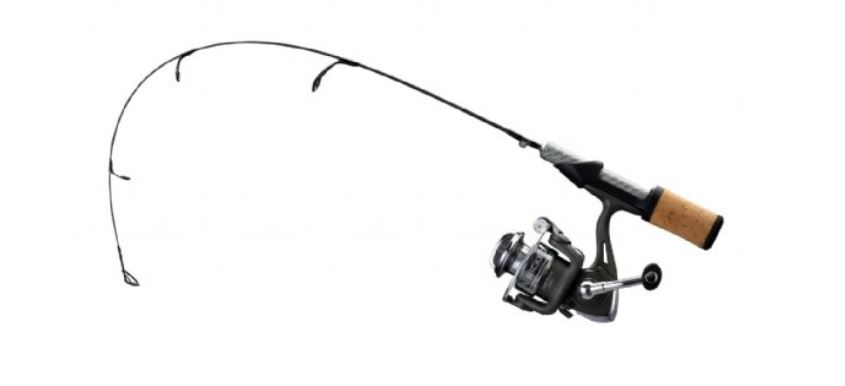
For sure! We all have these different experiences with gear and it is hard to say what the factors are leading to success or failure with them. I think my main point was that a rod tip is not a particularly vulnerable place as loading on a rod increases from reeling and lifting against big strong/heavy fish. A properly tapered and engineered rod creates a shorter and shorter lever as it loads up. The lifting point moves farther away from the tip. So, as in that little attached illustration, a whole lot of the tip isn't even bent, is under no pressure at all. I'm not even sure if the line is making anything more than casual contact with the rod tip area in these circumstances. It is, though, for sure under pressure up on or around the two guides on each side of where the rod is actually stressed. When rods explode, I think most people think the tip is the area most likely to break but it usually occurs much farther up the rod. One common way to see a rod snap rather high is when someone swings a too large fish over the gunwales and has the rod pointed up rather vertically. This prevents the load from transferring down the rod, the tip section bears the weight. Pop! Snap! Brad
-
Tips aren't typically the focal point of operational pressure. If you look at a rod under a heavy load where it is bent back toward its intended or targeted lifting point, the tip itself will be rather straight. See attached illustration. Rod tips DO break but I think when it occurs there, it is because they are easily damaged in transport, lying on boat decks, stepped on, etc. They can get nicked up and it go unnoticed. But, we'd never catch a fish of any size without breaking a rod if not for the fact that the forces on it are passed along to stronger and stronger sections. Brad
-
But, just from habit really, right? Take for example a guitar. For a right hander, it is strummed or picked with the right hand or fingers, the dominant hand; but, they make all of the endless intricate chord shapes and manage complex lead guitar "runs" . . . with their left hands moving up and down the whole neck of the instrument. If all of that can be done, spinning a reel handle is no big deal. I think it is just a tough habit to break. I'm like others so surprised the industry/its anglers haven't moved away from the way Zebco spincast reels were made a half century or more ago. Lefties are almost always a bit more ambidextrous by nature. They face zippers/buttons/butter knives and so much more every day. Odd that reels just happen to play into our favor with the switchable handles on one and the dominant right side reel on the other. Rare! Just a guess that after one season, most righties would prefer left handed reeling for both spinning and casting gear. Brad
-
So many good responses. I'd only add that line peels off of larger reel spools a bit easier and faster so it generally would be indicated for longer casting "potential." And, when you consider the play between a rod and its reel, that perfect balance, remember that when you are fishing, for most presentations you'll have some tension on the line so that offsets a heavier reel somewhat. Balancing a rod and reel on one's finger to determine a good balance is hardly the position we will find ourselves in on the water with line out. I totally agree on line size. For most presentations that are specific to spinning tackle, where it really shines, I don't want to give away that advantage by having a line above around 8 lbs. test (mono or fluoro) leader or main line. Yes, you can use a larger braid main line. Sufix Nanobraid 14 lbs. test is the same diameter as its Sufix 832 (another great braid) in 10 lbs. That's a lot of line strength for most finesse applications, more than enough. *** Casting reels are coming! Keep watching as I suspect we'll see more and more of these capable of throwing very light presentations within a decade. Brad
-
For spinning gear, there is definitely a technically correct way to operate it. Few do based on my observations. Whatever hand you split your fingers with around the reel post, that hand should never move. It should stay there . . . all day long. You use your off hand for longer casts by employing it down on the rod's handle, and it is also used to flip the bail, work the drag tension knob, flip the anti-reverse mechanism . . . and reel in line. Some people also use it to feather the line to slow down line release to shorten a cast but most do this with their rod-holding hand just sticking a finger up on the edge of the reel spool. I think there'd be a small advantage for a rightie to using left hand reels of both sorts, spinning and casting. But, in sports, we see a few different combinations. In baseball, we almost always throw with our dominant hands, catch with our off-hands. But, in golf, it is actually the left side of the body and the left arm and hand that are the power source for a swing, the right hand is more for guiding the club head. Go figure. I use right handed reels in both cases and it is one of the few times where I feel fortunate to be left handed! Brad
-
I can't even imagine using casting reels for a light drop shot presentation. I like to "pitch" mine since I am almost always fishing from a kayak. I can pitch them a very long way and doing so, at least for say < 50', keeps the weight from orbiting around the hook as much as an overhanded cast. But, if I was going to use a casting reel, I'd recommend something light and small. A Shimano Casitas handles light lines and small presentations really well for around $99. I'd go ML for a rod for such circumstances if it rated for the lure weight you'd be using most of the time. Brad
-
If you are throwing a presentation where it ends up on bottom, let's say a T-Rigged worm, a wacky-rigged worm, a drop shot rig, and if you catch your first fish immediately either in the process of it dropping through the water column (before it even hits bottom) or within seconds after it hits bottom, then fish fast, reel it in and cast/pitch or flip to different places to increase the number of presentations the way they like it that day at that time. If the fish are not biting it on the fall or immediately on touch-down, then slow way down, wiggle it, move it back slowly, really soak your bait. It is usually one or the other: you either want your presentation to "drop" really often and repeatedly . . . or soak really long. Brad
-
Bob, no offense taken. I was struggling for some sort of an analogy. So, when a reel is is the traditional position with the handles at the side, horizontal spool, the "weight" of the spool and its line and shaft is "supported" by the bearings on each side of the spool. This weight is pressing down on the inside of these bearings at the 6:00 position. Gravity. But, when one turns the reel so that the spool shaft is now vertical, it is no longer resting what little weight it is carrying directly on these bearings; it is offset 90 degrees to the bearings. The effects of gravity are aligned with long axis of the spool, just passing through the bearings, but not resting on them. Interestingly, the gravity on the "now" vertical spool might not be supported by the two bearings, but it is supported by "something." For there to be any net pick-up in casting distance, it'd have to have less friction than the shaft on the two bearings. Marginal, I'd think. Brad
-
For kayak fishing where we are often seated and low to the water, I LOVE using a 5'6" St. Croix Medium Power spinning rod for pitching finesse presentations up to about 75 or so feet. I can hit spots that are hard to get to with a 7 footer. The power you can generate, too, is greater with a shorter rod as your lifting point is closer to your hands. So, the power equation with the fish is actually better. I have a 6' MH spinning rod, too, and a short casting rod. I use them all. For making long casts, of course, this is when the additional length comes in handy. The leverage shifts in the other direction. Note that the Bass pros are now permitted to use up to a 10 ft. (I think???) rod. Let's see what happens when a power bass angler like Kevin VanDam can suddenly make casts that cover another 20 or 30 feet of water. For lakes where power fishing dominates, these super long rods will change results in tournaments I think. Brad
-
I doubt it amounts to much advantage . . . but I think I can explain the "physics" behind Rick Clunn's statement. Not that he couldn't, or wouldn't, but the format didn't lend itself to a lengthy discussion. So, a baitcaster generally has two spool bearings on each side of the spool itself. And, the spool has a shaft. Bearings do just that, they support and bear the shaft carrying the weight of the spool, itself, and the line. In a "spool horizontal, thumb to the side" sort of standard overhand cast, both bearings support this weight equally, divide the load. But, when the spool is turned to a vertical orientation, handles now up, the weight has been removed from the two bearings since the weight has been shifted 90 degrees. About the only analogy I can make would be a boat trailer. It has an axle instead of a shaft, opposing wheels (2 or more) and tires, and there is a lot of load on the wheel bearings. They are "bearing" the weight. If you pushed on the top side of one of the tires under just the load of an empty trailer, you could roll the trailer and turn the wheel and tire doing it. But, if the trailer was turned on its side with both sides' wheels and tires off the ground, you could spin a tire much easier. The load and a ton of friction have been removed from the bearings. So, that's my take, old recollections of studying such things earning a college degree minor in Physics all the way back in 1974! Ha! Brad
-
-
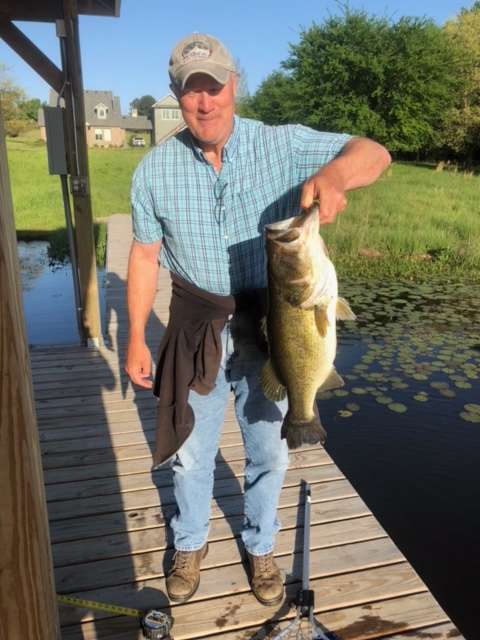
No, we photographed her several different ways for TPWD and the ShareLunker Program and submitted it just on her length (=> 24"). TPWD (Texas Parks and Wildlife Dept.) has a "length to weight" chart and it indicated that, on average, a 25.5" bass weighs 10.40 lbs. Funny, that was just about what Reagan and I thought she'd weigh before we checked the chart. Too bad she was spawned out. I'd suppose she might have weighed a pound or so more if not. A fish of the exact same length was captured (TPWD was electro-shocking for reports, I believe) at Marine Creek in Fort Worth yesterday, she had a belly full of eggs . . . and weighed 11+. At 13+, and between 01-01 and 03-31 each year, you can "donate" your fish to TPWD and they use them to breed big bass. But, they lose a lot of them, I think over 50% die. I'd rather have a photo and let them swim off for a few more productive years building bass the old fashion way! Brad
-
Well, there are some variables here that still make it dubious. First, was your experience that the angler with what we consider to be a more invisible line was the one always catching more fish? The second would be if two of you were sitting in a boat, both with a "fair" coin, flipped it 10X, would you expect the same outcome? Nothing is less different than flipping a fair coin. That is always the issue, that we can never be absolutely certain what would have happened in the other case. And, there should be no expectation of a similar outcome even if two guys are standing shoulder to shoulder and fishing. One might be dropping straight down on fish, the other a few feet away. It makes it all the more mysterious. And, still, you are correct that if you make an observation that repeats over and over, you have to consider it. Brad
-
And, other than true issues like floating versus sinking rates, shock absorption, etc., it hasn't been that long since most of us fished straight monofilament. Nylon lines were a huge step forward, held on and dominated for decades. Then, the "others" appeared. But, monofilament lines in "clear" spools were essentially invisible. But, leaders have been around for a very long time using very tough materials, heck wire, for catching toothy critters in salt water, so it was inevitable that we'd see leader usage expand once multiple line materials appeared and became commonplace. My guess is fluorocarbon lines would have disappeared from every shelf in America in, what, about 15 minutes after someone first tried to fish it with a whole spool of it on their reels. Especially the first fluorocarbon lines. Other "benefits" had to be sold and one of them is its refractive index being close to that of water, that it was even more invisible in water than clear monofilaments. It is, but to what end? And, is it sort of over-sold to us? I think so. So, still to this day, a lot of us use fluorocarbon as short leaders on braid mainlines. For sure, some use it as mainlines. I use a braid to fluorocarbon leader on my spinning tackle for better performance (on my end) and a more natural looking presentation (on the fish's end). The pros will often comment, Aaron Martens comes to mind, that he used an 8 lbs. fluoro leader on day 1 of a tournament, that he dropped to 6 lbs. the next day because fishing was tough, the bite slow. He was admitting that he wanted the 8 for its strength, less chance of losing a fish, that he dropped to 6 not so much regarding line visibility, both 6 and 8 are, after all, invisible, but to further influence the natural action of his presentation. Here, it does make a difference. That little worm floating around on a hook looks more natural on really light lines. Other than that, I'm like most here and I don't think most fish, certainly not bass, really much care about line visibility, it is never much for any line in typical water tints, and you could fish straight braid or mono or fluoro with similar results depending on the effects of each on presentations. Brad
-
Great information here. One technical point: There is a difference between elasticity and plasticity. Traditional monofilament lines are more elastic usually. The most elastic line I have ever used? the Red Cajun line reeled up on many Zebcos. That stuff stretches a mile. Back to elasticity. This would be analogous to a rubber band where after it is stretched, it retreats to its original length. It can be stretched over and over . . .though it does weaken by repeated stretching and it definitely is weaker when it absorbs water. Plasticity? Something that can be elongated, has some rebound back to its normal length, but its structure changes after a stretch. Think, here, of something like a stick of juicy fruit gum. You can pull on each end of it, it'll stretch, but it never returns to its original length. According to some really good testing over on TackleTour, fluorocarbons stretch about the same as monofilaments, I recall this surprised the testers, but only on the initial tug. I'm sure, just like the stretchy red line I mentioned, there are examples of lines that have very high plasticity characteristics, others that are somewhere in-between the extremes. *** For mono, I am a fan of Sufix Elite, use it on a reel or two. Brad
-
So many great ideas. I'd only add to these by mentioning to you to . . . slowing down is always a good idea. Although many of your bites will occur on the drop itself or just after it hits bottom, just let it sit there for a while first. Once you are sure no fish is eyeing it for dinner, it is time to work it back in with either a finesse technique (hopping it, etc.) or a slow to fast reeling depending on time of year, etc. I do better with the former than the latter. On your hook-set, bass will often hold that worm a lot longer than people think. Be sure it has it, be willing to adjust your timing (delayed or fast) on your hook-set depending on conditions. And, some days a hard set works best, other days a simple rod sweep gets it done. Brad
-
1. Drop shot rigged with a Rebarb hook and a T-Rigged Roboworm or with a wacky presentation using an Owner hook; 2. A 3/0 60 degree bend hook with an Owner CPS (medium size) rigged with a 4 or 5" Keitech Swimbait, either a Shad Impact or Easy Shiner; 3. SPRO topwater frog.
-
This and sully420's comment about rods. Both make sense to me. A parabolic bend and/or the proper power rating for a rod go a long way. I think so often the tendency is to get a power rating one more than we actually need. Rods seem to get longer and longer, and heavier and heavier actions, rod offerings are often dominated by fast tips. A rod needs to load up and stay that way to keep a fish pinned, to give the angler the best shot to land it. Let a rod straighten out and you have problems. The other benefit of a notch lighter power or a deeper bend? It gives you more, not less, power over a fish as the lifting point moves back closer to your hands. It seems we often use rods we could land tuna with. Brad
-
Interesting! I don't fish chatterbaits often enough to have a personal experience, a statistic to share. But, I do know that when big bass jump and shake a lure off, if the weight of the thing is tight to the hook, it gives them leverage to do so. If, in the case of a plastic bait, say a Senko, that slides down and away from the hook, they have much less leverage. One or more of the experienced chatterbait operators will likely chime in so we can know if this is an issue for them or not. *** Some experienced anglers modify certain lures so the body separates on a hook-up just for the purpose of robbing a fish of this leverage. I know Bill Wilcox of YouTube Honey Hole fame , some tv coverage, too, showed how he runs the line through a hard bait and rigs one up this way. I don't think this sort of modification would work for a chatterbait. Brad
-
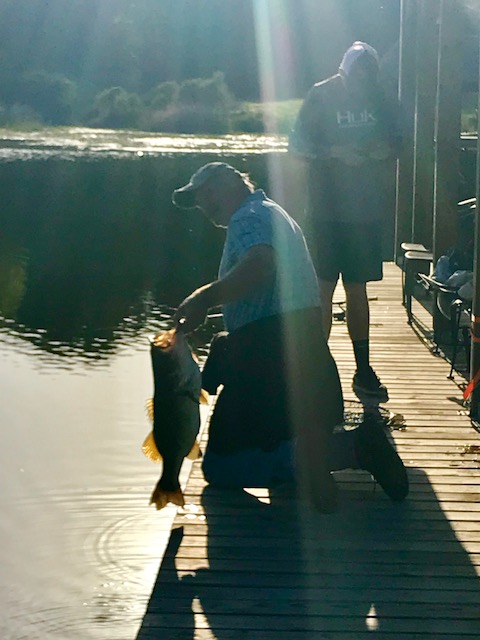
A 4+, a 3+, and a 2+ yesterday on around 20 total casts off my boathouse, so this afternoon I went down again and gave the same tackle and lure a go. On my 3rd cast to a vegetation line on a point, I caught this, a 25.5" LMB. Gear? a 7' St. Croix Medium powered, F, spinning rod, a 3000 Stradic Ci4+, 10 lbs. Sufix braid to an 8 lbs. Seaguar Invizx leader. The lure was a 3/0 60 degree bend jig hook with an Owner centering pin (CPS medium size) used to nose screw a Keitech 4" Shad Impact and T-Rigged from there. I had to be very careful playing the big girl, bringing her in. Photos, measurements, and off she swam to have more babies. She looked totally spawned out but healthy. Brad
-
Great ideas shared already. Once you do get your kayak, remember that you can now use it to pedal or paddle over to remote banks not accessible to people on foot; and, you can actually beach your kayak (on an island, a sand bar, a long isolated bank), get out and fish the bank, stretch your legs. This is an especially good trick on slightly windy days. Instead of fighting the wind for position, hop out. I have always loved bank fishing, make it out often just this way, leave my kayaks at home. Brad
-
Well, no, the originator of the concept of pattern fishing is attributed to fishing great and legend, Roland Martin, all the way back to 1969. In one article on Martin's concept, it reads: "A "pattern" is the exact set of water conditions such as depth, cover, structure, temperature, clarity, currents, etc., which have produced bass at similar locations all over the same body of water. It was first defined by the legendary Roland Martin in 1969." So, here, pattern just refers to the spot alone, nothing at all about being limited to a single lure or presentation once you are on that spot ("pattern"). I think I recall Martin covering patterns in a seminar and he said that if they are biting on a lake on, say, windy points, 5 feet deep, holding tight to structure, at a certain water temperature . . . that he interpreted that as a "pattern" that would be holding fish at similar conditions . . . all over the lake. Once the pattern was found, he'd surely throw whatever it took that got them to bite. But, Martin fishing a pattern meant that he fished a particular place, reproduced it all over a lake, not a particular presentation or lure. Tough to define, no doubt. Swindle's contemporary definition and approach to junk fishing, for example, is totally different than Iaconelli's and others. Brad
