


Big Hands
Members
-
Joined
-
Last visited
Everything posted by Big Hands
-
Touche!
-
In a general sense, I agree. But when you get to the point of pushing the performance boundaries of the system, casting light and/or bulky baits into the wind for example, the reel becomes more than just something to hold the line. And, sometimes, as you say, the reel just needs to hold the line. I have had instances of repeatedly casting a spinnerbait with the wind several times, and then turn and throw it into the wind as I pass by the target . . . . . Insert the sound of the sad trombone here ? Sometimes the only way to know where the limits are is to exceed them, and with the cost to fill a reel these days, that can be very costly.
-
I truly enjoyed it for almost 20 years and I became a ref before I ever coached. I eventually became a 'coach administrator' too, and was responsible for teaching new coaches how to to coach. Also enjoyed it enough to transition to teaching as a full time occupation. Now, I teach inmates how to use computers and use the same principles there. Only problem with coaching soccer again would be that it wouldn't allow me much time to fish. . . . and I'm not able to move like I used to, LOL.
-
After teaching my daughter to cast a spinning reel and a baitcaster this past year, this is exactly what I came here to say. Novices are a little reluctant to load up a fast action rod and cast it fast enough to get it right. A slower action makes it easier for them to learn. One of the techniques I was taught to use when teaching kids to execute soccer skills was to start with the simplest of actions, and doing it in essentially slow motion. Have them practice just that until they can do it well and consistently. Then introduce a 'complication', just a small one, and only one. At first, technique will break down, but again, with practice (perfect practice, not just practice by itself), the correct technique and consistency will return. . . . . And then it is time to introduce another 'complication'. Eventually, they would get to match speed with someone right in their grill and be able to execute consistently. In soccer, most of the complications would be speed, space, or opposition related. But no matter what you are teaching, the methodology works the same way. Start out casting practice in the best, easiest conditions. The easiest line type and size. With the wind. Maybe use a casting plug that weighs half an ounce. Use a rod with a relatively slow action. Tighten up the bearing tension and braking controls. Practice with all of those complications in the beginners favor. Once they get it consistently right, adjust one of the complications. Technique will once again breakdown at first, and then come back. Adjust another complication. . . . Lather, rinse, repeat. When they get pretty good with the moderate action rod in 'match conditions', then they'll be ready to move to a faster action rod and deal with that complication much easier and with more confidence than if you just throw them to the wolves. How many of know someone that tried a baitcaster, got some nasty backlashes, and put them down for a long time, or even for good? I know that I've known a few.
-
Based on the information at hand: For a lot of pond fishing from the bank, I think I would add a spinning rod that would be a medium power fast action rod that is at least 7' and maybe up around 7'4" to 7'7" so you can launch some of those finesse type baits at long distance targets . . . . if you have room to cast them without trees and bushes posing a problem. That can also let you have two different finesse rigs at the ready without having to re-rig to fish in ways that you use often enough that it would be a PITA to have to retie back and forth. Example: ned rig and a dropshot rig.
-
If you think technology like LiveScope isn't a huge advantage in many situations to anglers that know how to use them, I would have to disagree to say the least. Of course, having it and not knowing how to use it effectively won't help you. The instant feedback and pinpoint accuracy they provide to targets that you cast to (not right under your boat) is proving deadly. You can actually see in real time how they are reacting to your bait presented up to 100' out in front of your boat (where fish used to feel relatively safe). That gives incredible feedback as to how they react to both your lure and your presentation. This means that the learning curve regarding what is working and what isn't, is cut drastically if you can use this technology to it's full potential. I think the fish that survive will adapt to some degree, but I think regulatory agencies will have to react in some way if a decline in fish populations can be linked to the successful increased use of such technology. Even if it can't be linked, they may have to do something to keep fisheries viable. My guess is that the reaction will be to decrease limits and/or adjust size requirements.
-
Too much money in it for tournament organizations to outlaw it IMHO. It's not like an a-rig in that respect. Sponsorship money pays a lot of bills, and fish finding tech is red hot. If I was feeding my family tournament fishing, and the organization cut off a big supply of dollars, I'd probably follow the money. IMHO, this has little to do with what's right or wrong, just simple economics. If anything, I see limits being altered before banning electronics. I don't see how crappie especially can survive with bag limits at 25 per angler in many places, and not a lot of C&R that I know of.
-
Good times!
-
It seemed like it was always a race to see if you could get on a spot in there in the spring. I caught my PB in there too, but on the west bank right on the corner of the cut on that side. That wrist wrecker pistol grip definitely dates this photo. Glad we don't use those anymore.
-
I don't know. The few times I met him, he never offered, and I never thought to ask.
-
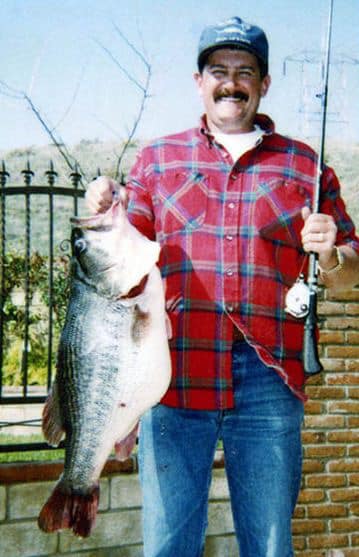
On this day in 1990, Bob Crupi pulled this 21 pound behemoth from Castaic Lake using a live crawdad for bait. About a year later, he caught a 22 pounder from the same lake. Note: Is it me, or does he have some tiny hands for a grown man, LOL.
-
It's interesting to see the feedback here on Smackdown braid. I have only used it on one of my baitcasters (30# - Stealth Gray) and I intend to use it on others going forward instead of whatever they have on there now. I have tried Power Pro, J-Braid 8, and Sunline SX1 among others and the Smackdown has performed the best IMHO. I can really lay into it with the baitcaster and get a lot of distance with almost no issues. It is generally easily controlled with a little thumb action in the rare instance I need to use it. I just dab my thumb on it as it strikes the water and that's it. I've not tried it with my spinning reels. My spinning reels all have either 10# or 12# braid though and not 20#. I have been thinking about trying 15# - Flash Green on a spinning reel to see if the extra diameter was 'good' or 'bad' for me. I could imagine the extra visibility being very useful on a spinning reel. I'll probably try the Flash Green on a baitcaster too. I don't see myself using fluoro that is as expensive as Tatsu is on my spinning reels because I do a LOT of retying on dropshot rigs due to line damage and/or breakoffs. With braid, I only lose a short piece each time I retie because I'm not losing the length of the leader each time. I can use braid like that for probably a couple of seasons whereas I would have to respool more than once per season if my main line was also my leader. Probably three times per season if I fish the dropshot as much as I did last year. I usually have two rigs (medium fast spinning rods with 2500 size reels) for dropshot fishing because I do it a lot. If I had to purchase that much Tatsu, it would easily be the most expensive line item of my consumable fishing expenses, and that would be for just two setups. That said, Tatsu might provide an excellent fishing experience, but I don't see myself stimulating their bottom line for that product because it just wouldn't be sustainable. . . . for me.In my small sample size of anecdotal evidence, I catch both species in the same areas, at the same time, with the same baits. I have not been able to discern a difference that would allow me to target one over the other. Perhaps my fishery is an unusual environment that allows for that scenario, or perhaps I'm not paying attention enough to be able to differentiate. I have never fished a lake that had smallmouth, but no largemouth either, so there's that for me as well. It seems like largemouth are the robins of the fishing world. Bird watchers have an acronym for when they spot a robin. It's "JAR" and stands for "just a robin".I agree. It's kind of like asking who makes the best car or who is the best athlete. Without anymore criteria than that, the only true answer is "it depends". It depends on how an individual defines 'best'. And, we all have our own individual criteria and attributes we value more than others. I decide on a case by case basis. It's usually one of those two brands, but I don't think that what is best for me is best for everyone else across the board. I think you serve yourself best by keeping an open mind about brands. I know some like to support all one brand for whatever reason they have, and then some like having the hats, t-shirts, and jackets to go along with it, but that's not my personal style. I had a friend (RIP Luke, I love you and miss you dearly) that had a set of rods and reels for each different color of line. Green rods and reels for green line, red for pink line, etc. Each rod in the set would be matching as would be the reels (all round ABU Garcias from 1500's to 10,000's, and he had an amazing collection). He would get different side plates if needed or at all possible. The rod brand might vary, but the reels were always Ambassadeurs. That's the way he chose to enjoy fishing and that's what matters in the end.They all have a different 'plop' to them. I have had more strikes on the 90, so I am a little surprised to see several users not too keen on them. In my sample size of one (or two if you include my sometimes partner), I don't generally have success throwing them randomly, but more so throwing past boils of fish that are actively chasing bait on the surface.Generally speaking, I can understand that a medium power casting rod may be easier to learn with (depending on what you might be using of course) because they will be more forgiving for new (entry level) users to get used to baitcasting reels. A rod like the 705CB might be even easier to learn to cast with, but if you're not throwing crankbaits, once the bait is in the water, a faster action is going to be better to fish with. Once you get dialed in, in most cases, a medium heavy is probably the most versatile. If I was going to try to build an effective three rod quiver, I think it would end up being a medium power fast action spinning rod, a medium power moderate action crankbait rod like the 705CB, and a medium heavy fast action baitcast rig. If you have specialized circumstances, that could vary. If it was a two rod quiver, I would eliminate the crankbait rod and use the spinning rod for most of that. Of course, the less rods in the quiver, the more compromises one must make in their expectations of how their gear performs with the wide variety of baits they may wish to use. An example of that would be that using a spinning rod to throw crankbaits will introduce a lot of line twist if you use it a lot for that. So, if the OP (as he has stated) is throwing a lot of crankbaits, a medium power moderate action rod like the 705CB would be best to start with for his particular circumstances. Based on the information he has provided, I think that would be my recommendation, followed by a MHF casting rod, then go from there. I would try to get something like the Dobyns Fury 705CB over the Colt 705CB, you won't regret spending the extra $40. JMHO.It's quite interesting to see what's actually there compared to what is shown on maps. The lake I primarily fish has water level fluctuations that could be considered significant to extreme at times so we get to see what's actually there every so often. The time slider feature on Google Earth is your friend Some structure gets to be more extreme over time, and other structure erodes and even goes away over time. Creek channels move in some cases. Things get silted in and disappear completely. A feature that might be interesting in twenty feet of water isn't nearly as interesting when it sits in seventy feet of water. . . . most of the time . . . . unless perhaps it is a submerged tree that is forty feet tall. And sometimes bass are found out in open water not really relating to structure at all. I think it was Rick Clunn that said he wished he'd spent more time learning about the forage that bass prey on instead of focusing so much on the bass themselves. It's all of the pieces of the puzzle that add up, but two things are certain, and those are that 1) bass must eat to survive, and 2) they must spawn for the species to survive long term. Anglers can use both of those facts to their advantage. Even if the bass wouldn't choose to hang out where their food hangs out, they must have access and visit there on a regular basis. The need to feed may not be the only reason a bass might choose to ingest a lure, but it's probably the most significant. Maps can be helpful, but are far from conclusive evidence. They are only a single piece of the puzzle. Thankfully, we have some pretty good technology at our disposal that can be used in conjunction with maps to confirm or cast doubt on an area's potential.This is a tale told to me by a friend: My friend and another friend went down to the LA Harbor area in San Pedro to fish the breakwalls at night for calico bass, sand bass, and maybe some perch or halibut. They were sitting more or less back to back in a 12' aluminum boat and my friend felt the boat move and heard something rubbing against the metal. Both thought the other was rustling around since they were looking away from each other. This happened a few times, and eventually he asked his friend why he doing that. His friend said he wasn't doing anything and thought it was him doing it. The next time it happened, he looked over the side and saw a shark that was a little longer than their 12' aluminum boat. The shark was swimming alongside the boat and rubbing up against it, and as the shark swam by it was leaned over so it's eyeball was looking right up at him. He instinctively took the butt of his rod and hit the shark in the eye, and the beast swam away, so they continued fishing. A short while later they felt the boat move and heard the shark rubbing the hull again. Once again, he hit the shark in the eye with the butt of his rod and it swam off. This time, they promptly fired up the outboard and called it a night.Fishing? ?






Important Information
We have placed cookies on your device to help make this website better. You can adjust your cookie settings, otherwise we'll assume you're okay to continue.
Account
Navigation
Search
Configure browser push notifications
Chrome (Android)
- Tap the lock icon next to the address bar.
- Tap Permissions → Notifications.
- Adjust your preference.
Chrome (Desktop)
- Click the padlock icon in the address bar.
- Select Site settings.
- Find Notifications and adjust your preference.
Safari (iOS 16.4+)
- Ensure the site is installed via Add to Home Screen.
- Open Settings App → Notifications.
- Find your app name and adjust your preference.
Safari (macOS)
- Go to Safari → Preferences.
- Click the Websites tab.
- Select Notifications in the sidebar.
- Find this website and adjust your preference.
Edge (Android)
- Tap the lock icon next to the address bar.
- Tap Permissions.
- Find Notifications and adjust your preference.
Edge (Desktop)
- Click the padlock icon in the address bar.
- Click Permissions for this site.
- Find Notifications and adjust your preference.
Firefox (Android)
- Go to Settings → Site permissions.
- Tap Notifications.
- Find this site in the list and adjust your preference.
Firefox (Desktop)
- Open Firefox Settings.
- Search for Notifications.
- Find this site in the list and adjust your preference.