Bankc
Super User
-
Joined
-
Last visited
Everything posted by Bankc
-
I have a Berkley Lighting. In the medium 2 pc, they're more of a moderate fast. Probably leaning more towards moderate than fast. I believe their Shock rods are the same. The Daiwa Arid X is probably your best bet. They have a 2 piece M/F at 6'6". Never used one though. Honestly, it's going to be hard to beat that deal from Fenwick. I'd probably just order that and stick with the Ugly Stik you have until it arrives.
-
Stable weather is usually good. I do pretty well during heat waves. Once the water gets warm enough, and you get a pretty definite thermocline, it really cuts down on the amount of possibilities that bass will be in. So, for me, it tends to make fishing easier. They're either in the shade, or hugging the bottom where the bottom meets the thermocline.
-
I thought this was going to be about something like what my great-grandfather did. He had a chicken coup that would get rats in it. He controlled the rats with feral cats. He controlled the cats by occasionally trapping them and then dumping them sacks into the bayou. That seems abhorrent today. But he farmed in the dust bowl in the middle-of-nowhere Texas, and things were just different back then.
-
Trolling is what I did before electronics. That'll allow you this cover a lot of water, and you can drop anchor when you find fish and work it more slowly. I will still troll to find fish. But with sonar, I can know ahead of time how deep to troll for them. Without sonar, you just have to make a guess and try it out. If it doesn't work, change it up.
-
A round reel should work. I have one of those with an Abu 5000D on it.
-
By my calculations, you shouldn't have used more than 30Ah, or half the battery. That's assuming that Newports publication that that motor draws 30 amps max and each speed below halves the current draw (like it does on my Minn Kota). Did you fully charge the battery before going out? How long before? Lithium batteries will eat power if they're just sitting there, doing nothing. They (should) have a BMS circuit that constantly monitors the battery, and that'll suck power even if its not plugged in. It's also possible that the charger doesn't know how to read the power left in the battery. They're really hard to get an accurate measurement from unless you have a circuit installed that counts the amps while it's running. There could be a problem, but it's hard to tell. I wouldn't trust the bars on the charger too much. The only real way to know if the battery has a problem is to hook it up to a load with a consistent power draw, and time how long it takes until the battery drops below 12 volts.
-
I knew a guy once who had a secret recipe for fried bass that actually made them taste good. He added a whole lot of herbs and spices. Outside of his, I don't like them. So I know they can be made to taste good. I just don't know how. If I want to eat what I catch, I'll fish for crappie or walleye. I won't even eat local catfish due to all of the mud in the water.
-
Honestly, you'll just have to try it to know. The thing about manufacturers rod ratings is that they're not very consistent across brands. One brand might list lower than actual numbers, another higher. I have a medium heavy and a heavy rod from two different brands with the same lure rating (5/8-1 1/2oz.). The medium heavy won't cast anything above 1 1/4 oz. well and the heavy won't cast well below 7/8 oz. If they were made by the same brand, I bet the heavy rod would be labeled 1-2oz. The difference in the two rod's powers is pretty dramatic, but looking at the numbers, they should be similar. I also have two medium lights with the exact same numbers. But if they were from the same brand, they would easily be a full step above or below the other, if not more. So the numbers aren't definitive. But they're good for getting a general idea. In the OP's case, it sounded like his rod was underpowered and the numbers backed that up. So stepping up a rod power or two would be the logical solution.
-
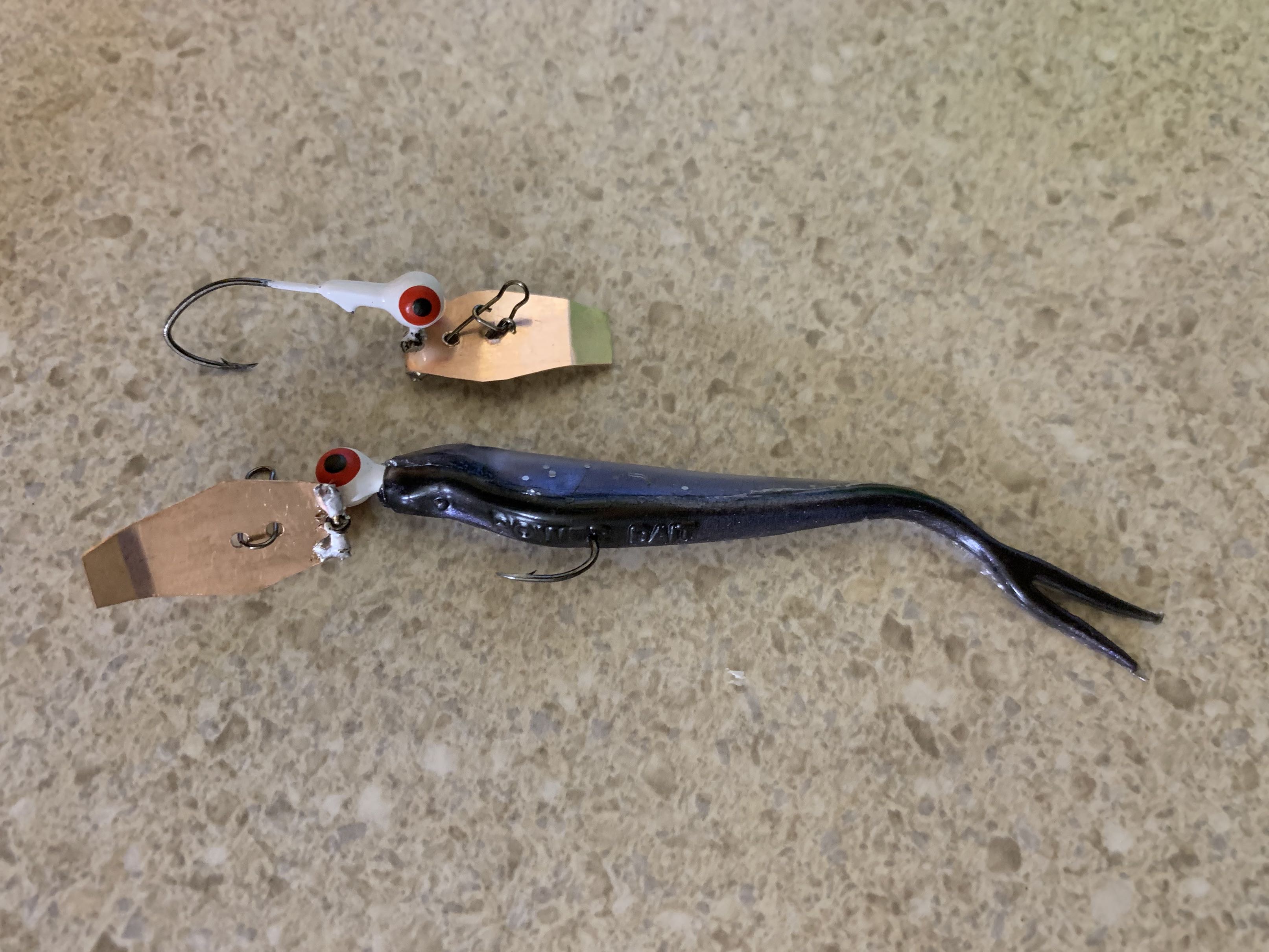
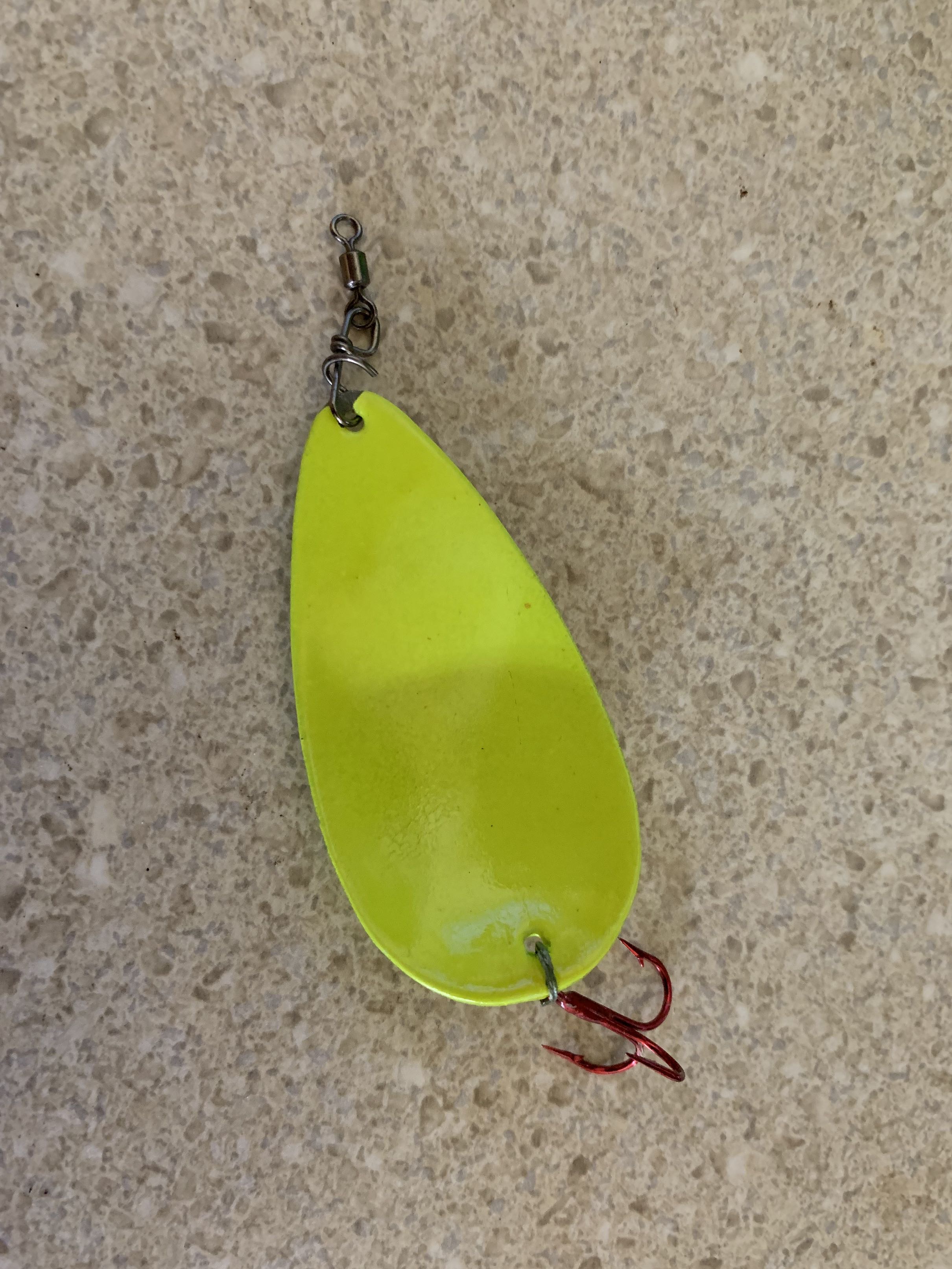
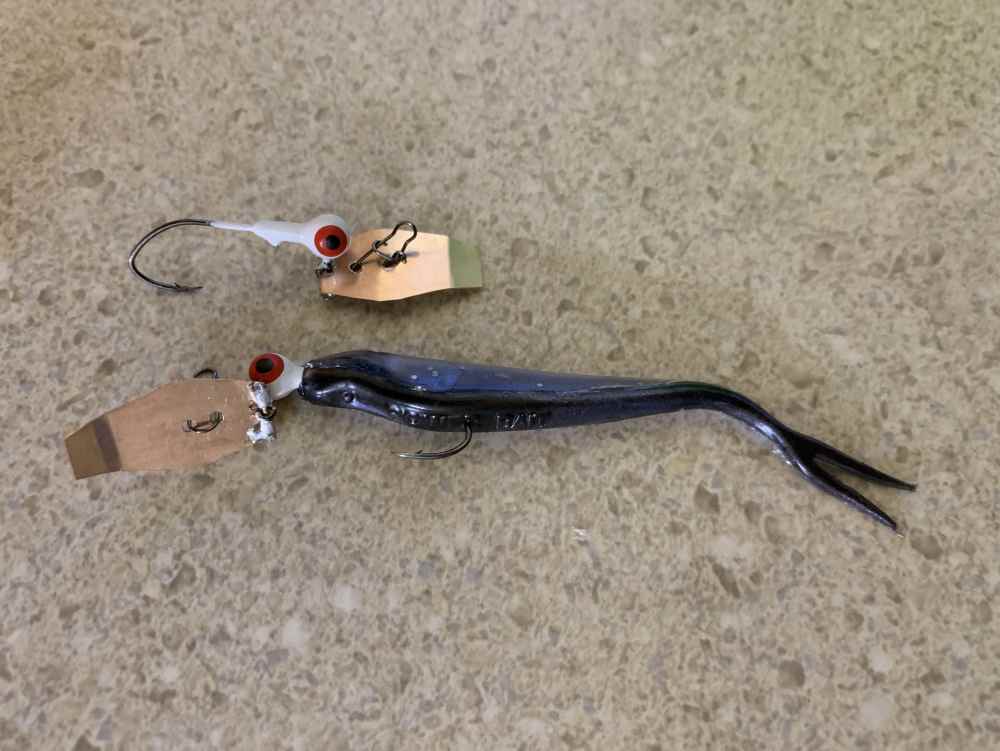
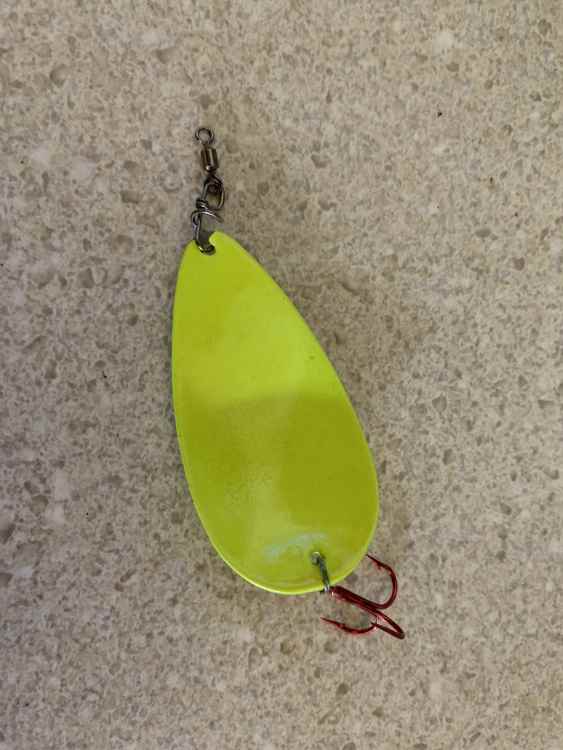
I got bored this afternoon and pieced together a few bladed crappie jigs with stuff around the house. I didn't have any split rings, and the jig's tie ran the wrong way anyway, so I snipped an Aberdeen hook and soldered it in place to attach the blade to the jig head. And here's a spoon from a month ago that I made from a spoon. I also made a spinning spoon by taking the handle of that spoon and twisting it in the middle. But I lost that on the first cast and didn't think to take a picture of it.
-
I will usually cast them out and let them sit for a minute. Let the ripples die off. Then I'll begin the retrieve. With the popper, I snap the rod downward, so it makes a "blulb" sound instead of a splash. With the torpedo, anything can work. Just get out there and try some stuff. They're both fairly easy to catch fish with. Just try something, and if it doesn't work, try it a different way.
-
If your rod is only rated up to 1/2 oz. and your lure without a trailer is already there, then your lure is overpowering your rod. You'll lose distance, and with a rod that isn't an Ugly Stik, you'll risk damaging the rod. You want to keep the lure as near to the center of the lure weight range as you can for optimum performance and casting distance. Too heavy of a lure, and the rod won't recover from the bend put into it while casting. Too light, and it won't load the rod properly. The right weight will load the rod and release it at the end of a cast, causing the lure to slingshot out. I'd probably start looking at heavier medium heavy rods or lighter heavy rods for what you're doing. A 3/4oz. chatterbait with a trailer will weight close to a full ounce. Some medium heavy rods only go up to an ounce, so I'd look for ones rated to 1.5 oz at least. You probably want a fast action rod, since you're fishing in depths below 30 feet, a slower action may give you trouble on hooksets with that much line out. Also, the longer the rod, usually the further it will cast. That's just a function of simple leverage. And lighter rods usually help as well. Less mass to fling means more speed.
-
You've got a wife that not only lets you fish, but enjoys fishing herself? And she's speeding up the excuse to buy new reels? All of this sounds a little too good to be true...?
-
No doubt. And if the question were more specific, it would be easier to answer in a forum post. Right now, we don't even know if this is for deep cycle, starter, or both. I even started to write up all of the differences between the batteries, but realized it would take me over an hour to just hit the main bullet points without going into the technical details. For me, I use the standard lead acid batteries. My theory behind them is that lithium batteries may come down in price in the future. I believe that the price of lithium batteries will drop more in the next 3-5 years than the current cost of lead acid batteries.
-
That's in celcius. That's a little over 145° F. Not temperatures that you'll likely experience on a lake. Still, a short, whether inside or outside the battery, could run it up over that temperature in a few seconds. That's why it's important to choose a good lithium battery with a quality BMS (battery management system) that will shut it down before it reaches a critical condition. Even then, you're not 100% safe. But I wouldn't even consider using a lithium battery without one. Also, keep in mind that lithium is a very broad category, and not all lithium batteries are the same. There's Lithium Ion, LiPo, LiFePo4, and probably a few others. They'll all have different characteristics. Basically, batteries are a huge subject. Too big to really explain in a forum. If you really want to know all of the subtleties between them, I'd recommend spending an afternoon or more on Google. Though generally, a good rule of thumb is the more expensive the battery, the better it is.
-
With a spinning reel, I can't recommend fluorocarbon. I've tried it a few different times now, and I always wind up stripping it off after dealing with all of the twists, wind knots, and line memory. I'd recommend using a baitcaster for fluoro, but with throwing lighter presentations, I really think you'd be better off sticking to the spinning reel. I've settled on braid with a fluoro leader as the winning combination in this case. Put on about 8-15 feet of leader, and you don't have to replace it that often. And it's usually not enough fluoro to give you trouble. It's the best of both worlds, in my opinion. I usually go with something like 6# fluoro and then try to find a braid of similar diameter, to make the leader knot easier to tie. As for rod, I think a M or ML fast to extra fast would work. It all depends on personal preference. I like the ML/F because it has a bit more tip and is a bit more flexible, which helps to really launch those lighter baits. But some people prefer the medium for more hook setting power, or the extra fast for better control when working the bait.
-
The internet, number one. All of that information available from forums to retailers to satellite imaging to depth maps. Sonar. When I first started, sonar was just a round flasher. Sometimes you could pick out suspended fish, but not very well. These days, we can see underwater better than the fish. Lots of other small things came about to help push the sport. But those are the two that literally changed the game in my lifetime. It's not even close to the same sport due to these two changes. I can go to a lake I've never heard of before and be on fish. That rarely happened in the past without a guide.
-
Whatever you're most comfortable with. Being able to tie a knot correctly is more important than choosing the right knot. I prefer the FG due to its slim design and the fact that I'm familiar with it. However, sometimes I don't want to mess with it on the water, so I'll use a double uni knot. I don't have as much confidence in the double uni, but on my small kayak in the wind and waves, sometimes I don't have the patience to deal with an FG.
-
There's a small lake near me that's about 35 acres and maybe 12 feet deep. I've never been there with less than 10 other people on the water, and there's usually around 30-50 if the weather is nice. On a holiday weekend, you may not be able to find a spot from the bank. So it's small and very heavily pressured. On that lake, jigs, spinnerbaits, topwaters, basically anything large and loud seems to work best. It's kind of the opposite of what you'd think. But most everyone who goes there fishes with live bait, so the fish are used to seeing small, finesse style presentations. They want large and loud, because it's the opposite of worms, nightcrawlers, minnows, and stink bait. It's a small City lake with no ramp, so most serious bass anglers avoid it, and everyone who wants to take their kids or grandkids fishing goes there. Senkos, drop shots, shakey heads, Ned rigs... they're a waste of time. Point is, it's hard to say what will work until you've tried it. On a pressured lake, it sometimes helps to throw the opposite of what the fish are used to seeing. So don't count anything out until you've tried it.
-
I don't use electric sharpeners for anything. They do more damage than good due to lack of control and excessive heat. Sharpening is all about consistency and precision, things handheld power tools aren't known for. And those dedicated hook sharpeners they sell at bait shops are worthless as well. They're usually 200-600 grit. They're only good for regrinding a tip that's broken off, in which case, you might as well replace the hook. You need something around 800-1600 grit to make a tip sharp enough to pass the thumbnail test. The reason factories chemically sharpen hooks and scalpels is because they're mass producing them and cost and speed are important considerations. It's not necessarily superior in it's ability to produce a fine edge or point. It's just superior in it's ability to do many fine edges or points on a large scale, without having to employ thousands of experts to do it all by hand.
-
Do you use the spool tension knob at all? Because if you do, then your current bearings are already providing less friction than you can handle. Upgrading bearings from there will only result in having to apply more spool tension.
-
For pitching and short casts, you'll never make use of the T-wing. Though some people complain about leader knots with them (an issue I haven't experienced). So the Fuego sounds like the better option to me. That $30 would be better spent towards your rod, in my opinion.
-
I had considered that one. But I think it's only rated to 80 lbs, if I remember right. That, and I think it requires special Yakima crossbars. You'll want to do some research on that before you put in an order. I remember it being on my radar for a few days and then something popped up and made me change my mind. There is also a side lift assist. Like the Thule Hullavator Pro. That one looked like the winner to me. But it's a bit out of my price range. I'd probably get a trailer before I buy that. In the end, I never found a perfect solution. With my truck bed extender, I have to mess with hitch clamps and pull the extender off to open the rear door.
-
I live in Oklahoma. You don't honk at someone unless you know them. Everyone in Oklahoma has a gun, and a few are just itching for any reason to pull it out. So no, in that situation you don't honk, you don't give them a lecture, you don't do nothing that might escalate the situation. What you do do, is talk to the guy. Be friendly. Say something about the weather, or ask how they're getting along. Stay calm. Then, ask them if you can use the ramp to get your boat out or whatever. Should you have to ask them for permission to use a public ramp? No. So why do you do it? So that 1 in 100th time where the guy is crazy, drugged out of his mind, or just mad at the world, you don't set him off and get yourself killed. Even if you have a gun on you, you don't do it because he might outdraw you. And even if he doesn't, you don't want to spend every dime you have on lawyers trying to keep from going to jail because you met a crazy guy once. If asking nicely doesn't work, back away and call the cops. Then keep your distance while you wait for one to arrive. Don't get mad. That dude's got some issues and it's not up to you to fix him. So you be nice, even when you know you're not the one in the wrong. Not because he deserves it. But because you don't deserve to let one crazy person dictate your mood.
-
I've found myself using braid for just about everything. If need be, I'll tie on a leader. But braid's castability, durability and strength just keep making it the best, all-around choice for me. And since I fish from a kayak, I have to make sure all of my rods are multipurpose rods because I'm quite limited in what I can carry. One thing I'll say about line stretch is you have to consider the rod you're using it on. I have an old m/m rod that I used for crankbait fishing, and it did not do well with mono. The soft rod and the stretchy mono combined to make hooksets near impossible with longer casts. With a stronger rod, it's not an issue. With braid on that rod, it's not an issue. But those two combined were definitely an issue.
-
Don't worry about the air flow. The air will come up of the hood and follow the windshield on any vehicle, and get under the kayak to try to lift it up. Fortunately, kayaks are hydrodynamically designed, so they're pretty good about passing water (and air) around them. So while with any car top setup, there will be air pushing the kayak up and away, they all work out just fine in the end. Just make sure it's properly strapped down in place, and you shouldn't have any issues. My old car was a 2 door Altima, and I transported my 100lb kayak on it's roof just fine using nothing but pool noodles and straps. I did, however, put a few dents and scratches in my roof after doing it probably 100 times. My new car is a Subaru Forester, and it too does just fine with my kayak on top. A little advice for the Forester (or any of the Subies), if you go that route... I use the standard Aero crossbars. They work fine. The Thule crossbars are a little nicer and have more accessories available, but the standard ones will still hold a 100lb. kayak just fine. They have a weight limit of 150 lbs., and it doesn't matter which brand you use, they'll all be limited to 150 lbs., because the crossbars are not the limiting factor here. So even if you buy some expensive ones that have a massive rating on the box, it's the roof design of the Forester itself that limits it to 150 lbs. If you don't want to scratch up your paint job, devise a system to help you get the kayak up there and down again so it's not resting on any part of the paint job. I installed a trailer hitch on my Forester and use a truck bed extender in reverse, so it sticks up to be level with the crossbars. I had to get a hitch extender to get it past the back bumper, and had to get two trailer hitch clamps (one for the hitch extender) because otherwise it shakes back and forth so bad, it becomes hard to load. But once properly secured with the clamps, that gives me a pivot point off the SUV and some extra stability during travel with a third tie down point to secure the kayak. Some of the Thule or other brands have extenders that go beyond the side edge of the SUV, and allow you to side load the kayak without resting it on the paint. Or you could just throw a bath mat up there to protect it. A lot of people will use tie downs in the front and back of their kayak to keep it from sliding forwards or backwards. You can do that, if you like. It works as I've done it many times before. But if you have side handles on your kayak, I prefer to just run the a strap under them. That will, in my opinion, keep your kayak from sliding forwards or backwards better than the long tie downs you see others using. Plus it's easier to mess with and gives you two less straps to worry about. And you don't have to worry about those two straps scratching up your paint. Just set your crossbars as far apart as they will go, and tie the kayak down to the crossbars, not the side rails. That's about it. Just make sure it's secured tight before you leave. It's usually a good idea to drive around the block and double check that nothing's loose before hitting a major road. Also, twist your straps and secure their lose ends (tie them down) so they don't flap in the wind. A single twist is all that required on any part that's going to be exposed to the wind. Otherwise they'll sing to you at high speeds. In my Forester, I usually have the sunroof exposed so I can occasionally glance up there to see the kayak and make sure everything is fine. In my Altima, the front stuck out far enough that I could see it. I never had an issue, other than a singing strap, but it's good piece of mind while your driving if you can look up and tell if it's moving around or holding steady. It keeps you from having to pull over on the interstate when you hear a funny noise.