
bulldog1935
Super User
-
Joined
-
Last visited
Everything posted by bulldog1935
-
On the flats prefer baitcaster most of the time, because of instant retrieve. Prefer the spinning tackle in the dark and especially before the coffee takes because you don't have to keep up as much with your lure landing, and am generally fishing topwaters then. With XUL, spinning is kind of a no-brainer for distance and countdown (in spite of strides in BFS).
-
In the case of Shimano, $200 reels come from a line in Malaysia, and I'm betting a $400 reel is made in Japan. I know in the case of Japan-made spinning reels, technicians at the bench match parts to improve smoothness and reduce inertia. The extra effort should also reduce wear in the long run. Asian Portal - $320 against a weak JPY
-
hey, this is fun (riding out a wall cloud squall with drift sock deployed at stern)
-
with so many friends on this thread, I tend to keep my mouth zipped. I can best explain it with an anecdote. I bought my daughter a Werner paddle (Shuna, carbon bent-shaft) when she outgrew her kid paddle - about 12. Right away, she would cross the flat upwind before the grown men. By the time she was 15, I couldn't keep up with her any more. I was using the top-line A/T - it was a Harmony product, seemed right with a Wilderness boat. I bought myself the Werner Camano carbon bent-shaft, and got my edge back - I left her behind on the new paddle maiden crossing on Boerne City Lake. There's a reason Werner's blade design is patented - it both enters and leaves the water more efficiently. The difference will be felt in your joints at the end of the day. IMO, the best buy in kayak paddles are the glass-blade Werner's. I propel my 16' Tarpon with the glass-blade Corryvecken, the largest-blade-area paddle made. I can keep up with my friends in Hobies and Mirage drive, except when they want to stretch their legs out. The straight-carbon-shaft glass blade Werner is only one-ounce difference from my all-carbon bent-shaft Camano. In my racy little Kestrel, my friends with Hobie Mirage drive can't keep up with me and the Werner Camano touring paddle. The Corryvecken badly oversteers the Kestrel, and makes it tougher to keep your balance. What you gain with bent shaft is automatically placing your hands in the position for most efficient paddling. If you know where, you can do the same thing on your straight-shaft paddle with indexed-position grips. I made these grips by rolling on thin closed cell foam with 3M 77 spray contact cement and covering with X-shrink tube.
-
For me, the strongest coffee taste with the lowest acid is Sumatra. There's a local coffee roaster, who also supplies local restaurants, or packaged Java Bean Joe's or Magnum Exotics. In Alaska, it's Koladi Bros coffee. I have many friends who buy green beans from Sweet Maria's and roast fresh at home. When I fish with my buddy Whit, he brings the coffee, and I make the breakfast tacos.
-
My buddy Lou bought his wife Susie the 7'6" Major Craft Crosstage XUL, and sometimes she lets him fish it. She flipped fishing my 12-y-o Takamiya 7'6" XUL, and Lou went straight in to his computer and ordered the Major Craft with matching specs. My NS Black Hole came from ebay vendor Autter drop shipped from Seoul - I know Maguro Pro Shop in Croatia handle the brand in Europe (worldwide tackle on ebay). UL rockfish rods are also big in UK, and there are vendors for several different brands.
-
Major Craft is a good brand. Also check NS Black Hole from Korea. Here is their spec chart for Dark Horse Rockfish model - I have the 802L, and it's a workhorse for UL, and priced at entry level. What you gain with the longer UL rockfish rods is the ability to cast UL to great distance, cast a wide lure weight range, and to handle bigger fish - they're intended for shore fishing (rather than vertical jigging from a boat). The 832L matches your spec, and though just slightly heavier (still very light in hand), the performance compares to the high grade Yamaga Blanks rods. wading a shoal and casting across a deeper cut here's a pretty good video of the spendy Yamaga blanks 83 at work - at about 7 minutes, he catches two fish with shoulders, a sea perch and a sea bass, and if you watch for fish broaching, you can see how far out he's casting and fishing. You can also see why they call them rockfish rods - fishing from the rocks and reaching out to deeper fish. I fish both rods I mentioned on this thread. Fishing tandem rigs, both rods have landed doubles, including mix of seatrout, redfish and snook. While I take the NS Black Hole rod out on my kayak, would never do that with the expensive Yamaga Blanks rod. I fish these with Shimano Stradic 1000, 2000, and Vanquish 2000, also Tica Libra SL 1500
.jpg.ecc186fe4614b1a2ebd4c6bbf9cc5ca2.jpg)
-
Beach Cliff pickled herring steaks in Louisiana Hot Sauce. When you crack open the tin, pour the oil on the water - it draws fish.
-
Here's my 16'er on bed extender. I took magnetic tow lights ($12 at Harbor Freight) and eventually made them permanent on the bed extender. With the addition of a bicycle taillight on the kayak stern, this is legal for night driving. I keep my boat on saw horses in the garage, and it's really easy to back up and slide it on and off. Also makes it easy to work on rigging.
-
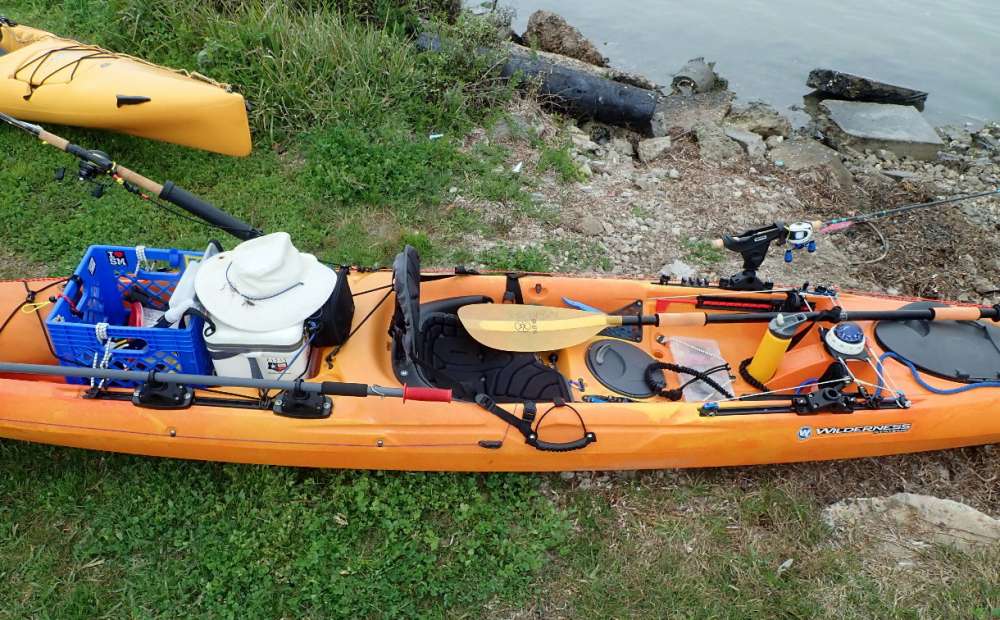
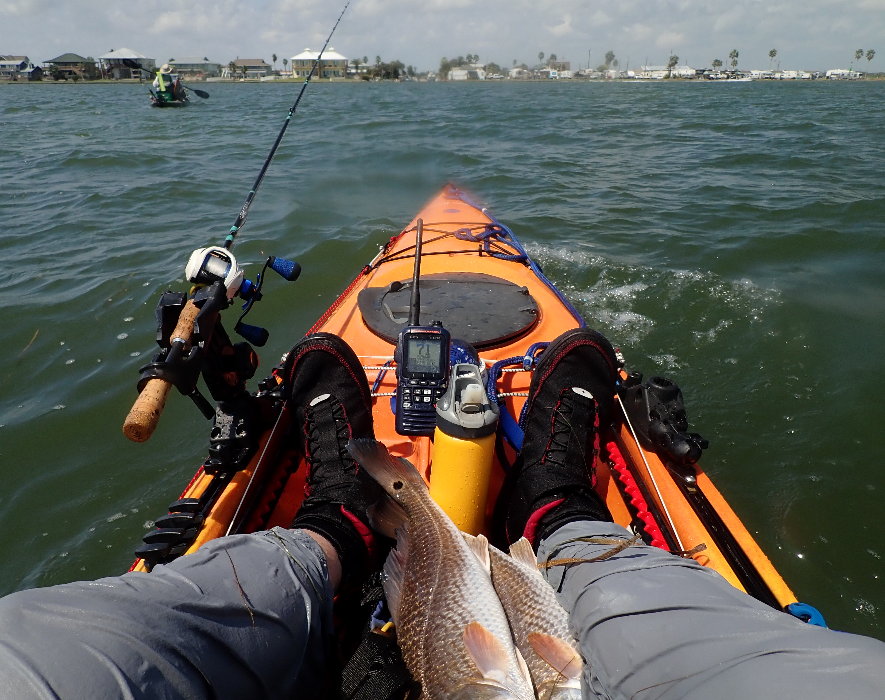
Hi Fred, Here's a seat option that will work with your kayak and still keep your CG low. this is made by Surf to Summit, and there are some knockoffs on ebay. We cover distance and like our go-fast boats in the salt. The best plan for rod holders and all future sundries (electronics) is to install a rail system. I've been fishing a T160 on the flats 12 years now - the track system was what sold me on it - the ability to rearrange my rod holders and other gear has been a boon.
-
I just went through spool shimming exercise over the last couple of days - honking big new surf reel, though. Matching with an 11' H Tsunami Air Waves, for throwing 2-oz spider weights on a bait rig. See how the initial wind trial doesn't go to the bottom of the spool? If I kept going, it would bulge and stack up at the front end of the spool, and wouldn't quite fill. Your new Vanford is much easier to shim than this surf reel - Tica Samira, who also make this same reel as the Surf Pro for Daiwa. (Heck of a buy for 1/3rd the price of the Daiwa - I don't mind shimming.) I had to remove the fiber-composite washer from its detente in the spindle, 2 spool BB and spacer, and click-spring to install my shims. Great result with 315 yds 35-lb X-braid The reel also has a cool drag feature. The center knob attaches the spool and sets the max drag. The outer drag adjustment will back off from there and instantly return to your max set point. It works like a lever drag. Save those Shimano spool shims - they will be solid gold for you. I've swapped braided lines on two of my Stradics, and both needed shimming the second time to get good braid lay. Yours will simply pop into place after you remove the spool. You should have two thickness shims, two of each - call them shim and half-shim. I had to use 1-1/2 on both of my high-use Stradics to spool them the 2nd time (each). A new Vanford will be properly shimmed from the factory. But they will compress with use, and you'll need them later.
-
The only UL rod that can cover that range is a long Japanese Rockfish - over 8' You could build your own from a 4- or 5-wt fly rod blank.
-
I use an Allbright knot, but double uni-knot will work fine for that joint. You will probably never see it again, if you have 150 yds braid over the top. You won't be casting 150 yards, and if you're paying that much drag on Moby Smallmouth, the knot will glide. The problem with all-braid, the capacity of that reel is almost 500 yds of 30-lb braid. I'll do an example calculation for you here: Let's say you're going for 150 yds 20-lb Sufix 832 for your working line - that's 0.23 mm diameter. Your total reel capacity is 200 m (220 yds), 20-lb 0.45 mm mono. If your backing is 20-lb, 0.45 mm diameter, you need about 170 yds backing plus 150 yds 20-lb braid working line to fill the spool. That 320 yds total of 20-lb mono + 20-lb. braid makes a lot more sense than 465 yds 30-lb braid, and will definitely cast farther. If you want to go all mono, the reel holds 280 yds of 17-lb, but won't cast as far. Fred, keep us posted...
-
A 9' rod with that big spool should cast very far. Every 20% increase in the speed of the lure leaving your rod doubles your cast distance. The reason to fish a longer rod is to get that extra cast speed/distance. I fish a 9' ML inshore when I need to reach extra distance (casting across cuts). The reel will hold 280-yds of 17-lb mono or 220 yds 20-lb. I think your best bet would be to spool it about 80-90% of the way with 20-lb. mono for backing, then finish it off with 20-lb braid. That would fish well with the MH rod, definitely get you a long cast. Here's a very good line calculator for stacking lines of different diameter: https://www.pattayafishing.net/advanced-fishing-reel-line-capacity-estimator/ (I use this calculator all the time and it's pretty accurate) Start with the capacity of your reel in yards and line diameter. Put in the yds and diameter of the backing, then the diameter of the braid, and it will tell you how much braid you need to finish filling the spool. (or fix the braid amount and calculate the backing length, etc.) Make sure you load your backing line under tension - I run mine through a phone book with a weight on top, can tie my knot without releasing tension on the backing, and finish loading my working line under tension. Just offering a positive outcome with what you have. Maybe later you could swap in a lighter reel with less line capacity.
-
me, too of course it's an unrelated company and always with excellent customer service. They hunted down my Crowder rod from another vendor and drop-shipped it in April when no one else could get anything.
-
One way to look at it is complication. The other way is seeing the forest without just seeing the trees, climbing the trees and falling out of the trees.
-
Mega drag numbers look impressive on paper - what you can count on is they should have a reliable fade-proof drag in real world drag numbers, and spinning reels with big drag numbers are hopefully designed with adequate spindle stiffness and gear strength to resist brinnelling. My offshore lever drag is set at 8 lbs (for 45-lb braid). If you've ever set a drag by spring balance to 8 pounds, it's honking. As long as you work your drag around your weakest link (line, leader, or rod max line rating), you can line your reel with whatever fits.
-
The tournament casting guys use copolymer (Sakuma), hard (and brittle) on the outside, very thin, and not worth a dang for fishing (if you google other forums). For the fishing trade-off, I'm on board with the Seaguar Tatsu and Abrazx guys - thin and excellent knot strength - and will also give a nod to YoZuri copolymer. IMO, Abrazx is the best-buy line. The YoZuri is not the thinnest, but limp and low memory. I fished a spool of Tatsu and, to me, it wasn't worth the cost difference over Abrazx.
-
My last order with TackleDirect, they were very nice to me. They broke out the rod and sent it Fed-Ex P2, and put the sundries in SurePost.
-
Only the forgetful or simple-approach forget. Fish-set-point is the purpose of one-quarter of weakest link, and it's where you have to begin with Every lever-drag reel, or you won't have a functioning drag. It becomes just as important when you're going after oversize fish on undersize tackle, or you're overlining your rod with heavy braid. My buddy Lou one day lost a big fish on the flats - I'm pretty sure it was a toothy sow spec that gulleted his lure and bit through his fluoro. He assumed he broke it off, lowered his drag and landed a nice 25" red that day - but it hauled him a mile down Traylor Island shore for an hour of drag run. I have him now using my spring scale on his XUL, at least, and it's the right place to begin hauling in meat, where XUL lures are needed. (these are all male schoolies, 17-22")

-
and all those other approaches use para-taper UL rods, while BFS uses a progressive taper rod.
-
Of course you guys know I'm going to be the historian of this crap. Finesse fishing, long rockfish rods, BFS all, of course, originated in Japan - the Japanese called it Caro, and probably goes back to bamboo days. The Europeans called their parallel approach Bombardo. The Brits coined the name "threadlining" in the 1930s. In the US, we have our parallel approach, first mentioned by Ernie St. Claire, and later dubbed XUL (and revived threadlining) by Joe Robinson. All these parallel approaches use progressive (fly rod) taper, to get the properties I described in my post above. Dave Whitlock and Joe Robinson began making XUL spinning rods from fly rod blanks in the 70s, and most of 30 years later, Joe got around to describing it in his book Piscatorial Absurdities. Here's Joe at work on Lake Travis. Joe's book created a following and for awhile, there was even a Threadlining internet forum. Here's my buddy Alex again, seducing some nice creek impoundment bass on a rod he built from a 2-wt fly rod blank.
-
Dee, Split seats always need a spacer. Rich used that graphite spacer on my rod. You shouldn't need a split seat with that foot length - should be able to find a spinning reel seat with a 75 mm L3. I've googled up a Fuji components catalog online before. If you want to take it on rebuilding your rod, you can identify the seat you want to use and order it from Mudhole or another rod-building supplier.
-
I set to no more than one-quarter of my weakest link - leader, line, or rod max line rating. (making sure this thing is on) I use a spring balance and measure it at the first line guide from the reel. Keep in mind shock loading can be more than that four-times factor. (of course it's an antique, but no reason for the Salter spring rate to change as long as its stored relaxed)
-
You can also make a spigot ferrule using a cut piece from glass or graphite (better) rod.