



Team9nine
Super User
-
Joined
-
Last visited
Everything posted by Team9nine
-
Once upon a time, before fluorocarbon became available and affordable in large spool sizes, I used only Big Game. That was probably a 20 year period of time. Caught loads of fish on it using it for about every application and technique available. Nothing wrong with the stuff at all. However, once I made the switch to fluoro, I'm now pretty much "all in." If I ever have to switch back or use mono (nylon) for any applications, it will probably still be Big Game for me.
-
There are a few studies, and like everything else, there are also some conflicting results. The short answer is 'yes,' stretching your line to the point of breaking off has most likely weakened the remaining line. To what degree, the answer becomes, 'it depends.' With monofilaments (nylon), I've seen two different results. I wrote the article that fissureman referenced on the first page of this thread, and in that example, stretching nylon to 75% of its breaking strain actually increased strength. This is believed to have something to do with lining up the molecular chains, actually making them stronger. However, I recently came across a study on nylon lines that showed anything up to about 1/3 breaking strain has no effect, while anything at 2/3 and above, up until the line actually breaking, does damage/weaken the remaining line, so there is a point where things head south, and that is likely in the 60-80% range. A similar study I saw in regards to braid showed a more clear result of weakening after breaking. In the case of braid, the line actually recoils upon breaking, often unraveling or at least loosening the weave for the first 3'-4' of remaining line. So with braid on a breakoff, the best bet is to clip off about 4 feet of line and then retie. A final study that had a mix of nylons, copolys and fluorocarbon showed that all line types weakened when pulled until breaking. In this case, they snipped off the last 4 inches, retied and then retested. But, there was a lot of variability. The worst result, which happened to be a fluorocarbon, showed about a 40% loss in strength. The best results showed almost no difference, with only a slight loss in the one to three percent range. On average across the 17 lines tested, the loss in strength was 20%. What they did not report or test was what happened if a larger segment of the end line was cut off and retested. That would have been interesting. When line breaks, it does so at the weakest spot, and typically through a process called "necking." Theoretically, the most damage would be caused in the immediate area either side of the break since that's where the permanent deformation (definitely) occurred. As such, I would say a good rule of thumb would be, like braid, cut off and remove the last 3'-6' of line after breaking off, then retie and fish. You still might be slightly weaker in strength, but you've probably minimized the worst of the damage. Of course, there are too many variables to know conclusively the condition of the remaining line, so in that regard, replacing a good casts length of line if affordable and practical would be the ultimate safeguard, as has already been suggested.
-
Still need my Dec. bass, but got every other month this year covered. Not usually that lucky
-
Woke up this morning and figured it wouldn't be good. Most everything I saw today up to 50 acres was at least partially skimmed over, and much of that stayed all through the day.With lows between 16-20 for the next 4 nights, I don't see much hope for the smaller waters. Hoping the big reservoirs stay clear into next week when we finally get a slight warm up.
-
Top 4 I believe are Rebel Baitfish Series line of baits in bass and perch @whitwolf Next is a Rebel Deep R of some sort...looks bigger than the Wee R Last 3 are Natural Ikes by Lazy Ike (Tom Seward design)
-
Always a guessing game, which is part of the fun to me (figuring out what will make them bite). My first option would be to play with action. Much like ice fishing, it becomes a game of cat and mouse, and can you do something to trigger a bite. Try light shaking, slow lifts, lift and drops, etc. Only if those didn't work would I switch baits or colors. Many guys will tell you how color selective crappie can be, but if I'm already using a known productive color, I'd probably try shape/bait change first. I usually start with both tubes and curlytails tied on. I'll try both and see how the fish react before switching through colors. No real right or wrong way. Having a second person in the boat can speed up the process of elimination, as can multiple rods or multiple baits.
-
You're in trouble if those are your only two options tackle wise. Better off not even trying, but that's just an opinion, obviously. Will be very frustrating trying to fish this on heavier tackle. As Tom mentioned, this is supposed to be a finesse option with light line, almost always spinning gear. Several guys around here use crappie rods (the long 8'-10' models) as an economical alternative rod (often $20-$35). Also, this technique is primarily designed to catch suspended fish, so regardless of how deep your waters are, it's rare to ever have to go much over 12', even in waters like Dale Hollow where you have 125' plus of water depth available. The more active suspended fish are almost always shallower. If you have to go deep, most guys that do that will switch to live shiners on a vertically fished down line - often a split shot rig, but I've seen guys use baitcasting equipment with heavier sinkers for this successfully.
-
Never seen any of the hardcore FF guys around here use a slip float. In fact, most still customize their own bobbers by cutting in half and adding weight instead of buying the plastic pear-shaped ones. Try the slip float and see how it goes. Buy a fixed float just to have something to compare to. I'm guessing you'll go fixed in the end if you stick with it long enough and use it on different waters or situations. A lot of control lost with a slip float. I've used Thill floats but always with the rubber collar to peg the line in place, essentially becoming non-slip.
-
He mentioned it in the article, and Tom touched on it. Fixed line for best detection of lift bites, working the jig by working the float (too easy to overwork with a slip float), and guaranteed depth control during the entire retrieve. Not saying it won't work, just not optimal.
-
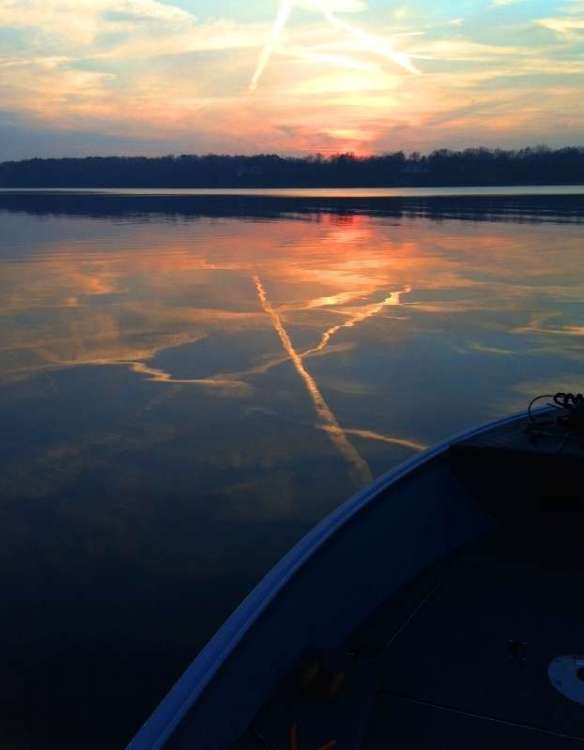
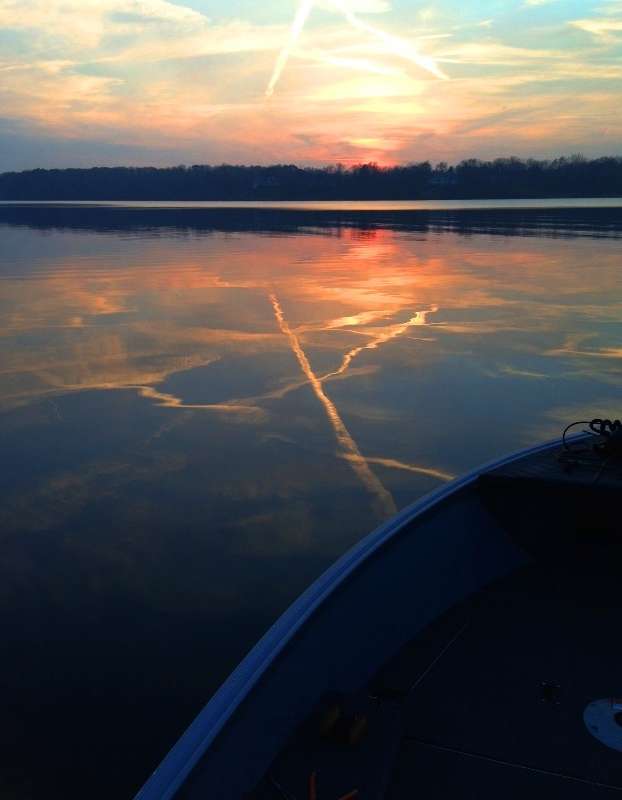
The view coming in this evening from an afternoon of fishing was rather cool. The fact that the crappie were biting was a bonus.
 Very nice diagram ? I'd fish those areas too, just with a different interpretation that got me there.And now you start seeing the nuances and differences in thought (and terminology). Sticking with my originalist mentality, Buck stated structure is a feature OF the bottom...meaning, the dirt. Breaks, or what most people call 'cover' now days, are features ON the bottom. Rocks, whether we are talking tied to a Christmas tree or laid down to protect a shoreline, are still sitting ON the bottom, therefore are considered break/cover. You can really get into nuances, and even Buck said there are some instances where what we would traditionally consider breaks could also be considered 'structure-like' because of the lack of true structure in certain bodies of water (and fished or treated accordingly. The good news is that whether I call it a break, or whether Tom considers it structure, it is recognized as something important by each of us, and would be evaluated and fished accordingly. The difference is just to what degree of importance (and terminology).The fence/hedge row example Buck used is a little tricky (IMO). It was diagrammed in an article on the best places to locate fish in a reservoir, as well as in a little booklet he published. In both cases, that example was in reference to what Buck referred to as "structure situations." Similar to Tom's original premise, "structure situations" are the areas Buck stated we are most likely to find fish consistently. This is because these "structure situations" are comprised of 4 different entities; structure, breaks, breaklines and deep water. It is the combination of these 4 things that make these areas so productive. In the case of the fence row, it was situated on a small bar (structure) and was comprised of individual trees or posts (breaks) that happened to run in a line (breakline) and that led all the way from the shoreline out to the channel (deep water). This example was used to try and explain why, as Buck put it, "'Structure fishermen' should [be able to] tell the difference between fence rows and standing trees out on some big flat."Well, at least they got 1 out of their 4 "structure" examples right I do agree they are completely different, and to whatever degree possible, they should be understood as separate things. However, so much use and misuse over the past half century or more, along with the natural evolution of word usage and meaning means we'll never all be on the same page when discussions get beyond a certain level of detail. Even hardcore Spoonpluggers don't completely agree these days on exact terminology. Such is the nature of life.Guess we can all agree on the general theme of isolated cover and structure or irregularities being important areas or spots to focus your attention and efforts on, and just agree to disagree on the specific definitions of the terms in play ?Definitely goes against most other results...I could potentially see it being close, but braid wins out most of the time.I'm not 100% quite sure of the question being asked, but in short, structure is my guide. That's what I look for/fish first. The breaks and breaklines on that structure, often the result of what you term "cover", will help me pinpoint exactly where on that structure I would expect to catch fish. I still have to 'check it out' though and fish the structure thoroughly (shallow, deep and in-between). It's possible there may not be any 'cover'/breaks on a piece of structure though, and that's fine, too. I'd rather fish a piece of structure without cover, than a piece of cover without structure (out in the middle of 'nowhere'). YMMV Hope the back gets to feeling better quick!When you dig into it, you'll see crappie fishing is just like bass fishing - a wide range of presentation options and technical levels of expertise, from fun fishing right up to National tourney circuits. I take it pretty seriously, but have several friends that fish either the state or national level events. You'll see planer boards, spider-rigging, crankbait trolling and pushing, dock shooting, jig casting and trolling, and both live bait as well as artificials. Boat rigging is very technical and specific for crappie fishing, too. It's become its own niche market in the fishing industry. Personally, I stick with single pole jig fishing on structure, breaks and breaklines. Spent 5 days over the Thanksgiving holiday chasing crappie in 42-45 degree water, and we caught a few hundred. Will be going again this weekend if we haven't froze over yet.I've got three of them. Two have been used regularly. If you don't break it within the first couple trips, there should be no reason to need a lifetime warranty, because anything that happens after that was likely because of something done while in your possession. Good for Cabela's. Just buy the rod and go fishing. They seem like good sticks for the money.The problem is that most anglers end up trying to match diameters of their braid to what their equivalent mono would be, completely negating one of the largest potential benefits of braid. Very common to read this "advice" in threads on this board. On your latter point, there are a lot of component changes that can be made to most every setup to increase sensitivity beyond whatever you currently experience. As you point out though, there are tradeoffs with all these options, and each angler has to prioritize what is most important to him/her for a given presentation.Fancy setup - pretty cool ? Unfortunately, a lot my ramps are too busy or exposed to main lake winds, so best thing is simply never let the boat leave the trailer. Back up, use truck bed to enter boat, start up and relocate boat to dock, then come back for truck. For me, using ropes ended up being too much trouble most days.



Important Information
We have placed cookies on your device to help make this website better. You can adjust your cookie settings, otherwise we'll assume you're okay to continue.