spoonplugger1
Members
-
Joined
-
Last visited
Everything posted by spoonplugger1
-
Until they invented the need for belly guides, for decades we ran running guides successfully. Rods of musky power levels have used them and even micro guides with long time success. The running guides and many others have tested all exceed 20 lbs. of load without damage of any kind, a typical MH bass rod under full load never exceeds 6 lbs. of load on any one guide and the most loaded guides are closest to the reel, for this reason all could very well be SF running guides, the guides on the tip have very little load, as they are pointing toward the load with little flex on them. My concern when building a rod is, therefore, how much durability is needed to be able to use this rod day in and day out, under all transport and fishing conditions the rod could possibly see, for this I may even select DF guides like those near the reel for reliability's sake in remote fishing areas.
-
I like composites for kayak rods, they lose little to carbon blanks and add a bunch of durability in any rod position which is a good thing in a kayak. Thrasher rods Magic Wands developed by bass lure designer/rod designer/ custom rod builder to the elite anglers/author Rich Forhan. They will set you up with the right blank and custom cut to your length before delivery at a great price.
-
Daiwa just loves IM7 so there is no reason to look into the high modulus blanks unless you want to.
-
How could you look at their EFX/Carbontex grips and not see the guides? Fuji, REC, SeaGuide, all right there.
-
Since you have done business with NFC why not use them for the other stuff, they could have put the components in the same tube as your blanks and shipped them on the same dime.
-
That guy who sells multi-colored camo eva round stock on Facebook had some last I needed some, I got purposely small ID ones and ream to fit as he doesn't appear to have every size available, they have been out of general stock for some time, I have 4 one gallon Ziplock bags stuffed full so I think I'm ok. He threw in some Pac Bay Minima triggers also that I will rarely use.
-
The number of guides needed is dependent on the layout used and what guides you use, I myself could care less if the line barely touches the blank at full load, some are just the opposite. On a Rogue 7 ft. light line blank I used 3.5 mm guides all on top and I used 10 guides, but I used a static distribution test to set the guides, instead of what many do.
-
I spend more time not holding any grip material in my hand fishing, I'm holding the reel seat and reel more than anything.
-
-
Kites R4, Don Mook ran Shikari out of Oklahoma, before that he worked with Gary Loomis at his first company LCI, Loomis Composites Inc., than Gary started G Loomis, Don helped start Talon Graphites off of the leftovers, it still is in operation in Woodland, WA along with Lamiglas, NFC/Edge, and G Loomis. NFC is just a few buildings down from G Loomis. Don than helped start up the All Star factory, early years at Batson/Rainshadow, back in the day Pac Bay and Rainshadows US built blanks were built at All Star, and he built Shikari, some time in there Cascade Composites was built by investors near the Batsons in Sequim, WA. When Cascade Composites closed Batson/Rainshadow went offshore almost exclusively.
-
I like my St. Croix 3C68MXF for jerkbaits, soft, XF tip, Rainshadow cloned them years later, but I prefer the original, no need to go to a high modulus blank for this, one reason is they rarely get as nice a tip, usually stiffer. The Point Blank use chart suggests the PB69MLXF, or the PB70MF for your application.
-
I build for the conditions, the position and way you are fishing, I fish better when my presentation can stay similar no matter the conditions. My selection for a jerk bait blank would change depending on what I'm fishing from, a high deck like a multi-species boat would be different than if I was fishing out of the bottom of a jon boat, kayak, canoe, or from shore because the distance from the water is different, the position in relation to the water and interferences are different.
-
Kites R-4, The only shop that sponsored me was back in 1981, they sold motorcycles and it wasn't much of a sponsorship. I liked Shikari SHX blanks back in the day, still have a few around, the Lamiglas XMG50 blanks when they were available, have some St. Croix SCV rods I'm fond of, but right now I don't see anyone out there that isn't setting on their laurels and doing much other than NFC. A US company, and at least they are trying to do business in a world market.
-
No foregrip. shortened thread reel seat would be the best option to get a finger on the blank, remember you also do not have to center the reel seat and blank connection, you can offset the reel seat to where the top of the entire reel seat is in direct contact with the blank and your finger to blank reach would be 1/16th to 1/8 inch from the blank, can't get closer than that.
-
By itself, I have used those style hidden thread foregrips for decades and never had a problem. Also, the fancy Fuji carbon fiber/aluminum foregrips can work with your system with a massaging of the length. Fuji's Jim Isling mentioned it in his videos on the Perfect Fit system. With the length of the nut and its contact length on the reel seat threads the size of the opening in the front of the foregrip is cosmetic only.
-
You need a 7 1/2 to 8 ft. MH crankbait rod. Newbies do better with carbon rods, mid to expert glass. Use it on any tight line lure presentations within its lure range.
-
The VSS has a curve on both ends and the IPS has a squared off side facing the threads, this makes matching up to the grips easier IMO, basic shapes after installation into the cork are pretty much the same, the IPS seat/grip is also 1/10 inch bigger in diameter which matches the size of standard cork grip, there was a short adaptor made by Fuji that let you match up an IPS seat for any grip length, the cork adaptor was long enough to fit the seat into and you just butted a standard grip to it to extend a grip to your desired length. Sorry to see your rod damage they used to ship blanks in ABS pipe, but the price for that went way up, NFC ships in a 3 1/2-4 inch heavy round cardboard tube that is close to 1/4 inch thick. So far none have shown even the slightest dent.
-
Not all X rays have the pronounced ridges, that has been true a couple years now since the perfected the special mirror finish buffing process, they can't sand that material and warranty the blank.
-
If you want to look back and see if there was anything on the older models the ones I was talking about were the IC747-3, 6 ft. 2 in., and the IC847-3 for the 7 ft. Your 3 power blanks against 7 power blanks, I think we can see maybe the new RX7 travel blanks were not rated on the same value scale. Your RX6 rod is a large diameter thin wall design that increases stiffness and cuts weight for the bass environment it was designed for being an SB blank, the RX7 may be designed with a more durable thin diameter, heavy wall design to hold up under more species and abuse without leaving you with a blown up rod in your hands far from the nearest tackle store, many places I have fished would have been a hundred miles or better by plane or boat to get to a tackle store of any kind, in other words, blanks that help avoid high dollar fishing trip killing failures.
-
I don't know about these RX7 blanks, but this is not the first time Batson has made a line of RX7 travel blanks, and the heavier ones were in no way built for just bass, the 6 ft. 2 in. and 7 ft. models were built for Peacock Bass in the jungles of Brazil throwing much heavier gear than you would throw here for bass, some of the plugs are what they use for muskies and pike. I built maybe a half dozen of the 7 ft. models and have one myself, the 6 ft. 2 in. model was for throwing those heavy plugs, etc. all day without blowing out a shoulder. One gentleman had his stored in his luggage everywhere he went, caught salmon, pike, musky, catfish, a bunch of fish in Florida, etc. on it. Very durable and versatile rod. Both were rated 12 - 25 lb. line.
-
On the steelhead/salmon rods that had that type ferrule back in the day that plug was merely there to protect the blank tip from dirt, being dropped, etc. the ferrule itself will function without the plug. that said just like the tip over butt ferrules of today I use some of my excess epoxy glue make an eva plug and fill the hole than clean up extremely well for the same purpose.
-
Material wise, the carbon in the High end MHX blanks is similar to the carbon in the Rainshadow Immortal series, a well known and respected carbon that has been in use for decades. The high end carbons used at NFC are many generations superior.
-
Depending on how your rod is configured grip preferences change for me, spinning I steer toward Fuji NPS seats and the old Lew's reverse taper grip style, or a large diameter grip like the Fuji IPS/VSS, AmTack Dagger, or the old Wiebe style that does pretty much the same thing. Add a Fuji HPS thread hiding fore grip and oversleeve of various designs and you have about as smooth a grip as you can have short of a Tennessee style. A casting split grip of the right design and length is hard to beat, many are to long and designed for looks over function. Anything that goes in a rod holder I like to put on a straight carbon tube or a slick butt, makes removal with a big hot fish on the end so much easier. On kayaks I don't know what goes in and out of rocket launchers, rod holder, etc. faster and smoother.
-
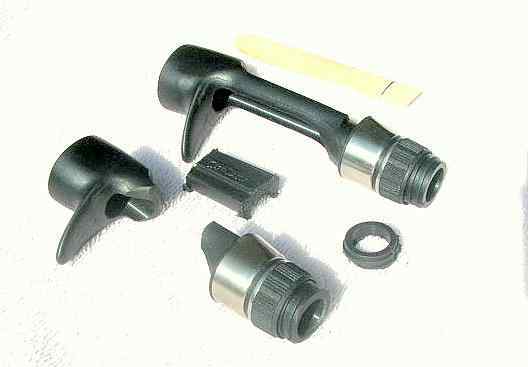
This gives the benefit of blank contact, is easier to install, faster and will always give you a stronger glue bond to the blank. The Castaway full exposed seat is shown here, we cut them up for testing skeleton seat designs long before there were commercial models, we found that blanks under 12 mm at the seat were uncomfortable to fish when cut up and that the larger the better as far as comfort. I have made skeleton seats to 18 mm.
-
Once upon a time there was a rod designer named Todd Vivian who had a very successful career at Lamiglas, he loaded up everything and moved to Florida to work at Mudhole. There was a very successful rod building company called Custom Tackle, one day he sold his business and moved to Florida and started working for Mudhole who by the way also had bought his company. All this happened at pretty much the same time, and it just happened that the MHX line came out after the fact. Coincidence?