spoonplugger1
Members
-
Joined
-
Last visited
Everything posted by spoonplugger1
-
My forever is 40+ years and counting, not a bad run in my book. Got my money's worth and then some. If I had to replace tomorrow, so what, I'm a rod builder.
-
Who said they were stronger? Every reel seat is held on by something, if that bond fails does the rest matter? I have been fishing for 65+ years and I have never seen any reel seat from any source or material fail due to a normal fishing load, how much force do you think the seats are under? Whatever you imagine it's probably way less, the same for the strain you think your guide train is really under. What we feel is because we are fishing holding the short end of a lever, the fish, line, and components are feeling the actual load, we are feeling the load times the length in a straight line from the tip top position to your hand at the lever fulcrum. There were tests done on bass rods and their components, where the rod were put under strain until the rod failed, at no time did the strain on any one guide exceed 5 lbs. the little short single foot guides you have near your rod tip can hold over 20 lbs. without deflecting, let alone being damaged or failing, that said just how much force do you think it would take to destroy the reel seat? We don't know, even blanks that that fail at 61.8 lbs. of load always fail because a tip top was destroyed some way or even pulled off, or the blank blew up. Sounds to me the components aren't prone to failure. If something is twice as strong when the other is more than good enough, is the money well spent, did we actually have a problem in the first place?
-
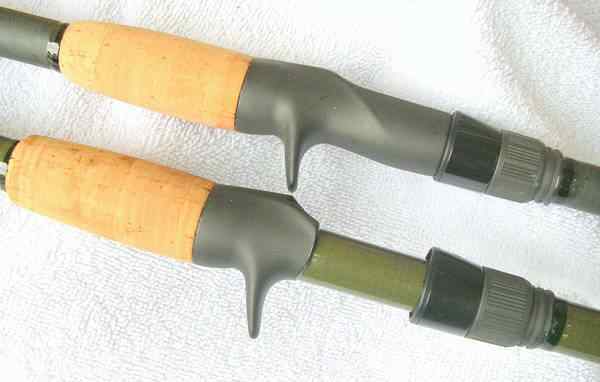
You can also just chuck up a drill bit or other straight rod long enough to hold your short grip, and shape it, than install on the blank as needed, I have lots of grips built just waiting for a rod to put them on. My favorite ergonomic shape on a Fuji TCSM skeleton on a Seeker BS 706S S-glass blank crankbait rod. Notice the center is a bit larger than the ends. Length, 5 cork rings, 2 1/2 inches. 180 it and you pretty much have the butt shape and length.
-
As shown above, the SP series, though it is probably Rainshadow's most popular is something you would use for popping and wading rods on the Gulf or as a crankbait rod, etc. for freshwater fishing, great kids rod for the times when they may encounter bass and panfish one minute and a catfish the next sort of thing. The lighter powers have been used for trolling trout and kokanee, great all arounders.
-
For a very long time now there has never been a way to safely sand the tip on the high end fine tipped blanks, they are having to be hand sanded by people who know what they are doing. The high-end rods that push the envelope as far as weight, performance, and blank wall thickness have to sooner or later see the writing on the wall and have to make choices. If you design a blank with twice the diameter using the exact amount of carbon or glass, you increase the stiffness by a factor of nine and change. 3.1416 X 3.1416 (pi). This is the reason glass blanks are all larger diameter, compensating for lower modulus with larger diameter to bring on the power and stiffness we want. Now though you have a blank with thin walls that when put under extreme stain would fail faster than then a narrower, heavy wall blank, but looking at the above, the small diameter blank to compensate for its diameter must use more carbon, this obviously make them heavier. An analogy, if you had a brandy snifter made with the same amount of glass as say your shot glass and dropped them both, which is more likely to survive? As modulus goes up you have to use less to keep the same power and action, this finer build can't be processed the same way as a lesser, heavier, lower modulus blank. It took NFC a considerable amount of time to find a way to not sand, but buff their high-end blanks to smooth the ridges, I can see the possibility that even this can't be done on some finer powered/walled blanks, it all involves a certain amount of pressure and movement to accomplish any kind of material removal. We of course have the option of not using the new materials and fishing sanded blanks if we choose.
-
Just had a bench rod building session, old off-road bike riders know what I mean, 3 hard ciders in and I had a bit of info on NFC rods that I hope will help. Lighter Jigs or TX rigs, blade baits, larger Z-Spooks, or stick baits, the MB 735 or 705. Jerk baits heavier than 1/8 oz., loves 1/4 oz. MB 664 Delta. 3/8 is max. Treble hook rod for small cranks and jerks, CB 704. 1/10 oz. Ned, weightless Senko, small Pop-r, soft jerks, 110 jr, SJ 703. Large cranks, spinnerbaits, chatterbaits, or jerks, MB 765-1 Neo.
-
If you are hand wrapping or have a reversible wrapping motor none of the ridged blanks are a problem. In the hand wrapper if you build with your grip to the left, just 180 and wrap grip to the right and you won't notice them a bit. Is your thread following or opposing the spiral is the issue. The NFC blanks aren't the only blanks with ridges we have wrapped before. The old UglyStiks, for instance.
-
Tackle Tour tested the MB 705-1 years ago, you'll find it in the review archives along with hundreds of others. The CB 704-1 would be my choice for a deep divers at or under 3/8 oz. Be advised that blank has an XF tip just like it's GLX counterpart did that it was derived from. The MB 705, MB 664, and MB 736 aren't that far apart in power, the tips are where the biggest change is, the 664 being the slowest, than the 736, followed by the 705. The MB 805-1 is the same power as the MB 736-1 but the tip is much faster. The MB 765-1 X Ray NEO is the monster of the group, and XF tipped, I've used it to catch Albacore Tuna, it's up there with the SW NFC rods people would use. Bass class I would put it in the MB 808 - 809 power range. There was a valid reason why it has been described as the "One" as far as versatility. Remember for the same power, the faster the tip the lighter the tip.
-
The X Ray SJ 736-1 is solidly in the MH power category, pretty dead center, the Action Angle is nearing XF. Not bad for a SJ blank designed to be a spinning rod. You do know the faster the action the lighter the tip compared to the power in the butt. Look in the catalogs, most properly rated XF blanks will throw a lighter lure offering than a fast or med fast rod will for the same butt power. If you bent a plastic pipe or 2 X 4, what action would it display? Is the tip light or heavy compared to the butt power?
-
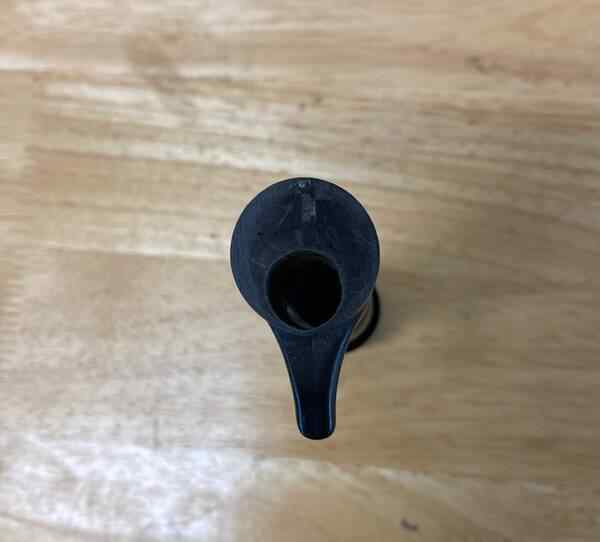
Not that long ago you could buy/build a rod with a Wiebe/Super Sticker grip that also helped with round reels as the hole running through the back of the reel seat was offset to raise the grip on top to help palming and pulling your hand closer to the reel on the bottom for the same reason. All the high end G Loomis rods used them and the Black Widow Edge Rods. Others used them off and on, they are now and always were U.S. made seats.
.jpeg.4df1f2c656937bb3fc166b705ee78300.jpeg)
-
I don't know how we can help you, the SJ 736 is one of the stiffer blanks and is no way a slow action. You have to have your definitions wrong. What is the CC Data power value and Action Angle of the rod you like?
-
10 second burst in microwave to liquify resin. It changes nothing.
-
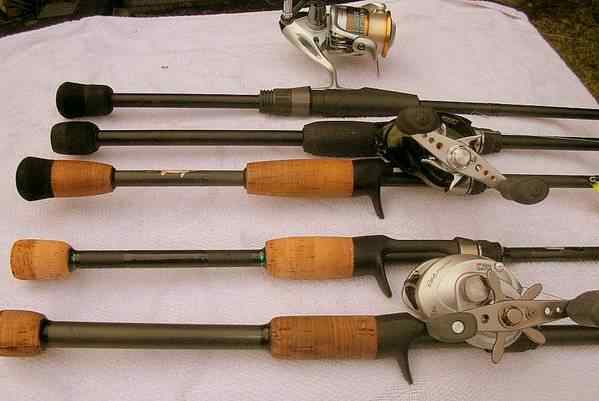
I use a fully exposed bottom Castaway reel seat for the same reason mentioned by crypt. The bent reel seats on the old rods were made to mitigate their design, and to straighten the line path to the guides, there was even one that had a hole in front and the guides ran on the bottom of the rod for a straight path. This is a picture of the Castaway reel seats on Swampland Tackle rods.
-
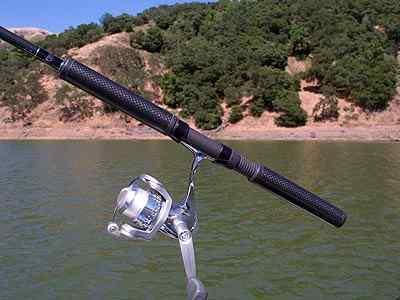
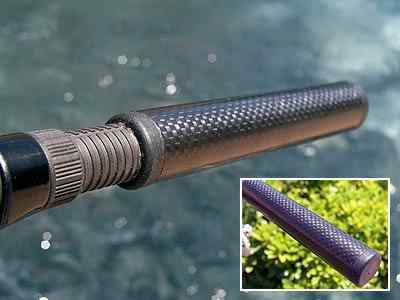
Grips like your description has been around for decades in many forms, the purpose is to be able to use the reel weight as a counterbalance to the rods tip weight from the guide train or the rods length, or both. For instance, the Skamania grip used by many steelhead as salmon anglers has been around in excess of 70 years, I saw them on the rivers when I was a little guy. Rogue Rods made a shorter version of this design and used them on some of their dropshot rods close to 20 years ago, using graphite tube materials. My version was much shorter since the blanks we were using were only 7 ft. long and really didn't need the grip length. You'd be surprised by the number of designs we see today that have been tried, used and dropped to be re-introduced later and accepted as a new concept and advanced to the norm on the rod racks today especially in the bass market.
-
What is Aaron Martens design? From what I saw on the Enigma rods, there is nothing there that hasn't been used for decades if you are talking about the upside down IPS/VSS grip, the foregrip on the casting rod has been used longer than he has been alive.
-
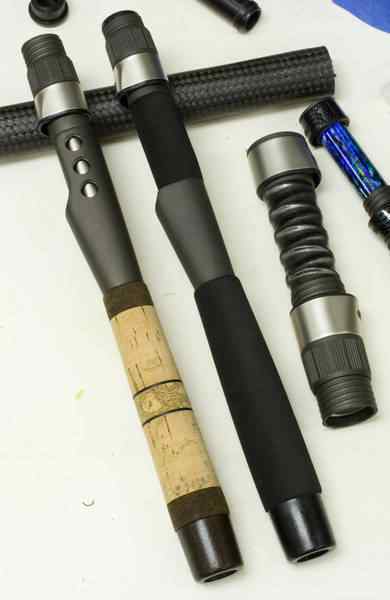
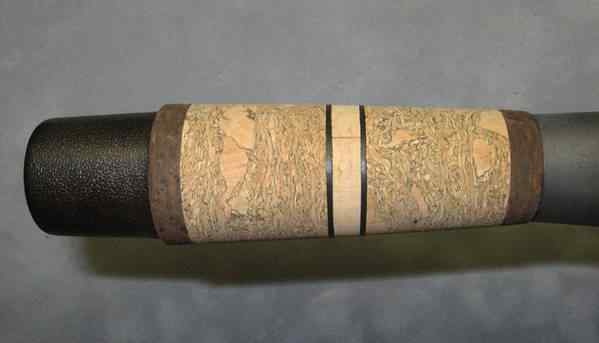
Grips done by Tom Kirkman, the shorter one was on his smallmouth bass rod for kayak fishing, all of them use a 20 or 22 mm Fuji NPS reel seat. and are extremely comfortable to fish. This style grip was popular on the old Lew Childe (Lews) rods. A grip built this way is less likely to slip out of your hands.
-
Saying that you need any specific length or type of rod to catch your prey negates all the time that same prey was caught before, its sales speak, it becomes what you can sell after all the media hype. That SJ 6400 IMX was the first dropshot designed rod, but then it was a vertical, shallow, cleaner water presentation back then.
-
I don't know, I still use my 5 ft. 4 in. G Loomis SJ6400 IMX, for the shallow and close stuff, a real feather wand.
-
Kites, If you step over to www.rodbuilding.org they are talking about your very concept, as you state it right now, however they also explain why what you see on the video is only part of the story. You can study something and get a result you like, but some very sharp fellows poke a few holes in the tested results that need a bit more work to hash out, with evidence of their own, it only becomes a theory or fact if under repeated testing and scrutiny by others they get the same result. Some of this concept was started by Emory Harry a couple decades ago when he was measuring the differences in rod oscillation, as you added more guides and also the difference seen depending on where those guides were placed on the blank.
-
The tin can phone is a vibration that changes state multiple times till it vibrates the air which moves your eardrum sending an electrical impulse through a nerve to your brain. If it a vibration in can be measured in Hz, vibrations per second. You are simply feeling irregularities in the pavement, minute pulls (tension) and releases. But call it what you want, as long as everyone understands your measuring system, ie: inches, pounds, gallons, etc. we will all get the same final repeatable result.
-
The concept that a longer rod is more sensitive is just simple physics, the same input on two objects of different lengths will effect the longer more, just like a longer lever can lift more. There is a reason steelhead and salmon anglers have always used the long rods. There was an extensive discussion between rod builders including many who are composite engineers maybe 15 + years ago on the rodbuilding.org site. Fastest way to find it might be to search Emory Harry as the author, all dates. An XF rod is more sensitive then a more moderate rod because of the lighter tip. We are simply feeling a difference in input, more or lack of, there are no vibrations, etc. that many talk about, holding a rod tip to your throat while humming God Bless America shows you nothing. Aleks is the CEO of North Fork Composites, if he hasn't got it right, Gary is right there to correct him.
-
Delaware, The guides were Permaglossed in place, they held up good enough that they have pictures of them trying to remove a double foot guide with a pair of pliers and the guide is already a twisted mess and still on the rod. Permagloss is a far better adhesive then epoxy finish which is a potting resin, tougher and more flexible also. Tom K. is a sharp cookie that can explain difficult concepts in a way most can understand and can demonstrate it too, developed rodbuilding.org that is the #1 forum out there and no other is even close. Rich Forhan has changed the look and development of bass rods, what you see on the racks today are things he was doing in the 90's for tournament champions, and he holds patents for many lure and hook developments besides. Steve Gardner brought micro guides to bass anglers, developing his concepts for a decade before it became aware to the rest of us. You can go on and on, there is enough accolades to go around.
-
Kites, The Aero seat in whatever size has a rear little pocket in it that hides a bit of the grip end so it makes it less important what the end of the cork looks like, the shallow tenon found on many grips to fit inside the back pocket of a trigger seat is hidden by the Aero pocket, or you can simply remove it, it also makes it handy when it comes time to maybe shorten a longer grip to meet your immediate needs, you can always use what is left as a foregrip or other purpose after shaping. The 16 mm Aero seat by the way fits carbon tube grips with a .920" interior. Right now Mudhole has some Kevlar tubing with a 3K nice deep red/black pattern that fits the 16 mm Aero perfectly, gives a great slick butt grip for kayak vertical or horizontal rod holders and the price is right. It's just nice to look at also.
-
Kites, Like everything you get to pick how dense of a foam core you pour, you can buy from 2 to the sky's the limit, For me from a durability standpoint, since the carbon sleeve has very little durability the foam should be at least 6 lb. and rarely do I exceed 8 lb. foam. I have gotten my foam at US Composites and other places. Back issues of RodMaker Magazine has articles on the varied ways pour foam cores, and I bet there are videos out there to since we have been doing it for well over a decade.
-
Single foot runners will make the rod look like 90+% of the rods built since the 90's. In today's world all double foot guides is the odd duck.