


Further North
Super User
-
Joined
-
Last visited
Everything posted by Further North
-
Fly rod and poppers. Seriously.
-
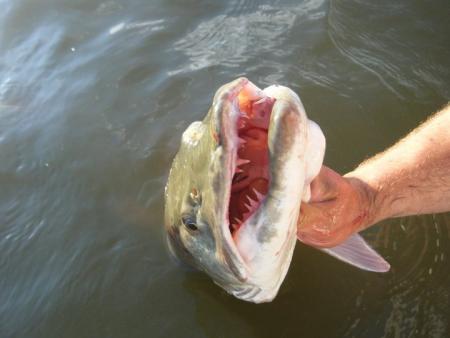
It's not a tiger. Tigers look like this: That's a 38" my friend Jeff from Red Cedar Fly Fishing caught in a local river last November. I was on the oars, and told him to chuck a cast at a mid-river log...and boom...
-
One to four weeks, depending on where you are, the weather, and water temp.
-
It's the end of spawning activity. The fish need to recover from the impact spawning has on them.
-
Casting gear is more accurate, casts as far, and it's easier to stay in contact with the line during a retrieve than on a spinning rod.
-
...and that's why I debarb all my hooks, right there.
-
I use casting gear - down to BFS - for everything I used to use spinning rods for. It's better in every way I can think of.
-
The most fun you can have catching panfish is with a 4 or 5 wt. fly rod and little foam spiders or poppers.
-
These all work on our local rivers. Not sure if they fall into the "bright" category.
-
You'll notice, particularly at the end of a long day on the water.
-
Other than the tools used to put the fly/lure in front of the fish, there's no useful difference between fly fishing for bass (or anything else) and using conventional gear. The process is the same: Find out where they are. Find out what they want to eat. Show it to them.
-
Even jerk baits aren't really my thing, but I get it. My favorite is small rivers in a drift boat...I'll take that over big open water every time.
-
Same here. I find the style of fishing on Lake Erie - which I understand to to be mostly jigging - to be a thing I don't care for. If others like it, that's great!
-
If you're 100% on a power boat, that means lakes, and that means Canada, IMO. If you were OK with river, and floating, the river mentioned above in Wisconsin from a drift boat, or jet are great, but you're not going to get a v-hull into the upper reaches of them.
-
There's so many open questions that make it difficult to recommend anything... What kind of fishing do you want to do? Rivers, lakes? Wading, floating, power boat? Conventional gear, or fly fishing? What part of the country (or Canada) do you want to go to? Is it just you, or will there be others with you? Will you be staying in hotel(s), are you looking for a lodge, or will you be camping? Will you be driving to where you fish, or flying?
-
Yes, both the fly and conventional angling books.
-
Sorry about the slow response, I just realized the notifications icon got moved... Great question: When I want the fly/lure/bait to have action on the pause, I use the multi-strand. It's amazingly supple. When I'm just pulling a fly/lure/bait (think Mepps/bucktail/spoon, etc.), the single strand is great. It's also great for turning over heavier flies on the fly rod. I tie a double fly with about 18" of space between them and it works great for that. Absolute truth. Same, but I use mono, and 50# on the 10 & 12 wt, #40 on the heavy 8. I'm curious why you say this? I've not had that experience.
-
Certainly a possibility. A couple of our rivers produce really dark fish, including the eyes; lake smallies here tend to be lighter. ...the rivers have so many crayfish it seems like the bottom is moving sometimes...
-
This book: Smallmouth Modern Fly Fishing Methods, Tactics, and Techniques...is flat out the best book on the smallmouth I've ever read. Yeah, it's got a focus on fly fishing, but tactics and patterning are the same for both fly and conventional fishing. The book is also available on Kindle, which I find very useful when I want to search for something. The In-Fishermen books are great as well.
-
We get a lot of red eyed smallies here.Fly tying, bait making, XC Skiing, stuff around the house...there's plenty to do.I understand. I do other things in these months.I'd rather be stuck in an airport with no hope of getting out for a week than go ice fishing. Mine too...but not through the ice. Pike on a fly rod is about the the most fun you can have on the water.I can't add a lot to what's already been said, except that in rivers - if they are eating - they are going to be where the feeding opportunities are, acting like any other fish in a river system. That means heads and tailouts of pools, mostly. Eddies along the banks are prime spots. Behind any object that acts as a current break. Gear for me, with conventional equipment is mostly heavy bass rods. I only own one "musky" rod, and it seldom gets used. My top three baits over time are a #5 Mepps, the one oz. Doctor Spoon and a Strike King Smokin' Rooster soft plastic. The latter isn't sold any more, but I have a huge stash of them (hundreds) and my own mold. I don't troll or use bait so I can't help there at all. Fly fishing for muskies is a thing in and of itself. It's gt little to do with other forms of fly fishing; you don't want delicate, subtle presentations and distance and power casting matter. 10 through 12 wt. rods are the rods to use, though a good, stout 8 wt. can work - in the hands of an experienced and "expert" musky fly angler. Reels need to balance the rod. Big fly rods get heavy when you make hundreds of casts a day, and an out of balance rod/reel rig will wear you down fast, plus be more likely to tear up shoulders and elbows. IMO, any advice that says to get one of the big, heavy reels like the Reddington Behemoth is terrible...unless the rod is really heavy and needs that kind of big, heavy counterweight. There's considerable difference between a musky fly rod and "regular" fly rod, even one used for saltwater. The flies are much bigger, and as already noted and angler is making hundreds of casts a day. The rods really need a different power curve to do that well. The rods need to be stout enough to get the fish to net ASAP. Muskies (and pike) do not tolerate long fights well, and the warmer the water is, the more this matters. They are at least as delicate as trout in this way, and we cut off our musky fishing when water temps get above 75°. There's debate about this in the musky fishing community, and while I don't preach about it like some do, I feel it's irresponsible to target them when water temps are above 75°. "Use enough rod" is a thing, and so is "Use enough net." Big nets are a must. Other boat tools that are a must: long (think 12") needle nose pliers, a good jaw spreader, and a good hook cutter have to be in the boat. Oddly enough, the best musky fly rods in the world are not terribly expensive, at least when compared to what a lot of people think regarding fly rods. All of them are (as of right now) less than $500. Bigger flies that move water, and get attention are the go-tos...and by "bigger" I mean 8" and up. Sinking lines of various types (I fish topwater on an intermediate sinking line) are the way to go. There's little use for a floating line in musky fly fishing. Hook sets with fly gear need to be strip sets. Trout sets will loose fish. Fly leaders for musky and pike are simple and easy - none of the more complicated set ups used for more conventional fly fishing are needed. 2' - 3' of heavy mono to a foot of wire work great. As noted above, subtlety isn't a thing. I use a perfection loop to connect the mono to the fly line - I don't trust the advice to cut off the loops and use a nail knot to connect to the cly line after losing two very good fish when a nail knot pulled the coating off the core of a flay line...and 3rd try to use a nail knot failed the same way when I tested it. I tie in a clip at the end of the wire to make changing flies easier, and to conserve wire. Wire leaders kick fluorocarbon leaders' butts. I've never seen wire fail, and I've seen at least a dozen failures with fluorocarbon - most of those from anglers trying to go too light with 50# to try to preserve some of the action of the fly/lure. Watching the line go slack on a potential fish of a lifetime because someone decided to go to light is a bad feeling. By the time fluorocarbon is heavy enough (80# - 100#) to give an angler some confidence that it can't get cut, they're so stiff that most of a lure/fly's action is lost, particularly is any kind of strip/pause, or jerk/pause retrieve is being used. ...or better yet, tie a foot of tieable wire into your main line. Almost all of my bass rigs are set up this way, all the time, with finesse type presentations being the exception. 25# wire does not, in my experience, spook bass an reaction type baits.


Important Information
We have placed cookies on your device to help make this website better. You can adjust your cookie settings, otherwise we'll assume you're okay to continue.