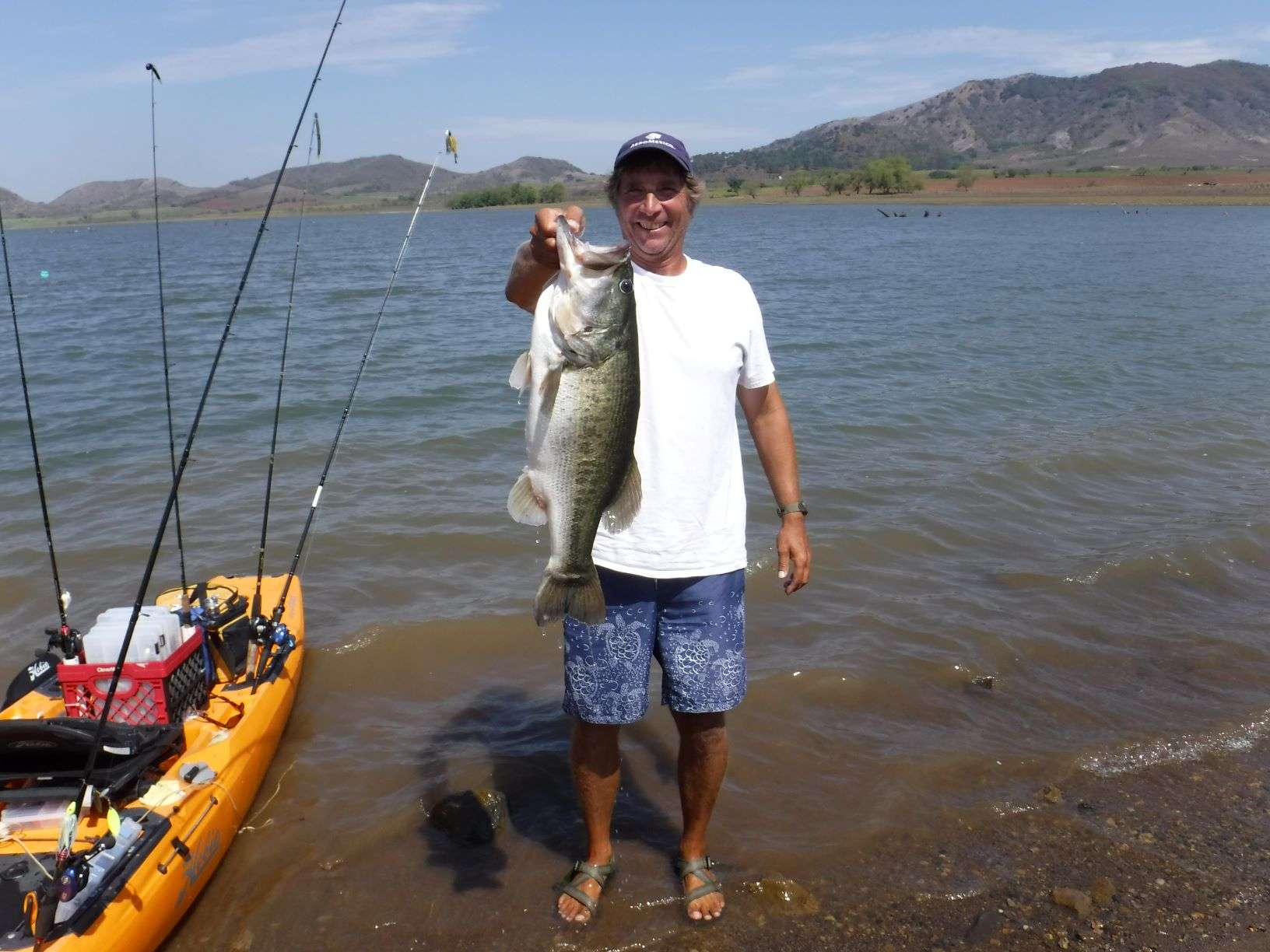

king fisher
Super User
-
Joined
-
Last visited
Everything posted by king fisher
-
Diawa J Braid.
-
The lakes I fish the surface temp. will be from 64 to 74 degrees depending on the time of day, every day form Oct. until April. I am more concerned with the water clarity.
-
Board shorts, T shirt, and sandals all winter long.
-
If a store has a single hook, I will take a look. My local Walmart in PV only has kids Zebco combo's with rod, reel, bobbers, hooks, and split shot all wrapped on a piece of cardboard. No other rods, or tackle. I still stop by and take a look every time I go there. One of these day's I just might need a snoopy rod combo, and I know just where to look.
-
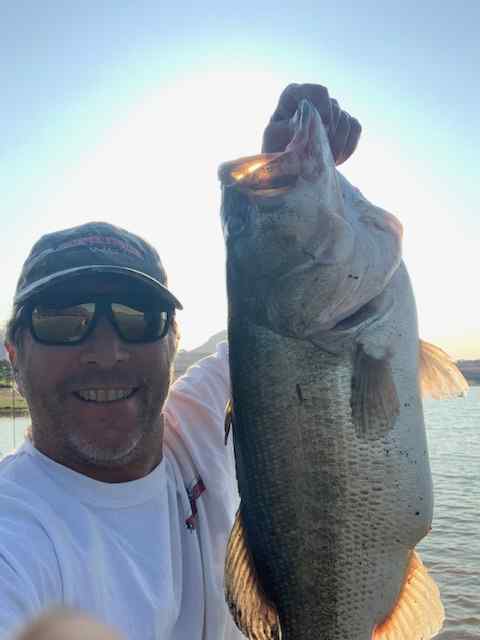
So far my biggest was 10.75 pounds, a little bit shy of 27 inches long, but the year isn't over yet. Caught on Junebug Zoom Magnum Trick worm.
-
I have never fished, them, but I know a guy that catches big bass with live waterdogs.
-
This is true, but I believe most, of the time an invasive species has a negative effect on the native species. Most of the time anglers simply adapt to the change, and don't really care about the effect on the native species, especially if the native species is small, does not bite topwater, and tastes bad. An example of this is the Northern Pike Minnow ( previously know as Squaw fish) in the Columbia River drainage. Introduction of bass and walleye have biologists concerned about the effect these species have on trout and salmon, but no one cares about the Northern Pike Minnow. They even have a bounty on them, paid by the power companies that built the dams, because they prey on the salmon and trout smolt. Why are people not concerned about them? Don't they have mothers too? The reason is their mothers are ugly, small, don't fight well, and taste horrible. Many trout lakes that have carp introduced, can still have decent trout fishing and eventually people will forget how much better the trout fishing was, and begin to think the carp had zero effect. After enough time fisherman will actually think the carp are native species. This doesn't mean the carp didn't have a drastic negative effect on the trout. Same can be said about other invasive species. Most weeds that farmers constantly fight, are invasive species. Will a farmer still have a wheat crop after a new weed starts sprouting in his fields. Yes but the crop will not have the same yield, combined with the extra expense of fighting the weed, his profit will suffer. Of course his crop is most likely a non native species, which shows weather an effect is positive or negative, can only determined by which side of the fence a person is standing on. If Martians came to earth and enslaved all humans, it would probably not have any negative effect on the universe as a whole, and the earth would continue to exist with a large variety of species existing in a balance state, for millions of years, but to us humans, the Martians would have definitely had a large negative effect. I like catching large mouth bass in Mexico, and admit to being selfish enough to not care if the bass displaced any native species. I am not saying the bass are in any way good for the native ecosystem, but I will say they get very big, hit top water lures, and taste great. Although I wouldn't go so far as legally plant them, I do practice catch and release on the waters that already have them in order to help sustain the population of these very large invading predators. I believe there should be an attempt to stop the spread of Alabama Bass, but I have to believe the cat is out of the bag, making it almost impossible to do so. Luckily the Alabama bass is a great sportfish. There are many other species of fish that could be far worse to sportsman's interests if accidently introduced. I would like to catch an Alabama bass some day, but I am willing to travel to do so. Please don't put any in Mexican waters, I am happy catching the invasive species of bass that are already here.
-
Uni to Uni is a strong simple to tie braid to braid knot. A Bimini on each end connected with a cats pawl, is a common connection for braid to braid for saltwater fishing.
-
The only bass I ever caught while ice fishing was with jig so Yay
-
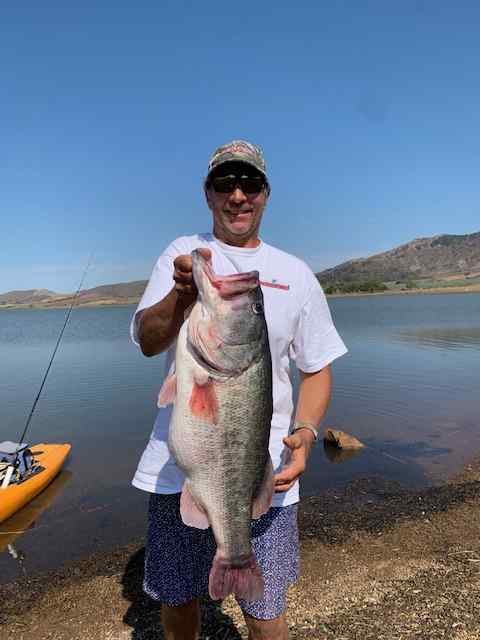
My goal was to catch a bass over 11 pounds. I got this one on May 7 my second trip of the year bass fishing. It was over 26 inches, long and close to 11 pounds, but had recently spawned ( notice bloody tail) and was thin for it's length. I landed two more bass right at 10 pounds each in June, and haven't been bass fishing since. I still hope to get one over 11 pounds before the end of the year, but right now I will be very happy if I simply get a chance to bass fish a couple days before then. I will have the same goal next year, and maybe I will be able to fish more then. It took me 40 years to break my old PB of 6 pounds, so another year to get past 10.5 isn't really a problem.
-
Much depends on the type of river you are going to be running. If it is a small river with very tight turns, and a steep gradient, a heavy welder tunnel boat with lots of horse power can work, but you better know the river well, and hope there isn't much other traffic. Going upstream will be easy, but going back down at the speed it takes to remain on plane can be dangerous. Lighter boats with less horse power work well on small rivers, or on ones that you are exploring and don't know what is going to come up around the next corner. There are some rivers that simply cannot be ran with heavy welded boats, and tunnels can even make it more difficult. Having a tiller for steering is also a big advantage on this type of river. When sliding around sharp corners, trying to work a steering wheel quick enough can be next to impossible. It can be done, but it is not easy. I have had to share small rivers with larger heavier boats that had no problems navigating the shallows, but made for some scary close encounters when meeting them on sharp turns. More than once being able to instantly make a 180 without tossing everyone out of the boat was the only way to avoid a serious accident. Larger rivers with big rapids, and short sections of very shallow water are perfect for larger boats with more horse power, or even inboard jets. For most situations, a welded boat works well, and will last many years while maintaining its value. I would prefer a welded boat for most salmon streams in the northwest. That said I would not feel I had an inferior boat if it was riveted. I really do not see any advantages with having a tunnel jet boat. The last tunnel boat I ran, we gave away to a guy that lived on the Nushagak River, because it had do much damage to the bottom by the transom, and none of the guides wanted to use it. It had only been used for a few season. It's top speed was slower, but took a longer distance to get on step, required more speed to stay on plane, wile being less maneuverable, than other flat bottom boats we had that were far older and the same size and make. I apologize for hijacking this thread, talking about river boats got me to thinking about all the adventures I had in my youth, and how much I miss living and fishing on the wild rivers of Alaska.
-
I am not a welder, and stand corrected. You obviously know much more about welding aluminum that me. I was only going on my experience with others welding aluminum boats. The welds always seemed to work great, for awhile right at the weld, but would develop cracks all around the outside of the weld, as time went by. The same people had no problems welding on welded aluminum boats with the same equipment. I was told, and assumed I was being told correctly the problem was the type of aluminum. This goes to prove if I listen I can learn something every day.
-
I always shimmed my motors with a piece of wood, to make them run as shallow as possible. They would be at the point where in rougher water I would get some slight cavitation, but at the optimal height and angle to run in the shallowest possible water. If you can afford to break a jet boot on a rock than the advantages of trim may be worth the cost. There are times I have hit rocky bottom, numerous times in one day, and done zero damage to the boot because it was not locked down. I have also seen guides forget and leave the motor locked down because they had previously been using reverse and forget to flip the lock down lever back, have their whole engine ripped off of the back of the boat when they hit a rock. Many lodges even go to the point of taking the reverse cup and lock down mechanism completely off of the motor. Many times when you hit bottom the reverse cup will come down instantly putting the motor in to reverse, causing you to come down off of plane in a place that is very inconvenient. Most of the time if the motor is not locked down you wont even come off of plane, and a person can wait until they are in deeper water to stop, pick rocks out of the grate and assess damages. If having a tunnel, and hydraulic trim is what works for you, than it is most likely the best set up for where you use your boat. I was only giving my opinions, and describing my experiences, giving the OP an alternate opinion that he can factor in while making his decision on a boat. I do not claim to know everything about jet boats, but after spending most of my life operating them, on numerous rivers, some that have never even been ran before, I do have strong and possibly biased opinions.
-
Airplane floats are not sealed. The compartments are lodge, and they have a big enough hatch, that a person can crawl into them to buck the rivets. If it were possible to weld floats they would do it. It can take all day to put a small patch on a float with rivets, depending on where the leak is and how bas of an angle you have to get the bucking bar placed correctly. I have watched many people with many types of welders try and weld riveted aluminum boats. they are able to make a decent looking weld, but within a few weeks that welds all get cracks around the outside of the weld. After seeing the same result time and time again. Mysef and everyone I know simply use Marine Tex or other similar product when fixing leaks., or Marine Tex combined with a patch if the hole is big. I'm not saying they can't be welded, but I have never seen it be successful. It is illegal to weld on airplane floats, because the FAA has never certified a welding technique for them. Floats are very expensive, and if there was a way to make welded aluminum floats some one would have gone through the paper process with the government and done it. There are composite floats now, that are tough and work well, but sell for $40000.
-
Optimal trim is nice, but when you hit the bottom, in the middle of the wilderness it is nice if the motor simply kicks up rather than tearing the jet boot off. You are also out of luck if the boat hits bottom, and gets a whole in it. It can be done, I have done it but not as easy as a flat bottom.
-
I know I'm going against the advice of many very knowledgeable people here, but I would not recommend a boat with a tunnel. I ran jet boats in many rivers of Alaska guiding for 30 years, and in my opinion flat bottom is the way to go with a jet boat. You need around 3 inches of water to run a jet boat, regardless if it has a tunnel or not. When the tunnels first came out many lodges in Alaska bought in to the new design, and now 25 years later, none of those same lodges use tunnels. I was so excited to get my first tunnel, being senior guide at the time, I had my pick of boats. I picked the brand new tunnel River Song lodge had just bought. Half way through the season, I switched to an old beat up flat bottom, and since then, I have only used tunnels when I had no other choice. The motor will be the first thing to hit bottom in a flat bottom boat, and if you don't have the motor locked down, most of the time, all that will happen is the motor will kick up and no damage will be done. You may pick up some rocks in the grate, and have to stop and remove them, but many times, by the time the motor goes back down, you are in deep enough water with enough speed to keep on going. In a tunnel boat the first thing to hit is the bottom of the boat, and even thick welded boats can get a whole in the transom been there done that. Tunnel boats take longer and require deeper water to get on step. They are less maneuverable in very tight quarters because the tunnel wont let the back of the boat slide as well. The water in the tunnel acts like a rudder making the boat more stable, less prone to slide, which can be a good thing, but you don't want to meet someone head on, and need to do a quick 180 in a tunnel boat, you better hang on tight, because it is very difficult to make a quick slide and change direction on a dime. You would think carving a tight turn, would be better than the back sliding, but if you really want to turn sharp corners, being able to slide the back end around a turn, will get you around tight spots that are impossible to make if you can't get the back to slide well. Another thing to consider is, don't rule out riveted boats. Welded boats are strong, and last forever, but are also heavy. A heavy jet boat requires more power to get on step, requiring a bigger engine, which means you have to go faster to remain on plane. In tight rivers, you want to be able to remain on plane at as low of a speed as possible. Big inboard jets look cool on videos, flying down skinny rivers, at break neck speeds, but if you want to operate in the smallest water, safely being able to remain on plane at the slowest speed, is what will get you to your destination. Another advantage to less weight is the amount of time it takes to get on step. Many times you only have a few yards of deep water in a hole before the next shallow riffle. If the boat is not on plane by the time you arrive at the riffle, you will come to a quick stop, with possible damage. A jet will go in 3 inches of water on step, but takes much more than that if not on plane, and even more while trying to get on step. Riveted boats are light because they use aluminum that is thin, and a type that can't be welded. That is why you can't repair a leak in a riveted boat by welding. I didn't know this until I had to help repair airplane floats. We always had to make patches and rivet the floats, which was very difficult to do. I would have to crawl inside the float with a bucking bar, while the mechanic would use the air gun to buck the rivets from the outside. The mechanic was an expert welder with aluminum, and one day I asked him why he didn't just weld the leaks in the floats. He told me that even though he was able to weld very thin aluminum, like he did with the fuel tanks, which were extremely thin, the aluminum in the floats was not the type that could be welded. They don't use the type that can be welded, because it has to be thicker in order to get the required strength, which means heavier, which makes welded floats and impossibility for float planes. He then laughed when I mentioned our lack of success welding aluminum boats. Basically if you want a lighter boat get a riveted boat. Welded aluminum boats with tunnels, are great boats, and I am not saying they aren't. I am simply pointing out, that spending a lot more money on an expensive welded boat with a tunnel, does not necessarily mean you will be able to get further up a river to unfished waters than with a less expensive flat bottom riveted boat. If you don't want to use a jet boat to the extreme limit, than get a heavy welded boat. I still wouldn't get one with a tunnel. The tunnel only makes the boat slower, take longer to get on step, require more fuel, and doesn't give you the ability to run in shallower water than a flat bottom. If you own a tunnel, and disagree with my opinion, I will ask if a tunnel boat is the only type of jet boat you have driven? If you have thousands of hours on both flat bottoms and tunnels, then please let me drive you tunnel some day, I would like to be proven wrong and would love to find a boat that will go in less than 3 inches of water. I believe the best riveted boats are made by Lund, but they do not have a model, that makes a good jet boat. I recommend a Lowe 1852 flat bottom, with a 40 horse tiller engine. A 40 horse engine will only put out about 25 horse power with a jet on it. Some companies now rate the horse power at the jet, so the horse power rating marked on the cowling can be as highly optimistic as 30 horse, but is still the same 40 horse engine if it had a prop. I realize my opinions formed by specialized situations on certain rivers in Alaska, may not apply to the water you want to fish. Others who have far different opinions, that fish in the waters you are wanting to go to, may be the people you should listen too. I just don't want you to think, you have to buy in to all the bells and whistles in order to access great fishing in shallow rivers. Sometimes simpler and less expensive can be better.
-
When I catch one.
-
Buzz bait- black. Pop R - silver, black back Floating Rapala - gold black back Rebel Jumpin Minnow - bone Tiny Torpedo - frog
-
It doesn't matter to me. As long as the Bait Monkey is allowed on the site, I will find a way to navigate it.
-
Banjo minnow is the all time best.
-
So many lures, so little time.
-
There has got to be a country music song in there somewhere.
-
Bounce a spinnerbait along the bottom, and hang on.
-
At some time during a day of fishing, I will try a spinnerbait regardless of the time of year, weather, water temp, type of prey present, or water clarity. I will give an A rig a try only if I notice similar size bait, schooled close together, or have already caught some bass on paddle tail swimbaits. I can almost always get some bites on a spinnerbait. For me the A Rig is either on fire, or nothing. Not much in-between. I will only give the A rig a few casts in an area before giving up on it. It is a rare day I completely give up on a spinnerbait. The A rig is a pain to cast, and I don't enjoy fishing it, but I have never experienced anything in fishing, quite like getting my arms almost yanked out of their sockets, when the big bass are on the A rig.
-
Another consideration that fisheries managers must take in to consideration before introducing foreign species is weather or not the species can reproduce in the new habitat, and if so, can they spread to other locations. Many lakes in the northwest are planted with rainbow trout which are not a native species. The lakes do not have a river system for the trout to spawn in so they grow to spawning age then die without reproducing. It is a very easy fish population to mange because they will not reproduce, and if fisheries managers, want to limit the amount of trout in the lake, they simply plant fewer trout or completely stop planintng them. These lakes are planted with far more trout than could be sustained by the food source in the lake, if they were to live very long, but since anglers are encouraged to harvest a limit, and thousands of anglers do, the food source in these lakes do not get depleted. For this reason the lakes are called put and take lakes. This put and take method of managing trout was also what was responsible for the numbers of giant bass in CA lakes. If a lake has a naturally sustainable number of rainbow trout, there are far to few trout to be a major food source of bass, and the trout can at times, essentially be a competing predictor to the bass. By planting thousands more small trout than what would occur naturally, the bass benefitted by having an abundant food source literally dumped into their dinning room. In this example both species of non native fish thrived, and both trout and bass anglers were very happy. The only complaint would be the cost of stocking so many trout to end up in bass stomachs, but the cost was offset by license sales from trout anglers wanting to take home a limit to eat. The trout were dependent on constant stockings, but the bass once established survived on their own. Tiger Musky cannot reproduce and can be planted in lakes that may be able to accommodate another large predator, but biologists are not sure how many are needed, and they want to be able to return a natural population in the future if that is what is warranted. It is far safer to introduce a species that wont or can't reproduce in to a new waters, especially ones connected by rivers to other extensive water systems in one or more states. These species can be managed simply by stocking more or less of them. Species such as carp, which reproduce in almost any ecosystem, and are almost impossible to eradicate. Should not be introduced without extensive study and debate. One persons favorite sportfish, may be hated by others, and some species are far more difficult to manage than others. We live in a democracy where all peoples concerns should be heard and evaluated before any species of fish are introduced.