Bankc
Super User
-
Joined
-
Last visited
Everything posted by Bankc
-
They've done okay for me in the past. But it always seemed to me like the DT series was just a bit better. They're not as bad as their reputation. But they they're hard to tie on when you know you have something better right next to it in the box.
-
In the heat of summer, when the bass are down 35 feet or more, that's often what I'll be doing as well. I rarely have much luck with it, but that time of year, even a little luck is better than no luck!
-
And sometimes I'll leave the split ring on, but just snap through the eye instead and let the split ring dangle. Really, it's whatever's easiest. I don't use heavy line for cranking, so I almost never bend out snaps or split rings. About 30lb braid or 12# mono/fluoro/poly is about as thick as I like to go, for depth reasons. So my line usually snaps long before any hardware failure. So I generally pick whichever sized snap will be the easiest to get on and off.
-
I haven't tried the Megabass, but I had a Savage Gear 3D Bluegill once (the soft one), and never got a bite on it. I eventually lost it in some brush and had no intention of replacing it. Another one of those baits designed to catch anglers, not fish, in my opinion. Even though there are a lot of bluegill in my lakes, I haven't had much success off realistic looking bluegill baits in general, other than an H2O Express 3.5 hard swimbait. And even then, I have to retrieve it so fast, that I doubt the bass know what they are biting. But it works pretty well when that type of bite is going. Now, bluegill patters on baits seem to work pretty well for me. As well as perch and trout patterns, which is odd since we don't have those in my lakes. But that's just one man's experience.
-
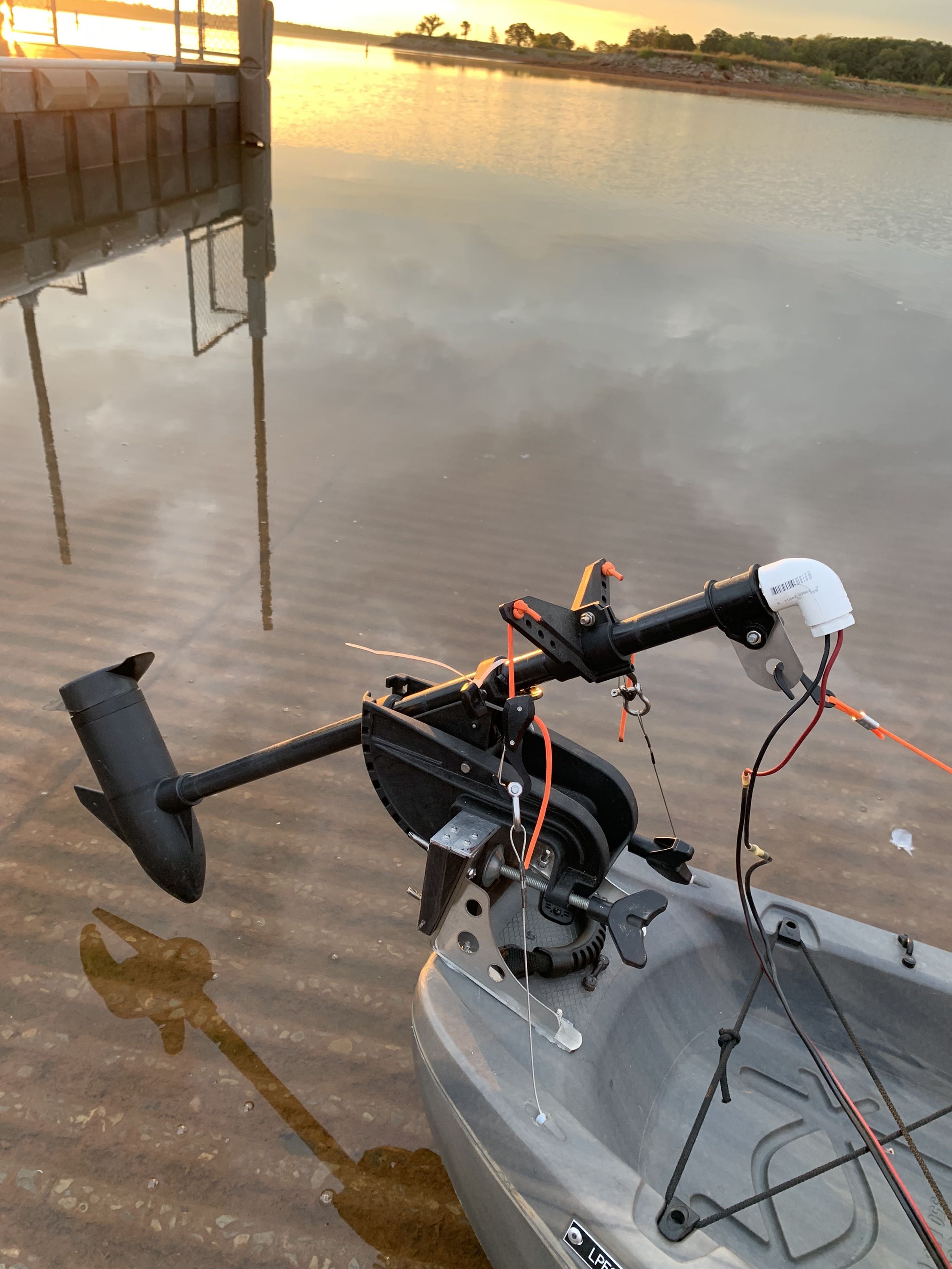
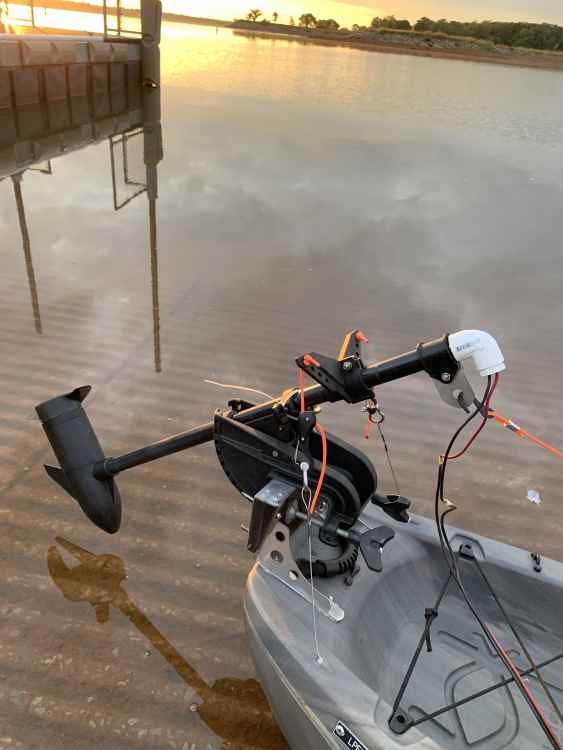
Well, it wanted to run the kayak at an angle with the motor pointed straight forward, which was a problem. But there's a set screw on where the handle connects to the shaft, and I just marked an offset location and drilled a new hole and set it up so the kayak ran straight with the handle pointed straight. Assuming there wasn't any wind or current, of course. Or you can just get used to pointing it at an angle. And I probably gained about 0.5 mph of speed when I moved it to the stern about a year later (going from about 3.5 mph to 4), so you lose some speed. And making tight turns were pretty difficult, but I usually did those with the paddle anyway. Still do. It went forward better than backwards. But again, I often do that with my paddle anyway. Also, controlling it while fishing took some talent, but I eventually learned to move it with my left elbow while fishing, which made things a bit easier. The worst part was the balance issue. Since you've got this chunk of weight sitting over the side of the kayak, it wants to make it very unstable. But I turned the battery longways, and moved it over as far as I could on the other side of the kayak, also right behind my seat. With the battery weighting 65lbs. and the trolling motor weighing 15-20 lbs, but sticking out much further, they balanced each other pretty well and brought some stability back. You can math out where to place everything, or just spend some time with trial and error. When I got the placement right, I riveted some eye bolts to secure the battery with bungee cords. All of that is to say that it definitely works, but there are a few drawbacks. But the benefits far outweigh them. You'll be happy you made the upgrade. The best part of it all was, it allowed me to get to the final setup I wanted, and by doing it all in incremental steps over the course of a few years, it didn't hurt me that bad financially to get there. I'm still using the same trolling motor I started off with and the old side motor mount is now my rod holder. After installing the side mounted motor, I installed a rear rudder. The cables and foot controllers for that would become used for the motor once I made the rear motor mount the following year. I also installed a PWM controller and used that for a while with the trolling motor set to 5 speed all of the time, using only the PWM box for speed control. Eventually, I removed the old speed controller entirely. My last upgrade was replacing that old lead acid battery with a lithium one.
-
I'd clean out the AR bearing and the shaft it goes around. With this bearing, you're better off using no oil than too much. Its purpose is to create friction, not to reduce friction like most other bearings. More than likely, you've got some old oil, dirt, or grease that's getting the rollers jammed, so they're not able to drop into place. A tiny bit of oil is good for them, so they can move up and down freely. But too much oil will prevent them from getting a grip on the shaft, and too thick of oil (or dirty oil or thick grease) will prevent them from dropping into place. More than likely, some lubricant has migrated onto them.
-
I've got a little chunk of scrap steel that I use. But really anything that's strong enough would work, so long as it doesn't have sharp edges and has some way of providing some resistance for the braid so it doesn't just spin around the thing. The good thing about heavy braid is sometimes you'll get your lure back instead of breaking off. Since I fish from a kayak, with thick braid, I usually wind up pulling myself directly over the snag first. And that's fine with me, as I'll often use a plug knocker to try to get it out anyway.
-
Try it without a motor first. See how it works for you. As noted, you can launch a kayak anywhere you can access the bank. So that makes traveling long distances less of an issue. Then, after you've gotten used to it, if you decide you do need a motor, the cheap way is to get a 30lb. trolling motor, deep cycle battery, and just side mount it behind your seat. My kayak has side rod holders that I placed some PVC pipes into and bolted a board across them and had one end of the board stick out just over the kayak to mount the trolling motor. It would probably run you about $300 for the motor, battery, and DIY mount including taxes. That's the cheapest way into a powered kayak. Though, make sure you don't have to register the kayak as well now, as that can also add to the cost.
-
Yeah, if it's just for the sonar, I wouldn't mess with a lithium. I run my sonar off a 7ah SLA battery. And while my sonar is supposed to draw 1 amp, in reality, it doesn't draw anywhere near that because I've routinely ran that sonar for 8 hours, non-stop. And since it's such a small battery, the weight savings aren't worth the price. Now if it's for a trolling motor, that's a different story. I saved 50lbs by going to a lithium battery.
-
Yeah, $100 for the motor. $300 for the lithium battery. Another $50 for the lithium battery charger. The shelf brackets were like $30. SS Cables and teflon tubes were another $50. The PWM motor controller and box were around $60. The 8 guage battery cables and connectors were another $50. The quick release connectors to the control cables were around $30. The foot pedal controllers were around $60, and the backing brace was around $30. And the control arm for the trolling motor was around $20. Plus a few other doodads I'm probably leaving out. And taxes. Always taxes. A side mounted trolling motor is much cheaper because you don't have to mess with all of the controlling mechanisms. But you're still looking at around $400 bucks for the motor, battery, charger, mount and connectors. And you've got a system that is inherently unstable and difficult to control. But I had that kind of setup for a year, and it's fine for a start. That's part of the beauty of doing it this way. You don't have to buy everything up front. You can spread it out over the course of several years if you like, while you slowly add to it, just upgrading one thing at a time. And no, that motors not falling off into the water. Both the mount and its attachment to the mount are rock solid. Even if it did somehow get loose, those two control cables are rated at something like 350 lbs each. The whole system may not look pretty, but it is WAY overbuilt.
-
As budget as possible? Then do what I did! A warning though, it took a long time and wasn't easy. First, I installed foot pedal controllers. That wasn't hard. I just bought new ones and swapped them out for the old foot pedal braces. I just had to drill out some old rivets and install new rivets. Next I ran some control lines from the pedals to the rear. That wasn't too hard, other than feeding the tube through the kayak, as I didn't have any access hatch in the rear. I just tied some braided fishing line to a screw and guided it from the entrance hole to the exit with a strong magnet. Then I used that line to feed a Teflon tube through and flared out the ends with a low watt soldering gun I use for plastic. Next I fed some SS wire, also coated in teflon (used as a saltwater fishing leader) from the pedals to the rear. For the mount, I used some SS shelving brackets and wood. I needed some extra support, so I created a SS metal bracket to mount the brackets on and soldered some bolts to it to keep them in place so I could secure nuts onto it from the outside and not have them free spin. Then I got that into place using the braided line and magnet method. The rest was just piecing it all together. It's probably more sturdy than most aftermarket setups, but not as pretty. It probably ran me a bit under $1,000 to do all of that, if you include the price of the lithium battery and trolling motor. The lithium battery alone was almost half the cost. Oh, I also added a PWM speed controller, and have that in a waterproof box next to my seat. Anyway, that's the short version. There are a lot of other steps I left out, but I could describe in more detail if you like. It took a couple of months to do it all, just working the occasional weekend. I did it in stages. Befire that I had the motor mounted beside me on a bracket, which was much cheaper to do, though no where near as convenient and with a side mounted motor, you lose some control and speed.
-
I fish standing timber a lot. And it can be a waste of time if you're not careful. As previously mentioned, look for structure on or near that cover. That's always a good start. Look for trees out by themselves. A grouping of 100 trees of nearly all the same size, tightly packed in with one another is a great way to waste and afternoon. But if you must, concentrate on the ones near the edge and any that stand away from the others. It's almost never worth your time to get in between the trees unless there are structural changes underneath. But if there's a channel that runs through the lot, fish any trees that come up to that channel. Bigger trees amongst a bunch of smaller ones are a good bet as well. So are ones with lots of branches under the water, or a different type of tree, especially if it's the kind that might have exposed roots. Horizontal cover is worth 10x's vertical cover. And a single tree, all by itself is worth more than 100 trees tightly packed together. Even if it's just 25 feet away from that 100-tree forest. Basically, anything that sticks out or is different is good. As for what bait to use? Well that depends on a lot of things. But anything you can pull through there without getting hung up is a good bet. Sometimes pitching a jig or T-rig at the trunk is a good idea. Sometimes swimming a weightless worm through it catches them. Sometimes a spinnerbait or squarebill pulled through the branches works. It largely depends on the mood of the fish and the type of timber you're targeting. Lots of small branches won't work for a squarebill, but a few larger, thicker ones might, as an example. During the summer and winter, I'm more likely to throw a jig or shaky head, as they can be worked slower than a spinnerbait. And in the fall when the bass are targeting baitfish, I'm mostly throwing a squarebill. In my local lakes with lots of standing timber, I've fished them enough to know which trees hold bass and which don't. So I'll see other guys come through and try to cast to each and every tree once. Meanwhile, I'll just concentrate on the few that I know are worth my time and try several casts to each before moving on. And I'll skip all of the others that aren't worth my time. I'll even circle back around to the same tree a few hours later. I've been to lakes with probably 1,000 trees in the water, and only 10-20 were worth your time.
-
More important than "best" knot, is which knot you tie the best. I have issues with the Palomar. Lots of people love it, but I have issues with it breaking on fluoro lines. I pretty much avoid it now when I can. But it still has it's uses. I prefer the Berkley Braid Knot for fluoro. It's easy to tie and holds stronger than the clinch type knots on fluoro. With mono, I use the Trilene Clinch Knot. Tried and true. My go to standard knot is the Fish N Fool, which I primarily use with braid, but will also sometimes use for mono and fluoro. It's just a reliable all-around knot. And if I'm tying directly onto a hook, and there's room for it (not all hook designs allow this) I'll use a snell knot and start by pushing the line through the eye on the same side as the hook. My belief is this gives the hook a tiny bit more leverage on hooksets, as when you pull the line tight, it'll want to kick up the hook just a bit. And there are a bunch of other knots I use depending on the situations.
-
I baby mine and always keep them in neoprene covers when not in use. I tear each one down at least once a year for a thorough cleaning and lubrication job. But if they get scratched, then I don't really worry about it. I'm the kind of guy who buys a reel and will use it until it's not worth repairing. I don't care about resell value, so I don't keep the boxes and stuff. I just care about them lasting a long time and staying in top working condition. My wife says I'm cheap. I say I'm resourceful.
-
Roland Martin, Jimmy Houston, and Bill Dance: My grandparents living room in the late 1980's and early 1990's. I'm don't really associate techniques or lures with famous people, because it wasn't those famous people who introduced me to those techniques. Most of the lures or techniques I know, I either associate with family and friends, or an endless stream of random guys at the dock that probably told me their names, but I've since long forgotten.
-
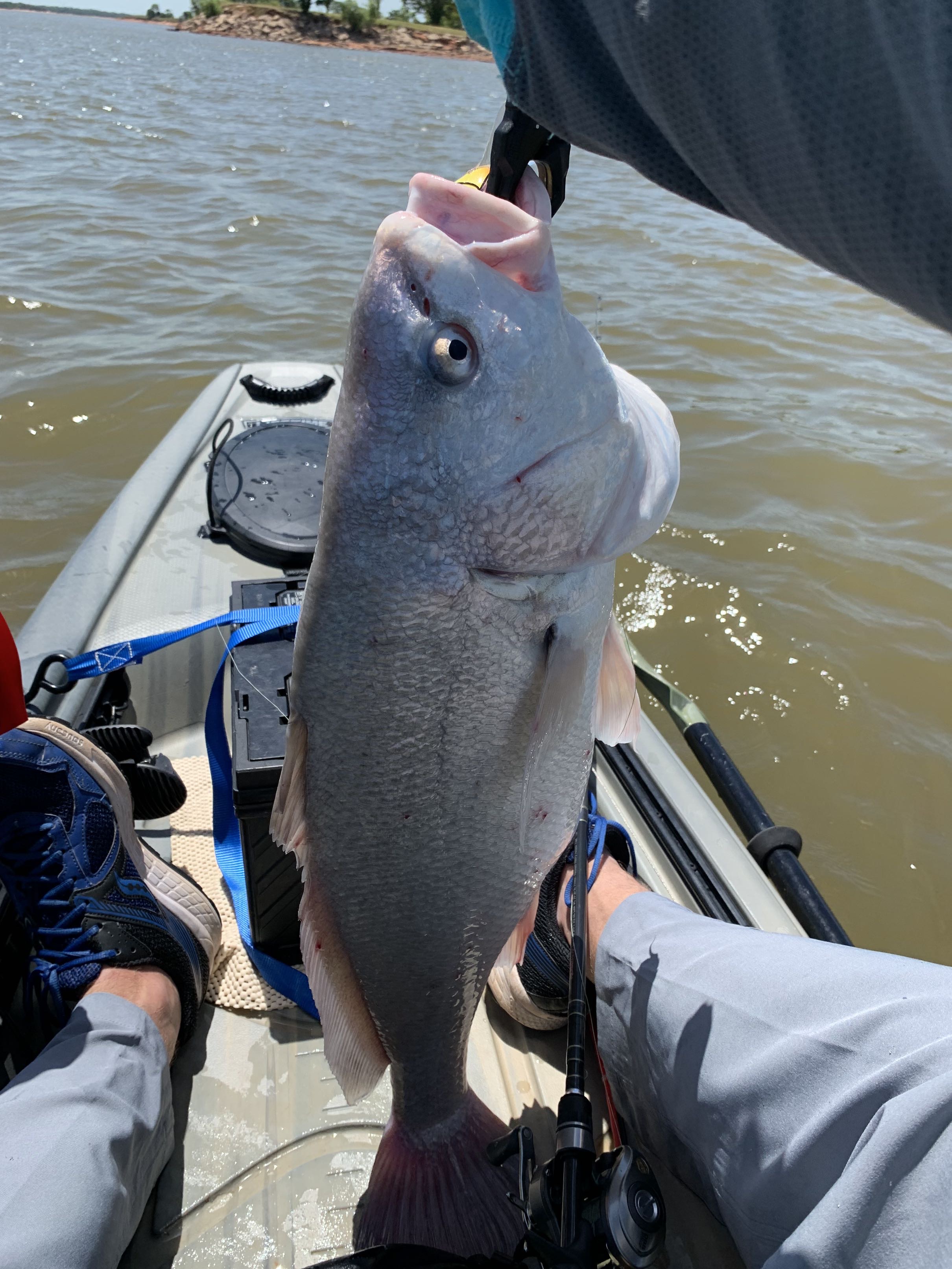
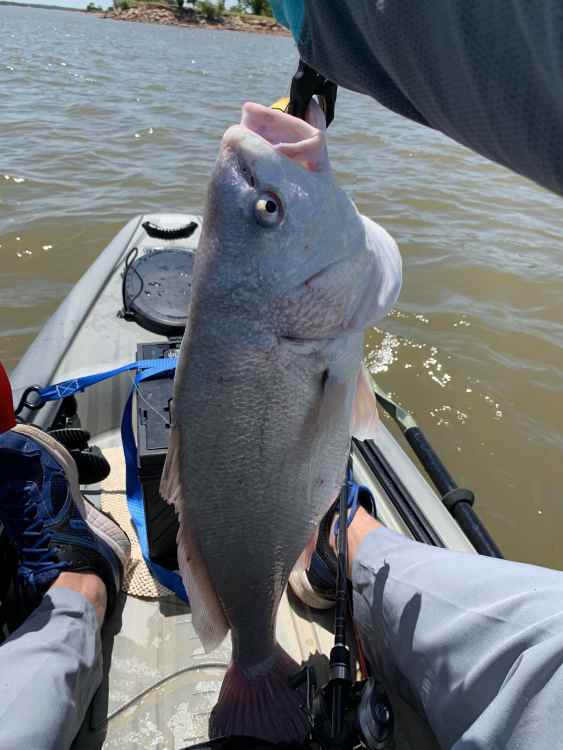
The weirdest for me was this 11lb. drum. What was so strange is that the lake I caught it in wasn't supposed to have drums in it. And it's not connected to any rivers or streams, so the only fish in it were put there by people. I've talked to a lot of people at that lake, and no one has ever heard of anyone catching a drum there before. I gotta tell you, when I first hooked it, I thought it was the biggest bass of my life! Or at least a fat catfish! Nope. Just a nasty gaspergou. I've lso caught a turtle and a crab in the Gulf. Though, the crab just got tangled on my line, so I don't know if that counts.
-
I've used all different kinds through the years, and they all seem to work pretty well. Some techniques I'm more picky about. But chatterbaits don't seem to mind, so long as the rod has the power to set the hook. Pretty much any Medium Heavy rod will work for me. You could probably get away with a stout Medium or even a Heavy rod if you're working a larger chatterbait. Same with line, though you'll want to match the line to the rod. In other words, you probably won't want to use a Moderate speed rod with mono, as that's just too much stretch to get a good hookset on a long cast. Sometimes, if the grass is really thick, I'll go for a faster rod. Sometimes if I'm trying to cast further, I'll go for a slower rod. Mostly, I just pick a rod that will work that doesn't already have something tied on to it that I plan to throw later, so I'm not having to retie more often than I have to. 3/4 oz. is a good all around size. I might go up or down depending on conditions, but that's my starting point. As for trailer, whatever you like. I tend to prefer the Keitech 3.5 swimbaits, but sometimes I'll switch it up to a rage craw or whatever I feel like at the time. So long as it provides plenty of action on its own, that 's about all I care about.
-
There's a local pond near me that you can usually find tons of baitfish swimming around. However, this is winter. So, you won't likely find any. I fish there just about every day, so I notice these changes. They're still in there, and they'll show back up in spring, but they're not swimming around being active right now. Our air temperature is in the 70's this week. But the water temperature is still really cold. So don't worry about it. This is normal. Besides, if you do introduce new fish, besides disease, it's going to be really, really hard to get those fish into the new pond without killing them by way of thermal shock. The winter is a really, really bad time to try this. Besides, bass don't hardly eat in the winter time anyway.
-
Those black and red post terminals up top that you're considering attaching bare wire to look like they'll also accept a banana plug on the top. I see those types of connectors on hifi speakers all of the time. That might be a more convenient solution for you.
-
Depending on the lake, dams can be good or bad. I don't think the drain would change that much. One thing I believe is the depth and clarity of the water mater as to whether the dam is worth your time or not. I don't have much experience with clear water, but in heavily stained water, a dam that sits next to 100ft. of water won't be a good spot to fish. But a dam that sits next to 25ft of water probably will be. My theory is that if the water is too deep for the bass to reach bottom without everything going pitch black on them, then they won't feel safe there. In any case, I'm not a huge fan of dams for bass fishing. They're better spots for crappie and catfish, in my opinion. I tend to look for points, flats, creek channels, or other structure that's not so large in scale.
-
I've never noticed it as causing a problem, and I anchor quite a bit. However, it's always windy here, so the sound of the anchor is nothing compared to the sound of waves crashing on your boat. And I'm honestly more worried about the shadow I cast than the sound of an anchor or waves. And the sound of something breaking the water once is a natural and common sound in the lake. Be it a fish jumping or a bird landing or taking off, it's not the kind of thing that I think would spook fish for very long.
-
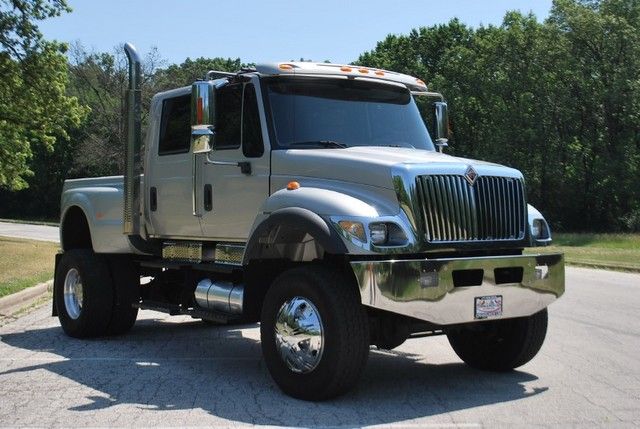
I've seen guys use 6" PVC drain pipes with caps on the end to transport rods. You also might be able to fit them diagonally in bed, if you don't have other stuff back there to roll over on them. A bed that's 5.5' long by 5' wide will have a 7' 10" diagonal. Or, just get yourself a real pickup!
-
I can see this, if you're fishing from a boat. If you're fishing into the sun from a boat, then you're fishing into the shade. And that's usually a good spot to be throwing topwaters early or late in the day.
-
Rip it up and let if fall! That's what I do. It's basically a weedless blade bait to me. Though, I don't do it often. Our water here is pretty stained, and you usually won't find much vegetation in deeper water. And I haven't had much luck with bladed jigs under any circumstance away from grass. But on the rare occasion I have got to use one, and had success, it's under this scenario.
-
In Oklahoma, and I know it's less windy in the Tulsa area than where I'm at in OKC, I don't think this would be a very good idea. Mainly because of the wind and waves. I occasionally see people out on paddleboards around here, but they always stick to the coves and you'll see them fall off all of the time. They don't cut through the water, so any waves will rock you hard and any wind will blow you around like crazy. They tend to spend more time swimming than paddling. However, you've already got one, so it might be better to focus on where and how you can use it. If you can find any small ponds that are protected from the wind and won't have motorboats or big waves on them, I could see this working pretty well. Like others have said, you won't want to bring much with you. And standing and trying to set a hook or fight a fish would probably be a bad idea. A kayak has a hull that digs into the water, so it's got some "grip" to brace yourself against. A paddleboard will slip out from under you pretty easily. But get down on a seat, and you'll lower the center of gravity, and make that a bit easier to handle. So under the right circumstances, I could see it having it's uses. It would certainly be easy to transport! I'd say take it out without any fishing gear and see how it goes first. That'll let you know if it's worth sinking money into to make it more fishing friendly.