Bankc
Super User
-
Joined
-
Last visited
Everything posted by Bankc
-
Most cheap baits seem to work pretty well for me. BPS and Academy's house brands have always done me well. I've even found several Ozark Trail (Walmart brand) crankbaits along the bank over the years, and I've caught quite a few fish off them. Though, for whatever reason, I won't actually buy those. But I do like saving those found lures for fishing areas where I know there's a good chance I'm going to lose my lure. I've also had a few higher-end lures that didn't run true or had other big problems with them. And while I know the manufacturer would probably stand behind their product and give me a free replacement, the effort involved in that process isn't worth it to me. I bet I catch more fish off cheaper lures. But I also throw cheaper lures in places that I wouldn't risk pricier lures, so it probably has more to do with the location than lure itself. I firmly believe it's less about what you fish than it is about how you fish it.
-
Yeah, my primary lake is about 10ft. below normal. Another foot and the last boat ramp will get closed and the lake shut down (again). We all need rain. Though our west coast friends have it the worst right now. I'm betting that the bite will pick back up in a week or so. I hope so for the health of the fish. The only problem is, usually once it starts to cool off, the winds come back. But adapting to conditions is what bass fishing is all about. If fishing were easy every day, I'd have lost interest in it years ago.
-
All of my neighbors are pretty old, so I don't think most of them could even get into a kayak. And while retired people are known to take up fishing, for whatever reason, my neighbors didn't get that memo. I've met quite a few kayak anglers out on the lakes. I've yet to meet one that I really bonded with though. Most of them seem to want to immediately want to jump into politics or personal problems like ex-wives and such. The kind of people that you immediately know drama just follows like a lost puppy. Besides, I kind of like being alone and doing my own thing when fishing. If I want to hang out with a buddy, I'd rather spend that time enjoying them deliberately and fully immersing myself into the conversation. When I fish, I want to concentrate completely on fishing with no distractions.
-
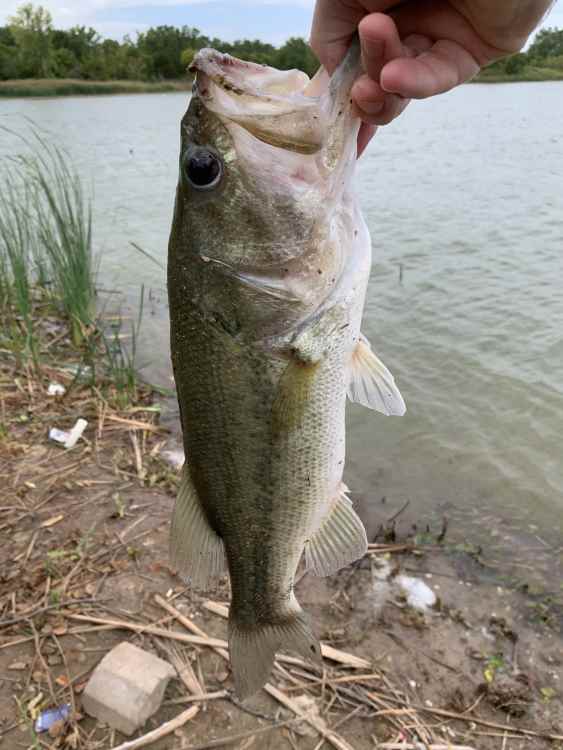
We had a nasty heat wave that lasted from mid July until mid September. It's still in the mid 90's. But it's finally cooling off a bit. As such, the bite has been shut down for almost two months straight. Fishing has been tough. Yesterday I caught one on my lunch break, which I fish every day and haven't had much luck during the heat wave, but a cold front had moved through and suppressed the temperatures and sun a bit. Not only was this bass pretty skinny for it's length, but he didn't fight at all! I thought I got a bite, set the hook, but then just kept reeling in what I assumed was a huge chunk of grass. Nope. It was a bass. He just went limp and let me pull him in. He didn't have the energy or desire to fight. Poor guy. But it's cooling off now, so maybe they'll have time to fatten up and the bite will pick back up.
-
Give it a try. There's a lot of "conventional wisdom" in bass fishing. And there are a whole bunch of people who buck conventional wisdom and prefer to do their own thing and do very well with it. You might like it better. You might not like it as much. Best way to find out is to give it a go. For me, a MH/MF rod is made for deep diving crankbaits.
-
Bank and kayak. I don't own a boat anymore. Though, for smallmouth, it's almost always kayak, as it's hard to target smallmouth from the bank where I live. And no waders. You will get stuck in the mud trying to do that.
-
I prefer the weighted swimbait hooks because it keeps the weight lower, and allows a faster retrieve without having to worry about the swimbait spinning. But I've done it before like you mentioned and it does work. It's just a bit more finicky. I tend to use the T-rig method for slow rolling in deeper water, because the weighted hooks aren't usually heavy enough to get the bait down deep and keep it down.
-
I will add that a lipless crankbait in grass is good, but prefer the bladed jig. Open water gets the crankbait for me. Also, spinnerbait works well for wood.
-
That's probably one of the big ones. VR glasses that link to your sonar, so you see an overlay of the live sonar image as you look out onto the water. There will also probably be electronic lures that provide some action, like random twitches, and recorded sounds of actual baitfish. There will be baitcasters that are impossible to backlash. And all boats will be electric. On the professional side, they'll have uniforms made out of flexible OLED's that will display full video advertisements for either of the two remaining corporations in the world, Amazon or Disney-Apple.
-
1. It changes with the season and lake. 2. Depends on what you mean by large. But if you're wanting something really large, a swimbait or glide bait might be a better option. 3. Yes, a stiffer rod is needed for deep divers. Otherwise, your rod will be bent halfway over just retrieving the thing and you'll have no give left should you get a bite and likely tear out the treble hook immediately. 4. It changes with the season and pond.
-
Smartphone. In Google Maps, you can download an area when you have service, and then still use the map and GPS features when you don't have service. Just type in the name of the place and then bring up the details of it. In the corner of the screen, look for the ellipses (...) and click that. It'll bring up a menu. Select "download offline map". It'll save the map of that area to your phone's memory, so you won't need internet access to use it.
-
They may be afraid to join. A lot of forums are toxic to women. This one seems to be pretty safe, but I think there's still a general anxiety about it. My wife doesn't fish, but she's active in several online things like forums and such. She has to hide that she's a woman for the most part, as she'll get online stalkers and harassment, and have to delete her account and start a new one from time to time for her own personal safety and peace of mind. It's quite a hassle.
-
Whatever they want. While I would definitely enjoy any pre-produced media, such as videos, podcasts, articles, whatever, I'd find most helpful a Q&A section. I've seen some forums do that. The problem always is, the pro loses interest pretty quick, and gets inundated with questions that go ignored. So they usually answer a handful and then disappear. I can't blame them. I'd probably do the same. They've got more important things to focus on. But just being able to have a conversation with one of your heroes, even online through text, is pretty special.
-
A week before, I'll start checking the weather. The wind speed and direction can affect my plans. Then, I load everything up the night before. If it's a new lake, I'll look up satellite images and depth maps if available to get a plan of attack. I don't worry about baits until I'm on the water. I also don't stick to my gameplan long if it's not working. Fishing is more about paying attention and reacting than coming up with the perfect plan. I'm wrong more often than I'm right. But a gameplan is as good of a place as any to start.
-
The good thing about brass and nylon is they're self lubricating. So if you don't keep up with your maintenance, they'll stay smoother longer. But you're right about aluminum. Personally, I've found that what makes a smooth, long lasting reel is less about what the gears are made of, and more about how well it's taken care of and how tight the tolerances are in their production. With these modern drag systems, you're unlikely to be able to put enough force on the gear to start stripping the teeth. But if the gears aren't aligned properly to begin with, you'll wear out the teeth just using it normally. Personally, I don't care about what the reel is made of, so much as how it's made. My Abu Zeta with a plastic composite body has held up to far more stress and has remained much smoother than my aluminum body BPS PQ2, just as an example.
-
The cheap way is PVC pipes (1-1/4" or 1-1/2") and zip ties. Or you could buy premade rod holders and zip tie them on through the holes in the H Crate. Hobie also makes rod holders for the H Crate you could buy and add on.
-
Standing timber is going to be my "favorite" because it's largely all there is around here. Why it's not a true favorite? It's tough to fish. Usually, it occurs in bunches, and the fish will be ignoring most of them. So it's really easy to waste time picking apart empty trees. You have to find the ones that sticks out in some way, as they're the ones likely to hold fish. And then, when you've located them, you have to figure out how to work around all of those horizontal branches. In a perfect world, bridge pylons would be my choice. You've got a choke point, structure, cover, your choice of depth, shade for yourself, and noise from traffic to mask whatever noise you make. But they're pretty few and far between around here.
-
Taper is how quickly the rod narrows as you go from butt to point. Action is how far down the rod it bends under normal load. They're kind of interchangeable, since the taper of the rod is largely what controls its action. But action is the correct term. Taper is correctly defined in terms like diameter and length, radius and length, degrees, or maybe something like #2 if it's standardized. It's describing the dimensions of a cone. But that's semantics that'll make no one happy. So for practical purposes, they're largely interchangeable. Even power and action are somewhat interchangeable. Just know that there's slow, moderate, fast which describes how far down the rod it bends, and light, medium, heavy, which describes how much force it takes to bend.
-
Here's how I decide. First, I try to figure out where the fish will be. The depth that I'm fishing and the type of cover that I'm fishing will eliminate most of my lures, so I have a much smaller selection to choose from. Next, I'll try to determine the fish's mood. If they're more aggressive, I'll go with a fast moving, reaction style lure. If they're not aggressive, then I'll go with a more subtle presentation. Maybe something smaller, slower, or something that makes less commotion. After that, I'll determine the color, based on water clarity and how cloudy it is, also taking into account the mood of the fish. Sometimes if they're not as aggressive, I'll go with a more muted or natural color. If they are aggressive, I'll go with a very bold color. This will eliminate more lures. From there, I typically will only have a few lures left in my tackle box. I will then choose the one that worked best for me the last time I was in a similar situation, or one that I'm most familiar with. From there, it's all about seeing what works, and what doesn't. Sometimes your guesses about where the fish will be and the mood they are in are all wrong, and you'll have to start over. How long do I give something a try before switching? It depends. But usually if I don't get bit after 5-10 minutes, I'll change either spots or lures. Every cast, I change my retrieve, speeding up, slowing down, adding pauses, etc., until I find out what the fish want.
-
I don't have much luck on dropshots around here. These lakes are heavily pressured by the Bobber Bobs, so I think most of these bass are conditioned to avoid minnows and worms just sitting in the middle of the water column. That, and our waters are very stained. However, what luck I have had has come from hopping or dragging them very slowly across the bottom. I can't seem to get bit just dropping them onto structure and letting them stew, motionless, like everyone else suggests. I've tried scents, rattles, even glow in the dark soft plastics. The scents might help a tiny amount, but who knows. Really, drop shots are a desperation move for me, when Ned rigs and shaky heads have failed.
-
I could see sanding the hull being a thing for racing kayaks and other longer, thinner designs. That's where speed would matter, and you wouldn't be hitting rough objects with it very often. But on a fishing kayak, they're going to be slow no matter what you do. They're built for stability, not speed. I will say, I gain about 0.2-0.3 mph on my kayak by pulling the transducer out of the water. It dangles over the side and creates quite a disturbance (TripleShot transducer). Much more so any all of the scratches combined, I'm sure. So I wouldn't guess I'd get more than a 0.1 mph boost, if that, if I completely smoothed out my hull. As noted earlier, you could easily repair scratches with a soldering iron and some extra HDPE stock. Or, if you wanted, you could melt some HDPE in some acetone to form a thick paste, and then apply it over the scratches. The acetone will melt the plastic, and as it evaporates, it'll allow the plastic to reharden.
-
None. The Arkie style (I prefer the SK Structure Jig, but also use Arkie brand sometimes) are pretty close. But they still get hung up in rocks too often for me to want to throw them around small boulders and large rocks. And they don't come through thick weeds as well as a swim jig. But they're about as close to an all-rounder as I've come across, and what I throw the most.
-
I grab the lure, not the fish. Once you have a firm grip on the lure, they can thrash all they want, and you won't get hooked, unless you let go. I'll usually grab the line and slide my hand down to the lure very quickly. Sometimes I'll wait for them to thrash, and them move immediately afterwards. They typically will take a break from thrashing for a second or so after a spurt, so that's a good time to move if you're quick. If need be, I'll grab the fish by the body. It's pretty easy to do in a kayak, since you're already sitting level with the water. Just be weary of their dorsal fins. If it's a big one, I'll often slide my hand down its head to push the dorsal fin down, and tuck it under my armpit like a football with its belly pointed at the sky. I'll also lean forward, so if he does start to get loose, he'll slide forward and not poke me with the dorsal fin spines. And when you grab the body of the lure, grab it hard and fast with confidence. Often they'll shake about the second they feel it start to move, so moving without conviction is what'll get you hooked. Always assume the fish is about to thrash. So move quickly and take control of the situation. Fear of getting hooked is what will get you hooked. It's all kind of hard to explain, but of all of the times I've been hooked, it's never been because of a fish. It almost always comes about because I left the baits on the rods and tried to dig through them or got snagged or missed a hookset and the lure flew back at me. On the rare occasion, it's been the other guy I'm fishing with not paying attention to his cast. But from a hooked fish? Never.
-
Lots of research has been done recently on weight gain. For years they thought it had something to do with calories consumed vs. calories burned. And this makes logical sense, so no one really questioned it for 70 years. Then finally, someone started to test it and the new data suggests that what causes weight gain isn't calories, but hormones. And there's a bunch of hormones that effect weight gain in different ways. But the big one is insulin. Insulin triggers the body to convert calories into fat, and insulin production is stimulated by sugar intake. And this makes sense looking at historical weight trends. As sugar, and more specifically high fructose corn syrup, consumption has increased dramatically since the 1980's, so have waste lines. Another thing they've discovered is that fat cells live for around ten years. So once you've created a new fat cell, it takes about ten years for it to die off. It can shrink and swell during that time, making you gain or lose weight. But it'll still be there. So you'll be at a high risk for weight gain for about ten years after first losing a bunch of weight.
-
If you're not a professional, then do what's most fun for you. Some people chase numbers. Some people chase size. Some people like to constantly fish new lakes with new challenges. Some people like to master one lake. Some people like to catch fish any way they can. Some people like to learn new techniques. And some people just like to practice casting for distance or accuracy. Whatever brings you the most joy is what you should be focused on. And if that changes with time, then change with it. Me? I enjoy being out in nature. I'd rather fish a lake in the woods with no fish in it than fish lake in a busy city park loaded with 10+ pounders that bite anything you throw at them.