Bankc
Super User
-
Joined
-
Last visited
Everything posted by Bankc
-
Especially on a 1-1.5 acre pond. On a big lake, visibility is a bigger deal. They may have to travel a ways to find you. On a small pond, it's a whole lot easier to drop the bait right on their nose. I'd go with T-rigged Zoom 6" lizard in junebug. You'd fish it the same as the Senko, but you get more action and vibration underwater, which might help. And if it doesn't, you could start ripping off appendages until you're left with an ugly Senko. Versatility. If you can cast it far enough as is, I'd go weightless. Otherwise, I'd add just enough weight to get it out there. The slower the fall, the better. As for the retrieve, try everything. Swim it in the middle. Slowly drag it along the bottom. Hop it up and down like a jig. Burn it across the top. Swim it like a jerkbait. Let the fish tell you how they want it. I'd just keep circling the pond until you find the sweet spot. The good thing about small ponds is you can fish the whole thing over and over again, every time you go out.
-
I did some research on these a year ago. Ultimately, I decided against it. But the one that got my attention was the Vexilar SP100. The reasons are, it was cheaper than the Deeper, by a good margin, and it had wi-fi connection versus Bluetooth. Bluetooth doesn't have a long range, and from what I was reading, a lot of the Bluetooth enabled fish finders would get disconnected if you casted it very far, making them not good for much other than fishing live bait from a dock. The Deeper has wi-fi too, and if the price difference doesn't bother you, that would probably be the way to go, as they're a bigger company and they are a bit heavier invested into the technology. So I'd assume they have better support. Though I'll be honest, none were without their faults. I read a lot of complaints about all of them. So I ultimately passed, which was an easy decision to make, because that's when the kayak bug bit me.
-
Nah. They're pretty fragile and break easily if you bend them. In a reel, they won't get bent, so they'll last a long time. In a drawer, other stuff will rest on top of them and bump them around, so they have a lot higher probability of getting destroyed. Plus, you'll probably start to notice them going bad in a reel, as you'll find yourself having to tighten the star nut tighter and tighter to get the same drag pressure. So you'll have time to order new ones when the old ones eventually get worn out. Plus, by then, there will probably be other parts that need replacing as well, like bearings and maybe gears. And just because the drag isn't holding like it once was, doesn't mean the washer is worn out. It could be that it's gotten oil or grease on it. So before you decide to buy new ones, clean your old ones. And when you have them out for cleaning, you can feel if the texture is worn off or not.
-
No. Not fishing stuff. I like to frequent pawn shops and thrift stores, and have found a lot of good stuff in both over the years. I've even made a fair bit of money buying and reselling stuff. But never anything fishing related. If they have anything, it's usually a 30 year old, beaten up combo that they want quadruple what it's worth.
-
Most of my rods are 6'6"-7'. But that's just what I like, regardless of where I'm fishing from. For the most part, I don't feel like kayaks need special rods. I do, however, have a 5'5" pistol grip rod for poppers and walking baits. I find the shorter rod helps with popping the rod from a standing position, since unlike a boat, you're pretty much standing level with the water. If you stay seated, then it doesn't matter. I've thought about a shorter rod for jerkbaits as well, but I don't fish them often enough to justify buying a rod only for kayak jerkbait fishing. So I just use a 7' rod for that and pop the rod more to the side than straight down.
-
Yeah, that is the thing with Zebco. Their quality control is pretty atrocious. When I got my latest 33 combo at Walmart, I had to go through every one they had in stock to find the one reel that actually had a properly functioning drag. Then I had to go through all of the rod tips, and swap tips (two piece rods) to get the one tip with straight line guides. Definitely worth the $10 I paid. But you gotta keep a finger on the line, because that rod has the sensitivity of Archie Bunker.
-
Yeah, I wind up using different knots for different lines. I use the Fish n Fool for braid. The Palomar more fluoro and co-poly, and the improved clinch for mono. In my experience, those seem to be the best for knot strength for each line in the diameters that I typically use. Though if you go up higher or lower in diameter, sometimes you have to switch out knots again. What works best is often what you can tie the best, so you really have to just experiment to find out what works for you. I keep loosing spinnerbaits. I use braided line and tie on a mono leader to keep the braid from getting wrapped up in the blades. But then, since I'm pulling it through standing timber, the mono gets nicked and I don't check it as often as I should. Then I bomb it half way across the lake and for a split second think, "man, that was a good cast" before realizing what I've done.
-
I know I'll go through periods where I'll fish one type of lure a lot more than another. But I think that has more to do with what I like than what the fish actually like. The last couple of years I haven't been too much into T-rigged worms and craws. They just haven't produced for me. But I've talked to quite of few other anglers at the docks that say that's been their No. 1 bait on the same days I couldn't get a nibble. Then I'll tell them that they really seemed to be keying in on cranks and spoons, and they'll tell me that they can't buy a bite on those. To be fair, I think most of the fishing pressure on my local lakes come from worms, minnows, and other live baits. Which thinking about it now, could help explain why finesse fishing never seems to do me much good.
-
Could be a hybrid. Unlike smallmouth and largemouth, which rarely hybridize in the wild, spotted bass and largemouth hybridize fairly regularly, from what I understand. Much like Florida and Northern Largemouth, which at one time were considered different strains of the same species, but now are generally considered two distinct species. On my local lakes, it can be hard to tell. Many, if not most, black bass seem to be hybrids, and have a few features of both, none of them very distinct. Maybe one in three are distinct enough to make a fairly definitive identification. But I bet with DNA analysis, you'd probably find out that even fewer than that are genetically pure.
-
You might check out a stand up paddleboard, or SUP. The thing to keep in mind with standing in any of these, is how well do you balance? A pro skateboarder at the peak of their career can probably stand up and fish on a floating cooler box. Later in life, my grandfather couldn't even stand up in a pontoon boat on a calm day.
-
I love Zebcos! There's nothing quite like the feeling of landing bass after bass on a Zebco 33 combo while the guys around you are skunking on a G. Loomis and Metanium. Bonus points for holding it upside down. That drives them insane! I only own the one. I keep it mainly incase I want to take someone fishing who doesn't have much experience. But every once in a while it's fun to pull out when you've found the juice and a bunch of other anglers start trying to crowd you out.
-
4 miles, ain't bad! Especially if you haven't gotten used to it yet and built up those muscles. Also, that's a nice looking yak! And yeah, you have to keep your head on a swivel in a kayak. Jet Skis are bad, but the worst are inexperienced boaters in new boats. You have to anticipate potential problems and react before the problems arise, because whatever reactions you make are going to be slow and whatever mistakes they make are going to come at you at high speeds. And I am praying for 9-10mph winds with gusts at 16! That's calm where I live! I've been out several times in 20-25mph sustained winds with gusts at around 35-40 (Don't do that, by the way. I sufferer from what doctor's call "stubbornness" and "stupidity"). The trick in higher winds is to go out with the wind blowing into your face, so when it's time to come back in, the wind is at your back. And make sure to do your homework and see if the wind is going to change directions while you're out. That can really help or hurt you.
-
8-12# in fluoro, mono, or co-poly is good. 30-40# in braid. Each line has it's advantages and disadvantages, and a lot will depend on what lures you're throwing (how deep they dive) and what rod you have it paired with. But mostly it's a personal preference thing. You just have to try something and find out if you like it or not. What you're wanting to do with balance how much line stretch you need with how much rod flex you have. And using the line's resistance in water (line thickness, though with braid it's shape will also determine drag) to help control depth and how quickly it gets down.
-
I've build several amps. But I generally just build them if I have a specific reason (like they don't make what I'm looking for, or doing it on commission), as I've found it's a lot cheaper to buy one prebuilt by someone else. So now I do more amp repair than build from scratch. At least then I have a chance to flip it for a profit when I'm done with it. Or at least break even.
-
Crankbait. Deep, shallow, big, small, anything with a bill and a wobble. Most of my other lures seem to work best in one or two situations. But crankbaits tend to produce for me anywhere and anytime.
-
For buzzbaits, as fast as you can get. For spinnerbaits, whatever you have. For spinnerbaits, I usually like something in the middle, like 6.8-7.1. Sometimes you'll burn them and sometimes you'll slow roll them. It doesn't matter what ratio you choose because some days it'll be the right one, and some days it'll be the wrong one. But even if it's a day where you have the wrong ratio, you can usually make it work. I've fished buzzbaits on lower ratio reels before. It's not too hard to keep them from sinking once they get on plane, but the big problem is getting them up to speed in the first place, after they enter the water. So the faster ratio really helps there. I like a minimum of 8:1 here, but you can make do with a slower one if need be. You can get a buzzbait up on plane quicker by sweeping your rod as your start to reel if need be.
-
Yeah, it'll get you. My Kayak cost me $500 by itself. The extras ran me another $1,000. I'll say this though. I used to own a 2 door coupe and it was a lot easier to car top it than with my SUV. The SUV is a lot higher up and it's a huge difference trying to control a kayak that's shoulder height versus one that's above your head. It's at least twice the work.
-
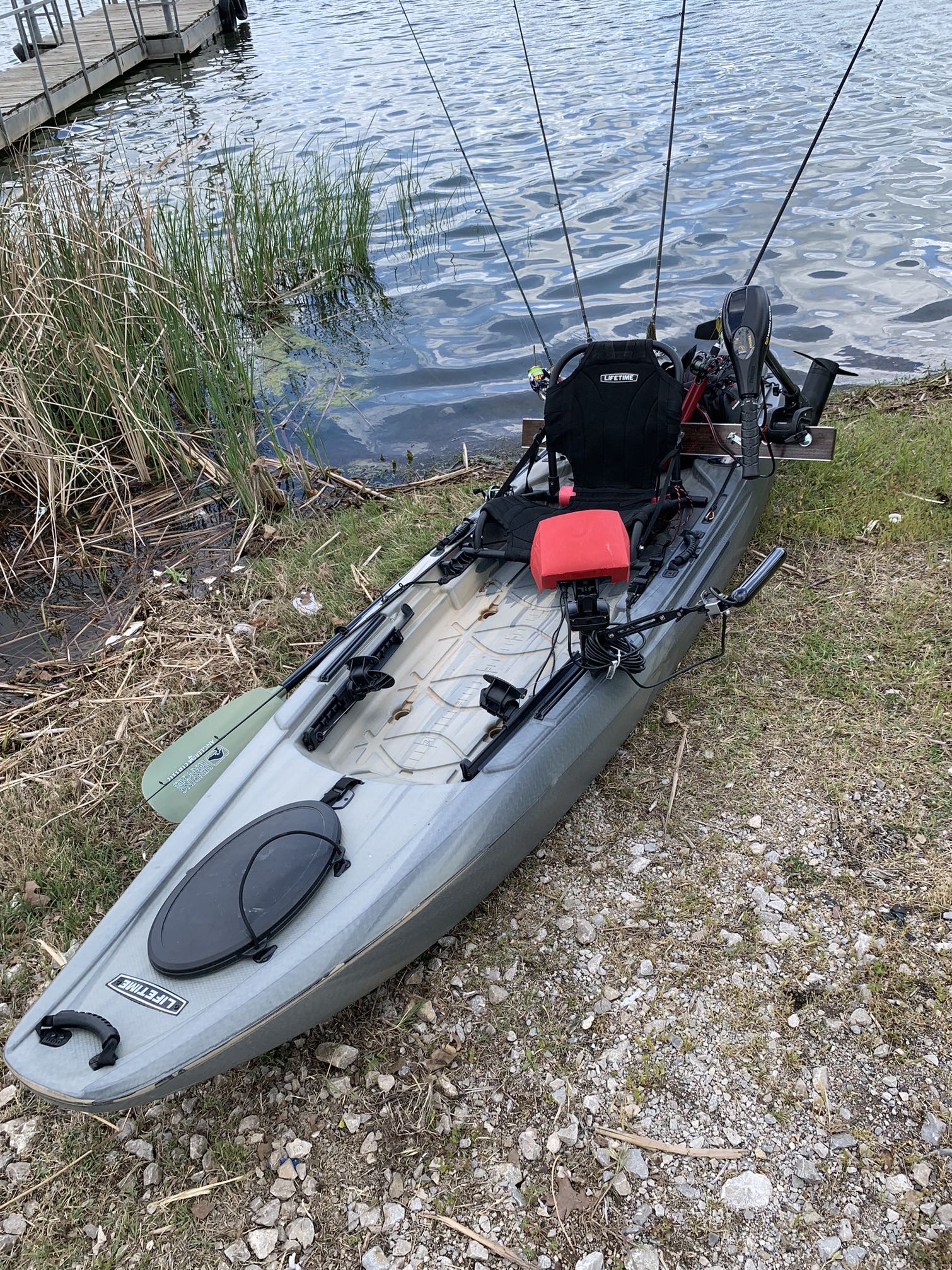
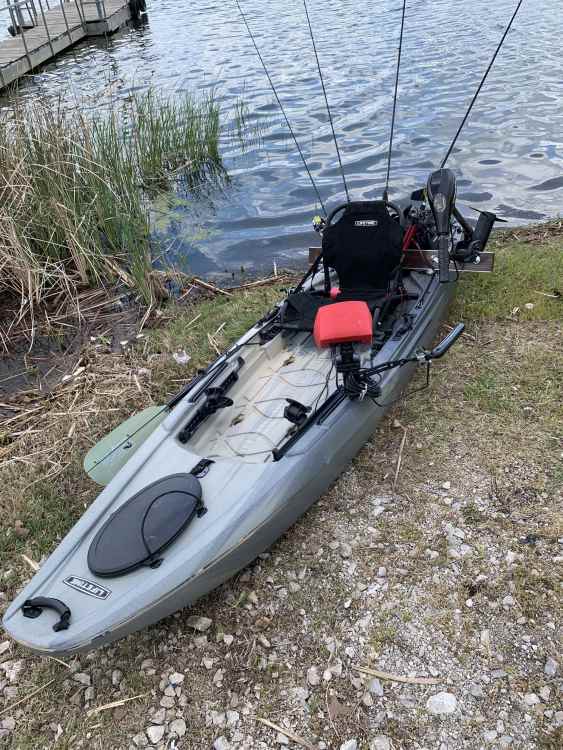
I don't have a pic of the rear, but I added a trolling motor to the side and a rudder to the rear. The trolling motor is connected to a piece of Birch that I reinforced with aluminum strips at the top and bottom. It connects to the kayak in the fishing pole flush mount holders using PVC pipes. I installed more PVC pipes to add rod holders to it. It attaches with wing nuts, so it can be installed in seconds. As for the rudder lines, I ran some Teflon tubes through the hull and some Teflon coated steel wire through them to control the rudder with the foot pedals. I drilled the entrance and exit holes and then tied some braided fishing line to a screw that I cut the head off. Then I used a powerful magnet to feed the line through the hull, out the other hole. Then I sewed the braid onto the Teflon tubes and pulled it back through. Lastly, I took a soldering iron and used it to flare out the Teflon tubes and sealed it with silicone, so the tube stays in place. It actually looks like a professional job, which surprised me. For the rudder itself, I created a bracket with 304 SS steel and drilled, cut and bent it into shape. Then I fed it through the same way, with the braid and magnet, and attached the rudder to the stern with rivets through the bracket. I tried it without the bracket, but the rivets wanted to pull out through the plastic hull. I had to build up some additional plastic on the outside of the stern with a soldering iron and spare HDPE (from the scupper hole inserts that I popped out when I bought it), to get the stern flush with the rudder, and keep it in place. It's Rock solid now. I think the whole rudder system ran me about $150 in parts. The red sun cover over my fish finder is a cheap polypropylene cutting board that I cut and welded (soldering iron) into shape. Then I attached some Velcro to it to keep it on the fish finder. It was free, as it was all junk I already had on hand.
-
I bought a used rod from Amazon once. I forgot the listed condition, but it was in perfect condition and still had the tags on it. Probably never used. My guess is someone bought it and returned it because they didn't want it. As for trolling motors, I'd buy a used one if it was one of the low end models from a good brand. The higher end models with all of the fancy electronics would give me pause, as there's a lot more that could go wrong. Like the motor might run, but it might have connectivity issues with the fish finder. And I just wouldn't mess with an off-brand TM unless it was free. A well built trolling motor can take a lot of abuse and keep on going. A cheaply made one... who knows.
-
You could certainly do it. But I don't have distance issues with walking baits. They're pretty large and aerodynamic. And I use a M/M rod for them anyway, which will really slingshot them out. Plus, I prefer BC reels because I'll often throw to something and need the ability to precisely drop it into a small area, which is a lot harder to do with a spinning reel, since you can't thumb it as easily. So it's not for me. But if the advantages outweigh the disadvantages for you, then I say go for it.
-
Six and one half dozen. I use an FG knot for leaders anyway, and I don't feel as though micro guides add anything to the rod. I have rods with both, and the only time I really notice the difference is when I go to restring the line through the guides. I'm more concerned with the material of the inserts and the number and placement of the guides.
-
What kind of bottom are you fishing in? For me, it's usually soft mud, so I can't feel it hit bottom either, no matter how sensitive the rod. I can feel it hit other things though. Also, the more line that is out, the less sensitive it will feel. So long casts or deep water will numb the rod a good bit. Back in the day of fiberglass rods where sensitivity didn't exist, we'd keep a finger on the line to "listen" to what the bait was doing. These days, you can sometimes tell what's happening on a less sensitive rod by watching the tip. It can sometimes show you what you can't feel. And it helps to keep the rod kind of loose in your fingers. Not so loose that it's in danger of slipping free should you get a hard strike, but also not a death grip. You just want to give it a little play so you're not dampening the action of the rod and pressing too hard on your finger pads to be able to feel slight changes.
-
A few weeks ago, I was out on the lake casting a Norman Fat Boy that I found floating in the water a few months prior. I had been casting it into some heavy wood because I figured it's a found lure, and I wouldn't be afraid to lose it. Also, I had fished it several times before with no success, so I was ready to lose it. I got it hung up and my plug knocker cracked the finish off one side getting it free. I kept fishing it, and suddenly, it was catching fish! And that's the way the crankbait game goes. The difference between a gold medal and participation ribbon can be almost indistinguishable to us, but the bass know.
-
The topwater bite is real fickle. When it's on, it's usually the best thing in my bag. When it's not, it doesn't seem to matter what you do, they're going to ignore it. And it can vary, day to day, hour by hour. So I always check to see if the topwater bite is active. And if it's not, I won't spend much time on it.
-
I've used regular reel grease before on drag washers. In my experience, it works just as well as Cal's, which is what I use now. I think the main problem with using a regular grease is heat dissipation on long runs. And that's more of a saltwater thing, in my opinion. I switched to Cal's because it's not that expensive and I wanted to see what all the buzz was about. I have no complaints. I've also gone grease free with Carbontex drag washers before, and they work fine that way. But I slightly prefer the grease because it seems to make the drag pressure profile smoother, giving you a bit more control while sacrificing a bit of max pressure. I agree with J Francho though. I always swap out any non carbon fiber drag washers for carbon fiber ones. It's cheap, and it makes a big difference. It's not the first thing I do, as I'll usually fish a new reel as-is, right out of the box. But it's something I always do the first time I open one up to clean it.