
Team9nine
Super User
-
Joined
-
Last visited
Everything posted by Team9nine
-
In my neck of the woods, bass start showing up on “fall patterns” when the water drops to about 70 deg., but the best bite overall starts once the lakes turn over and lasts almost until ice-up, so beginning roughly around 55-58 degrees and ending around 44-45 deg.
-
The Color-c-lector was probably one of the first “tools” to specify clarity based on how deep you could see the probe. If it was less than 2 feet, you read the “muddy” band. Between 2-4 ft, the “stained” band, and greater than 4 ft, the “clear” band. That is still a decent guideline IMO, though on my waters, I’d tweak it a bit. For me, anything under 12” is muddy, 12”-24” is lean hvy stain, 24”-36” or even 42” is lightly stained, and greater than 3.5-4 ft is clear. Anything approaching 6-8 ft vis or greater is super clear to me.
-
My short answer is yes, relationship to deep water is always an important consideration (though not an absolute), especially since those fish likely came out of deeper water in the spring and will return to deeper water in fall and winter (much of the year when there is no thermocline restricting their movement).
-
Not being there, it can be hard to say exactly. In my ponds here the past month or so, micro jig-pig has been really productive. Finesse worms and TRDs have also been strong producers. Small swimbaits worked well early, and I expect them to start showing again as the water starts cooling this fall. Cover and water clarity will usually point you in a general direction.
-
Because at least based on the posts I've seen on this forum, they can't get past the loss in sensitivity once they've tried braid first, which is a bad place to be in my opinion.
-
"Sensitivity" is overrated IMHO. More negatives than positives with braid/leader on baitcasters for me regardless of the leader knot, and I still believe it ruins newbies in the short term if they start learning/fishing with it before using nylon/copoly/FC. In the end, whatever works for an individual is what is best. For me, on baitcasters, that is predominately fluoro. On spinning, I'm a big braid/leader fan.
-
The knots are fine regardless. I'm just not a 'braid on baitcasters' fan. I'm one of those who believes braid is only needed for a couple techniques with baitcasters, and with those techniques, it's straight braid, no leaders. YMMV
-
Normal behavior for the ponds I fish. I see cruisers and wolf packs running the bank and weedlines all the time. Some areas are consistently better for quality fish, and warming spring temps and winter cold will congregate the fish at times, but I believe every inch of a pond can hold a bass at some point throughout much of the day/seasons...at least I can't point to any of the ponds I fish and say, "I've never caught a bass over there." I'd focus more on presentation right now.
-
FG to start when everything is prepped at home for a trip; Alberto if I need to retie on the water...and on spinning tackle only.
-
Seems the way of most fishing mags. Have a bunch of old In-Fisherman mags and they were all well over 100 pages, and the content was heavy and cutting edge, and the ads were there but minimal. Subscribed to Bassmaster from about 1980-2007 or so, but dropped them because it was more and more promotional, and less and less new/novel content, and I stepped back from tourney fishing which often required membership. Gave my entire collection of B/M and Bass Times to Jacob Wheeler to learn from and dissect ?
-
Make that 3 votes for bone or baby bass ?
-
Braid doesn’t belong on a baitcaster except for the few instances it does ? Anglers put way too much emphasis on sensitivity these days, and I’m not convinced its that important an attribute. Today’s fluoros give me enough improved sensitivity over nylon/copoly/hybrid lines while still maintaining much of positive attributes of them, so I don’t need to reinvent my entire system. YMMV
-
I'd have to first decide, do I want to throw baitcast (fluoro) or do I want to throw spinning (braid) for the rest of my life. If I couldn't make that decision, and felt I couldn't give up either, then I'd have to go fluoro
-
Been having a good laugh with the recent Senko threads... ...which leads me to two of my favorite less popular lures/rigs: Flick Shake and Slider rig
-
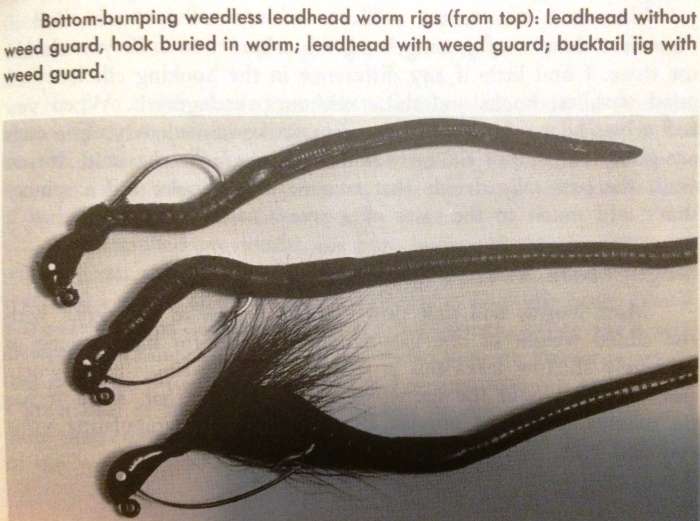
An argument can be made that the original shaky heads originated around the same time, and in the same area. Creme had a "bottom bumping worm" called the Shimmy Gal which was a 7" plus worm threaded on to a weedless jig head. One modification of that was to remove the weed guard, or to use it after the guard broke off, and rig the worm weedless just like a modern day shakey head. This pic (below) is from Grits Gresham's 1966 bass book showing the different modifications to fishing the Shimmy Gal style ("bottom bumping") rig. A Creme catalog I have from 1967 also shows their Scoundrel rigged weedless on a weighted head ala Brewer style, about 10 years before Brewer started to popularize his rigging style of Slider fishing in the TN area.
-
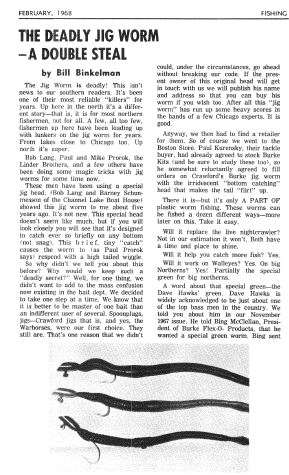
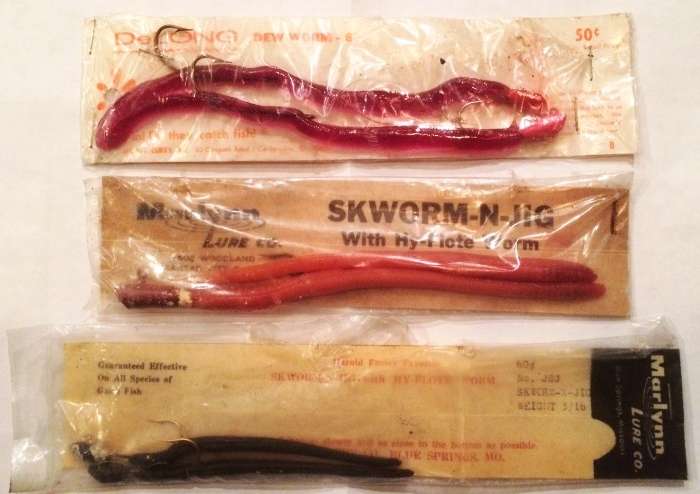
Just for historical context, I want to post a couple pics of what "jig worms" were originally. Ned has written about this extensively, which can be found with a simple search on the internet. I still have some in their original packages which you will see in the pic below. Marlynn out of MO is largely credited with the first packaged design, but you can see DeLong from OH also had their version. There were several similar versions floating around the upper Midwest at the same time, with various credits to Ron Lindner, Jack Crawford, and a couple others. This would be from the early 1960s. The second pic is from a 1968 story detailing the specifics of the jig worm in regard to details and construction. You'll notice all the original "jig worms" used the "horse hoof" shaped jig head, paired with plastics from Delong, MarLynn, Creme and Burke, among others, always threaded onto the shank of the hook, not like today's traditional weedless rigged shakyheads. From this design morphed the mushroom head jig, a creation that I believe was born in the upper Midwest (MN), and which was also called a "jig worm," the next generation if you will, taking hold in the 1980s. This is where Ned got the Gopher "Ned rig" mushroom head idea from via Ron Lindner for his Midwest Finesse approach. As for "shaky heads," I only use two; Jewel's Squirrel Head designed by Jeff Kriet, and the VMC Rugby Jighead, which I believe is an Ike design.
-
Not Ebay, but I placed an online order last month with a Japanese tackle shop and they ended up canceling the order because they said they cannot ship airmail or EMS to the U.S. right now due to Covid restrictions.
-
Lots of posts covering this one. If tied properly, zero issues with a Palomar and fluoro. The above mentioned Pitzen, along with its near twin (SDJ) are also solid knots for fluoro.
-
Lol - all of the above, but at the heart of Midwest Finesse is "nothing looking" banks, except in winter where shallow green veggies, esp. on flats in the backs of creek arms, tend to hold significant groups of fish. Seems like so many people want a weedless/woodless "Ned," but part of the beauty of the bait is to find largely coverless banks that don't attract a lot of fishing attention. Just some scattered cover here and there, like riprap, emergent vegetation, scattered docks, clay banks, shallow points and shelves, etc., stuff where you don't need weedlessness (not that it won't work in those places).
-
Been a staple of the pros for years, and is often referrred to as fishing "Florida style," though they also fish it a lot in the northeast similarly, but on a Slider head instead of Texas rig...but still nearly the same setup.
-
Is that a typo? Did you mean 1/32 and not 3/32? ...because 3/32 is a rock, and on the heavy side of Ned for me. I can fish a 3/32 down into 20' plus of water easily if need be. But as for lighter weights, say 1/16, 1/20 and 1/32, they are all fished in about 12 ft and less (usually 8' and under) as part of the Midwest Finesse approach. Lighter weights float over cover better without hanging, sit on top of vegetation instead of burying, and are more amenable to swim and glide retrieves (more marabou like as you suggest), which is where Ned shines. No shortage of baits I can fish and drag on bottom and catch fish if I need to.
-
I've been throwing the regular 3/16 Bitsy Bug with great success this summer. I sometimes swap out skirts, and finding the right size matching trailer takes a little work, but I've been very happy with the results. Been throwing it mostly on an MBR-783C with 12# fluoro.
-
Buy the rumor. Sell the news.
-
Should be able to throw a lot of baits in that situation depending on cover and clarity. Anything topwater obviously. Anything floating diving like cranks, traps or bladed jigs. You can swim bottom type baits over the stuff and be good, like Neds. I'd spend some time fan casting and learning the bottom of your lake better as it is likely this stuff isn't everywhere, just where grass grew previously, or on other cover like rocks, limbs, etc.. As such, there should be areas where bottom type baits would also still work fine.
-
Confirmed my suspicions. Sticking with the dead algae theory. That could also explain the water color...likely not due to fish population but weed treatments and elimination (at least partly). See it all the time over here in similar type waters.