
Team9nine
Super User
-
Joined
-
Last visited
Everything posted by Team9nine
-
Good job... -T9
-
Aaron Wiebe - Uncut Angling; Canadian, multi-species, entertaining and educational. Start with their recent "39 hours" series, the best angling concept I've watched online in a long time. -T9
-
Don't worry about adjusting them, they're built that way. It's caused by the torque of the blade and the direction of spin. To get rid of it completely you need to use a double blade configuration with counter-rotating blades, either on the same arm or on two independent arms. Instead. use what you have to your advantage to do things like run under docks and overhanginig trees, or even walk partway around stumps. If you really get serious, look around until you find another brand that will torque the opposite way, then keep two rods rigged with buzzbaits going in both directions. That way no matter the angle or direction of boat or cover, you'll always have the right retrieve path available to you. -T9
-
The general consensus seems to be Tatsu is the better handling, but InvizX isn't far behind, especially for the price difference. I use them both, and haven't had any problems with either - but then again, fluorocarbon in general has never given me handling problems like many complain of. Haven't figured out a good way to quantify "memory." -T9
-
Thank You
-
Tatsu is double structured: Double Structure Fluorocarbon (DSF) creates two custom, 100% Seaguar fluorocarbon resins: a softer exterior resin to enhance knot strength and a high-density interior resin to improve tensile strength that are extruded together as one solid piece.
-
You missed the point/context of the larger discussion... -T9
-
I agree completely with your latter statement on yielding - When a engineering plastic yields it stays elongated or stretched which also reduces it's cross section or diameter, permanently weakening the line, but in the first part of that paragraph, the yield strength or yield limit would be the point at which that permanent deformation occurred, not the point at which the line first started to stretch at all. The line will still stretch some up to that yield point, just not to the point/percentage of permanent deformation. This would be the elastic phase of the material. It's why if you're not careful, a bait suddenly pulled free from a snag might rocket right back at you like a projectile. That wouldn't happen without the elastic nature of the line. For example, braid won't do that (a nice thing) If you take a length of nylon line (say 12# or 15# test to keep with the discussion) and measure that length, then add a 3# weight (or apply 3 pounds of pressure however you see fit), nylon line will stretch - a good 5-6% depending upon brand, and this would be immediate. As soon as you took the pressure off, the line would return to its original length since you didn't exceed the yield strength/limit. If you left the weight on, creep would eventually set in and that could become a permanent deformation even if you didn't exceed the yield point. In that regard, your point about leaving knots tied is a good one in this regard. Why risk possible deformation and weakness. -T9
-
Tom, could you elaborate a bit. Does that statement only apply to long line lengths such as in your explanation? What about pitching or short casts with the same line, say 30'-50' where line drag is considerably lessened due to a variety of factors, and where testing has shown that anglers can generate higher forces (2X or better vs 3lb) that would exceed that drag setting and force it into operation (slip)? I know that if you hung a 3lb. weight on any length of monofilament, in water or out, it would certainly stretch. What would be the difference between that and a hookset? The line wouldn't know which end is applying the 3lb of force. -T9
-
The honest answer is you just have to play around with the various components and come up with a system that works for YOU. A perfect example is David Fritts and David Wright, two of the absolute best crankbait anglers to come out of the Carolina's (combined 16 FLW wins and $1.7 M), yet their approaches to crankbait tackle are almost completely opposite. Fritts likes a flexible ("soft") glass rod with a low stretch mono line, while Wright prefers a stiff rod with only a bit of softness in the tip, a sensitive graphite rod, but then compensates with "stretchy" softer monofilament. I've tried both setups and there are advantages to each. The only thing I've found that absolutely didn't work for me was using an x-fast rod action. Beyond that, just use what works best for you and ignore the rest. -T9
-
I know where you're talking about, and yes, do yourself a favor and fish it. Stay up that right arm where you'll launch. Not necessarily a ton of fish, but there are some nice ones up there that don't get near the pressure that the rest of the lake gets. Will take you a bit to figure out the best areas, but should be great fun. Bring a small stick for white bass, too, as they sometimes pile up in that creek. -T9
-
In most cases you have to make then yourself However, you can sometimes find some hidden gems in the USGS and Army Corps archives. -T9
-
On a new lake, as Catt said, you evaluate or interpret the situation (map) from the deepest water, but when you/I begin fishing, I always start in the shallows. Why? Because Buck said Once you learn the structures, breaks and breaklines (paths) in a lake the fish use regularly, then you can start in deep water if that's what your experience tells you to do. -T9
-
What most everyone tends to overlook when talking about Bill Murphy's book is that it was produced and edited by Paul Prorok. For those that don't know, Paul was one of the original Chicago/Milwaukee area spoonpluggers that both fished and learned around the likes of John Buoy, Don Nichols, Vic Saunders, Carl Malz and Terry O'Malley, all men who personally fished with Buck Perry extensively. Anyone who has read and understands Buck's work (including his book, Spoonplugging: Your Guide to Lunker Catches) will immediately identify with most everything written in Bill's book. It's basically a spoonplugging lesson written in much more easily digestible language. Every single picture showing double anchoring positions and trolling passes should be immediately recognizable as what Buck termed "structure situations." I could spend all night pointing out spoonplugging references and similarities in the two books. On the subliminal spots, Bill/Paul wrote: On the same subject, Buck wrote: -T9
-
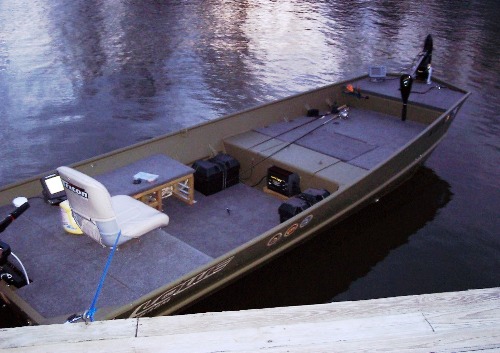
Lots of mods - built decks, flooring and carpeted all; 24v TM; onboard charger; livewell w/recirc; bilge; command center with 12v receptacle and fuse panel for all electronics; built-in tackle box storage; nice Triton seats; Tackle Rac; rod straps; upgraded electronics
-
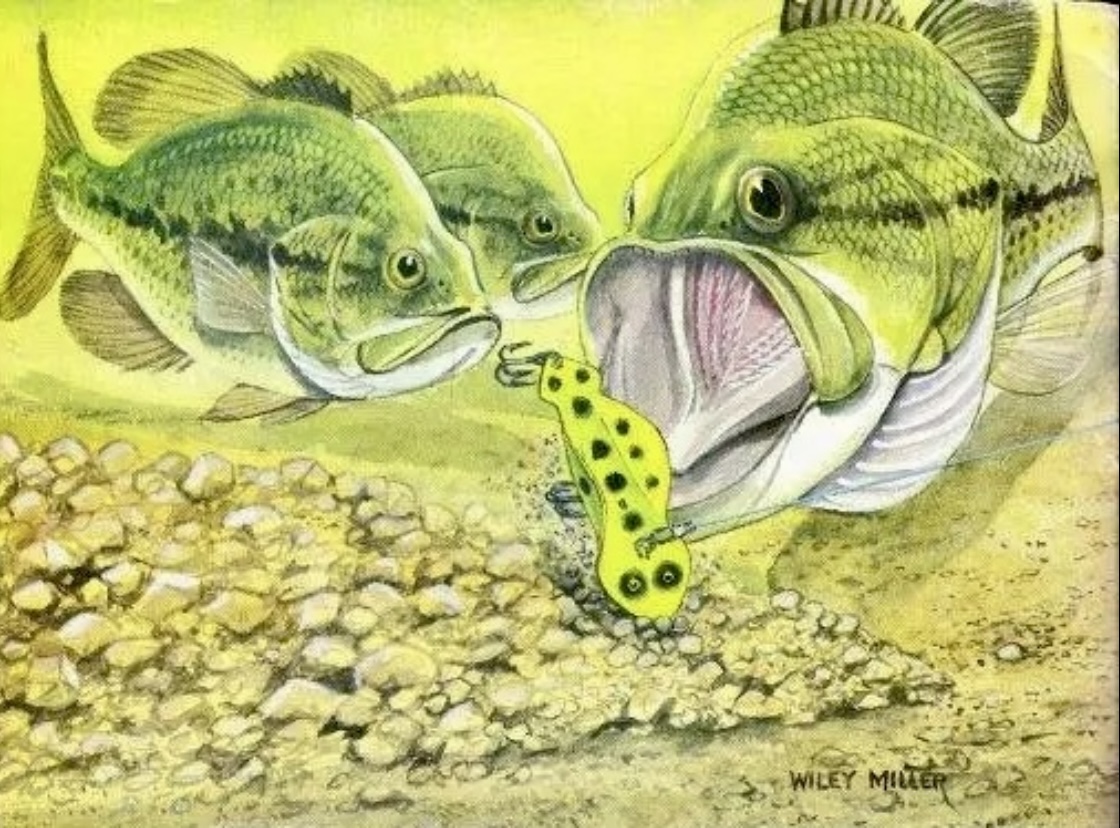
Zara Spook - there is no way I'd have a bait named the "Pro Sizzle" in my box, no matter how many extra bells and whistles it had Spook colors - bone and baby bass are staples. Skunk (black) for night fishing. Something transparent with chartreuse highlights for smallies. -T9
-
If you mean a solid body tube that can be fished on the same jig heads, that's being released at ICAST next week from what I've been told ...and yes, the 4" TRD and 3/0 jig head is going after the shaky head (and traditional/tourney bassin') crowd. They're even using Ned's term and referring to it as a "power finesse" bait. -T9
-
I live not too far down the road from Mayberry Café, an Andy Griffith themed restaurant with tons of memorabilia inside, and all the TVs playing endless episodes from most of the shows. I've eaten there enough that there's not too many I probably haven't seen They even sell T-shirts with a picture of Andy and Opie carrying their poles and stating, "Wishin' I was Fishin'." Many people don't realize that the whistled theme song for the show actually has lyrics and is titled "Fishin' Hole" and was sung by Andy Griffith https://www.youtube.com/watch?v=oE3OBiFflHI -T9
-
In test data I've seen, the improved clinch was slightly better than the Palomar. However, it also had more variability (deviation) in repeated testing. San Diego Jam was right there with the Palomar for strength and consistency. The Uni and Trilene knots were somewhat weaker than the others. Actual knot breaking strength compared to tested line braking strength for the 5 knots ranged from 67%-78% with fluorocarbon. Keep in mind that brand of fluorocarbon will make a difference in overall knot strength, as well as how well you tie any of these particular knots. Personally, I use a Palomar for all three line types. -T9
-
Trolling for what, and with what? Wouldn't think you'd need to go anywhere near $150 for a good trolling rod - more likely $100 or less. -T9
-
I have some similar thoughts to fishnkamp, but a little different. I prefer a fast or even x-fast action rod for blade baits. M or MH would just depend upon the specific rods characteristics. You need some backbone with a 1/2-oz blade, especially in deeper water with hooksetting. On length, you have what you have, but I actually prefer something in the 6'9"-7'0" range. The reel would be irrelevant to me in that the two you mention are both high speed, plenty fast enough for pumping blade baits. As for line, I've always preferred straight fluoro for blade baits, either 10# or 12# test. I could see an advantage to braid if fishing really deep, say greater than 25' or so, but actually prefer the larger diameter and drag that fluoro has for anything shallower. -T9
-
Nope - but I don't watch TV either -T9
-
Any species, any size (not just bass)? You're going to have to go well north of 199 before I can answer this poll, and I think it's been a slow year -T9
-
I think the reel ess is on the right track with it being either a pondweed or a naiad - they actually aren't the same for the most part despite the link info shown. Lots of submerged plants are referred to as "pondweed" even though they aren't part of the actual pondweed family. -T9
-
TRD's have salt. From Daniel Nussbaum, Z-Man Fishing Products general manager, via Ned: