MickD
Super User
-
Joined
-
Last visited
Everything posted by MickD
-
Nope. I use the old Calcutta 100 for trolling and some easy casting, but the new ones, including Daiwa Tatulas, are so much better they always find themselves in my hands.
-
Best way is to take them fishing and just do it and help them do it. It won't be preaching at all. Start simple and work up, giving them more and more to do as they learn.
-
What pound test lines are you using? Both knots go through my 4mm micros well with 15 pound braid, 15 pound leader. I usually don't retie unless I've changed lures so often that the leader gets too short. I start with about 6 feet, which stays out of the reel.
-
You have to hold it farther out in front of you.
-
Rapala DT 8 or 10 in Ike Smash color or Keitech 3.8 swimbait in smallmouth magic. If that fails, drop a Ned in Canada Craw color among them.
-
While I have done no testing/ have no data, it is my opinion that the pulling the line tight and tweaking it has negligible effect on a rod. If rods are breaking, and breaking after having been used a good while, it is because they were at some time damaged. A blow on the gunnel most likely. I've aggressively snapped many rods with braid getting snags out without having a rod fail. (Knock on wood!)
-
Why would anyone be angry when someone of unknown skill comes up near his dock and throws a lure with a fishing hook attached near his expensive boat/dock cover/boat cover/dock and bathing area? What is the world coming to?
-
You are charging them between fishing trips, right? And not depending totally on the engine to charge them?
-
I'm going to have to stop reading this forum. I dreamed last night that I had a reel seat come apart which resulted in a disastrous episode dealing with many yards of heavy braid hanging over a road and tangling with passing cars. JEEZ!! ?
-
If the reel seat is coming loose from the blank, it's not a Seaguide problem, it's an assembly process problem. If the seat is coming apart then it's a seat problem. Who could know what the manufacturers' plans are except the manufacturers, so you might contact them.
-
As Dodgeguy says, I've never had braid damaged by a backlash either, and I've used a lot of braid and have had a lot of backlashes. I also see posts stating "You must have had a bad batch of line." I've never had a bad batch of line or leader, any type. I expect it happens, but it has to be very rare. (Except for the old Vanish-it was all bad). I think if you fall back on the "bad batch" theory, you simply have not yet found the real reason.
-
It is possible to glue it back in, but might not work. Worth a try; I have one 25mm guide I fixed a few years ago and it's still OK. I used rodbuilding epoxy, but a quality epoxy adhesive from the hardware is worth a try. I don't think you have anything significant to lose by trying. Be sure to keep the ID clean of epoxy. If it hardens in there it can be tough to remove. Use alcohol to clean up uncured epoxy. Most use denatured alcohol. I think most builders will say don't bother.
-
Carefully check your tiptop and guides for cracks or chips. Q-tips sometimes work, but I just had two that the Q-tip didn't find, had to use a magnifying glass to see the chips/cracks. Usually it's the tiptop. Look your line over carefully too, if you can see or feel damage along its length you have something that is damaging it. It could be the tiptop/guides or possibly riprap/stone/other in the water structure?
-
If the lock nut is spinning then the seat threads underneath it are not attached to the blank. This is the most common failure of "big box store" rods, from my experience. Either the seat or the grip. An experienced rod builder can most likely fix it by drilling a hole in the seat and injecting structural epoxy to glue the seat to the blank.
-
Not quite the same in that with ultra light spin many anglers prefer to go short, like 5 and 5 1/2 foot rods. That won't work nearly as well with BFS as longer blanks give a more forgiving casting action and longer casts. For BFS I recommend about 7 foot + a little , blanks that normally would be called spinning walleye blanks. But with the right BFS reel and line, and the right rod one can cast neds, very light jigs, etc with a baitcaster.
-
I think the comment on more forward grip/shorter butt may be limited to the VSS because with the type of build I showed the reel seat can be up locking and the reel may be positioned anywhere you want it.
-
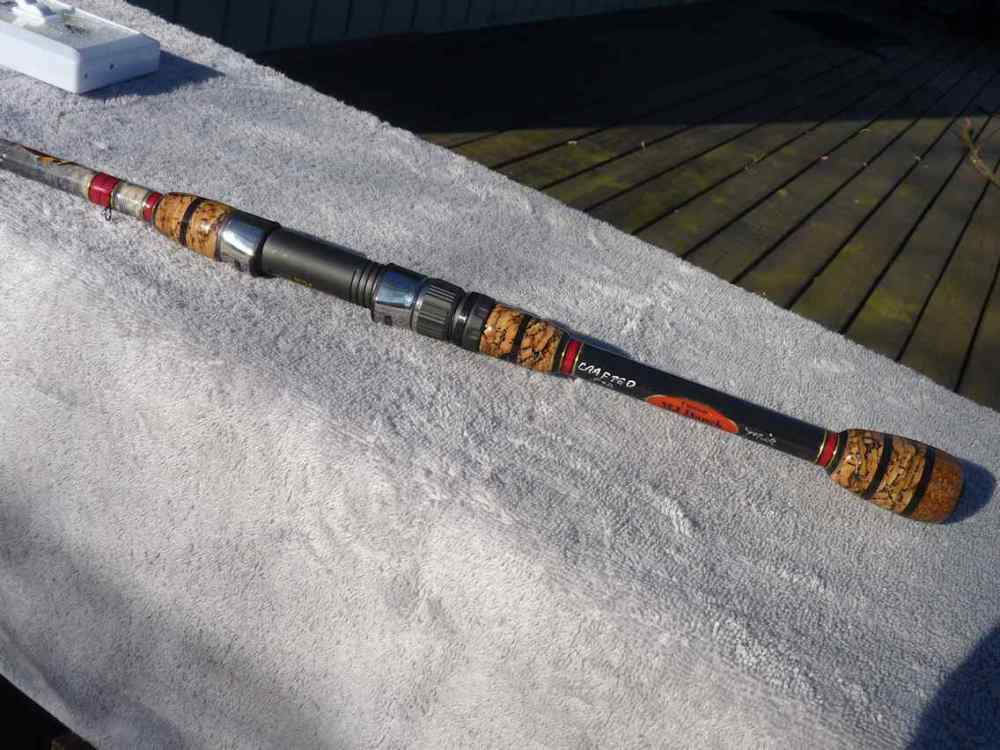
Or size 17 DPSSD up locking with split grip like this. Place the seat position based on another rod you like. Measure from the butt to the installed reel stem, not the seat end,
-
One advantage Simms and a few others have is vent holes at the nose. They help. I'm not a fan of Simms gloves, fingers too long. Huks that I have now are nice.
-
While my opinion is in no way expert, I'll state it: I've caught many smallies in pretty cloudy water, but it was mud from wave action. They seem to find a way to find the lure, even without noise. Algae, if it has an effect, IMHO, is more likely to be not in its effect on vision but more on the "temperament" of the fish. I think algae may turn them off.
-
I think most of them are. It will be very easy to try something like 10 pound premium (8 carrier braid) braid and see what happens. Keep in mind that braid lasts most of us for years so price is not as big an issue as it seems when you first see it. You also don't need to fill the reel, put about 100 yards on so that the spool of the reel is properly filled. Insufficient line costs distance. My casting technique when going for distance is two handed overhead, rotate the rod back to about 2 oclock and without really stopping aggressively rotated it back to about 10 oclock with a sharp stop. This loads the rod really well. The lower hand goes forward when the rod is rotating back, and it pulls sharply on the butt of the rod when it's going forward. Try it. When you get it right you'll say "why didn't I think of that?" It's that simple and obvious.
-
I use the tiny black ones for wacky rigs, too. Work fine. Will handle any size worm/stick.
-
The contention that micro guides cost distance is false. As is the contention that the Microwave guide train costs distance. Proper guide train design (reduction guides) is necessary, but micros if anything increase distance. The biggest factor in distance, assuming good guide train design and execution is the line. With high quality braid of less than about 15 pound test almost any guide/reel combination will cast very well. If set up this way and still having distance problems, it may be technique and not having a rod that loads properly (power vs lure weight). I use all micro equipped spin and cast rods and have no problems with distance. Yes.
-
You can cobble a wrapping stand if you have basic carpenter skills. The "dryer" (epoxy does not dry, it cures, it's a chemical reaction) from cheap motors available on line and a simple stand. I use a tuna can with pegs at four spots and use rubber bands to "grab" the rod butt. RPM should be fairly slow, like less than 20 rpm, if I remember right. Others correct me if wrong, but you don't want high rpm for the curing process.
-
No one can answer except you. I will say that many are doing it and enjoying it. A buddy just built a rod and since he really likes baitcasters better than spin, he's having a ball. Even with light neds. I'd say go for it.
-
Keep in mind that most Daiwas still have anti reverse switches and the Vanford and most Shimanos do not.