MickD
Super User
-
Joined
-
Last visited
Everything posted by MickD
-
Wine label writer going fishing? :-) Try the new braids with 8 "fibers," my favorite is Hitena 21 pound at .006 diameter. Make sure your spool is properly filled, only an eighth of an inch free space from the line to the lip, two handed casts, work on technique with your longer rod. It is believed that micro guides add distance. I'm not sure it's solid science, but it makes sense since micros better take out the loops that have to be generators of air resistance. So I'd recommend getting a rod with micro runners. That's all I build, and works for me. By micro I mean runners that have a ring outer diameter of 3-4 mm. Go smaller and it's hard to find a braid to leader knot that will work well, + you won't get smaller guides than this on a factory rod. My thoughts are, as others have said, longer the better, action more on the moderate side unless you are willing to perfect your technique, match the power to the recommended lure weight, then consider the details above.
-
I think all Lunds are riveted hulls. Crestliner, part of the same company, are welded. I expect in both cases their leak detection methods on the production line have to be very robust, so most likely the cause is something like hose fittings or other operations done after the hull is inspected on line.
-
I have had times when in very clear water during the day black spinnerbaits or chattebaits were the only color that largemouths would hit. No so for smallies, I believe, but I don't use spinnerbaits much for smallies. From what A-Jay says, I better get at it.
-
If you're being told that water intrusion is normal ask how you are supposed to leave the boat on the water overnight or for days? Trust the auto bilge? I have often wondered how to find a slow leak, not sure I know how. But you should not have to accept water intrusion. First place I would suspect is through the transom engine mount bolts. New boat with dry rotted drain plug? If you plug the outlet hole in the transom that is used to exhaust the live well, and put water into the live well either through the auto or manual fill pump, you will get overflow of the livewell into the bilge.
-
I'm not saying anything about Smackdown since I have not tried it, but have you tried Hitena 21 pound test, .006 diameter? It's pretty darned good.
-
If you are a newbie, you most likely are like I was at one time, using mono/FC and not being able to feel a damned thing. The biggest improvement in sensitivity you can find is to use braid. Quibble about which one, but the difference between braid and the others is truly dramatic. With mono/FC you can hardly tell if your cranks are weed free or not, hardly tell if a fish does a soft take on your tube, hardly can set the hook on a fish that hits on a long cast. A few feet of mono/FC as a leader gives a little cushion but does not keep you from feeling what's going on. An expenditure of hundreds of dollars in high tech rods will not do as much for sensitivity as simply using braid. It has a learning curve, but get started.
-
They don't change action or power. If they take a set it's because they were not stored properly.
-
Not all clinch knots are the same for strength. If that knot is lightly set, it most likely will fail. If set really hard, lots of tension and push the knot down tightly, then more tension , wet of course, it has a much better chance of success. But it's not the best knot, not even close.
-
Around here the fish are still very available when the wind gets so high and the temp so low that I don't go anymore. 10/30 last year, rainy, air 39, water 47, 2 of us caught 25 smb from about 2 1/2 # to a measured 5 1/2. Lower left pic on my profile pic.
-
There is another factor that I don't think has been mentioned. It is heat generation by long fast runs of salt water fish. For this application there are differences that matter. SIC, I believe, is the best material other than possibly the Fuji Torzite rings for heat dissipation and lower heat generation. I don't cut corners on guides for my salt water rods. Also, for salt, titanium is bulletproof for corrosion. Some stainless steels are very good, too, but not as good as titanium.
-
A-Jay is right, the best way to fix it for display is to fit a spigot (rod, dowel, etc that goes inside the tubular blank at the break) to the rod, use epoxy adhesive to hold it. If the rod has splintering you probably can glue at least most of them back into position so they won't be visible exc up close. This would not be the right way to fix it if you were to want to keep fishing it. That would involve an external sleeve, which would change the appearance.
-
How can it be as small as an FG which uses just one layer of leader and the GT uses three, I believe?
-
I submit that retying a double uni will not make it any smaller. It will have 5 thicknesses of the leader no matter how many times you retie it. The Alberto, which has only two thicknesses of leader, if tied like I've advocated, is IMHO the smallest really reliable leader to braid knot. If tied as I instructed, 9 wraps, it will end up a very uniform, very small knot about 3/16 inch long. The FG is even smaller, at least as strong, but even the slightest screwup in tying it will result in knot failure.
-
Good input above regarding length. The two most likely reasons to replace are the damage that can be felt near the lure caused by fish, rocks, other stuff. Just run your leader between your fingers and you'll find it. The second is damage to the line to leader knot caused by hitting the guides on its way through. Here is where it gets tricky. If you use a double uni, which is very reliable and easy to tie right, it will hit the guides pretty hard if you use heavy leader and small guides. How heavy and how small? You need to figure this to your own satisfaction, but my opinion is that with size 4 Fuji running guides I can use up to about 10 pound leader with braids 15 or below and it runs pretty cleanly. But for anything heavier I need an Alberto or FG knot to go through cleanly, and both of those knots depend on exactly right execution of the tieing to be successful. I have recently spent a lot of time on the Alberto trying to figure out why I had "mystery failures," where the knot would just unravel. My conclusion is that the tag end has to be run back out the loop in the right direction (this is covered well in the on line instructions) and ALSO that the knot has to be properly tightened, or set. When you have passed the tag end of the braid back out, then pull the knot fairly tight by pulling on the tag end of the leader. Then wet the knot and set it by wrapping the braid around a dowel or other tool so it won't cut your hands, and very heavily set the knot by pulling on the main leader and braid lines. /This heavy set procedure is not covered in the on-line instructions. While this may seem a lot of bother, I know that braid has increased my catch over what it would be if I were using mono or FC by an order of magnitude, MAJOR. I just loaded mono onto a cast outfit and I can't believe how dull it feels, how hard it is to fish and feel what's going on. It will be removed ASAP and replaced with braid. Braid is the biggest improvement you can make to sensitivity. Period. Even more important than the rod.
-
For really clear water, don't forget white and ghost, unobtrusive colors, like A-Jay says.
-
The biggest factors in runner weight, where the sensitivity is best maintained by light guides, are frame material and size. Titanium is expensive, but light. Price point is very important in selling assembled, big box store, rods, so in most cases titanium is out. Small is good, but I don't think all anglers are ready for the really small micros yet. They take a good knot to pass leader knots through, they can ice up in cold weather, they look fragile to many anglers, so most assembled rods use bigger guides with stainless steel frames.
-
What you're seeing here is the contrast between removing a tiptop that was installed with epoxy and one installed with hot melt. Hot melt takes very little heat. Epoxy will take you into the range of damage to the blank. Try the steam before you cut it off. You may luck out and get it off without damage. Then try the Dremel on the tube to get it to spit. Don't cut the blank until you've exhausted all the options.
-
I have never had a guide get grooved. Even the old cheapies on the big box store rods I used to use. Even with braid. The guides near the butt have little to do with sensitivity, unlike the runners, the ones near the tip. You want the lightest you can get along with there. I have had a number of tiptops groove, which is why I always use SIC tiptops. As stated above, if you have not tried braid, you have not yet taken advantage of the biggest sensitivity improvement you can make.
-
My son just caught a number of smallies in a mid MI river with small surface lures, Pop R's. The fish were sighted before casting to them and on the first one, it refused all the plastics. But nailed the Pop R. Might take a small one along.
-
What size guides? Can you tell how many layers of the leader are in this knot? I can't figure it out from the video. Looks like it might be big.
-
All good advice except, IMO, for this. For a new user of braid to leader knots to master the FG without a whole heck of a lot of practice is very unusual. And unless he is using very small guides it is not necessary, the double uni or Alberto will work fine. The easiest, most reliable knot is the double uni, IF the guides are big enough, like 6mm runners. It took me a lot of failures of the FG before I found a way to doing one pretty reliably, and I still don't fully trust it and use it only on my smallest micro guides. If done right it is a great knot, lasts a long time since it doesn't get beaten up by the guides, goes through any guides cleanly, very strong. But. . . It probably should be mentioned that many fishermen don't use leaders with braid. They tie direct to the braid and say they do well. I like a leader because I just think it will be less visible that braid, it gives a little stretch in the system, and when I cut off lures or lose them, I lose a little leader, but not the braid, which in time with direct tying, will get shorter and shorter.
-
If you are going to use it for surface some times, use mono since it won't sink like FC and ruin the action of some surface lures. Some have gone to mono for everything to avoid the "foibles" of FC. I use FC fly tippet material since it is a little stiffer and I think tougher , although I have no data. Anyway, I don't have problems with it for non-surface techniques. As implied above, the big question is what knot are you going to use. The FG is the best if you use micro guides AND can learn to tie it well, which could take some time and mistakes. The most reliable, IMO, especially for a newbie, is the double uni. I'ts a big knot, not suitable for small guides and 20 pound test leaders, but it's easy and hard to screw up. A really good small knot is the Alberto, but it has its foibles too. You must stick the tag end back out of the loop properly or it WILL fail, and a really hard setting of the wet knot will give the most reliability. Look for the posts under "Alberto knot mystery failures solved?" for more info.
-
For just one rod that will do it all pretty well, MF. Power and action can be measured, with CCS, and can be objective, not subjective. Preferences for different powers or actions are subjective. Length is objective, easily measured. Preferences for length are subjective. But the length of the rod does not have an impact on action and power. Any length of rod can have any power and any action. This does not mean I disagree with your preferences, but just the second sentence.
-
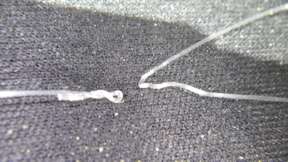
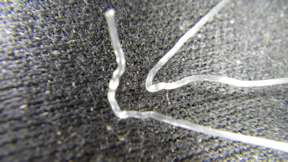
Here are two photos of Albertos tied with 15 pound braid and 20 pound FC, with the braid taken off. The lines in the top picture is the FC as it looked after the braid was cut and unwoven from the knots. The right line in each photo is the line from a hand-tightened knot. The loose loop (right in each pic) is the FC from a knot which was progressively tightened to close the loop as much as possible with the final set using only my hands, no tool. The tight loop is the FC from a knot tied the same way, but the final set was done with a tool to prevent hands from being cut and which allowed a tighter set, just like the set one does on an FG. In the top photo you can see it didn't open up when the braid was removed. In the bottom the image shows it after I opened it up for a better view of the condition of the FC. You can see that with the tool the FC is much more "distorted," from the braid embedding into the FC, just like one sees with a well-tied FG. The appearances of the finished knot differed in that the tool-set knot was shorter than the hand set knot. (9 wraps in each knot) The FC loops at the end looked about the same to the naked eye. It is logical to me to conclude that the tool-tightened Alberto knot will be more reliable than the hand-tightened knot, just like in the FG where a very hard set knot is more reliable than one not set very hard. I don't like to use super glue as it seems to always get where I don't want it, like on my fingers, and I don't like the white blob it forms. And it seems that when I need it, it has hardened in the tube/container spout and is a general PIA.
-
Yup. I think I have that figured out, but. . .