Way2slow
Super User
-
Joined
-
Last visited
Everything posted by Way2slow
-
One word of caution from someone who has been there, done that many times. You get on of those hydro rockets like the Allison and Bullet, that basically have no speed limitation. The more you add horse power and better the setup, the faster they go, and you are a speed freak like me, you are creating you one huge money pit, and time hog. You never quit trying to make it faster. Because of that, if I had to have one, I would lean toward the Gambler. They are a fast boat, but they seem to have their limits, meaning when they get to a certain point, it's almost pointless to keep trying because that little extra you gain, is not worth the money and effort it takes to get. Because of my first paragraph is why I've stuck with my 20' Javelin for over 15 years now. When I get that wild hair, I can throw my 326 hp hot rod motor on it and wipe that funky grin off every Triton driver on the lake wants to give you when he goes by. I know that boat has it limits and I've reached it. It's very easy to get it into the mid 80's with a load and passenger, but it hits a wall at the mid 80's. I have had 450hp motors on it breaking them in and testing them before sending them home and it only ran in the lower 90's then, a 7mph gain for a whole lot more expensive motor, ain't worth it.
-
If it is welded where it won't come apart, use a side grinder and grind the welds off. Grind mostly on the old jack face and not the frame as you are grinding so you don't destroy the integrity of the frame. It's not uncommon to find the plates welded but usually you can disassemble the jack from the plate and assemble a new jack to the welded plate. Then again, most of the jacks I've seen were about half the size they needed to be for easy cranking, so I replace them with a larger jack anyway. If you have a Tractor's Supply, they usually have a pretty good selection of trailer parts and jacks.
-
You need to take it to a professional fiberglass repair shop. Preferably one that has experience with boats and have it looked at and an estimate for repair. I looks bad enough the water can get into the inner layer of the fiberglass. This will make it separate and blister.
-
Most of the time, the one on my Javelin won't come off when I first jack it up with the tongue jack. I usually have to jack it up to when I know it has lifted the hitch enough to release, then get in the truck, and move back and forth a fraction and it pops off. Sometimes, if say my last action was backing the trailer, I can put it in forward just enough to relieve any pressure that might be on it and get it to come off without having to get back in the truck a second time to release it. The design of the ball socket in the hitch just has too much curve to release it if there in any pressure one it. Been having to do that for almost 15 years with that boat.
-
My boats have been under a covers for many years and have found, you pretty much get what you pay for. I've used numbers of those $150 covers and they might last three years, if you are lucky. You are pretty much going to pay over $400 for a cover that's going to last any length of time. $400 is on the low side of what a decent cover is going to cost.
-
The two batteries in the rear are connected in parallel, not series. If you look at the terminal markers on the batteries, Red is going to red. They are only producing 12VDC in that configuration, but twice the amp hours a single battery would provide for over twice the run time of one battery. There is also a large circuit breaker for them sitting at the corner of the front "cranking" battery.
-
I use reloads but mainly because of the load I shoot. The first three rounds in my Glock-20 are 155 grain Hornady XTP being pushed at and ungodly speed so they will make a mess out of a human body, but not go all the way through it. Behind those are 180 grain Golden Sabers being pushed at 1350 fps. Now, the loads I use for carry are not exactly reloads. I only use brand new brass for my carry loads. One the brass has been fired once, it get's fired, it's relegated to target practice. Glocks are hard enough on brass that does not create a problem anyway. The thing you have to worry about more than the person you might be trying to defend against, is the people you might injure in the process. You have a legal defense against an attacker, you have no defense against an injured second party. Before you send a bullet, you had better be dang sure of where it's going, and I'm talking about it's full flight path. Last year, I had dog attack me and actually bit me. As he was coming at me, I pulled my pistol and thought if he came a couple more feet he was going to be dead. I was in the streets of our residential neighborhood and figuring I was about to shoot, I made a quick visual scan, Knowing there was no way a 50 pound dog was going to stop that bullet. Had I shot, and it Ricki shade off the ground, it was right in line with the front of a house. It ended up, just as he chomped down on my thigh, I'm managed to make one wicked blow across the top of his head with it.
-
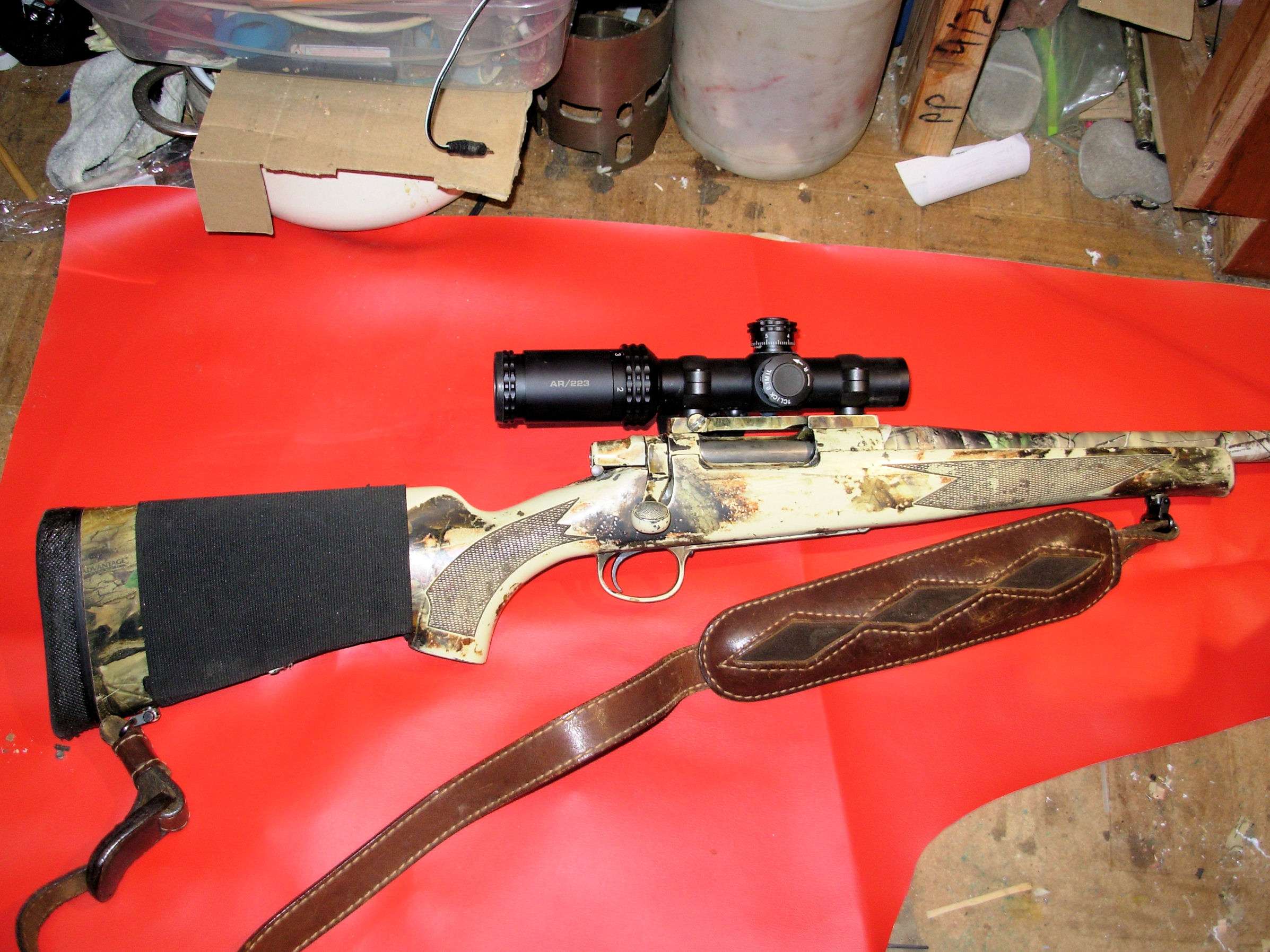
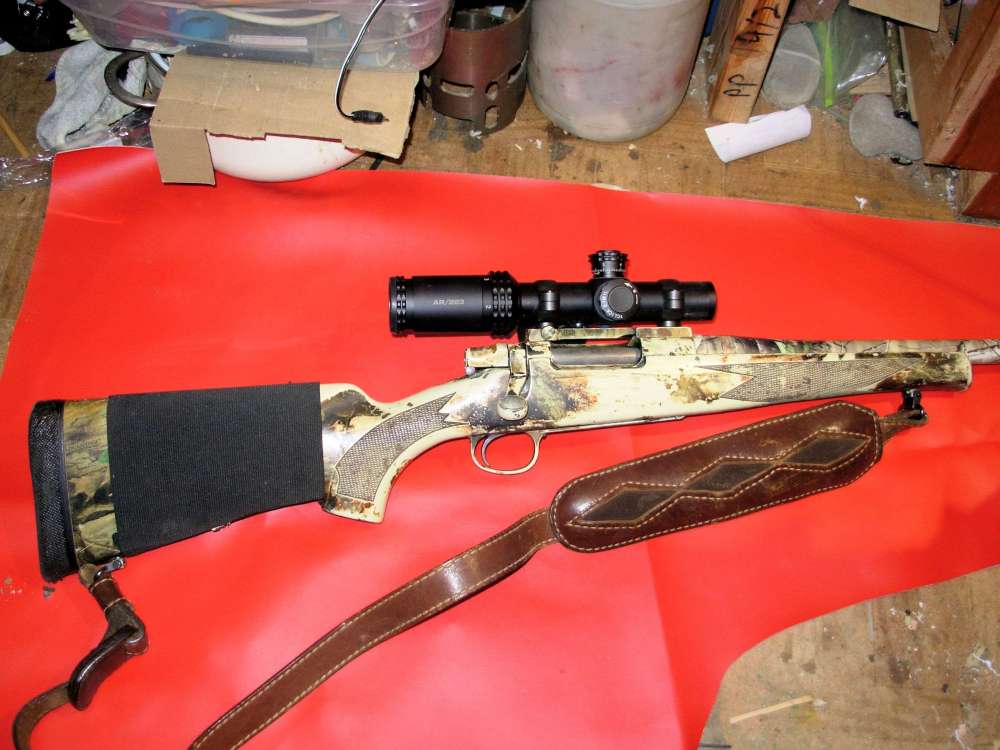
Ok, I guess I need to be totally honest, the rifle looks plain Jane, but looks can be deceiving. If you look at the factory Model 7, 260, the barrel looks like a drinking straw. This one looks way fatter, because it is. The action has been completely blue printed, and accurized. The stock was machined out and there is an aluminum V-block, bedding plate for the action imbedded in the stock, and the action has been pillar post bedded and heavy steel floor plate added to stiffen it. The barrel is a Shieling, select #7 light target, that has been air gauged. So, what you have is a very plain Jane looking rifle that will hold it's own it most any target competition. Like I've said, I'm an accuracy freak, and since I can do the work myself, almost all my rifles are of competition target quality.
-
Thought I would show you the pea shooter. Just a plain Jane deer rifle. I'm left handed, that's why the ammo band is turned the way it is. You can tell by the wear on the factory camo being worn off around the receiver, it has been shot few times.
-
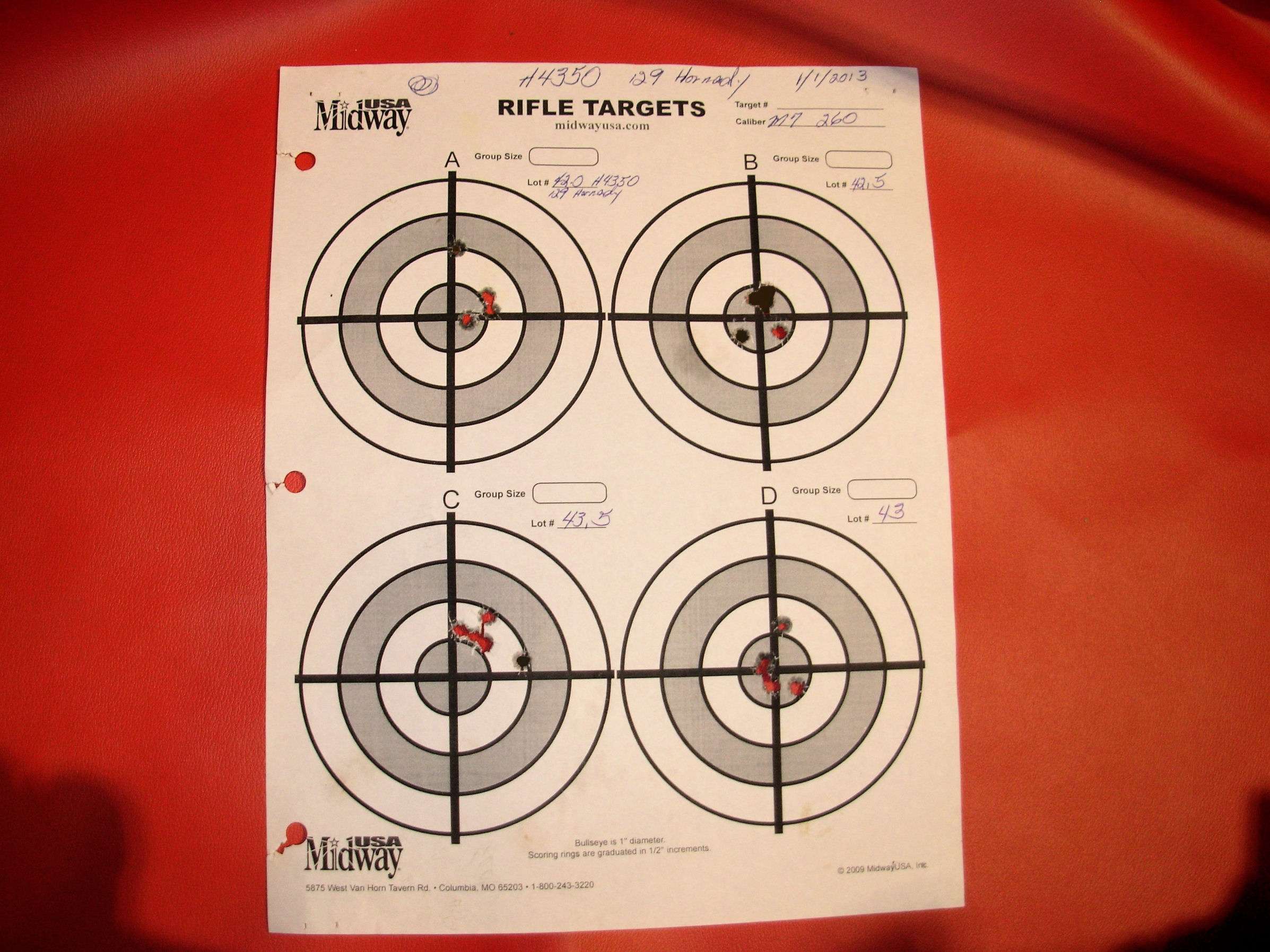
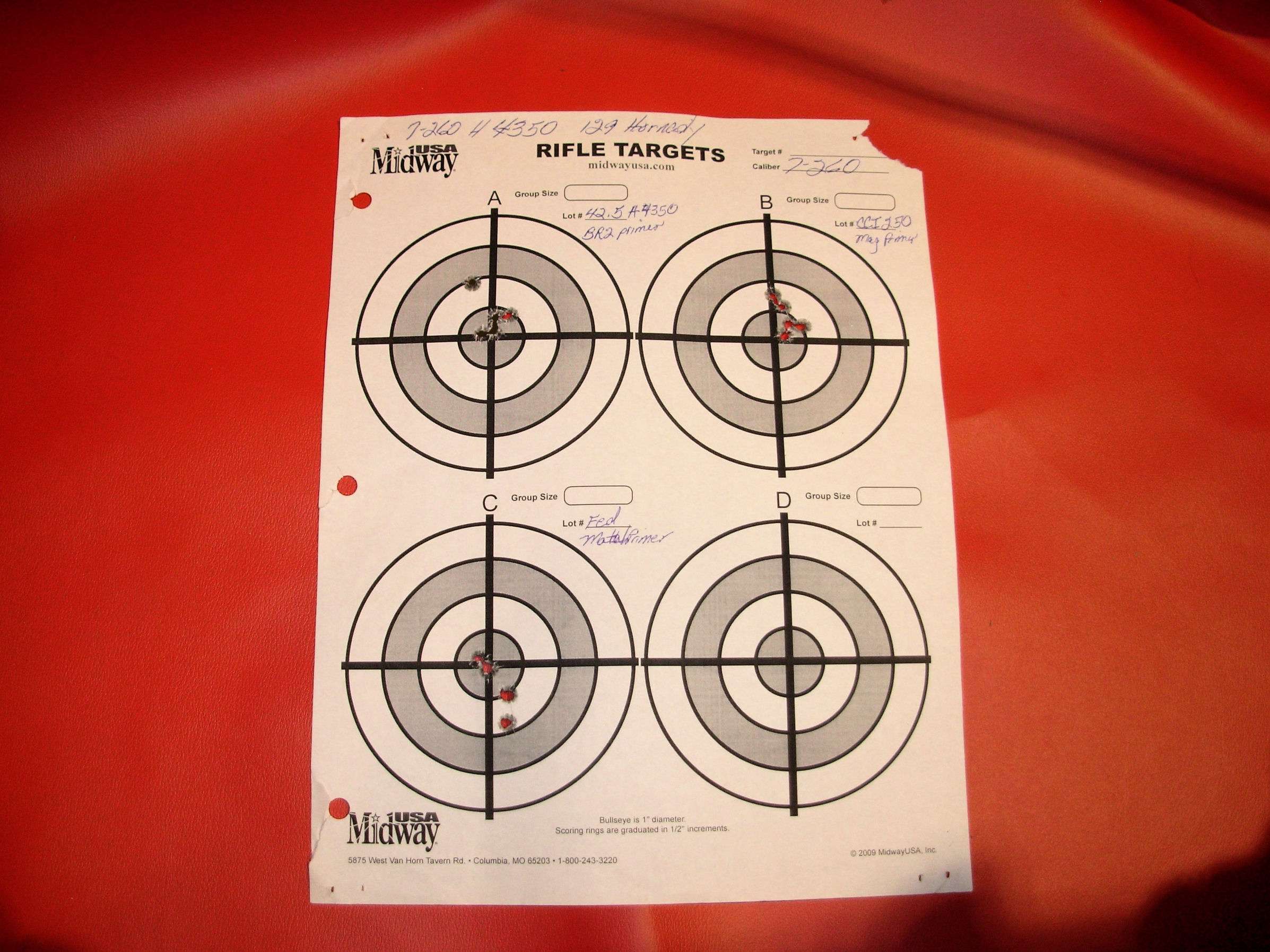
Why I don't buy ammo. Came across some old load development targets cleaning up my work room today. These is from a Remington Model 7, 260 with a 20" barrel at 100 yards, shooting five shot groups off sand bags resting on the tool box of my truck. Wasn't even using a steady bench rest. Of course, it probably wouldn't have made a lot of difference, I do know how to shoot. Center of target is a 1" rings. The top one was one of different powder loads of H4350, the bottom one was one of different primers using the H4350. This rifle now shoots 2 1/2", five shot groups at 500 yards all day long, and one big raged hole at 100 yards.
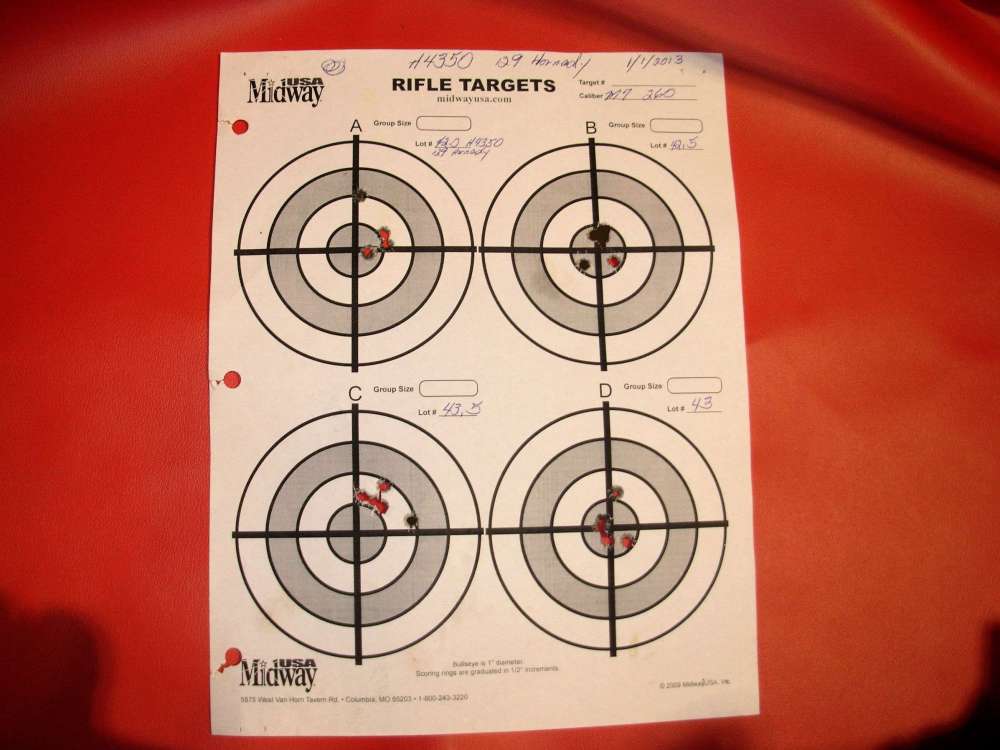
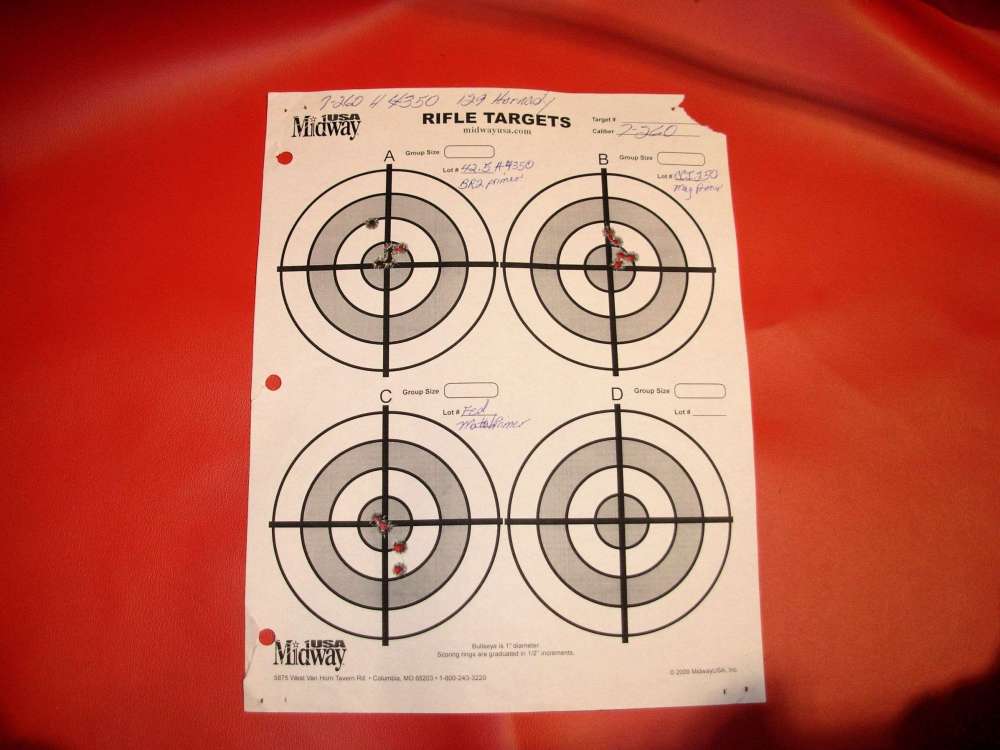
-
I noticed in one of your other post you said the throttle body looked "almost" 100% open. Almost is not good enough, it has to be 100% open. Prop height being low will only cause a couple of mph slow down from the extra drag the LU is creating, it's not going to make that big of a difference (unless it's way down and the anti-cav plate is dragging under water) but even at that, shouldn't cause that much of a slow down. Another thought, someone may have put a 200 ecu on it. I'm not a black motor mechanic and know little about them, but I think the main difference between the 200 and 225 is the programming in the ecu. Unless it was from one of the few, reputable, engine builders, there is no telling what it's got for a powerhead. I've seen builders go through and only repair damaged parts, not even bore the whole block, slap a new set of rings in and call it a remanufactured power head. Several years back, when I was more involved in this stuff, I know one guy that over the years changed company names three times because he would do that and when enough people got the word out, or looking for refunds, he would disappear and show back up later with a different name. Scream and fly banned him from their sight every they found out he owned the company he was doing business under, and he was a major builder. Remanufactured means all machined surfaces have been inspected and checked for tolerances and/or machined and all wearable parts have been replaced. Rebuilt, can be as little as just having any broken parts replaced and maybe a new set of rings. Basically, they got it running again. If you are not doing the work yourself, outboard engine repair is one of the biggest rip offs going. If you can find an honest, reputable mechanic, your lucky, and don't complain about what he charges, he's worth it. They are hard to come by.
-
If the motors have the same style lower unit, with same gear ratio and he's running the same prop on the 2004 motor he had on the 1999, their performance should be about the same. Has a compression or preferably a leak down test, been done on the motor. Sounds like he has just bought himself a nightmare. The first thing I would do is find a shop that has a good dyno and knows how to use it, and have the motor checked out because it sounds like the performance is way down on that motor.
-
I'm just gonna make one comment. Running a deep cycle battery for a cranking battery on a small motor is not a problem, it does not harm the battery in any way. Where the problem comes in using a deep cycle as a cranking battery is with the big motors that require heavy cranking amps. A deep cycle will not produce a large amount of cranking amps, it's not designed to do that, and you can have cranking problems with large motor. The voltage drop can be too much to power the ecu and other things to make it fire. Matter of fact, a "true" deep cycle does not even have a CCA/MCA rating on them.
-
Sounds like the carbs need cleaned. The low speed jets are probably partially clogged. If they have a mixture adjustment on them, you might try opening the low speeds up another turn
-
I fought it for three weeks and have just gotten rid of it. I thought mine was an inner ear, and my doctor said it was those crystals and I have an appointment with a ENT next week, but I have figure out the cause and cure for mine. Now I've just got to find a fix for the cause. I sleep with a CPAP and about three weeks ago I woke up with bad sinus congestion, that didn't want to clear up, So I quit using the CPAP. A couple of day later, I woke up with a bad case of VERTIGO. I assumed it was my sinus had caused an inner ear infection. I order all new supplies for my CPAP thinking it was probably contaminated, so I still didn't use it, waiting for the new supplies to arrive. In the mean time, Vertigo is giving me fits. When I tried to practice on my flutes, this caused severe vertigo, or if I bent over to pick something up, I would have to hold onto something a couple of minutes. Supplies came in for my CPAP and since it had been almost three weeks since I had used it, figure I have better get them installed and get back on it. The next morning, after sleeping with the CPAP, the vertigo was gone. So, I've come to realize my vertigo was caused by low oxygen levels in my blood. When I retired from the military, I get disability for a medical condition I have that reduces you lung capacity, and it was only 73% then. So, now I figuring it's a lot less. Oh, and don't assume, I have never smoked a cigarette in my life. When I see the ENT next week, my next stop will be with a pulmonary specialist. At least for now, being back on the CPAP, the vertigo is gone.
-
The lake I mainly fish, it's 28 miles east to the dam from where I launch and can turn north at the dam and go another 25 miles, and over a mile wide in the main body. I prefer to fish over spend all my time driving a boat when I take a notion to move. Driving a boat that's up on the pad and hauling a** with a hand throttle would be like trying to use cruise control and then try driving Watkins Glenn.
-
Other than 22 rim fires, Choosing ammo is something I've never done. I bought my first rifle, a Marlin 336C 30/30 in 1965, and bought the dies, press, brass and everything needed to load them at the same time. I now have over 30 guns, and to this day, I still have not bought a box of factory rifle or pistol ammo. I have bought some shotgun shells, in special types, and used to could buy AA skeet and trap loads cheaper than I could load them through a military range I shot at. It makes life a lot nicer when you can tailor a load for a specific gun rather than use that over the counter stuff that might shoot OK at best.
-
Yep, the nut holding the steering wheel. Couldn't count the number of people I've seen with no real boating experience or maybe a little in a 16, - 17' aluminum that decide they need a 20' or 21' boat with a 250 or 300 on the back to make them feel like real bass fishermen, and in most states, they are legal to drive it as soon as they drive off the lot with it.
-
Hower08, Read what I said in the first line of my last response. Also understand, that motor does not have a "choke". When he presses the key in, he's activating a solenoid that opens a diaphragm that lets more fuel go directly into the engine, commonly referred to as the fuel enrichment solenoid. When you cold start the motor a press the key in, you are priming it, not choking it. Also read in that response, he could have someone try pumping the primer bulb and see if that held, didn't say anything about he was pumping the primer bulb. As Ski213 mentioned, two strokes can do strange things, that's why I suggested having someone pump the primer, even though I don't think it's a fuel starvation problem. That's a quick and easy check. Although, I guess since I'm just an old retired fart that don't know anything about these things, we can just leave it to your expertise.
-
OK, gonna get on my soap box a minute. I have to ask, those that prefer hand throttle, how many of you are running over 70 mph in a boat that's trying to go where it wants to go instead of where you want it to go. Dealing with chine walk, choppy water, other boat wakes, I find that very hard to do with a hand control. Yea, at moderate speeds in white caps, hand throttle works great, but it could be deadly trying to drive at 70 - 80 mph in fairly calm water and the unexpected happens. However, I doubt most have driven a boat over 70 or 80 mph and don't have a clue what's involved when dealing with those O-S*** moments that can arise. Remember, the boat he is referring to is very capable of running those speeds and a hand throttle at those speeds makes him a candidate for the next U-tube video where they are fishing him out of the water.
-
Fuel delivery is a very common cause of this type of problem, however when he presses the primer and it gets worse tells me it's not fuel delivery. Normally when it's a fuel delivery problem, pressing the primer or hand pumping the primer bulb will make it run better. The limp home mode usually cuts it back to approximately 2,500 rpm. Like I said though, I've never had to trouble shoot or had any dealings with one that was going into the limp home mode, so I'm a little cautious about making recommendations on how to trouble shoot the problem. If I had to take the shotgun approach, my first guess would be a heat sensor, but those usually set off and alarm also. Doing this and not giving an alarm has guessing. Might try having someone hand pump the primer bulb and see how it responds then. Coastguard requires manufactures install anti siphon valves where the fuel line going to the engine connects to the fuel tank. It's nothing but a barb fitting with a check ball inside. I've seen several of these fail and make an engine starve for fuel, but that can be detected by hand pumping the primer bulb. Also, fuel starvation problems usually cause the engine to surge when held at higher speed settings, not just cut back and maintain a reduced RPM.
-
Before someone says I'm the OMC guru, I know a lot about them but not all. It sounds like it's going into the limp home mode and that's usually caused by the VRO or temp sensor. I've never had one to do this, so I'm not going to start sending you on possible wild goose chases when I know a person on another sight that can help you a whole lot more. You will have join the sight but do that and post your question. Hopefully, a member that goes by the name racer will respond. He is the guru god of OMC's.https://www.screamandfly.com/forumdisplay.php?20-Technical-Discussion&s=a8ac6f612e24300564e306eaebdc35cc&order=desc
-
Never had a bass boat I had to look through the windshield. If I did, I would take it off. The one I have now and the ones in the past with them were designed so they deflect the wind up and over. I guess that's one of the advantages of always owning go fast style boats, and being almost 6'2" probably helps a little also. I would take it off, or use some Lexan to make another, I would not cut it off unless you had a spare. They can be hard to find and expensive. Being made out of plexiglass they can break very easy in the wrong place if you start trying to cut it. Lexan will not break so it can be shaped a lot easier, but you have to dig a little deeper in your pocket for a piece.
-
If you plan to be there a while, use two anchors, at least 18 pond mushrooms. Drop on well before you get to your spot you want to hold on so there's plenty of angle on the rope but still plenty of extra rope. Go well past the spot you want and drop the second. Let the boat drift back or use the first rope to pull you back to the spot you want. Snug up both ropes and fish. If it just for a short time while you are working and sweeping the area, then you just learn to use the TM to hold it or control the drift. It's best if you keep the bow into the current/wind and let it drift backwards. Since you already ruled out power poles for now, that pretty much rules out a GPS controlled trolling motor also, where you just hit the anchor button and it keeps you there.
-
What did you do, reload it centered on the trailer, because after looking again, it looks like you just missed getting it loaded properly when you took it out of the water.