



redmeansdistortion
Members
-
Joined
-
Last visited
Everything posted by redmeansdistortion
-
Super Lube. I use ISO 10 on BFS spool bearings, ISO 22 on standard spool bearings, ISO 68 on spinning reel bearings, ISO 220 on frame bearings and level winds, NLGI2 grease on larger conventional reels and NLGI1 on baitcasters and and spinning reels.
-
The TD Sol is the USM Alphas 103. Primary differences aside from color, Sol uses brass gears and also uses a brass gear on the level wind. Alphas 103 has a duralumin drive gear and a nylon idler for the level wind. Every part for the '03-'19 Alphas is interchangable, even the spools when using spool spacers. The only gotcha, if running a 28mm or 30mm spool, the longer pinion gear from the Alphas CT SV is required.
-
This is where the comment "this is pretty strong for x pound line" comes from. Those arbitrary measurements used here let manufacturers get away with using larger diameter line and labeling it as something weaker. Berkley Big Game is a good example. Their 8lb is a diameter similar to competing 12lb lines.Trout and salmon are my preferred species but I live in a part of Michigan is largely devoid of cold water streams. Aside from a few feeder creeks, the rivers by me are low grade with lots of impoundments which creates a warm environment. The smallie fishing in the rivers, especially the Huron River, is out of this world. I usually find myself on multi day excursions fishing for trout in the northern part of the state. Trout is a May, June, and September thing for me. King salmon is during August. October and November I'm usually chasing coho and steelhead with some pier Atlantics and lake trout in the mix. Another is white bass, it's an absolute slam fest on the Detroit River during May and early June. 100+ fish days are the norm with many master angler fish (16"+). Many don't eat them up my way, they're pretty dirty fish and the DNR has warnings in all of their literature associated with the Detroit River. The walleye guys hate them with a passion because of their reputation for being bait thieves. December is time for burbot from the piers. DNR considers them trash fish, but I'll tell you, they're the best kept secret of the Great Lakes. Burbot are freshwater cod and fry up just like cod, and when boiled they have a meaty texture and a flavor almost like lobster. I'd rank them right up there in flavor with perch, walleye, and pike. We fish them with bottom rigs baited with dead minnows.Baitcasters are catching on with walleye people where I am by the Detroit River. They like the models with the flipping switch since it lets them quickly adjust for the depth they're fishing. Not so much casting and retrieving, but they make great jigging reels.Some guys out there are casting streamers, euro nymphs, and deer hair mice on BFS. Personally, most of what I'm fishing is substantially larger by comparison, but the super light stuff can be done. It still isn't as effective as using a fly rod, but most of those guys throwing that light are fishing small creeks where distance isn't of concern.Oh yeah, I remember the first time I opened one it was a jack in the box lol. Another fun Shimano component is the FTB brake found in their BFS models. The springs in it are tiny, very tiny, and take a steady hand to re-seat correctly.Factory built BFS reels usually have a level wind with a wider pitch, this means the line guide moves faster so the line lays in a manner that doesn't enable it to dig in as easy. Like @bulldog1935, my everyday line is #0.8 (0.148mm diameter) which covers bass, trout, panfish, steelhead, coho, and Atlantic salmon. Sometimes I'll run #1.0 or #1.2 if the situation calls for it, but it isn't too often I go that big.That's what me and my business partner refer to as the learners tax. A few years back, a customer of mine bought some Daiwa Seaborg electric reels second hand from Japan and sent them my way for some refreshing. Between the 30 some odd shims, drive belts, and 2 sets of planetary gears, the learners tax was heavy with those. Now we know our way around them, but the first go round was "what did we get ourselves into"? 😂I understand what you're saying, but you're comparing a mountain stream rod to a bass rod. Stepping up to a mainstream rod, those have the backbone required to fight steelhead, cherry salmon, and coho which are far and away much more formidable fighters than bass. I got a raging 26" Lake Huron run brown on this combo a couple of weeks back. It would've been a master angler fish a few years back, but Michigan upped it from 24" to 30" for brown trout. That's a Smith Troutin'Spin 7'4" 5-16g, got the fish on a ghost UV Hot n Tot.Mountain stream trout rods tend to be UL or L, those are intended for small trout and char like yamame and iwana, similar in size to our brook trout and rainbow trout smolts. Nobody I know of makes a mountain stream rod with a slow action. It's the antithesis to fishing fast water, which is common of mountain streams in Japan. When you step into the main stream rods, those made for cherry salmon, steelhead, and coho, those are typically ML to H power and moderate fast to fast action. I fish steelhead on two different rods, a 6'5" 3-12g and a 7'4" 5-16g, both rods made by Smith Ltd in Japan. I use them for lures like the Major Craft Eden 60H, Rapala CD5, CD7, and CD9, Storm Hot n Tot and Wiggle Wart, and Daiwa Silver Creek Minnow 61S.Trout rods aren't necessarily soft. Yeah the AliExpress rods are, but many JDM trout rods are not. Trout rods are designed to keep the fish pinned as they fight much different from bass. Having a tip that follows the fish better ensures they are brought to the net. Most of the stiffer trout rods are designed for fishing fast water as a softer rod won't be able to cope with the current. My Palms Rera Kamuy 6'9" ML and my Major Craft Finetail 5' L are very rigid, yet progressive blanks. I find the longer ML and M trout rods to be better than many bass rods for bass fishing. The only exceptions to those is when fishing slop or big swimbaits, then the broomsticks work best.I've posted this in another thread. My lake run brown/rainbow setup. I drew first blood with it a couple of weeks ago when we had a warm stretch. I was rewarded with a 26" brown that I caught on a Hot n Tot in the Ghost UV pattern. Setup is a Calcutta Conquest BFS XG on a Smith Troutin'Spin 7'4" 5-16g.You really should. You will want to price on the lower end and gradually increase as your reputation builds. It also plays to your benefit giving discounts on bulk jobs. I give a discount when a customer sends me 5 or more reels. I also discount my own in-house die-cut laminated drag washers when a customer has a number of reels in for service. Give them incentive to want your services. Reel service is such a niche thing that there is never any shortage of work. I do a lot of conventional reels like the Shimano Tekota, Okuma Convector, Okuma Coldwater, Daiwa Sealine, and various Penn models. These are the reels most charter services run here in the Great Lakes, especially the Okuma models because they are cheap and can take the abuse. My business is probably 75% charters and 25% recreational fishermen. As I type this, I have 14 Okuma Convectors, 8 Okuma Coldwaters, 11 Daiwa Sealines, and 9 Penn GTIs that were delivered between Thursday and yesterday. It's crunch time as the charters scramble to prepare their outfits for the season. Between the months of October and March when the charters are closed up for the season, I often get so many in that I have a friend help. Charters are the most consistent business you'll get. They want their stuff in tip top shape and will send annually for routine maintenance. My charter customers are all over the Great Lakes region with most on Erie, Huron, and Michigan.I use dental tool trays for parts, they work very well and at the time I bought them they ran about $2 each. No idea what they cost now as this was about 5 years ago.It's a cheap Amazon mat. I haven't fully built out the shop area yet. At my old house I was using cafeteria trays lined with a towel. I actually prefer that setup over the mat because it contains small parts a lot better and I can work on more than one reel at a time. Using the trays I can do 2 or 3 at a time.I have quite a bit of tools.Check out Harbor Freight, they have a lot of options for cheap tool storage. A plastic ammo box runs about $6 and will hold quite a bit. I used one years ago and it served well until I got more specialized tools and had to keep them more organized.You need a handle with an 8x5mm mount. This is standard for Daiwa, Abu, and Lew's handles.redmeansdistortion replied to Delaware Valley Tackle's topic in Fishing Rods, Reels, Line, and KnotsYou will see differences, whether those differences are beneficial is up to you. First and foremost, your retrieve rate will nosedive since the spool isn't filled to capacity. By filling with less line, you're effectively reducing the circumference which equates to less line being picked up per turn of the handle. Second, your casting distance may be reduced since the spool being filled less has to rotate more to let out the same amount of line as a full spool. Lastly, having less line on the spool will require braking adjustments to compensate for the increase in spool speed. Many can and do what you describe, but it would be much more optimal to purchase the right spool.redmeansdistortion replied to Delaware Valley Tackle's topic in Fishing Rods, Reels, Line, and KnotsAssuming you have a USDM SLX 70 MGL, it'll work. This spool holds less line than the MGL spool, making it lighter at full capacity.New combo for migratory rainbow and brown trout. '23 Calcutta Conquest BFS XG and a Smith Troutin'Spin 7'4" 5-16g. It's spooled with 50m of YGK #0.8 16lb. It's a very light combo, tipping the scale at 10.3 oz.The Tatula BF is the CDM (Chinese domestic market) Salamandura Air TW in a different color scheme so it matches with the rest of the USDM Tatula lineup. Those have been available on AliExpress for a year or more now and run about $180 to $200. The PX70 is the USDM version of the 2020 Alphas Air TW. The Alphas Air TW runs about $220 to $230 from any of the big JDM tackle retailers. The only difference is the PX 70 comes with a 90mm handle whereas the JDM Alphas Air TW comes with an 80mm. Outside of the handle, they are the same reel. Salamandura Air TW Alphas Air TW
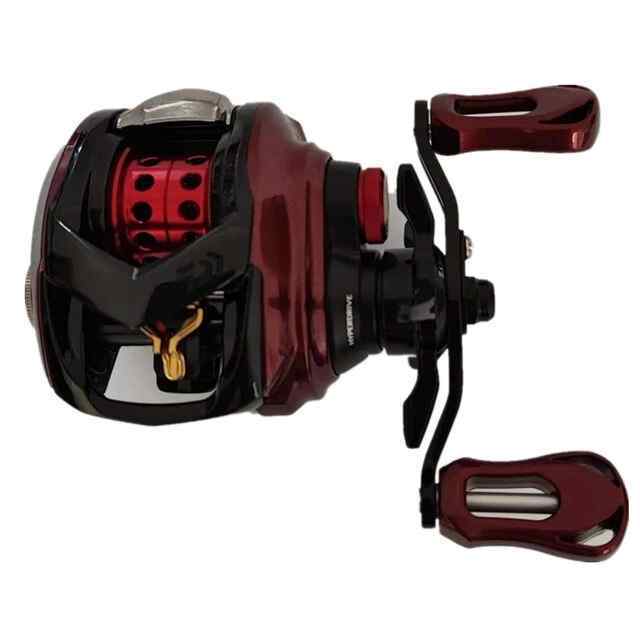
 redmeansdistortion replied to Delaware Valley Tackle's topic in Fishing Rods, Reels, Line, and KnotsThere will be very little to no difference in size. Shimano uses existing platforms for their BFS reels. The current production Scorpion BFS/Curado BFS/SLX BFS is built on the 70 size frame. The '12 and '16 Aldebaran BFS were both based on the Aldebaran 50. In terms of the Calcutta Conquest, the BFS variants are based on the 100 size reels. Where weight differences usually come into play are in the materials. The BFS uses an aluminum driveshaft and in the case of the new '23 model, an aluminum drive gear. Drag is weaker on the BFS reels because they come with a clicking drag, which means a smaller diameter drag washer and thus, lower max drag capacity. In the case of Daiwa, their BFS reels too are built on existing platforms. The current production Alphas Air TW, Gekkabijin, and Silver Creek Air TW are also the same platform as the Alphas SV TW 800. The Japanese made Alphas, produced from '03 to '19 was a 100 size reel with many BFS variants; the '05 Pixy, '06 Presso, '11 Alphas Finesse Custom, '12 PX68 SPR, '16 Alphas Air, and '17 Alphas Air Stream Custom. I really can't think of any production BFS reels that weren't built on an already existing platform. I feel it would cost too much in R&D for a market as niche as BFS. It's far cheaper to tune the braking, drag, and spool diameter on something already being manufactured.



Important Information
We have placed cookies on your device to help make this website better. You can adjust your cookie settings, otherwise we'll assume you're okay to continue.