
Team9nine
Super User
-
Joined
-
Last visited
Everything posted by Team9nine
-
Like all other line types, there is no standard with braided line ratings, as such, labeled ratings are somewhat subjective. You need to keep in mind that braid is rated differently than other lines. Most superlines are very strong, actually testing 2X to 3X their labeled strength. So why the lower rating? It is because they typically lose 50% (+/- 10%) of their strength when a knot is tied in them. As such, they label the test rating of braid based on the approximate breaking strength of a knot in their line, and not the line itself. And, since they have no clue which knot an angler will tie, or how well they will tie it, they have to make an educated/arbitrary guess as to what pound test rating to put on their packages. That leads to much of the variability you see (and pointed out). -T9
-
Maybe in California, but with all due respect, I can assure you the bass here in Indiana will chase down and try to capture dragonflies. It happens so fast, you never know if they actually catch them or not. I have sat on the front deck of my boat and watched for long periods of time, fascinated by the behavior. On one particular local lake, the specific dragonfly species is small and yellow, and very prolific, and a yellow hollow-bodied frog fished fast across the shallow open water moss edges will draw big numbers of strikes from bass versus other colors because the bass are so keyed in to them. -T9
-
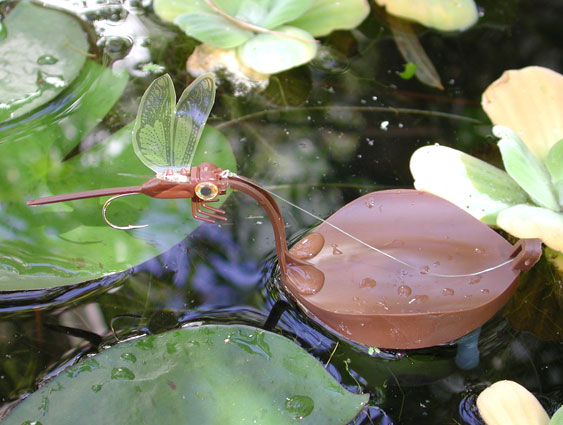
At least until a few years ago, you could still purchase the Hover Lure, King of Bass even comes in a complete kit...
-
Using an old Ugly Stick works perfectly fine with the technique, and is why Ned himself uses and prefers $20 cheapo bargain bin graphite composite rods (from Shakespeare). "No feel" is a pretty self explanatory term. Keep in mind the majority of the retrieves are performed with the lure off bottom where you want your rig to perform and swim along more like a neutrally buoyant jerkbait or a weightless wacky rig than a Carolina rig Many bites you will still feel regardless, but many others will simply be your line moving off or your rod starting to load a bit more than normal (think spider-rigging crappie). "Feel" in the traditional sense is over-rated with this technique, and more a matter of personal preference. Yes, it works, but no better than the traditionalists. -T9
-
Just my experience, but this is the best all-around solution to the problem ^^ My favorite overall Midwest Finesse rod is a 7' ML built on a popping rod blank. That action also serves the purpose of making reaction times to bites slower since the feel aspect is delayed...which also addresses your second point. That latter point is the reason Ned states the technique is best accomplished using a "no feel" retrieve, and why he can fish with a $20 cheapo graphite rod and catch thousands of bass each year. High end, super duper modulus rods with x-fast actions provide no real benefits to the technique when carried out as espoused by Ned. That aspect really only comes into play when you go outside the realm of traditional MF depths. -T9
-
A thermocline is nothing more than a breakline, and the best breaklines are usually those that are somehow connected to structure. So don't just "fish the bottom," but instead fish the bottom where the thermocline and structure meet. Either find several areas like this to rotate around on, or just find one good one and wait 'em out. Either way the result is usually better than chasing fish suspended out in the middle of nowhere. -T9
-
I only weigh a bass if it looks like a legitimate 4lb. plus bass, otherwise, just eyeball it. Will occasionally measure a fish or two out of curiosity as to whether it exceeds legal length limit if it looks close. Large majority go back quickly to where they came from -T9
-
I use 3# and 5# on most of my spinning outfits, with my heaviest outfit spooled with 8#. The advantages are just like any other line - the smaller the diameter, the better the bait fishes and the better your line control, assuming you simply aren't overpowering the line with a big bait. So for Ned, dropshots, jigworms, inline spinners, weightless trick worms, wacky, shakyhead, and anything crappie, etc., this is all I use. Allows me to fish something as light as a 1/16th oz. bait into 20' of water comfortably and with good feel and control. I can bump up to a 3/32-oz and go to 30.' Almost no (depth) limit to what I can do with a 1/8-oz or heavier. -T9
-
Yes - not unusual and will vary based on exact specifics of the rod (guide size and spacing) and reel (esp. spool diameter)....fish on
-
My old Lowe 1648 Modified V jon boat was 15 feet, 10 inches in length (not including engine or trailer tongue) with a 70-inch beam, 48-inch bottom and a transom depth of 15 inches. Trailers usually run a bit wider in most cases than the boat beam because the wheels/wheel wells tend to stick out slightly wider on each side for better stability. -T9
-
Dan is an old Indy area native who grew up just a couple miles from me. Used to read about him in the local paper all the time. He helped form one of the earliest bass clubs in the area, the Indianapolis Bassmasters. Another really large private collection belongs to a man named Karl White. His personal collection is valued around $4 million and includes some old boats in addition to old lures. Wife and I just got back from a visit to the Branson area where he recently opened up a museum in order to showcase his collection and make it available to the public (for a fee). It's called the "History of Fishing Museum" and you can Google up a lot of info on it easily. Worth visiting if you're ever in the area. -T9
-
I pretty much stick with 65#, but know a couple guys who've bumped up to 80# for the best performance in certain situations - go ahead and do it -T9
-
Thanks for saving me all that typing J I was feeling a bit lazy today and not quite into typing up a long response -T9
-
-
You find it at the link I posted a few replies up It didn't come up when you searched because you didn't put the entire statement (Ned rig resource) in parens. The search function on this site doesn't like three letter words. -T9
-
Try this link.... Ned Rig Resource -T9
-
^^ THIS ^^ The only thing I'd add is to also ask yourself, "What problem are you trying to solve by using braid?" -T9
-
Generally speaking, anytime you go lighter in line and smaller in diameter, you gain casting distance and better bait presentation. You might not notice it in general usage with typical plugs, but it is very apparent on the margins. -T9
-
If you just want to try one, I'd start with the Super Spook Jr. Great size that will get bit most everywhere. Another point that hasn't been made yet; if you're new to walking baits, the "knock" of the Spook Jr. will make learning a piece of cake. You have the sound reinforcement beside just the visual coordination - remember the kid learning to fly fish with a metronome in "A River Runs Through It?" You can learn and get good at "walking the dog" with your eyes closed -T9
-
Rapala touch scale comes with both a hook and a clamp. I just use the clamp all the time. If you don't have the clamp and have to add one, simply add it before you turn the scale on as the scale is self zeroing upon activation and doesn't have a tare function. -T9
-
I've used about every color of line made over the years, and caught plenty of fish on all of it. As was stated, it's not necessarily what they can see (they can see it all for the most part), but rather whether they care. Most times they probably don't, but in certain waters and under certain conditions, I've heard respectable people tell me they've seen big differences at times, so I don't absolutely discount the possibility. If your fish catching is keeping pace with others, then don't worry about line color. -T9
-
All great advice above. Might be able to squeeze a small 17 footer in there, but it will be close. Would definitely have to have swing-away/drop tongue, remove engine from the toter and trim straight down, perhaps even turn engine all the way to one side in addition to gain valuable inches - or slightly angle the entire boat once inside to utilize the extra diagonal length. No way to know for certain though because it will all depend upon the specific combination you buy. Every boat will be different. Things like length and horsepower of the engine, jackplate or not, where the tongue actually breaks away on the trailer, the beam and actual trailer width, etc. Only way to know is take exact measurements of a boat you're interested in and then try and measure out in your garage. Better yet, make the purchase contingent upon it fitting in your garage and you bringing it home to try first. Guessing you'll end up with something closer to 16' when it's all said and done -T9
-
-
-
On the trolling ban thing, I believe the primary answer is because when Ray Scott first started and devised the rules for his national B.A.S.S. events, he envisioned a competition where guys who didn't know each other were paired together in boats and competed "mano y mano," cast for cast, one lure each. Each angler was competing against all the other guys, and everyone's weight was an individual score - let the best man win. As such, there was no good way to implement trolling into the game and keep with the spirit of competition and fairness he sought. Since Ray and B.A.S.S. set the rules, most every other bass tourney organization that followed did the same. If you take note of the professional tours for other species you'll see a difference. For example, the walleye guys (PWT, AIM, etc.) were always paired as a pro and a co-angler in the same boat, and had a shared weight system (work as a team, and the weight for the boat is the weight recorded for both the pro angler and the co-angler). Makes trolling and scoring fair for both partners. Even lower AAA levels like MWC are team events, fish with a "buddy." Similarly, nearly all professional crappie events are "team" events, where the team (both guys) get the same weight for the day. As such, trolling is a perfectly good tactic again, fair for all. Ray set the rules for bass competition, so that's how we play the game. I think the Perry/Eisenhower thing really happened, but the timing was coincidental given it happening shortly before the formation of B.A.S.S. and their professional tourney circuit. -T9 Oh, and Ray Scott once held a fly fishing B.A.S.S. tourney B.A.S.S.' fly rod tournaments preceded a trio of Invitationals in 1975. The events were B.A.S.S. founder Ray Scott's way of promoting fly fishing among the Micropterus crowd. Anglers earned points for the fly rod events that counted toward AOY. About the only rules for these one-day tournaments were that you had to use a conventional fly rod and reel and cast in a conventional fly-fishing manner. Lots of anglers unaccustomed to fly fishing used the long rods to throw small plastic worms and jigs....Ricky Green won one of them, and even Rick Clunn placed high in an event... and it was at a fly fishing conference where Ray first got the "catch and release" idea.