
king fisher
Super User
-
Joined
-
Last visited
Everything posted by king fisher
-
Does your Senko always catch fish? Does it always out fish other baits? My theory is when there is no hatch which is a majority of the time, a bass or other game fish will simply be looking for something to eat. A Senko definitely looks like something to eat. When there is a hatch (crayfish, insects, shad, minnows etc.) they will most likely key in on certain aspects of the hatch in order to become more efficient predators, making them appear to be selective, but most likely are simply extremely focused on a certain trait of the bait that helps them find and catch that particular bait. If the bass are busting shad on the surface, you may still catch bass with a dark colored Senko on the bottom, but you might do better with a white one twitched on the surface, or a shiny spoon allowed to flutter below the crashing fish. Even if an angler doesn't want to match the hatch with their lure. Finding out what fish are feeding on will give an anger an idea of where to fish, as well as time of year, water temp. day light, etc. If they are feeding on a variety of bait, than an angler will most likely can catch them on a variety of lures, in a variety of locations. Just a theory. My reply's may only prove I spend to much time trying to think like a bass and not enough time bass fishing. Matching the hatch has been productive for me with many species of fish, in both fresh and Saltwater. I have also had success catching the same species of fish on lures I can't imagine matched anything a fish would eat. In my experience the larger the hatch, and smaller the bait being eaten, the more selective the game fish appear to be. When bass are feeding on large bluegill they probably wont turn down a crappie. When feeding on small schooling shad, the large crappie may swim by unnoticed. Again just a theory. Many people that have far more experience catching bass than me may think I am way off base, and I am the first to admit it wouldn't be the first time I was wrong. Most of the time an exact match is not necessary. Maybe only a certain movement, is all that is needed, and size and color doesn't matter. Sometimes size is most important, and many speeds will work. If the crayfish are bright red, you may only need a small part of the lure to be bright red. I do believe it doesn't hurt attempt to generally match the location, action, size, color and sound (in that order), to what the bass are eating. If an anger finds the fish to be selective, and keying in on one particular type of abundant bait, then they might have to find a closer match in their box. If that doesn't work something completely opposite might. If all else fails, Senkos work great.
-
Maybe plastic worms work so well because much of the time there is no hatch, and they look like something good to eat. When there is a hatch they can be retrieved in so many different ways, come in a variety of sizes, enabling an anger to imitate the hatch with them. Twitched on the surface they can look like dying shad, crawled on the bottom they can resemble crayfish, sculpin, bullheads, or other bottom dwellers. The versatility and the ability to look like something alive at any retrieve speed even still on the bottom is what makes plastic worms work so well.
-
First there must be an abundant hatch in order to make matching it important. If there is no abundance of a one type of prey over another, than a bass will just be looking for food, which can be almost anything. If for some reason there is a huge amount of red crayfish, then bass will key in on one or more characteristics of the crayfish. Enabling them to take advantage of the hatch and catch as many as they can before they are gone. It may be the red color, a quick movement for a specific distance, a certain size, sound, mud coming off the bottom, or a combination factors. In this instance it will be beneficial to an angler to match as well as he can. He may only need to use a retrieve that imitates the way the crayfish are scooting along the bottom. It may help to have the color or sound of his lure similar to that of the prey. An angler most likely wont have to have an exact match, but imitating the movement, approximate size, color and sound will help. If a hatch is large and competition for the prey extreme, a bass may be so busy trying to catch whatever is hatching, they might not even notice something they normally eat swimming right by them. If they are trying to catch crayfish on the bottom, a bluegill may swim right by them and not even be noticed. An extreme example is when yellowfin Tuna are eating dime size crabs. They concentrate so hard on getting as many crabs as they can that they ignore all other live bait. If there are very few crabs, they go back to eating 8 pound skip jack tuna or other large live baits. They don't really prefer the crabs over the bigger meal, they are simply so focused on catching the crabs, that they don't even notice the larger bait. Most of the time it is not essential for a bass anger to match the hatch. It is even far less common for an anger to have to match any aspect of a hatch to the extreme. Most of the time an approximate size, color, and retrieve will suffice. Matching the hatch is rarely necessary but it can't hurt. As others have said, if matching doesn't work, than going the opposite and trying to stick out may be best. A bass can and will eat almost anything, but there are times, when for some unknown reason they key in on one food source, and completely ignore all others.
-
I caught my PB smallmouth on an old Bagley crank in their classic brown and yellow color. I don't throw yellow lures much because of an article by Dough Hannon I read in 1977. In the article he said that studies indicated bass are repelled by yellow, and attracted to green. I haven't been able to get the article behind me and go back to catching fish on yellow lures. After all if it was in an article it has to be true. I tend to substitute chartreuse for yellow.
-
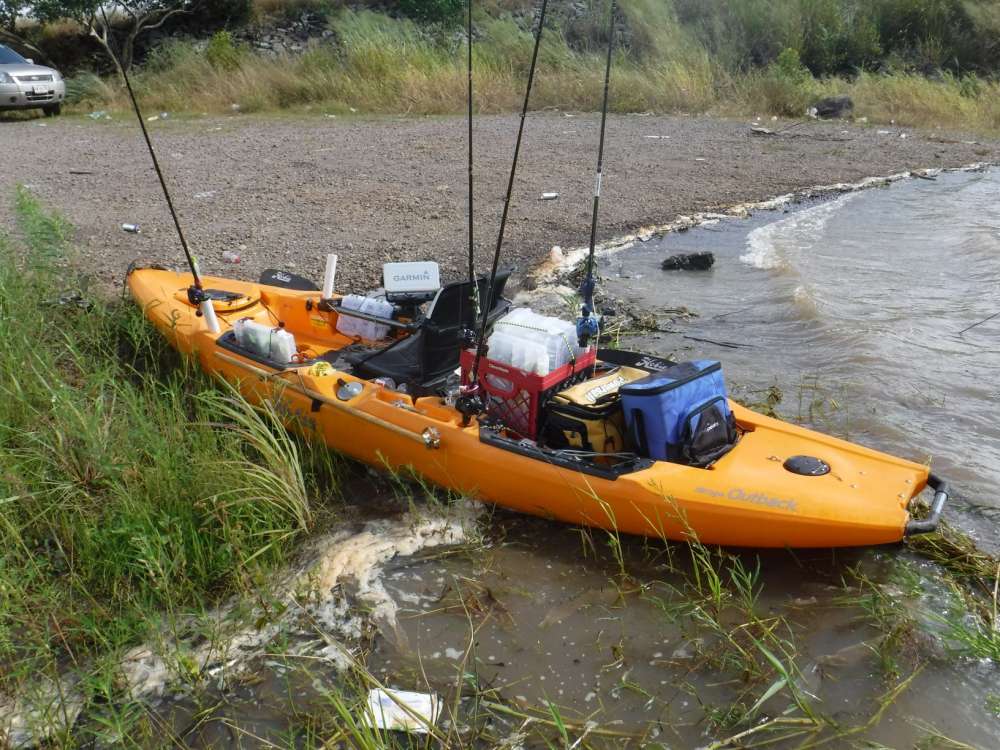
Four. One medium casting, one medium heavy casting, one heavy casting, one medium spinning and way to much other gear.
-
The difference for me is a one hundred dollar real will catch fish, and a $500 will get me a divorce.
-
I have a friend that still uses one rod, and reel, the same one he used when we were kids. He still casts the same dozen lures he did back then, and he still uses mono. I asked him why he still fishes with monofilament, and he told me he doesn't trust new fancy lines with big names, he prefers what he calls fishing line (Trilene XL.). He still calls all my latest fishing technology useless money wasting gadgets, and he still catches more fish than me. l almost told him Trilene XL. is monofilament, but realized all he would say is his fishing line caught more and bigger fish no matter what big name I made up.
-
Stop hanging out with the Bait Monkey looking for a magic big fish catching lure. Instead, becoming more skilled with what I already have, making those lures big fish magic.
-
A person can use 100 pound test braid tie a square knot and never have one fail while fishing for bluegill. A doubled line Uni is a very effective knot for braid, and tests at the top of the list. Other than using more line and three tags, it is as good a practical to tie knot for braid there is. My only point is braid knots fail at far below the actual strength of the line. Most 50 pound rated braided line will actually break at around 70 pounds. With a 65% knot you will still straighten out most hooks before the knot gives out. Hook in to a 200 pound tuna with 50 pound braid, and your confidence in a doubled line Uni will be tested. (Bimini with Cats Pawl for that situation) I use 50 pound braid when I punch for bass. Switching between, doubled line Uni, Palomar, and snell. All work well, and failures have been extremely rare, but I can't say never for any of those knots.
-
I hope I live long enough, have the good fortune to be able to fish often enough, and use that time on the water efficiently enough to master multiple techniques. It would be nice to also catch some nice fish, and have a great time on the journey to becoming a bass master. So far I have mastered buying more gear than I need, loosing almost as much gear as I buy, and thoroughly fishing the 90% of the lake that doesn't have any fish.
-
For braid I use a Palomar or double Uni if a Palomar is going to be difficult to tie. A clinch or improved clinch knot will not slip and come untied, but will cut into itself causing it to break slightly above the knot. Doubling the line on a clinch does help. I have tested every knot you can find on the internet. Many have this problem. I'm not saying you can't use a clinch knot with braid and catch bigger fish than me, I'm sure someone has used a clinch knot with braid for years and never had one fail. I am saying if you test a clinch or improved clinch it will break just above the knot at about 65% of line strength. Braid does not hold knots well. Even a Bimini twist with a cats pawl, won't get 95% strength. The good thing is even a 50% knot with 50lbs. braid will break at 25 lbs. which is 5 pounds better than 20 lbs. mono with a 99% knot. I will also say, anyone who has never had a knot fail, either hasn't fished much, or has a selective memory. I have used every type of line, from two to 400 pound test, with many different knots. All have failed at one time, maybe on a snag not on a fish, but still failed. Knots are the weak link period. Find one you have confidence in, can easily tie correctly, and set you drag properly Just don't try and convince me that any knot will NEVER fail.
-
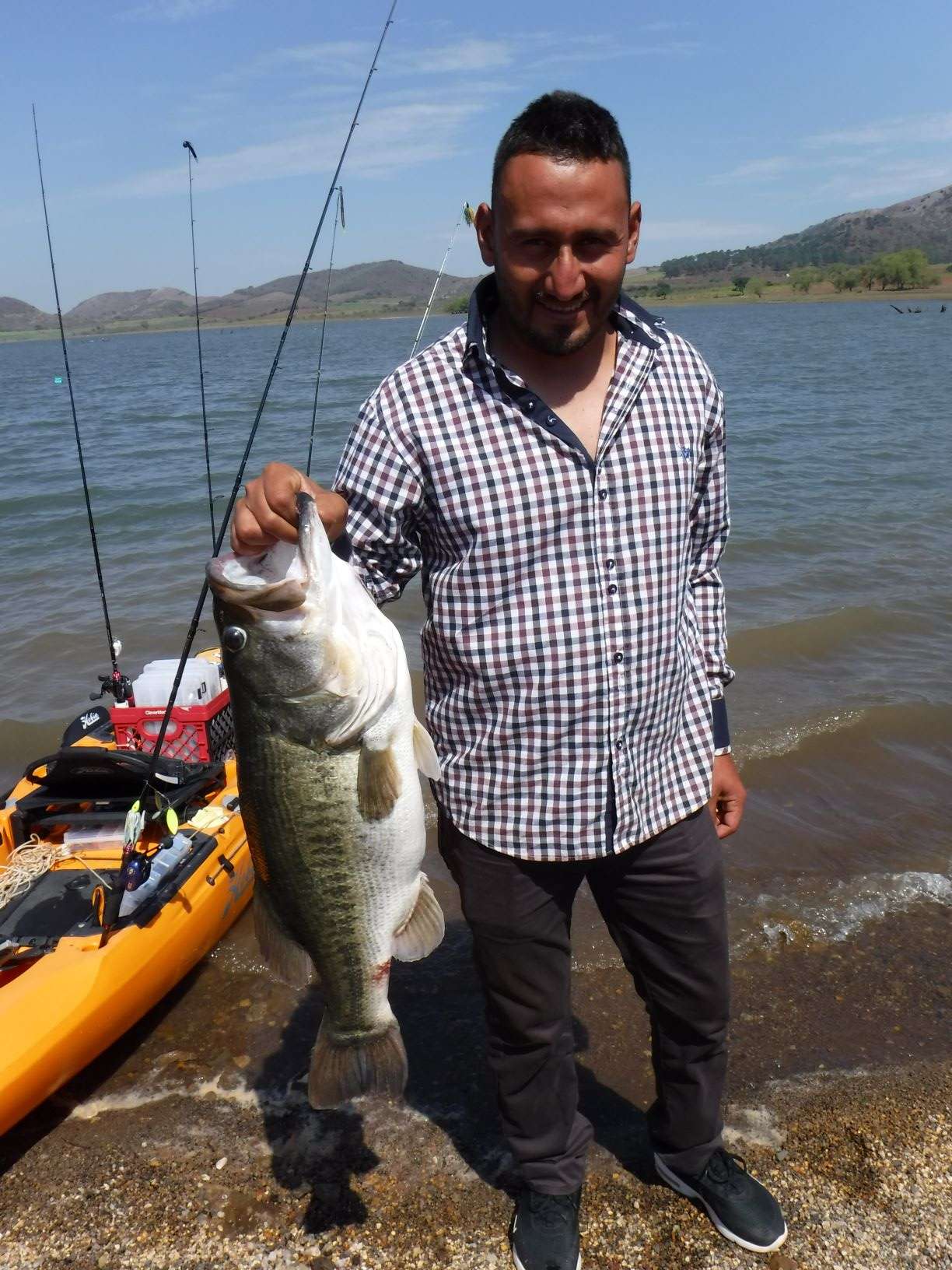
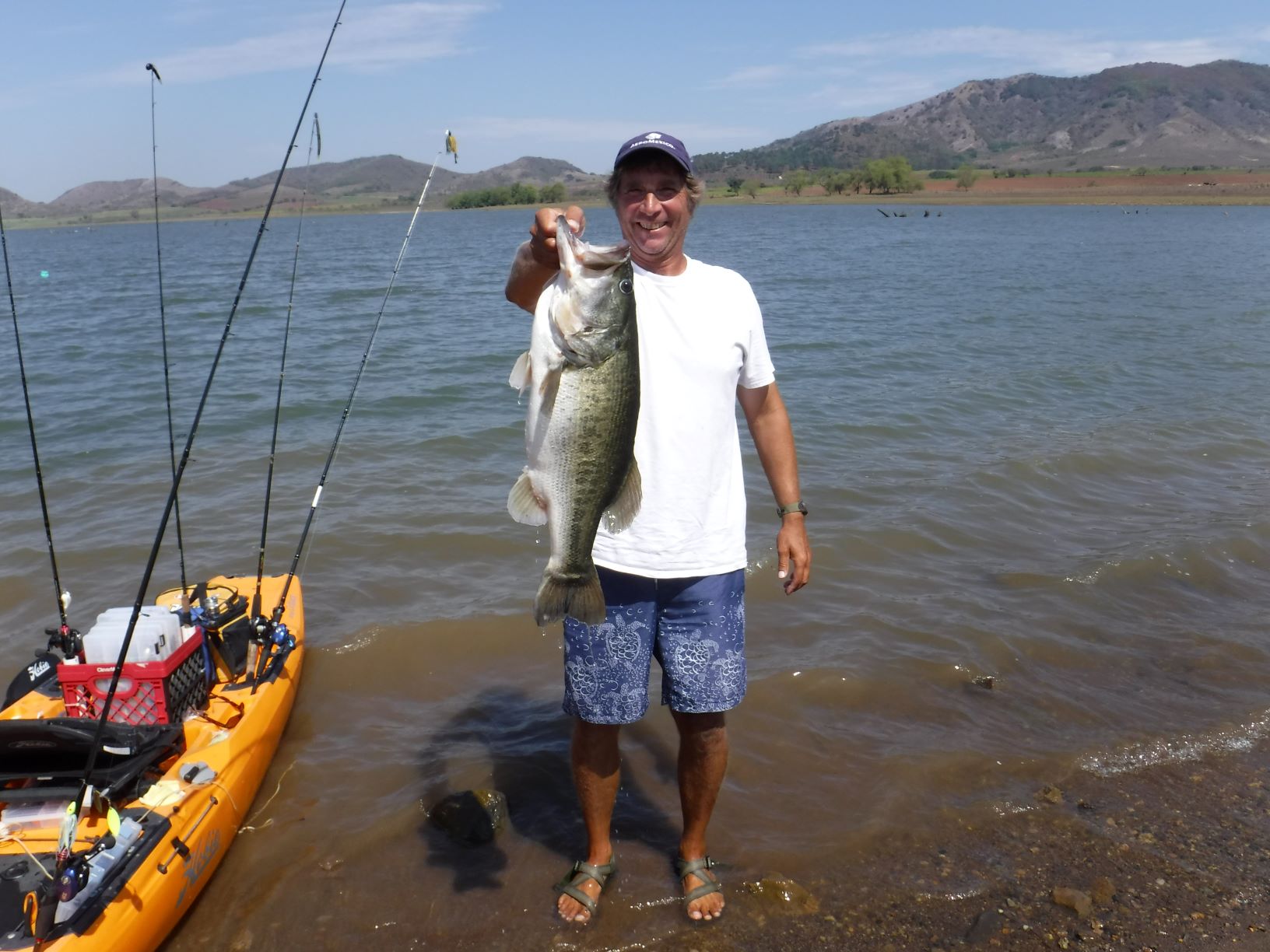
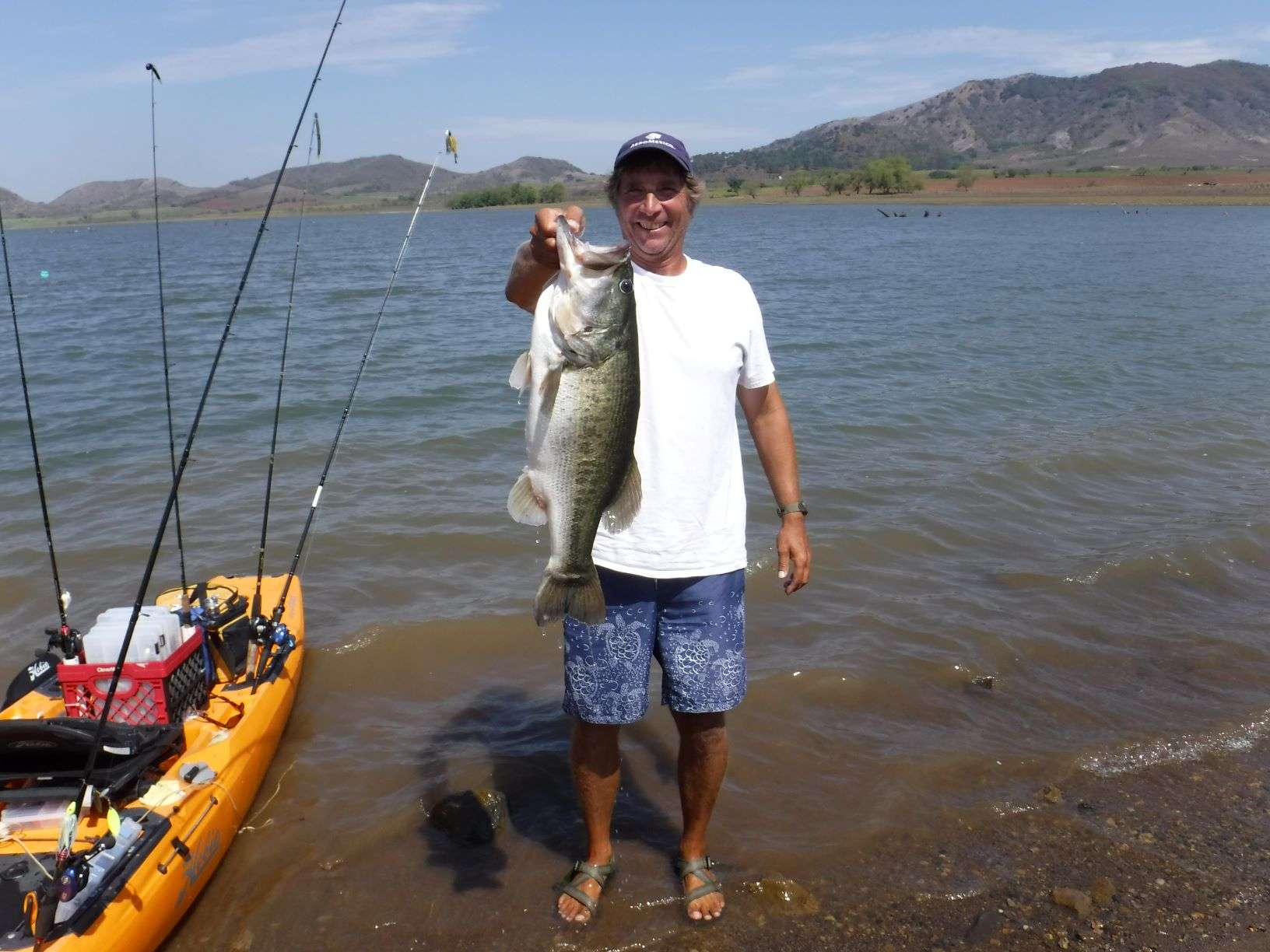
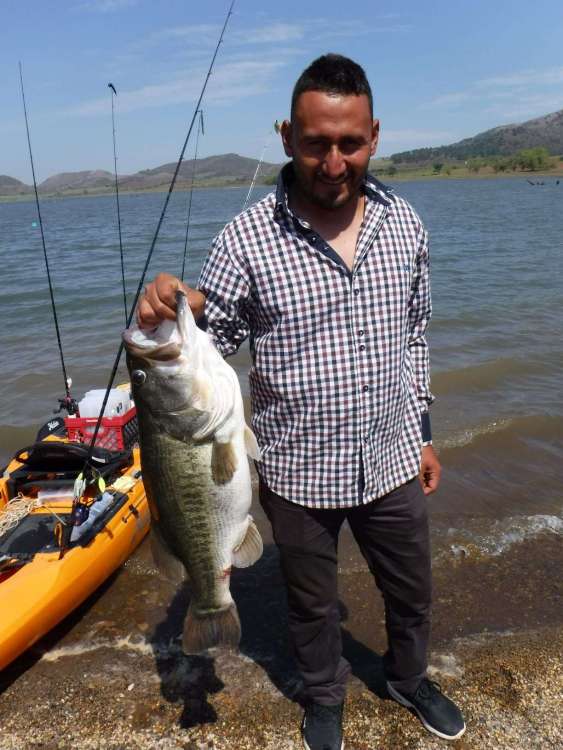
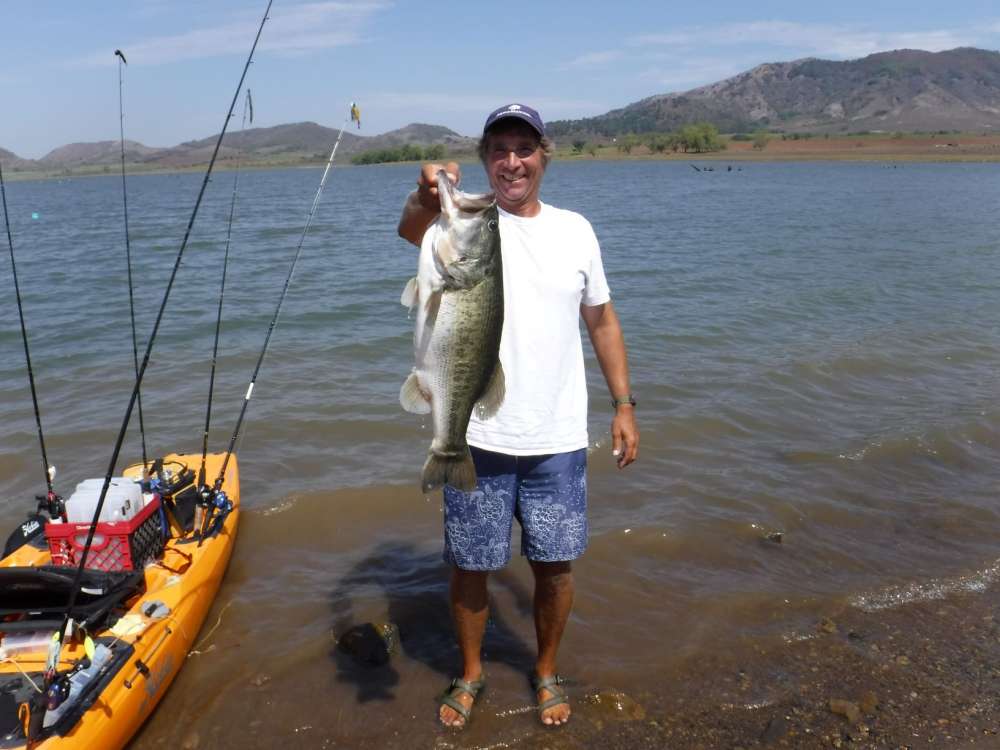
Only able to fish for large mouth this year. My biggest was on a spinnerbait. I didn't have a scale, it measured 25 3/4 inches long. A man fishing for Tilapia from the bank, was kind enough to help with some pictures. The next biggest was 25 1/4 inch, 10.2 pounds, on a spinnerbait. Also landed 25 inch or longer fish on buzz baits, square bill and a Rebel Jumpin Minnow. My PB before this year was 5 1/5 pounds caught in 1977. I hope I don't take quite so long to get another PB.
-
March is a great month for fishing in Mexico. Bring some camp gear and your kayak, fish lakes with next to zero fishing pressure, great weather, cheap food, and beer. You could stop and fish lakes in CA on your way down and back.
-
#1 spinnerbaits.- Many different colors and blade combos. 2 over 10 pounds and many over 7. #2 Cavitron Buzz bait. Chart. or black. 2 over 8 pounds a few over 5 #3 Rebel Jumping minnow. One over 10 and many inshore and offshore saltwater fish. #4 Owner under spin with Skinny Dipper. Nothing over 6 pounds but lots of smaller bass. #5 Many crankbaits. DD 10, Bomber, Norman, H20, Bagley and Rattle Traps. Best for numbers, Biggest crankbait fish was 7.2 pounds. Lost dozens of old crankbaits. I started replacing them with mostly 6th sense and am happy with the results. Splurged and bought a Spro Rock Crawler. Caught a 5 pound bass on first cast, lost to a net on the second cast. Will buy more if I can find a good price. Have tried a large Spro Rat early in the morning every trip. Most expensive lure in my box. Landed many bass, none have even been as big as the lure. Big disappointment so far. #6 #3 Blue Fox Vibrax inline spinner. Saved the day more than once. Biggest 7 pounds. #7 7 inch Senko. No big fish but great on slow days. #8 A few fish on jigs, and creature baits, but haven't had a chance to fish the lake where I flip and punch one time. I tried jigs on structure every trip, but only a few small bass. #9 Live Tilapia. I have been spending most of my time lately experimenting with live Tilapia. So far no luck, but hopefully am going to get to the top of the learning curve soon. I have mastered catching the bait, next step is discovering correct presentation.
-
-
There is a commercial fisherman that uses a cast net in the marina inlet in PV. His boat is an old jet ski with the motor and drive removed. For propulsion he uses a stand up paddle board paddle. I don't know how much the old jet ski cost. Probably got it for free at the dump. I would bet with the paddle it comes in under $150. I thought this was a one of a kind boat for many years. Then last week I was fishing my favorite bass lake, and two men drifted past me in another gutted out jet ski. On this lake the wind consistently blows from the east in the mornings and from the west in the afternoon. They launched their jet ski in the morning letting the wind drift them all the way to the west end in the morning. Then waited until the wind switched to drift them back to launch in the afternoon. They also had two shovels, they used as paddles and a rock and rope for an anchor. While not a fancy boat, it was stable enough for both of them to stand up and cast. They were able to fish the whole southern shoreline, make it back to their pickup safely and had bass for dinner. I had an expensive kayak complete with a fish finder, and I'm glad I didn't have to depend on bass for my dinner.
-
You have two reels. Put 12 pound big game on one, 40 pound braid on the other. Practice and fish with both. You may end up preferring one over the other, but probably will use each one for a specific technique.
-
There are many lakes in Mexico that have no lodges, or guides and bass are considered trash fish to the commercial fishermen because they eat tilapia. One of the largest is Trigomil in the state of Jalisco. Most of the bass in this lake will die of old age having never seen a lure. I know of one bass a friend caught there that was right at 15 lbs. The locals had never even seen a sport fisherman before. Many other smaller lakes have potential for giants too. I found one unnamed small lake where I have landed a few over 10 this summer. I plan on exploring another half dozen similar lakes next summer when I have more time. I'm not saying there is a world record in any lake in Mexico, but the chances are as good as anywhere.
-
Bait Monkey told me to look at the reels on Tackle Warehouse today. They have the old model, Tatula CT on sale for $89. You could get two and still come in under $200. I don't need any more reels, but for that price the Bait Monkey may have a talk with Santa. I'm not saying that they are better than more expensive reels, but they are very close.
-
If there is any chance you will ever want to use the reel in Saltwater, than get the Diawa BG. If never planning on saltwater fishing, then all major brands make lighter, quality spinning reels in that price range.
-
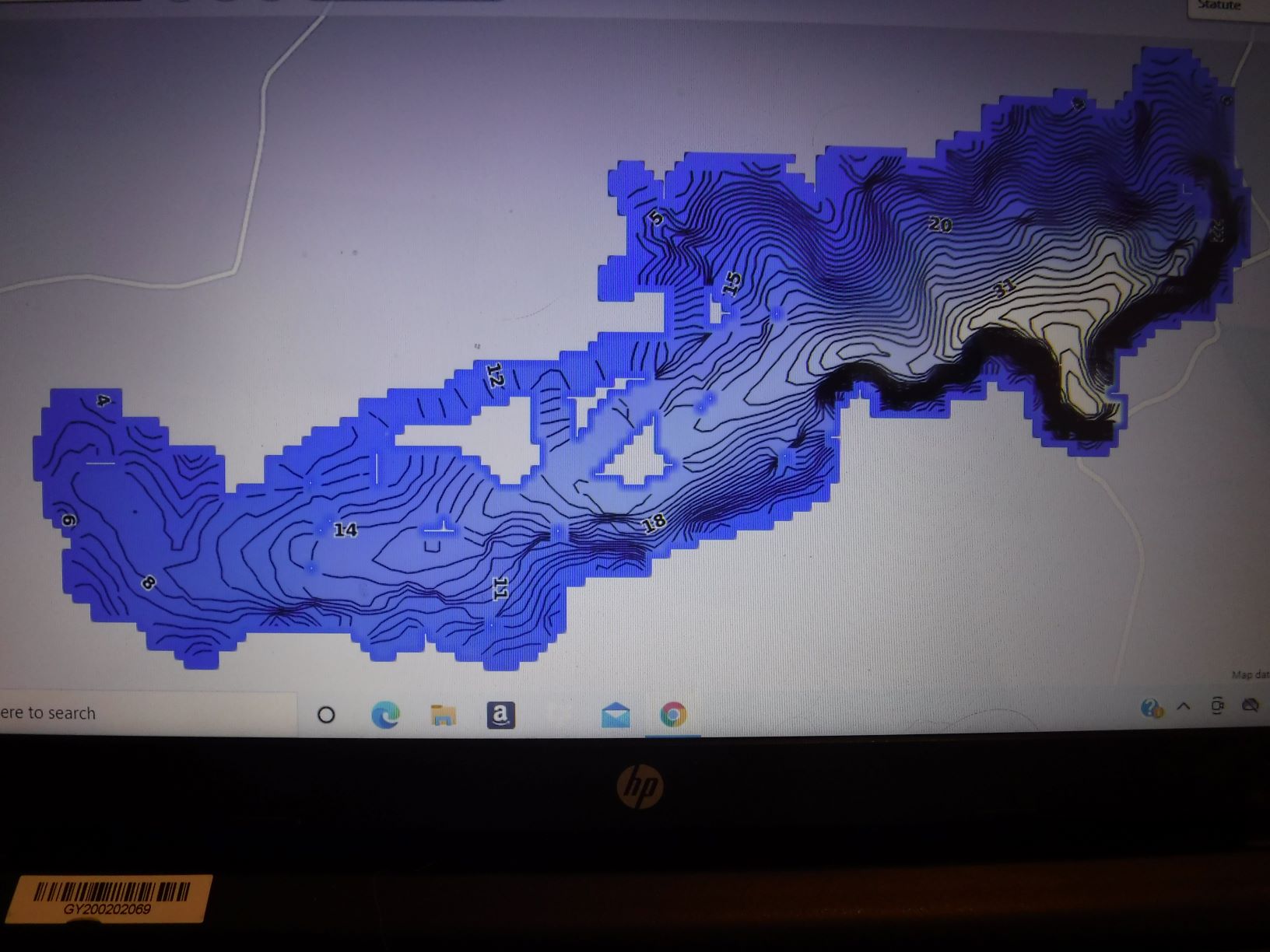
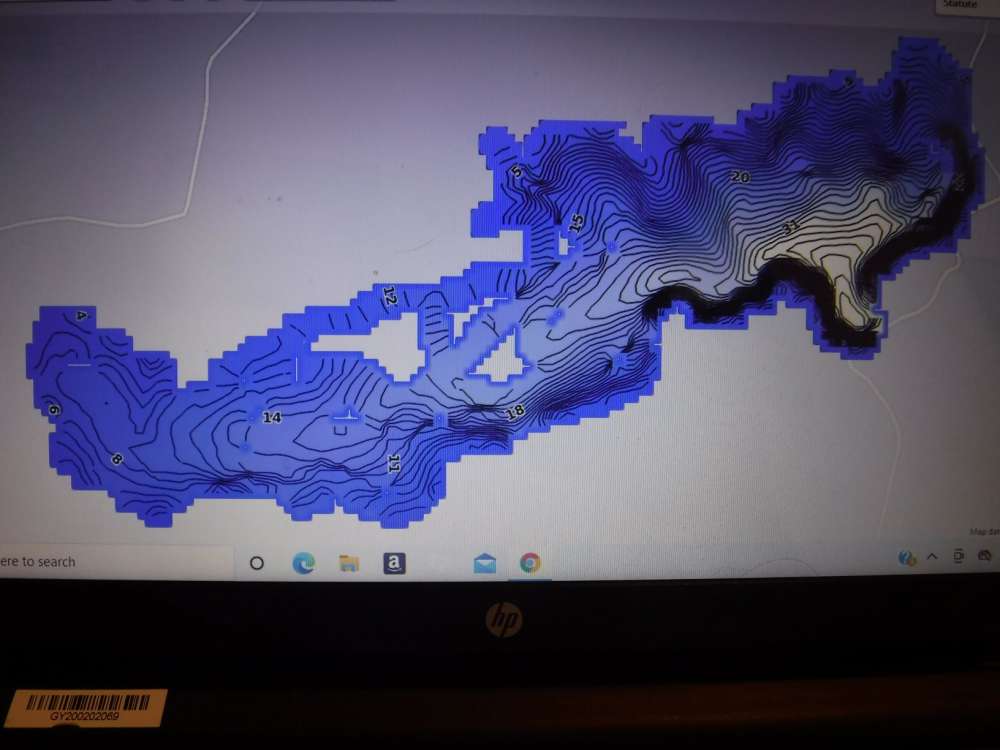
Here is a map I made of the lake with my fish finder. Lake is 2 feet lower now. Water temp. is 66 degrees at daylight, warms up to 71 degrees in the afternoon. Air Temp. day time low 58 high 80. Will not vary more than a couple of degrees from the first of Dec. until Mid April. Sunny, with mid. afternoon winds 15-20 MPH. from the west every day. Water clarity 1 1/2 to 2 feet. Other fish species are carp, tilapia, and catfish. I have assumed the bass eat mostly tilapia, but according to the local angler they eat frogs. Where would you fish? West end is where I'm going next chance I get.
-
I learned a valuable lesson the hard way. I went to a small lake I have had good luck with huge bass since discovering it last spring. Rarely does anyone fish the lake, and I had started considering it my personal lake with me being the knowledgeable local expert. I planned on fishing a spot on the shore with buzzbaits. Then cranking a rock pile in 15 feet of water, both places I had success in the past. I was starting to fish the bank at first light when another Kayak angler passed by me. ( he must not have heard it was my private lake) He told me he was from a town close by and fished the lake often but only in the winter. He kindly offered to tell me where the fish lived, and how to catch them. He told me the big bass are all at the far end and only eat frogs. Having three rods all rigged with different hollow body frogs in his kayak, he definitely believed in his theory. The lake level was dropping fast, the far end is flat, muddy, only a couple feet deep, and far from any deeper water or structure. I have had some success there when the lake was flooded, but didn't think it would have any large bass now that the lake had cleared and dropped. The end I preferred to fish has varied depths, steeper shore line, steep drops, ledges, humps, and other structure, with flooded trees and large rocks for cover, both along the shore, and off shore. I thanked him for the advice and said I would try the far end later in the day. Like a fool, I went ahead with my game plan. Landing large numbers of small bass in both places. At the end of the day the local anger stopped by while paddling to the take out. He told me he caught 4 Grande bass, lost three, and had a giant bass break one of his rods. I pulled my kayak next to his to see the pictures. They say pictures are worth a thousand words, well these pictures were worth a thousand pictures. All four bass were over 9 lbs. with one close to 12. He had a picture of a large size popping frog all the way down one bass's throat. The frog looked no bigger than a fly rod popper, in that giant mouth. He said, I told you bass live at the far end, and eat frogs. Only small bass at the end I fish. His English was as bad as my Spanish, but I will just say I got the picture. Next time a local fisherman offers me some advice, I will listen.
-
I noticed from the photo you have a medium chirp frequency transducer more popular for Saltwater or deeper water use. How do you like using medium chirp? Are you happy with clarity and target separation in 40 ft. or less water? I have a Garmin echomap 64 plus that came with a medium chirp transducer on my Kayak. I have no complaints, and like the medium for the fishing I do in the ocean, but am tempted to buy a High wide transducer to use on lakes. Hate to spend the money and go through the effort of switching transducers, but ending up with no significant improvement in shallow water.
-
I would have to score that professional over run a 7 plus two added bonus points for expensive line. Good job.
-
I wish I would have brought a camera, and scale with me on the day I caught the biggest bass of my life. This next year, I will always have a camera, and scale with me. My other goal is to slow down. I always think I need to fish fast, and cast at what is around the next corner, when I probably just past a fish by that I could have caught if I had just slowed down. I need to realize there is a reason they sell more plastic worms, than buzz baits.