
Tennessee Boy
Super User
-
Joined
-
Last visited
Everything posted by Tennessee Boy
-
I would imagine if the BPT was still using the best 5 fish format you would see a difference in the size of the fish caught with FFS. When every fish counts there's no need to chase the biggest fish just target any over the size limit.
-
Well said. I could see the offshore "scoping" that produced the jaw dropping numbers at Conroe getting harder as more people learn to do it and the fish get conditioned to seeing minnows shaking around them all winter. On the other hand, if the entire field had been as good with the technology as the top half, the FFS numbers would have been higher.
-
 Y’all got some pretty streams up there in the mountains.
 -
Although my evidence is far from unassailable, I feel strongly that anglers who use BassResource.com catch more fish than those who do not. Has bassresource.com has ruined the "sport" of bass fishing? 😆 Here are the numbers per period for the entire season. Average Number Caught Per Period with FFS: 5.22 Average Number Caught Per Period with Without FFS: 4.18
-
I would be happy to address your skepticism but you will have to say more.
-
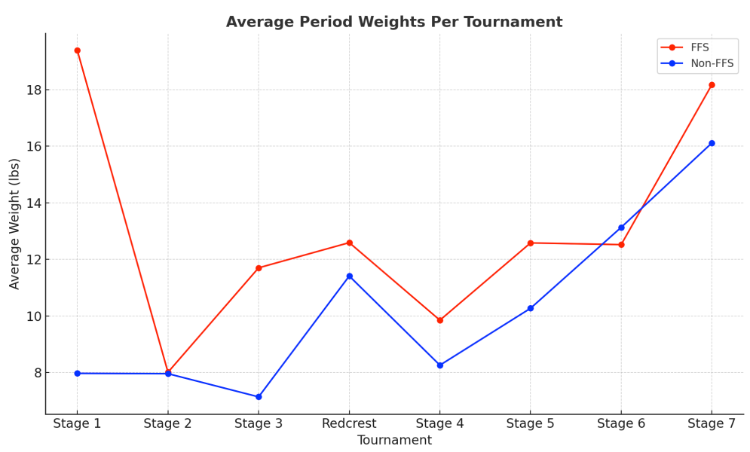
The impact of forward facing Sonar on the sport has been a hot topic on this forum and elsewhere. Major League Fishing’s Bass Pro Tour 2025 rule that limited forward facing sonar (FFS) to one of the three periods each competition day created a straightforward way to gauge the technology’s real impact. The season is over and the results are in. I’ve run the numbers for the entire field and compared the average of all FFS periods to the average of all non-FFS periods across the season. The question was simple: when FFS is allowed, how much more weight do anglers bring in on average and who actually uses FFS to their advantage? Across the entire season, FFS periods produced 27% more weight than non-FFS periods. In actual weight, FFS periods on average produced 2 lb 12 oz more weight than non-FFS period average. That’s a meaningful amount in a tournament where every fish counts, but it’s not the automatic, sport-ending dominance some claim. The advantage was far from uniform across events. In Stage 1 at Lake Conroe, the field averaged +143% more weight during FFS periods. in Stage 6 on the Potomac River, FFS periods averaged –5% less weight versus non-FFS periods. If Stage 1 is excluded, the season-long FFS advantage drops from 27% to 13%. The advantage also varied greatly between anglers. The Top 10 in the Angler of the Year (AOY) race averaged +53% more weight in their FFS periods relative to their non-FFS periods. Meanwhile, the Bottom 10 in AOY averaged -19% less weight in their FFS periods relative to their non-FFS periods. Notably, the top three in AOY were also the biggest FFS gainers: Drew Gill (+169%), Jake Lawrence (+89%), and Jacob Wheeler (+74%). The takeaway is clear: FFS is powerful, but only if you know how to take advantage of it. Another very surprising finding was that FFS usage did not increase the size of the fish caught. The average weight of the fish caught during FFS periods was less than an ounce more than the average weight of fish caught during non-FFS periods. This held true regardless of how I looked at the data. In all tournaments and among all anglers there was no meaningful difference in the size of the fish caught during FFS periods. So has FFS “ruined the sport”? The numbers don’t say that. They say FFS delivers a real, measurable advantage on average, can swing events when it’s the dominant factor, and—most importantly—separates anglers who are proficient with the technology. If you plan to rely on it, plan to practice. The technology won’t outfish your decisions, but it can reward the right ones. So what do you think? Are the numbers what you expected? Has your opinion changed now that we have real data showing the impact FFS is having on the sport? What do you think the MLF policy on FFS usage should be going forward?
-
I've been wearing Crocs for years.😆
-
You line up the sights of the gun on the target when you aim a gun unless you just "shoot from the hip" like the gun slingers do in the old westerns. You aim with one eye. When you shoot from the hip you look at the target with both eyes. The only time I aim (line something up) when casting would be when I'm flipping or shooting with a spinning rod. I do both with my left (dominate) eye. Using both eyes gives you depth perception which is important in casting and hitting a ball.
-
I was diagnosed as cross-dominate (left eye dominate, right handed) as a child. I've always felt it gave me a big advantage shooting a gun or bow. It allows me to aim with my dominate eye and control the gun with the dominate hand. I agree it doesn't apply to casting. I don't line anything up with either eye when I'm casting.
-
When the line breaks it almost always breaks at the knot. If I'm hung and have to break off, I want it to break at the lure knot not at the braid to leader knot. Less stuff to retie.
-
Things that affect the way I fish. Season Temperature Current Wind Rain Light Level Water Clarity Thermocline Aquatic Vegetation Life Cycle Willow Fly Hatches Shad Spawns Things That Matter but I can't control or adjust to Water Level - Usually, not a factor but if it's rising or falling significantly it's major. Weather Fronts Moon light Water Quality Things I don't think matter Barometric Pressure Humidity Solunar Calendar Cows lying down. Things I'm not sure about Sonar Noise College Football scores 😆
-
So much of the sport of bass fishing is in our heads. I've often said there is a need for fishing psychologist. They would be kind of a cross between a sports psychologist and a witch doctor. 😆
-
I'm with @TOXIC. If I didn't have a graph up front I would fish from the console. 😆 Even if I'm fishing the bank I want to know how deep the water is under me. I also like to see the map to know the structure around me.
-
I don't have experience with any of the boats so my opinion may not be worth much. I have a Ranger aluminum and have always own aluminum boats. I would choose the Vexus. You have to ask where you want to put your money. I've always tried to get the most fish per dollar spent. A lot of anglers like to go fast. Going fast is expensive you don't catch fish when you're going fast. The 115 motor on the Vexus lets you put your money into other things that will enhance the fishing experience more. But if you're one of those guys that likes to go fast then you will probably ignore everything I've just said. 😆 The Xpress would be my second choice. I've heard nothing but good things about Xpress boats. I'm biased against the Crestliner. I just don't associate the name with bass fishing.
-
This may sound crazy but when I was a little kid in the 60s I saw a wild turkey with my grandfather. It was a big deal. They were rare then, now they’re everywhere.
-
I helped a buddy replace some gears in the head of his Edge a couple of years ago. I don't remember all the details but it was easy.
-
We want to see pictures. 😀
-
The Bass Pro Tour records the lure each fish is caught on. Here are the top five for the 2025 Season 1. Bladed Jig 2. Jighead Minnow 3. Wacky/Neko Rig 4. Drop Shot 5. Creature/Craw For the 2024 season when FFS was not limited to 1 period 1. Jighead Minnow 2. Bladed Jig 3. Lipliess Crankbait 4. Jerkbait 5. Soft Body Swim Bait
-
8 years and counting on my Dual Pro.
-
30+ years ago my bass club was about to fish a spring tournament. Rumors started going around that the fish were hitting pink trick worms. I caught my fish on them in the tournament. I'm pretty sure at least half of the fish caught in the tournament were caught on them. There were two reasons for this. First, the fish were hitting pink trick worms. Second, everyone was throwing pink trick worms. 😆
-
Lakemaster is a Humminbird brand of maps, not a version. Navionics sells map chips that are compatible with Humminbirds. You can also download the maps to your own chips. If you go with the tablet you can use Navonics and you can also purchase LakeMaster maps and use the Humminbird One Boat Network app to view them. It's a cheaper way to get a larger screen for mapping. The big downside is the tablet will not be able to share data with the other fish finders or the trolling motor.
-
It's my understanding that you can use Navionics with Humminbird units but you will loose some functions. For example I don't think you can tell the trolling motor to follow a contour of a Navionics map. That will on work with a Lakemaster map or an Autochart map. You could always switch to the Lakemaster map if you want to use that function.
-
I know you're not suggesting that every reel is unique and that none of them share any parts. Yes there are different alloys, tolerances, and quality controls. It's just difficult if not impossible to know when you're paying for quality or if you're getting ripped off. I know an $8 no name reel did not cost $200 to make. I don't know that a $200 no name reel did not cost $8 to make. I don't know what to think about Kestler Reels for example. I know they're not made in the Kestler factory in Texas. I don't know who makes them or if they are quality reels. Can I be sure that the management at Kestler knows what alloys, tolerances, and quality controls were used to make the reel? Kestler Rods have a good reputation. Does that mean I should trust any product that bears the Kestler brand. Does Kestler sell frozen foods? lol. I'm pretty sure that a $350 Diawa reel cost more to make than a $99 Diawa reel and is a better reel. I'm sure Diawa knows what alloys, tolerances, and quality controls are used in their reels. That's why I stick with companies like Diawa and Shimano for the reels I buy. Their core competency is in making fish reels. They control what goes into them and I have a better idea what I'm buying.
-
I'm casting my vote for Coontail but it's hard to get a sense of scale with the photo.
-
This isn’t just about fishing—it’s the way the modern world works. A few months ago, there was a recall at a factory that makes prepared frozen meals. The news listed the affected brands, and there were about a dozen well-known names on the list. That’s because the modern way of doing business is to focus on your “core competency” and outsource the rest. The fishing industry is full of companies that do nothing but marketing. Nothing! In today’s world, you can hire people to do everything. There are companies like BBS Tech that manufacture braid for multiple industries, including fishing line. They’ll make it, package it with your branding, and distribute it. All you have to do is tell them what kind of line you want and I’m sure they have engineers who can advise you—even if you don’t know much about fishing line. Your only real job is convincing people your braid is the best on the market. And if you’re not good at marketing? You can hire people for that too. In theory, a one-person company could own a major fishing brand and outsource everything—manufacturing, marketing, distribution. In reality, it’s hard to compete unless you bring some real value to the process. In many cases that's just marketing expertise. How to Peek Behind the Curtain I enjoy trying to figure out what’s really behind the fishing brands we discuss on this forum. Companies try to keep that kind of information secret, and it’s hard to get a complete picture. But there are clues. If a company doesn’t tell you something, it’s probably because they don’t want you to know. Companies that own their own factory brag about it. They post videos of their facility and show off the people working there. St. Croix, for example, will let you tour their factory. Their website even includes names and pictures of the people who build their rods. Cashion Rods is another example. They proudly tell you their rods are made in South Carolina. If a product is made in the USA, the company will usually say so—on their website, in their marketing, and on the packaging. It’s something to brag about. If you can’t figure out where something is made, the answer is probably China. If a company doesn’t have an address or phone number on its website, that’s a red flag. A missing phone number often means there’s no full-time staff to take calls. A missing address might mean the company is being run out of a garage. That doesn’t automatically mean the products are bad—but it does mean you should dig deeper. Even if the address isn’t on the site, you can usually find it through a quick search. Business registration records often include physical addresses. Then plug that into Google Maps Street View—you might find it’s someone’s house or a warehouse with no signage. That tells you something. What can you learn about the people behind the company? Companies usually list their leadership team. If the company shows a president, a CFO, a director of marketing, and a product manager—but no lead engineer or head of product development—that suggests their products might be outsourced. If a company claims to have designed “the best reel in the world,” they should be proud to name the engineers behind it. You can also check job postings. Are they hiring more marketers—or more engineers and product developers? That tells you what they actually value. What happens when a company gets bought out? There are a few possible outcomes: • It keeps operating independently under new ownership. • It becomes a division of a larger company. • It becomes just a brand name slapped on generic products. That last one is common. Anyone can source gear from China, slap a logo on it, and sell it. The catch? No brand loyalty. But if you buy a struggling company with a respected name, that problem goes away. You can now sell anything under that brand—whether or not it lives up to the original reputation. Strike King fishing line comes to mind. My Take It’s impossible to know everything about a company’s inner workings—but there are always clues. Googan Squad products might be designed by the strongest team of experts on the planet. If that’s true, I haven’t seen any evidence. It sure looks like a marketing effort to me. Some people say they don’t care, as long as the products catch fish. To each their own. But I try to support companies that add real value to the products I buy—not ones that just repackage someone else’s work. I want to reward companies whose core competency is fishing, not marketing.