



Tennessee Boy
Super User
-
Joined
-
Last visited
Everything posted by Tennessee Boy
-
On the lakes I fish there is literally a switch that will turn on the bite. Unfortunately, only the people at the dam have access to that switch. I agree with what many have already said. Current matters as much as anything.
-
Good point. I absolutely agree size has a big impact on their behavior. They go from being bait fish when they're young to being apex predators if they live long enough. My belief in the importance of seeing them as individuals comes mostly from tracking studies. It seems like in every study they find a general trend in behavior but there's always a fish or two that completely buck the trend. For example, studies show that the majority of bass establish a home range but the same studies have found that some bass are nomads. I don't know if they are just looking for a home or if they live their entire life that way but you see fish that the scientists have trouble tracking because they move all over the place.
-
Very interesting discussion. The idea of a ‘bite window’ really resonates with me. Have I experienced it? Absolutely. We’ve all had those moments—hours of nothing, then suddenly, every cast gets bit. It sure feels like a bite window has opened. But that raises some big questions: - Was the window open only in my immediate area? - Was it lake-wide? - Was it happening on every nearby body of water? - Was it truly a “mysterious window,” or did something specific, like a school of shad moving in, trigger the feeding? Watching tournaments online you’ll hear commentators say, “The bite has slowed down,” as if a lake-wide switch got flipped. But when I’ve looked at actual catch data from those same tournaments, the numbers don’t always support that narrative. Yes, catch rates can vary by time of day, but they typically don’t show abrupt shifts. We’re wired to see patterns, even when they aren’t there. Our brains want explanations—even if they’re not backed by evidence. Research says that bass feed for only a small portion of the day. Feeding activity increases at dawn and dusk. Not all fish feed at the same time. I’m convinced bass are individuals. They adapt to their environment, and their feeding times and strategies reflect that. We often want to believe “they all do X,” but that’s not supported by the science. They feed when they can be the most successful. It can change from lake to lake and from location to location. It can change as conditions change. I don't think it's mysterious. I don't think it can be tracked with an app on your phone. One bass may feed regularly on crawfish at dawn in a certain place in its his home range. Another fish may feed primarily on shad in open water because that's the best source of food in it's area. These things affect when they will be the most successful at feeding. I read one study showing that bass can see better than bluegill at certain light levels—and see worse than blue gill at other light levels. So if a bass targets bluegill, it likely feeds when it has a visual advantage. In some ways, bass aren’t so different from us. Look at a restaurant parking lot—you’ll see obvious “feeding windows” there too. But those are tied to common schedules and routines. If a place gets busy at 3:15 p.m., it’s more likely because a nearby factory’s second shift just let out, not because of a blip on the Solunar table. I’ve enjoyed reading everyone’s thoughts. It’s a fascinating topic, and I’ve thought about it for years. I don’t claim to have all the answers. I’m always open to new evidence. But I try not to put too much faith in my own perceptions—or in others’—without data to back them up. Bass are complex, adaptable, and far more interesting than we often give them credit for.
-
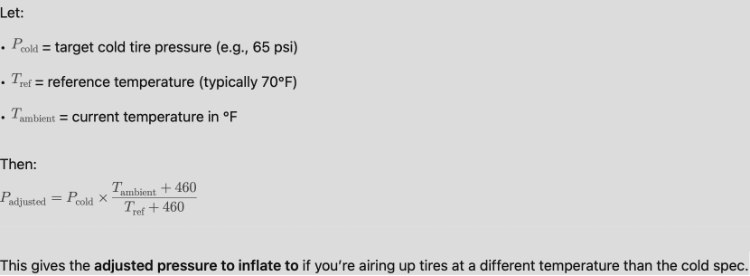
Well I just air them up when they look low until they stop adding air when they stop looking low. I just posted the formula because @TnRiver46 ask for it and he loves AI. 😆
-
How about an equation generated by AI. 👍
-
My first thought is it might reduce the number of fish you catch but it's not crazy if you enjoy it. Now if you're doing it while competing the Bassmaster classic, that's crazy. Personally, I enjoy trying to figure them out and sometimes that means experimenting.
-
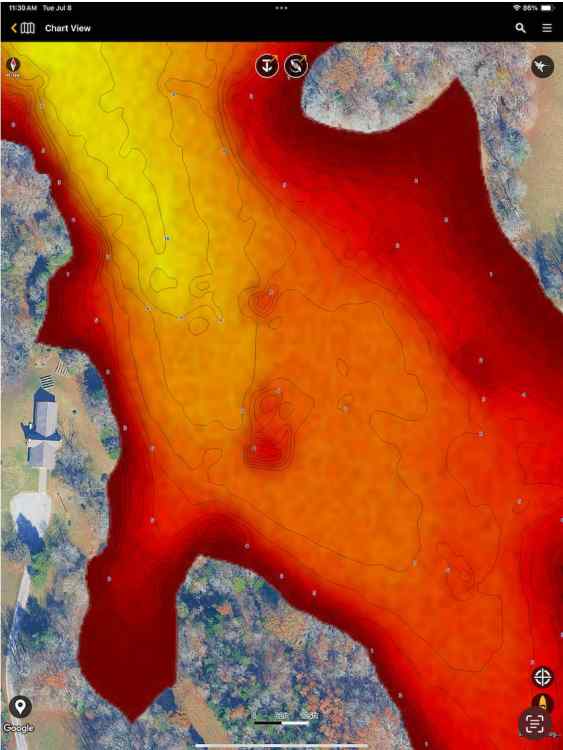
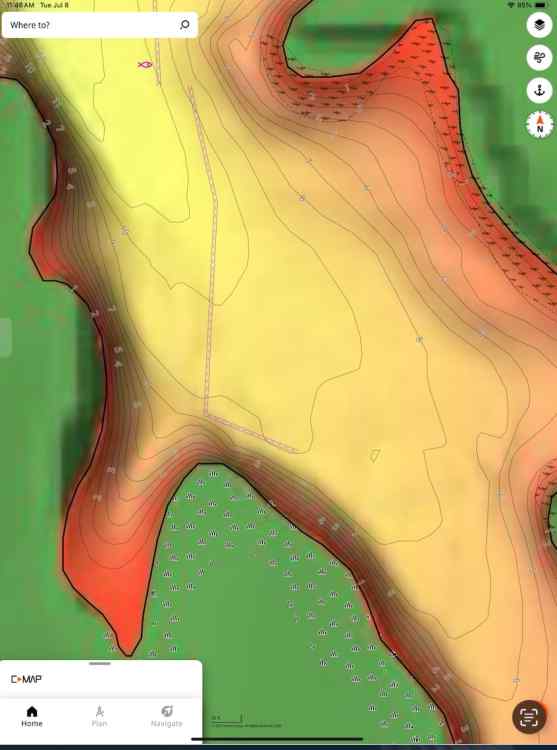
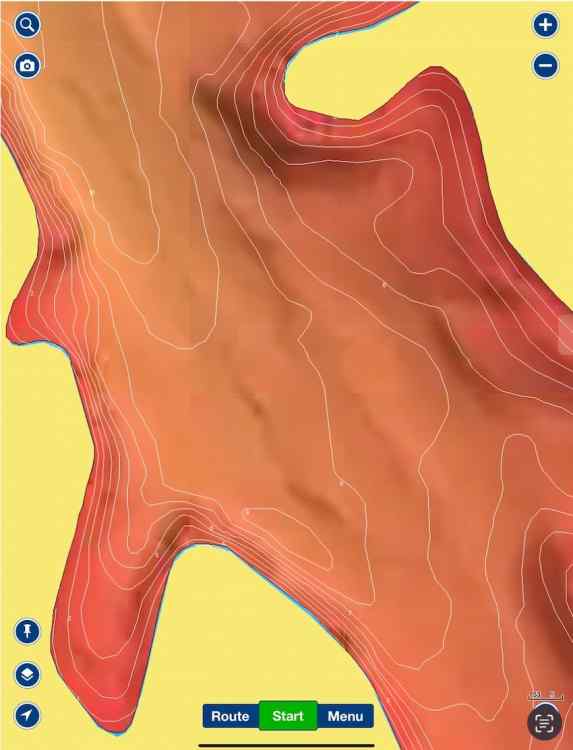
Here are 3 screenshots taken from my iPad of the same spot which hopefully shows the difference in mapping data. The lines and depth numbers are clearly visible on all three but are less so after I compressed the images. LakeMaster has the most depth detail and shows some small humps that the other do not. This extra detail is not always accurate. Navionics shows additional detail in the sonar shading but not in the contour lines. C-Map has some vegetation symbols along the shore. The vegetation is there but the map is not that accurate. Each map provides some data that the others do not which might help you catch more fish. Navionics C-MAP LakeMaster
-
If I could only use one app per lake I would choose Navionics for some of the lakes I fish and Lakemaster for others. For some lakes it doesn't really matter which app you choose because they are all using the same data. For me it's more about the data than how it's displayed but the quality of the app does matter. I pay for Lakemaster and Navionics. I've tried C-MAP, they seem to have quality generic contour maps but nothing to get excited about. If you're just looking for major structure that's on every map then C-MAP is a good option from what I can tell. I'm sure every region is different in terms of the quality of data that's available. I have no experience fishing in Canuckistan so I can't help you there
-
Most of the apps that require a subscription have a free trial period. I would encourage you take advantage of this to view the lakes you fish. I use the Humminbird One-Boat-Network app on my phone and iPad most of the time. With a subscription you can view LakeMaster maps (the same maps I have on my fish finder). It has all of the features you are looking for to make the map look the way you want it. The quality of the data used to make LakeMaster maps varies by lake but is generally good for the lakes I fish. I sometimes confirm the Lakemaster data with Navonics for certain lakes especially when I see something that doesn't look right.
-
I agree. What I'm saying is that they are all bathymetric maps. The term bathymetric does mean that a certain type of data was used to make it. It's simply an underwater contour map. I'm disagreeing with the statement "Bathtymetric is outdated sounding method to map lake bottoms."
-
All of them. Bathymetry (/bəˈθɪmətri/; from Ancient Greek βαθύς(bathús) 'deep' and μέτρον (métron) 'measure') is the study of underwater depth of ocean floors (seabed topography), river floors, or lake floors. In other words, bathymetry is the underwater equivalent to hypsometry or topography. Bathtymetric Maps are underwater contour maps. The source of the data that is used to make the map does not change the fact that it's a bathymetric map.
-
I’m always focus on my lure and the fish I’m trying to catch. I can’t even tell you what kind of knobs are on my reels. I must be doing it all wrong. 🙂Read just about any thread on this forum and you’ll see that we don’t agree a much of anything. My advice which others will disagree with is to start simple. Your rod and reel are fine until you decide it’s not working for you. I would recommend you start with 2-3 baits. Pick something slow moving, something fast moving, and a top water bait. Go fishing and have fun. You’ll begin to see what’s working and what’s not working. Find ways to improve on what’s not working and you’re on your way.I've been fishing about 60 years and never used a leader with swivels. If you watch too many YouTube videos you'll spend a fortune and never get around to actually fishing.My twisted mind says that if adding 1/64 of an ounce to worm makes a difference then I need to be able to add weight in 1/64 ounce increments. So instead of carrying 4 different worm weights up to 1/2 oz (1/8, 1/4, 3/8 , 1/2) I need to carry 32 different worm weights up to 1/2 oz (1/64, 1/32 , 3/64 , 1/16, 5/64, 3/32, etc, etc)@Catt, I've learned two things about you from reading your post over the years. First, you're a no nonsense fisherman that's as good as they get. Your wisdom will live on here on this forum. The second thing I've learned is you've lived your life knowing that death is not the end. Prayers for your family. I know they will miss you. I will think of you and continue to learn from you every time I read one of your 32,000+ post on this forum. Thank you for all you've contributed to this community.It happens to the best of us.I agree with @MN Fisher and @WRB-2.0. Dee Thomas invented Flipping. I don't know who invented pitching but Denny Brauer mastered it. Flipping is done with a long rod and is more of a vertical presentation. You get in close and gently drop it right on top of them, often in the thickest cover that you could never cast into. You yank them out of the thick stuff right into the boat so you need a very heavy rod and line. Pitching allows you to accomplish almost the same presentation from a distance. Denny Brauer used to demonstrate his technique at shows. He would pitch a jig across the stage at targets 25 feet away and point out that his jig was never more than 12 inches from the floor. He used this technique to get to places under docks that most people could not get to.I haven't noticed the drag slipping on hook sets but I'm not worried about it if it slips a little. If I manage to put 5 lbs of force with 4 lbs of drag then it will slip but it will still deliver the 4 lbs of force to the hook set. The purpose of a drag is to limit the force on the line and rod. If I somehow manage to set the hook to hard, I would rather have the drag slip a little than have the line break.I ask because I set my drag with a scale and I'm very confident in my hook sets when I set the drag to 4 lbs. If I'm using light line I set the drag lower and I start thinking about the hook I'm using and if I can set the hook successfully.So does your rod load up like that every time you set the hook?I agree with @MN Fisher on the differences between 4 and 8 carrier. I would encourage you to ask yourself why the fish broke off. Did the knot fail? Was your drag set properly? Were you fishing around abrasive cover? The solution is usually not stronger line, especially when you're breaking off with 22# braid.I am a Mac guy and a retired computer geek. I’m not a Garmin user. When you have data in a file on an SD card, you need software on the Mac to display it. If you have opened files like this before on your Mac then you must have the required software. If you have not done it before then I would think that’s the problem. The same is true with screenshots but I would expect that Garmin uses a common image file type that can be opened on any computer. If you take a screenshot on your Garmin then it should be stored on the SD card or you should be able to copy it to the SD card. Maybe a Garmin user can clarify that. Concerning the map showing depth on the bank where there is no water. Humminbird provides zero-line data for major lakes so you already have the shore line (where the depth is zero). I assume Garmin does the same. The shoreline data is probably not available for your farm pond so you will need to account for that. Humminbird allows you to edit the depth readings when you make your own maps. If Garmin will let’s you do that then you could change the readings closest to the bank to zero depth. That might let you define the shoreline for your pond. Again I have no experience with Garmin so I’m speculating.It’s also hard to listen to people say it’s cheating and requires no skill when half of the best pro anglers in the world are getting their butts kicked because they cannot figure out how to utilize it.




Important Information
We have placed cookies on your device to help make this website better. You can adjust your cookie settings, otherwise we'll assume you're okay to continue.