Brad Reid
Members
-
Joined
-
Last visited
Everything posted by Brad Reid
-
Gosh, I'd take Glenn's advice in a recent video and work down on your spinning reel line test strength. For finesse applications, I can't imagine ever using over 10 lbs. You can fish it straight as a main line or add a fluoro leader as required. I doubt there are many fish that could snap 6 lbs. braid line if you use the spinning rod the way it is intended to fight fish (with the rod, not the reel). It'd match up well with your M power. Brad
-
Michael, I use both Stradic Ci4+ and NASCI Shimano reels, both superb. Hmm? The Stradic has an exceptional drag system so I prefer it for LMBs, larger fish in general. And, I actually prefer the material it is made of over various metals. For panfishing, I use 1000 reels. A NASCI 1000 is very nice and I just don't see any huge advantages when fishing for smaller fish to spend $200+ for a Ci4+. A strong drag isn't as important but the drag it has is very smooth. I have two other brands: one is the 4000 series 13 Fishing ***, then another is an inexpensive Daiwa that came paired in a St. Croix rod set. Both of these reels operate nicely . . . but do some strange things. The Creed manages to get line caught behind the spool somehow on occasion. I haven't used the inexpensive Daiwa enough yet to know much about it except that it doesn't feel as solid as my Shimano reels. A mix? That's my approach! Brad P.S. I see Scott posted while I was typing. I agree that the higher end reels likely end up being less expensive than seemed just because they last so long. A little drop of oil and a regular cleaning keeps a high end reel in top notch working order for a very long time. br
-
Well, the Hobie PA *** are both fantastic vessels and they'd be in top contention for me as choices if I were going BTB at times, fishing far out in the ocean. But, for other needs, they are more than a bit on the heavy side. That, and seeing one "in person," they aren't nearly attractive as, say, the muscular Old Town Predator PDL or a Big Rig. These are good looking kayaks! I know, I know, it is more about fishability than outward appearances . . . but tens of thousands of Harley motorcycles have been sold just based of looks and a certain sound. Back to the BSB 360 Angler, can you imagine having a tilt up horizontal rack for paddles/push poles and rods, two really large compartments built into the hulls for storage, a true bass seat, a giant rudder, built in cart feature, tackle pouches that hang off the seat arm, rod holders, and more. All standard equipment. For propulsion, there'll be multiple spots to rig one up, even small outboards, then the E-Drive is supposedly days away from release, too. It will motor the 360 around at 3.5 MPH is what I have heard. Not so fast but ready to plug in. I see myself getting one of these. Brad
-
It's the dangest thing, too, Choporoz, regarding its "tongue weight." I would have guessed that it would feel considerably heavier. In reality, since it has two carry handles, it feels like carrying along two 30 lbs. suitcases, something like that. Being able to stand between the two bow ends makes it very balanced. There is a promotional video showing about a 10 year old boy wheeling one down to the water with ease. For sure on the trailering. While that is great if it is an option someone wants to use, knowing that the 360 just slides on and off a modest sized truck bed is a big positive. The vessel, itself, is no longer than a Big Rig or a PA 14. Though I believe it is listed at 48" in beam, that is back by the seat and the two pontoons "taper" in a bit going forward so it slides in between the wheel wells in my truck bed. Brad
-
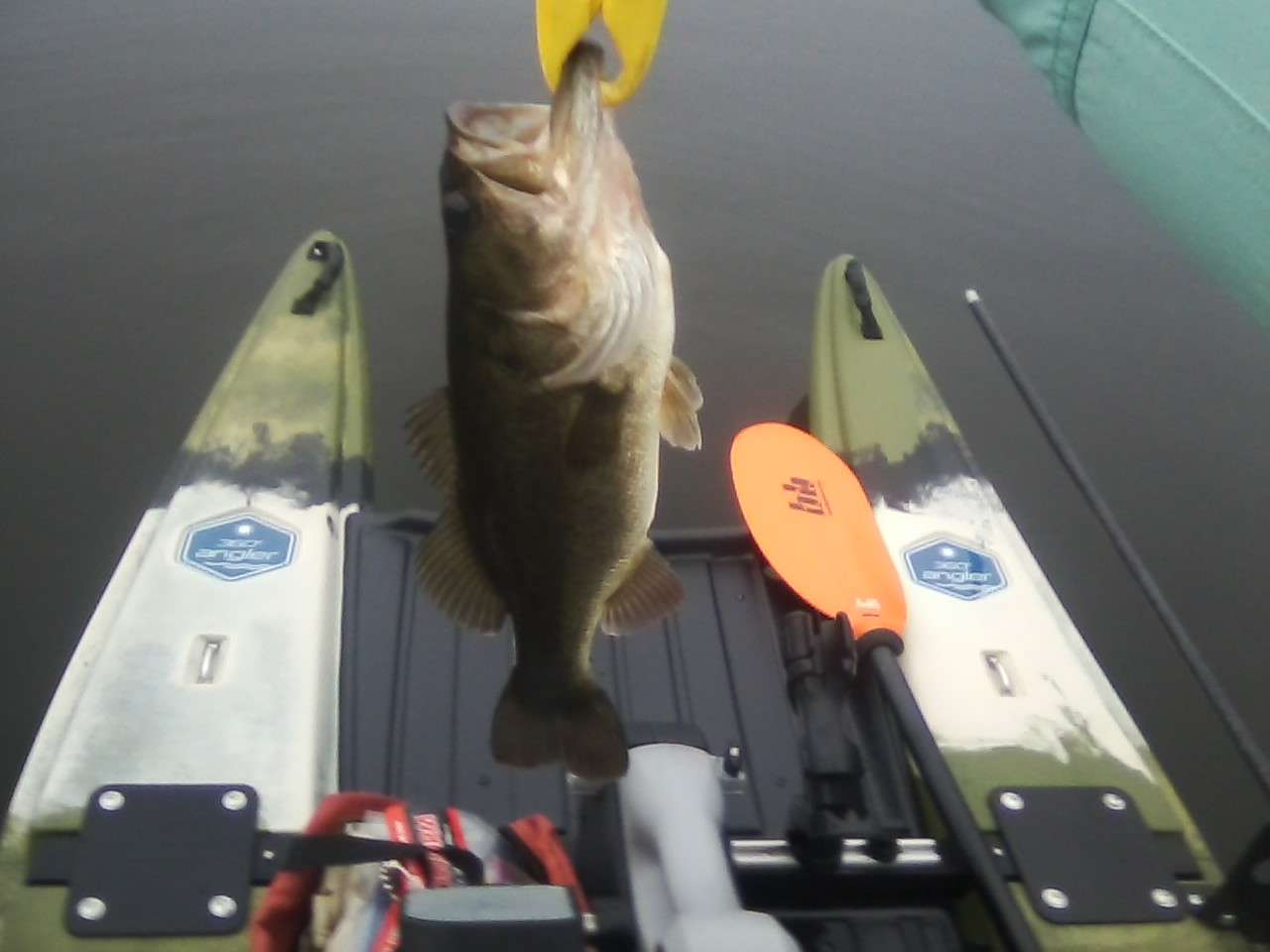
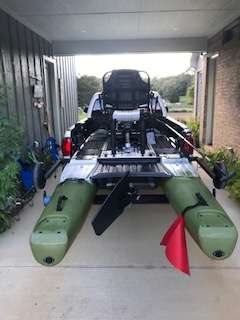
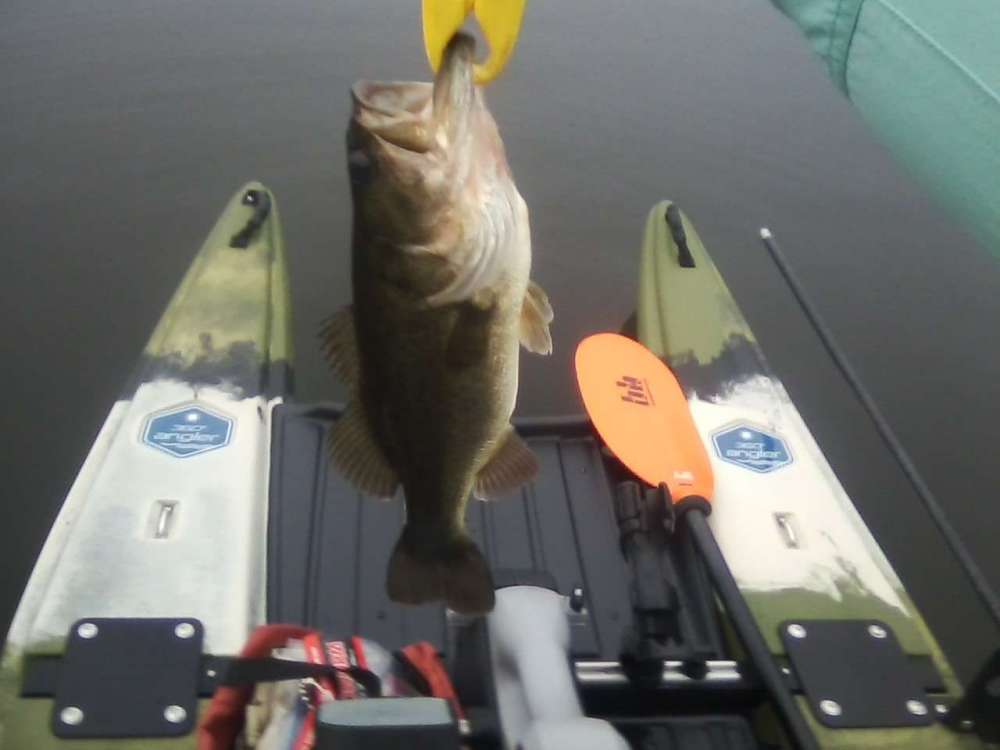
Andrew, I owned a Jackson Big Rig (sold it a while back), just the standard model from a few years ago. It was exceptionally stable as kayaks go, along the lines of a Hobie PA 14 . . . but lighter and paddle, of course, versus pedal power for mine. Here in the D/FW area, Kevin Dismuke makes modified trolling motors that mount to the power pole attachment at the rear. Gosh, the Big Rigs are so well equipped right from the factory. Just grab a few Plano boxes (a place exists for them), a few rods (rod holder options from factory) and off you go. And, I loved the chain anchor drop off the stern. Such a super vessel at well less than 1/2 the price of a PA 14. And, I currently own a Bluesky 360 Angler. It is beyond stable, feels sort of like walking around on a bass boat deck. Seat is high, storage . . . everywhere. Even though it weighs more, in line with a PA 14, it has the lightest tongue weight of any kayak I have pulled down to the ramp. A woman or a fairly young kid could pull it down to the water with no issues. And, the cart is built in. Too, it fits right inside by Toyota Tacoma bed just fine. No need for a trailer. To this, I add a bed extender. It is almost a boat, it really is. So, at least for the 360, it is definitely no speed demon. Neither is the Big Rig, for that matter. I'd say 3 MPH is about its max speed; but, again, you have all sorts of potential power options including one soon to come out from the factory that fits into the pedal drive area. With the pedal drives, if you want speed, the PA 14 would be the way to go. With a PA 14, you will definitely need some sort of cart to get on and off the water. Hmm? 3 great choices. We may end up moving to the Texas Coast . . . not at all certain what I might need but a possible change coming yet again! Pic on the back of my truck, loads like a dream; pic of the first bass I caught off of it. Brad
-
For sure, good points. And, each of us have different skills, preferences. I don't often have an anchor out but no issue here for the OP who'll be doing, I guess, a controlled float down lazy rivers. One of the clumsiest looking moments in kayak and canoe bass fishing for newbies occurs at the actual landing. It is totally different than from a high boat deck . . . with us being so low to the water. So, what often happens is the kayaker rears a long rod back to lip the bass with his other hand just to find out that he or she has too much line out and room for the fish to fight. Lots of bass become un-buttoned because of loose line at this point. Oh yes, for sure! I have missed some really nice bass pulling them up right next to my canoe or kayak, lost them in the final seconds. Brad
-
A couple come to mind. One would be a Shimano Zodias 7'3" in Medium Light. These rods have that unusual cross wrapping and worth reading about it as you do your research. The feel of the hand grip area on these rods, holding the rod that is, is the best ever. Another to look into would be the G-Rod International graphene rods. I have one of the trout rods and it feels like nothing else in my collection of various rods. Graphene is the one atom width carbon fiber material with the huge strength to weigh ratio. Worth a look. Brad
-
For the fishing the Op is describing, 7' seems so excessive especially fishing tandem with other anglers (up to 2) in the tight confines of a canoe. I did find the rod I'd recommend, a St. Croix PS60MHF, and I think it would be perfect . . . though its lure weight range extends only to 3/4 oz. But, you aren't describing long casts but rather lobbing out a bobber/sinker/live bait presentation on a slow drift on rivers. This is the shortest MH power I could find in the St. Croix line. If you drop down to a 5'6" length, M is the highest available power from the same manufacturer. This one is a PS56MF, the rod I never leave at home. Brad
-
I think it could be an issue, Crow Horse, but I can't recall even a single instance for me personally where it has ever even come up. For the sake of convenience, I keep my 15'3" Meyers Sportspal Canoe down at the boathouse where I can just drop it in and go fishing in a moment's notice. I sit in it about "midships" so I have a good solid 7+' in front of me (more than most all kayaks) and the bow tip is much farther up and out of the water than any kayak and I can't think of even a single incident where I had a line issue with a fish crossing my bow. Usually, if a bass is going to make wide runs and swings, it seems to happen early on just after the hookset when plenty of line is still out making it a non issue. By the time I have a bass near my yak or canoe, it is largely spent, energy-wise. For sure, many bass have that "reserve," that one more burst of energy we have to deal with at the landing. If it happens using a short rod up near the boat where it'd be the sort of issue we are describing, what I would do is treat it exactly the same way I treat a bass that runs directly underneath the vessel. I'd just drop my tip down and continue the fight on the underside of the boat until I regain control of the fish. And, it is a whole lot easier to control that "under the vessel" final surge by a bass with a 5'6" rod than it is with a 7 footer since you don't have to plunge the rod as deep. Brad
-
Guys, in a kayak a short rod is a godsend. So correct that long casting isn't our issue nor our advantage. Where we excel is floating in tight to places boat anglers can't go. Technique-wise, I wanted to share a tip for tossing deep under boathouses. I reel the lure I am tossing really close to the tip of my 5'6" rods, maybe an inch of slack line, if that, then I drop the rod tip down to a few inches above the water and make a casting "swipe" parallel to the water. It allows the lure to get under even very low gaps and way back up under these structures. This is a bit different from the typical skipping an angler does standing higher on the deck of a boat. The great thing about doing this from a kayak is we can be just a few feet away to begin with. I've had many occasions where I have slung a lure all the way out the other side of a wide boathouse, farther than I really intended. Brad
-
I'll pass along an analogy of sorts. Think of rod action in terms of a competitive 3 meter diving board. You likely know that these diving boards have a wheel where an athlete can "tune" it to his or her bodyweight and for the height he or she jumps to load it up for a dive. So, if the wheel moves the fulcrum close to the end of the board, it makes it stiffer; if the wheel moves the fulcrum far back and away from the end of the board, it makes it soft and spongy. Rods are like this: as regards the distance they can cast a lure, there is sort of an optimal point. If you put a 4 ounce large swimbait on a M powered 7 ft. rod, and you rear back to cast it for distance, you may snap the rod. You certainly won't get good distance. The lure is too heavy for that rod. On the other end, if you attempt to throw a 6 gram ultra-light lure on a MH rod, the rod won't load up, you won't get good distance. Beyond casting issues, then you have hook setting issues, too. The rod that casts the farthest might not have the hook setting power you need for certain applications. Say, St. Croix used to have a pretty good descriptor for each of its rods, what they are intended for. I like this over just giving a lure weight range. A new format may or may not do this any longer. Brad
-
Fishing legend, Hank Parker, has a relatively new video out where he fishes with a close friend on a private lake built primarily for irrigation. Parker had input regarding its design. They caught 400 bass as I recall, more than the 300 caught the year before. So, sort of toward the end of the video, Hank promotes a pistol grip rod, a Berkley Lightning Rod as I recall. One of his sponsors. It is a 6 footer and medium powered. He talks about being able to make casts to spots tough to hit with longer rods. Also, some casting techniques that are easier with that grip. I believe he caught an 8 or 9 pounder on this rod in the video. I have a St. Croix casting rod with a pistol grip, PC56MF. 5'6" Medium power. Love it. Not many quality pistol grips around these days but several to choose from if you add to your collection. Brad
-
Small world, huh? Yes, my father wrote for Bob Hoffman and Joe Weider, others; then, I was asked to put that primer together years ago, wrote various articles related to cable puling, strength training, also several dozen esoteric articles on field events. Hope that exercise helps. It is one of my favorites! Brad
-
I was a competitive weightlifter in my youth, then later set some records as a master lifter up into my 50s. My brother still lifts at age 64, travels internationally to world meets, two years ago to New Zealand which made for a good trip. But, that aside, it was our father, Jack Reid, who got us started down this path and he was sort of the "poster boy" for Noe Xercisers so we always did a lot of cable (rubber strands) work. One exercise in particular would work well and it is referred to as the Overhead Pulldown. But, almost all cable sets, if you get a good one, will work all of the large muscles of the torso, the more minor supportive muscles, too. And, you can do them from home. A photo of my father from Bob Hoffman's (of York Barbell Club fame) "Big Chest" book taken when he was 20 years old. Brad

-
I think Jim is correct if he means "length" and bass speed correlations. Sort of similar to a longer kayak moving generally faster than a shorter one. When you see really fast moving fish species, they look more like barracudas than groupers: long and sleek. But, on a relative size basis where speed is measured in units of body length, small is faster. And, really big bass begin adding disproportionate girth to length at a certain point, especially big female largemouth bass. Those huge heads? Hardly shaped for cutting through water fast either. The general body shape changes dramatically, the length to girth ratios are lower. Big girls look less "barracuda" shaped. They lose their figures so to speak. Old fish, like all other older animals, are less energetic. Here is just a quip from a scientific source (My quotation marks and bold print.): "On the other hand, when relative swim speeds (body lengths per time) are studied for some species the relationship between length and speed is reversed. Smaller fish generally have higher relative swim speeds than larger fish; but this relationship can be affected by temperature. For example, smaller largemouth bass were found to have higher relative prolonged swimming speeds than larger fish of this species when temperatures were near their physiological optimum, but when temperatures were lower this relationship was not apparent (Beamish 1970). Both biological processes (such as, muscle and fin size, or respiration) and the hydrodynamic properties (such as various components of drag) underlie the relationship between fish swim speed and size. Informative discussions of these topics can be found in Beamish (1978), Grey (1998), Videler (1993), and Webb (1975, 1977, 1994)." Brad
-
No doubt about the rarity factor. Many other good points. I'd only add that I think very large bass are often missed because they are relatively slow moving and slower reacting compared to frisky "teenaged" 2 to 3 pounders. Smaller bass just grab your bait before the big'un can get to it. This might then explain why so many of them are caught in colder weather . . . I believe that is a fact. And, I also seem to recall that a common catching time of day is more in the slack time, like 1 PM, not in the early and later hours. Correct me if I have this wrong but I know I have at least read both of these statements. So, if it is so, in the case of cold water, it could be large fat bass are more insulated and less affected by cold water, smaller fish are just slower acting and any youthful advantages they have are lessened at these times. And, if many DD bass are caught in the early afternoon, it might be that smaller bass, when the bite sort of is in a lull, have already filled up earlier, so less competition. Brad
-
I have a Slayer Propel 10, one of the best kayak fishing vessels out there regardless of size. It is super stable seated, just "okay" standing and I really only do it to stretch my legs and only in calm water. The main issue it has is the stern can swing around a bit and it tracks oddly in heavy wind and waves. I have owned 12 and 13 footers, one Big Rig and another Jackson model, and they tracked better, for sure. But, I have this general theory that if you can't reach it, all that extra length is a waste. The 10 footer has another extreme advantage. It is so easy to move around that I simply get out way more often in it than I do in kayaks that have a lot of set-up time, issues getting on and off the water, etc. Brad
-
Gosh, I use it for any "short" work. I fish almost exclusively from a kayak or my canoe and I just don't make many long casts. Drop shot, tossing my Keitech 4" swimbaits, T-Rigged worms, etc. And, in certain locations like under trees, under bridges, under boathouses. No doubt, though, that for long casting applications covering a lot of water, power fishing, you want a long rod. One of each? Brad By the way, there is a new video Hank Parker put out. I think I saw it up at the top here. In it, he and a close friend were tearing it up on a private irrigation lake. I think they caught 400 bass, something like that. Anyway, Hank espoused the virtues of a short rod with a pistol grip one of his sponsors manufactures. Lots of video of him casting with it, great accuracy and I believe he mentions the general benefits. His was a casting rod. Brad
-
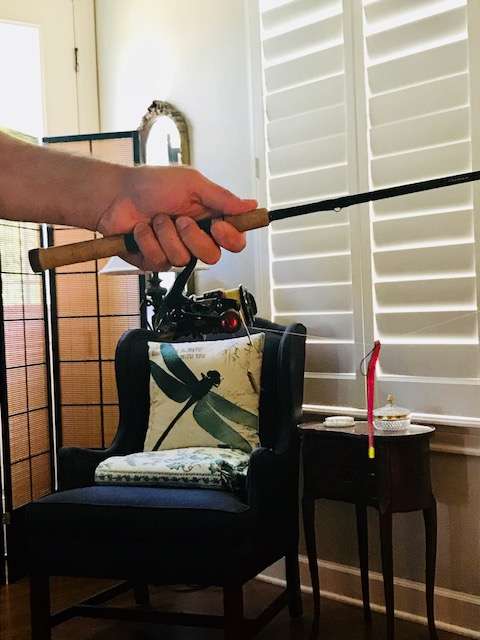
Minnow, Do yourself a giant favor if you intend to use a short rod from your kayak and think much shorter. My favorite kayak rod, by far, is a St. Croix PS56MF. It is my "go to" rod. You'll be able to cast much farther under boathouses, piers, etc., your accuracy will improve, and the shorter rod means you'll wield better leverage over the fish once it is on the hook. When I am standing in my canoe or kayak, I am also pleasantly surprised at how very far I can pitch with this short rod. Some of this is likely owing to I can make my pitch from a lower rod angle. It is also a much easier rod to pitch while seated where kayak anglers use that sort of horizontal version. Gosh, I love this rod! A small photo below. Brad
-
Should be okay. A cubic inch of water weighs .036127 lbs. and if you take a 12 foot length boat, use 50" for its bottom width, in order for the boat to be "pressed" down into the water 4", that's 28,800 cubic inches of displaced water, it'd take 1,040 pounds including the weight of the boat itself. So, say, 940 lbs. Of course, these vessels won't be perfectly rectangular, and I may have the width wrong, and the boat bottom's contours will make a difference . . . but it is a good general way to get a decent theoretical reading. Brad
-
jimmiejoe covered most of my thoughts and sentiments. If you had to use one or the other, silliness of course as no such limitations exist, spinning gear covers everything either better . . . or at least functionally. Not so with bait casting gear. I will say that I have seen anglers who can use a casting reel for almost any possible circumstance or occasion. They are not common in this respect. But, the new casting reels are getting closer and closer to solving most of their limiting issues. One thing, for certain at least for me, that a casting reel does better is the rapidity of recasting. So, if I am firing off a crankbait or some similar power presentation and my intent is to go "KVD" on the fish in an area, I think a casting reel can make consecutive casts quicker. For me, 2X, that is, I think for every 5 casts I make with my spinning tackle, I could make 10 with a casting reel. It rarely influences me since I am more finesse than power. Brad
-
Here in north and east Texas, we do have the occasional cold fronts. Last year, it hit 6 degrees on Lake Athens. This is likely a temperature many of you experience off and on every year, and even colder. Our issues relate to how very fast weather can change, that and wind. Texas is windy. A "funny" attached showing something us Texans are all familiar with. Check the foreground, check the mirror! Brad

-
Whew! This set up hits all my buttons. I love the look of that round reel.
-
For sure. And, implicit in your question is you are talking about the "finesse" version of a drop shot, the light hook, line line, and small plastic version of the presentation. The drop shot is only a rigging qualifier, sometimes called a down shot, and that is all it is: hook above a sinker lower down. In some cases I see a heavy version of drop shot and I believe they call it a Bubba shot where the angler uses MH or even H rods, bigger line, hooks and a big weight. Gonna certainly need a MH for that version of a drop shot! If you do use a MH for the finesse version, just be careful and use a passive hook set, that is, let the fish hook itself. I think you'll feel the fish jump on board just fine with a MH rod. Brad
-
Always a great topic. Somewhat sensitive, but great. Do you think old manual cotton pickers begrudged the devlopment of tractors and mechanical cotton picking machines? Just the displacement it caused, not the work itself. If, as mentioned on 60 Minutes the other day, 40% of jobs in the not so distant future will be replaced by automation and robots, if you own a company that creates a good or a service, to whom will you sell it? That is, if more and more automation and robotics implies less and less work, so less and less income, explain how the owners of the automation will find customers and be paid? It will create a new social and economic paradigm. It is already slowly at work, hard to see, but it began with the industrial revolution and is gaining speed now. Brad