Brad Reid
Members
-
Joined
-
Last visited
Everything posted by Brad Reid
-
Several posters here have noted that St. Croix rods, many of them, seem to be about a half power greater than other rods with the same designation. I have a 7' MH casting rod that is just so, not quite MH but not H either. Based on experience with the St. Croix rods I own, I'd say an M would be just fine. Brad
-
Paul is "spot on" here regarding what we all need to use for making line comparisons: line size. There is a well-known formulaic relationship between the cross-sectional area of a line or a rope or even a human muscle . . . and its tensile strength. Comparing a .14" line diameter to another with, say, .16", this irrespective of stated test strength claims, is "apples and oranges." Brad
-
Some really good advice! I wonder if one of the main selection determinants is how deep you fish? So, if you are always fishing shallow and the "cone," that is, the scope of the image is rather small, wouldn't this make a difference what one selects? A Deeper could be used to determine the basics . . . but would side imaging in, say, 5 or 6 feet of water be effective for kayak anglers? Brad
-
For sure, this is a very individual thing for us, so in the end you'll choose for yourself. For me, I use spinning tackle for finesse presentations and usually from a stealthy approach in a kayak or canoe, rarely do I make casts for distance. And, I use spinning tackle as it is intended, that is, I fight the fish using a series of rod lifts, then reeling down to pick up line. For a ML or an M, I would personally never use over 10 lbs. braid as its strength greatly exceeds what it takes to fully load up those rod powers. I think the caveat here is abrasion and a few other issues that can occur. I don't have abrasion issues here in east Texas but for those who do, they'll often want a bit more line thickness to combat it. But, back to braid, really any line on a spinning set up, to go up in size means you are giving away the very advantages light lines offer. Not that I cast for distance, but lighter tests will cast farther, they are harder for fish to see if you believe that is an issue, your presentation will move and appear more life-like. I most often use mono backer, I just spool on a layer or two of wraps. There is no physical advantage to adding a ton of mono but some anglers add quite a lot to cut down on the amount of the more expensive braid required. Under any circumstances, you want enough braid so that on your longest casts, you are nowhere near having that backer to main line junction knot surface on the reel spool. Once you have topped off the braid, but never too close to the lip edge, I usually tie on about a length of fluoro that will bring the second junction knot, braid to leader, back reeled up to but not onto my reel. For my short rods, that's about 6 feet or so. Brad
-
K-sam, Gosh, you can take out more than you will ever want to pack. I go out with as little as one rod when I am just out for a few hours. And, I carry that folding chair often. They weigh next to nothing but for longer days on the water, most people find it more comfortable to have a seat with a back support. Just a big styrofoam ice chest is great for carrying out food, water, supplies. A good anchoring system always helps with canoes if you fish in wind or current. Brad
-
Budget, for sure! If one stayed with nothing more than this one presentation, a T-Rigged worm, you could use a more or less basic 7' rod give or take a foot, a basic reel of either sort . . . spinning or casting, 12 lbs. line of any sort give or take some test rating range there too, fish it from the bank, a kayak or a $70,000 bass boat. You could fish nothing but 2 or 3 colors, a few different nose weights, a few different worm styles. You are in business! Say, there is a nice recent video of one of the bass pro anglers talking about this very issue, that so many have gotten away from the simplicity and effectiveness of fishing a simple worm. He says he has won more money off of worms than any other bait, that he often catches fish behind another boat or two that missed them throwing other things, say jigs. Brad
-
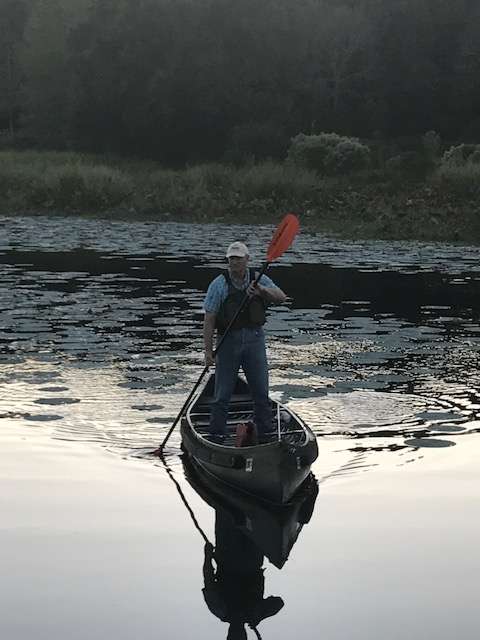
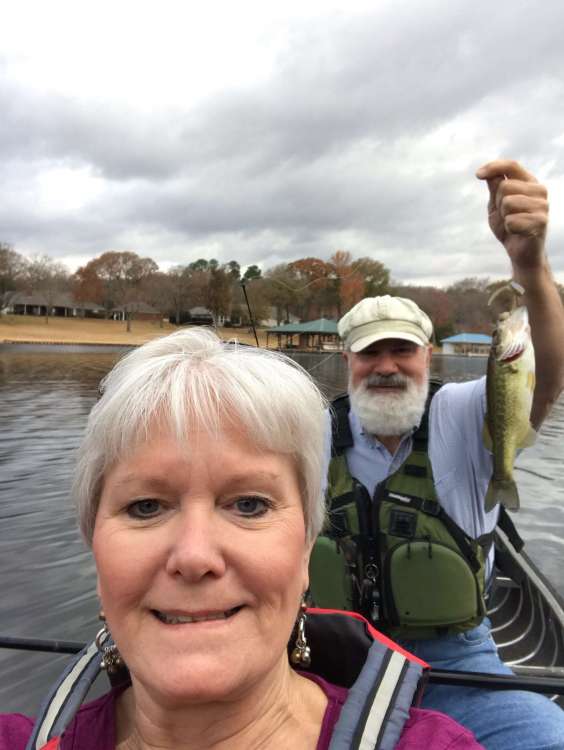
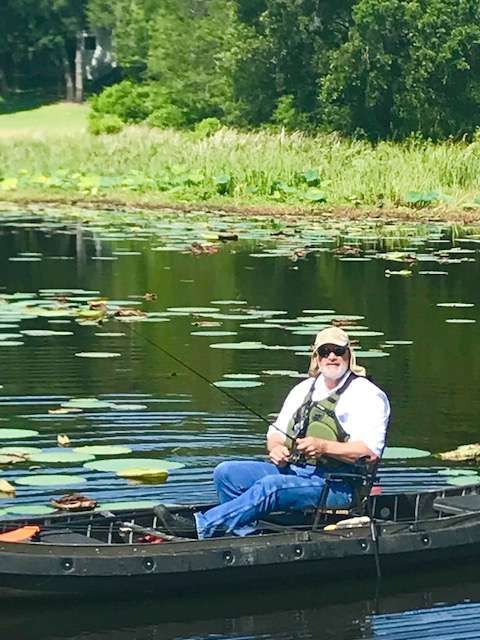
I have the Meyers Sportspal S-15 which has a square stern. I bought it from the factory and had them add a third seat "mid-ships area" and I find that to be the optimal point to fish from solo. If I go out tandem with a partner, I give them the bow seat, and I take the back seat. For a paddle, I use a Bending Branches 280 cm length double blade. It works great for getting the S-15 up to top speed. One other trick is to bring along a simple folding lawn chair, aluminum and nylon webbing, not one with 4 pointy legs but with "blade" legs. These chairs are the ones that fold up flat. I position mine over the center seat wedged between that and the thwart bar. To say this seat is comfortable compared to any of my kayaks is an understatement. If you spend any time, long days on the water, you will appreciate having a seat with a back, sitting a bit higher making getting up and down rather easy. If you need a lower profile to cover water paddling, simply stand up fold up the chair and put it behind you. Stability? It is far better than any kayak I know of excepting the new catamaran styles. But, compared to a Big Rig or a Hobie PA 14, it is far beyond that level of stability. I was on a very windy lake on a very windy day and was fishing with a kayaker. I told him I was going to head over to an island, did so using my attached trolling motor and standing as I crossed the lake. Big wind and chop and I felt totally confident. From my current boathouse where my canoe stays all the time now, I often paddle it while standing about a mile to the boat launch area, then back. I sit down to tie on things, maybe take a break. And, last year, I fished Lake Naconiche in east Texas and both me (250+ lbs.) and my nephew, Lucas, (160 lbs.) stood and fished at the same time. Not a wiggle. In this regard, the standability issue, it is much more so than a SUP, a stand-up paddle board. I'd go square stern (S-13 or S-15) over pointed (S-14 or S-16) in the event you ever want to power up and put a small outboard motor on your canoe at times. If I were to do so, I'd go as small as possible, so a 2 or 2.5 HP, even though the S-15 is rated for up to 5. Paddle, trolling motor, small outboard, "floats in wet grass" as they say, Very heavy loading (I have had 550 lbs. in mine - - - two big men), well constructed and should last a lifetime. Some pics. Note the chair in the one, my paddle in the other. I can paddle right through heavy vegetation where most kayaks sort of bog down. Brad Tandem with Louise sitting up front and snapping a selfie with me in the background. Another with me seated, sitting high and comfortable. I can drop and anchor and for some presentations, say drop shotting and other finesses presentations, just sit and really fish slow. Brad

-
A Ci4+ would work fine in a 1000 series if you mean for short casting presentations like a drop shot. You'll save 1.1 ozs. if weight is your main driver. But, you'll be limiting yourself for other presentations where larger (or more) line might be preferable, in casting distance, in line pick up speed, less apt to get spooled, etc. Someone here "schooled" me on a fact about the difference between a Ci4+ 2500 and a 3000, maybe it was A-Jay a few months ago, when I learned that both the 2500 and the 3000 weigh the same, just have different line capacities. Knowing this, I'd always select a 3000 over a 2500 just for that added bit of, what, capacity I guess. Back in the 50s, my grandfather once sewed his own tent for canoe trips up in Minnesota where portaging between strings of lakes made packing light essential. I recall him weighing everything to minimize loads. Sort of like Appalachian through-hikers . . . where every ounce counts. So, I get the idea of wanting to stay light for its own purpose. Brad
-
You are going to get a ton of recommendations to pair that rod up with a Shimano Stradic Ci4+ in either a 2500 or 3000 size. I'd go ahead and get the 3000 I suppose. Light, strong, durable, water tight, great drag. It may even be cost-effective as they are made so very well, it'll likely outlast some of the cheaper models by years and years. Brad
-
I've caught tons of white bass using a simple Mepps Plain Aglia, no trailer, but of course this is an inline spinner with a treble hook . . . and an altogether different sort of fish, too. This year, I am going to really concentrate on developing a spinnerbait presentation that works for me. Lake Athens here in Texas, my home lake, looks like a lake meant for spinnerbaits. I'm thinking that for tossing them into slop and any areas where they might get snagged easily, I'm going to try a short trailer (a Keitech with about an inch snippled off its nose) and hook it up weedless. I have a spinnerbait on its way that will allow for easy T-Rigging a trailer to hide the hook. For casting down long weed lines, making a long pull along a drain in deeper water, and just covering water, I guess I am still inclined to put on at least a small trailer just because it'll allow for a longer cast, cover more water. I sure like the look of A-Jay's set up! That'd kill them on Falcon Lake where big spinnerbaits are one of the go-to presentations. Brad
-
Gosh, I rarely make an overhead cast while drop shotting. I just pitch mine, can do so way farther than I want to place it. Caveat: I fish out of a canoe and/or kayak. The pitching technique I use is on a cast retrieve, I let the sinker swing back to my free hand, dip my rod tip, and use and underhanded swinging motion. It is very accurate for short to medium casts. Not needed at all, of course, for more vertical drop shotting some of the anglers here do on deep lakes. So, if you do use a braid to fluoro or mono leader, and you have knot concerns, just keep your leader short enough that it never reels up to your rod tip. With a 6 to 7 feet rod length, that'll give you as decently long leader. Say, just know that arguably the greatest contemporary pro drop shot angler out there is Aaron Martens. He tore them up using it on MLF the other day. And, Martens will often say something to the effect, "I use 8 lbs. unless the bite is tough, then I drop to 6 lbs." He'd likely use 4 pound test if he thought he wouldn't lose fish. The moral of the drop shot story is this is a light line presentation, the lighter the better. I think, by the way, that straight mono (fluoro, too) is just fine. Brad
-
Well, I think my first post ever here mentioned an "unmentionable" and, being new, it confused me for a minute or two. But, I actually think that the posting policy is quite liberal here as regards all of us sharing equipment and gear ideas. If you ever read an Internet article, then go down to the "Reader's Comments" section, it is rare you won't see posts that have nothing to do with the article . . . but someone claiming "Make $1000 a week from home sitting on your $$$" and then drop a URL to direct you to some shady website. So, I surmise what could happen here, if this is not checked, is some small manufacturers of lures, etc. could use someone else's private platform to bombard viewers with sales promos. It is like someone rushing a lectern and commandeering the microphone. They have to use someone else's platform because they don't have one themselves that people will pay attention to. Anyway, no shortage of good ideas and good products shared here. Brad
-
I have a couple of NASCI reels that were intended for ultralight rods. However, from my kayak where a big spool of line isn't all that necessary nor great casting distance, just because I am short a spinning reel, I have used a 1000 NASCI on a ML rod with really good success fishing for bass. Of course, if you use back reeling, it is a no go. And, no, it isn't a Stradic Ci4+, but at 40% of the price it is 80% of the better reel. I think you will really like this reel, may decide to never return to the higher end models. No doubt that many have done this very thing a "step up on the quality ladder" by choosing a Stradic Ci4+ . . . or several of them . . . over owning one Shimano Stella. Brad
-
Reorient the hook eye by bending it 90 degrees? I suppose it'd work but likely make for a mess with regard to the swimming action of, say, a Keitech shad. The hook eyes generally need to be of the "in line" sort common to jig hooks. I suppose you can find other hook shapes with in line eyes. Try modifying one, let us know how it works out!!! Cheers! Brad
-
Regarding which CPS size to get, the mediums will be the size you will use 90% of the time. The small CPS size is very, very tiny so only indicated for tiny plastics and hooks; the large size will work well with larger plastics, 7 or 8" sizes or those with "broad noses" to attach to. The large CPS work poorly on the more standard sized plastics most of us use where there isn't enough "nose real estate" to attach to. Hooks? I buy them in bulk and it seems I bought around 50 3/0 jig hooks with a 60 degree bend for less than $20. Then, I bought the 50 package of CPS locks, too, and match them up. My favorite presentation is a 3/0 hook with medium CPS and a 4" Keitech paddle tail or soft jerk bait. I use this particular set up all the time, fish it weightless. Brad Oh! I meant to mention don't screw your plastic lures all the way on tightly, that is, leave it a turn or two back so that some of the CPS is exposed and not buried in the plastic. It allows the plastic to compress easier when a fish bites down on it, makes for better hook-ups. You don't want your plastic affixed too stiffly on the hook and CPS . . . keep it limber. Brad
-
Kayak angling "usually" means shallower water . . . though I know some real studs who fish out deep. And, kayak "usually" means a slight preference for finesse presentations over power fishing especially for those who stay seated. And, we can work really close and under docks and boathouses, back into heavy timber where boats have to stay away. Our greatest advantages are getting into tough places, and stealth. So, long casting for me is usually floating up on a bank or a point and making casts parallel to the bank or fan casting points. I'd use a 7 footer for this, likely medium power, maybe MH depending on what I am throwing. For the short work, bottom and finesse, many know here that I prefer a short rod. I never go out without my 5'6" M powered spinning rod. It'll handle most everything I throw on the bottom, fishes around docks and boathouses better than most. Third? During the proper season, a frog rod is tough to beat as a third option. 7 footer for casting presentations 5'6" M for short finesse work Frog rod. Brad
-
Tom, exactly. And, I would hazard a guess that most of these knots were tied by seafaring fishermen literally thousands of years ago. There appear to be about a half dozen "typical" knots . . . with about a hundred names attached to them. Note, too, many fishing celebrities sort of name knots after themselves, maybe at most adding some minor "twist" to the way they tie it. A "Jimmy Houston knot" is essentially a San Diego Jam, for example. *** A "uni" knot is "universal" abbreviated. Can't recall the exact story but an article appeared back in the 60s and an angler gave it this name. It had likely been around for millennia. Brad
-
Tom, just another name for an Improved Albright knot. I tie it 9 away, 3 back and out. Most knots have multiple names it seems. Anyway, of the "Alberto/Albright" sort. I watched a video of a man on YouTube tying it, a Royal Polaris knot, 5 away and 5 back, but his hand technique was so bad I just can't believe an experienced angler would do it that way. I really need to put together a technique video! Brad
-
For sure, an FG knot tests higher in breaking strength than most others. Its advantage is that it doesn't rely solely on friction like most knots where accurate wraps place line "skin to skin." An FG is plaited, albeit without the usual definition of "3 or more" strands. But, what gives it its incredible strength is that each strand weaves in and out of the other. When you tie it properly, set it hard the way LionHeart describes, line material "bunches up" before each up and down weave of the lines through each other. Analogy? Think of the difficulty one encounters slipping off a too tight ring from your finger. If it is stuck, what causes it to be so is not only friction, it is the bunching up of skin on your finger blocking the way from it coming off. So, when you tie a good FG knot, it isn't just friction holding it together but these little bulging deformities in the lines, generally the softer line (mono). I think of an FG as a bench knot to be tied the night before going out. On the water, I can tie a really, really good version of an Alberto or a Uni junction knot in about a minute or so, use these when I need to. Sitting in a kayak or canoe and tying an FG isn't my favorite thing to do. Great knot, for sure! Brad
-
For "round" lines as Tom describes above, just take the radius (line is usually given as a diameter . . . so divide it by 2) of the larger line, then divide it by the radius of the smaller line you are going to replace it with. So, if we have .08" spooled on now, want to drop to .07", do this: (.08 * .08) / (.07 * .07) = 1.3061 So for every foot or yard or meter of line you have on with the larger line, say 100 yds., multiply by 1.3061. You will need 130.61 yds. to fill your spool to the same level. Or, you can go the other way and take the reciprocal of 1.3061 = 1 / 1.3061 = .7656 and work up in line size by spooling on less length. Say, I did an Excel spreadsheet that showed the variance in line pick up from a casted distance, say like 50 yards when the circumference of the line spool is reduced since so much line is out . . . to how much line is picked up as the lure approaches the tip of the rod. You all know it speeds up a bit as you take in more line per rotation of the reel. Brad
-
At least as regards using Keitechs paddle tails, I really like the Owner Flashy Swimmer where the plastics are attached with a CPS pin. They come in a variety of sizes from 1/8th to 3/4s oz. and a couple of different blade designs/colors. For certain, no jig head, but such an effective lure at the right moments to add a bit of weight and flash to a soft swimbait. Fishing something really big? In the Beast version, you can get a 12/0 hook. Brad
-
Chris, I have done this a time or two, see no reason why one can't tie on an 18' leader of fluorocarbon. The issue won't be the junction knot moving through the guides, if you have an issue at all, it will be as the line flies off the reel spool. As it comes off, it can catch on the junction knot as it "surfaces" on the spool. Your junction knot needs to be very well-tied and small. Brad
-
Good observations here already. Things I try to remember. One is that most people, me included, tend to err on the side of rods about one power up from where they ought to be. This is especially true of kayak anglers. So, if I think an MH is called for, I find an M often better. A second thing is related to the first and that is if you use a spinning rod the way it is supposed to be operated, you want a rod that really loads up for the size fish you are targeting. I want a good solid, deep bend in my rods. For example, I could use an M powered rod for bluegills but I use ultra-lights. It just isn't the same, seems less fun, less sporting to use something too heavy. I suppose a third one I don't forget but I think most people overlook is that a lighter powered rod fighting a large fish will actually bend deeper, creates a shorter lift point, thus a shorter lever, and will actually create less force on the angler's hand (fulcrum) than a power up.The harder a fish pulls, the better leverage an angler is given. So, when you are fighting a big fish, say you are in an area where you are most often targeting and catching 1 to 3 lbs. bass and a 5 pounder jumps aboard, an M power will load up deeper than a MH and make it easier on the angler, not harder. There are, for sure, issues related to hook setting where the faster distribution of power down the line makes a difference, but for most finesse fishing, that isn't so much an issue as the fish are more involved in the hook sets, the size of our hooks are often lighter. Brad
-
The first trick with a Boomerang is to note that the blades are offset, not centered in the plastic grip. I think you can see it in the attachment. So, be certain to have the blades near the point where you want to make the clean cut. This means "inside" and not held away from you and the knot. It makes a difference how you hold the clippers in relation to the knot. The second trick is to push the line way back deep into the jaws of the little device, not mid-way or out toward the tip. Brad

-
Tatsu and many of the fluoro lines listed above are super lines. But, reeling on a third of a spool of Tatsu for drop shot presentations seems a waste to me. I do what Fishin' Fool recommends: I use a bit of mono just as a backer, then spool on 10 lbs. braid as my mainline and attach about a 6 ft. fluoro leader. I use Seaguar Invizx out of habit. With 6 ft. of fluoro as a leader, there simply isn't enough length for line attributes to matter much. Well, other than issues related to abrasion if that is an issue in your fishing areas. I fish almost exclusively from my canoe or kayak and I make very short casts, actually pitches with drop shot riggings. A spool of good fluoro will last a very long time used for short leaders. The braid main line? It'll last for literally years. If you go this route, be certain and tie on a fresh leader before every trip out, then keep and eye on it. It takes just a few minutes to re-tie the terminal tackle, another minute to snip off the junction knot and make a fresh one. If you begin with a 6' leader, you'll still be around 4' after one re-tying both knots. After that, time to pull off some fresh fluoro. Brad