
bulldog1935
Super User
-
Joined
-
Last visited
Everything posted by bulldog1935
-
Both are very desirable rods. @islandbass described their river use perfectly. They also have a couple of salt uses - make great surf rods, both for light spider weights (2 oz +bait) and, especially, casting lures in the surf. Inshore, drifting grass flats, they have the advantage of getting a 1/4- or 3/8-oz lure far away from boat hull-slap, also the reach helps keep a weighted paddletail in the zone above 2' grass. For any shore fishing, the cast distance will be a boon.
-
It's a really good platform for blue trim There are a couple of Steez upgrades in SLPW Zillion - in the clutch, and LW is full-BB, while Zillion SVTW LW has a mix of BB and bushings. Of course Steez gains you magnesium frame, but I only have one rod where the (one oz) weight difference in Steez and Zillion is notable.
-
I could live with that. When I bought my Zillion, I sold the Boost spool that came in it on this forum. I already had my Steez spool in a can to back-up both.
-
Double and counter-balanced handles make a difference for finesse feel. Gravity acting on the weight of the rotor and bail in certain positions tries to keep turning your crank. Counterbalance offsets this, and gives you more subtle feel, e.g. big fish sipping tiny winter bait. Note it's important to match handle length (pitch) with gear ratio. Too long handle on a low-geared reel won't let you keep up with charging fish.
-
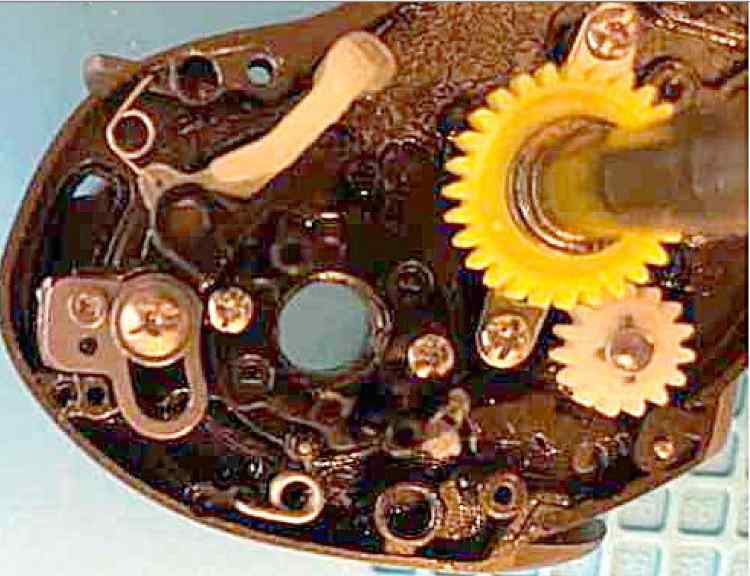
The only way to see the holes (bosses) is to zoom it past camera resolution - not really a critique of the photo, but the series to have is where the parts were placed before you removed them.
-
White vinegar also passivates the aluminum, but keep it Far Away from magnesium, which it attacks aggressively. https://fiberglassflyrodders.com/forum/viewtopic.php?f=4&t=1385 Even blue Loctite attacks magnesium - don't use it on your Steez screws.
-
We gotta get you into a camera. At your bench, they can be really handy for bread crumbs to get you back out. The problem with 1987 reels (ok, '77) - they'll still be working in 2187.
-
It's nice to have gear staged, ready to grab and go. Can also be smarter when staging your gear to give your reels TLC before the trip. But some trips pack better with rods in a multi-tube, and reels in a reel bag. If you use the same reel for something completely different in winter v. spring and fall, mixing and matching can save you the price of a Steez and Silver Wolf.
-
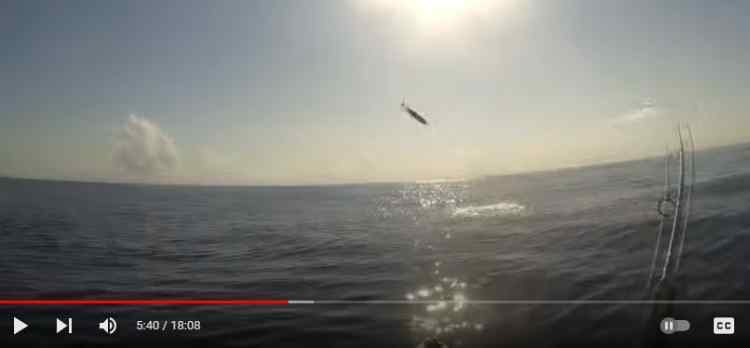
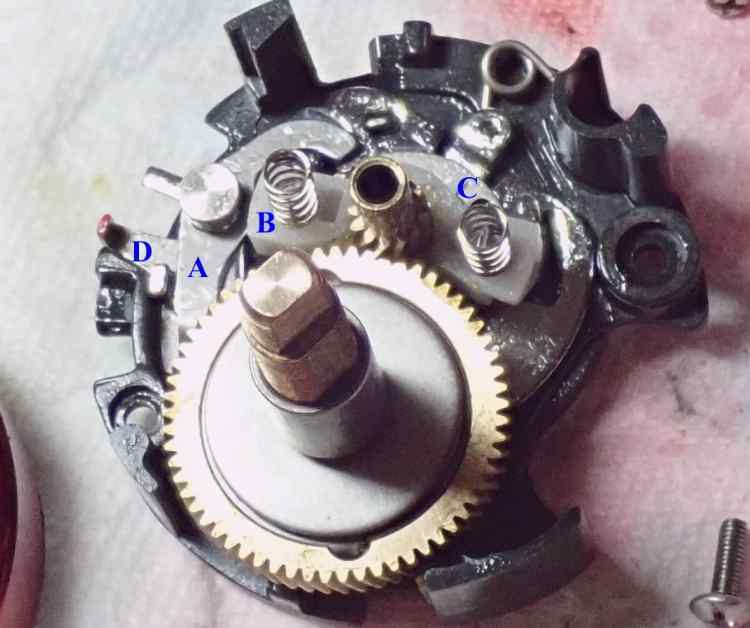
set up a couple of photos, and we can talk details, friend. If all else fails, go to a video, stop it where you can see what you want to talk about, and use Snipping Tool to capture a jpeg. (or snip a schematic) https://www.youtube.com/watch?v=7_b_ag6VorY The freespool functions are all the same - the geometry may be different for the package, but they all work the same (1954 invention). A yoke lifts the pinion off the spool pins and away from the main gear. The clutch (different) yoke clicks into a notch at the main shaft, so turning the main shaft will push it free. Some kind of link connects both yokes, so they move together. Different reel brand (different millennium), same idea A is the clutch yoke, B is the pinion yoke, C is the link that moves them together. Pushing the thumb clutch (D) moves A into grooves (keys) in the main shaft. Cranking the main shaft pushes A back and releases the clutch mechanism.
-
it's a lot of words - photo essay is the stuff of internet bulletin boards. Since 1918, the function of freespool clutch is to lift pinion gear out of engagement with both main gear and spool. (Douglas patent didn't have a button - rotating the handle backwards lifts the yoke and pinion) All reels with a clutch button also have a clutch yoke that reaches to the main shaft. Cranking the handle, the main shaft pushes on the clutch yoke to snap it back to engagement. Most of the springs there preload the clutch yoke when you move it, and then snap it back. @Glenn Sorry Glenn, I'm too good a fisherman to bite.
-
I haven't needed to be in that market for a long time, but there are some very good spool options for Daiwa from Ray's Studio, Roro and AMO. I went 34-mm Daiwa SV, 3 reels, all the spools interchange. @Kites R4 Skyfishing - I'll send you a pm w/ link to AMO store, and you can check there for what's available for your different reel models.
-
Electrical tape leaves forever messy residue. I use PE/acrylic film (mylar) tape, which sticks better and doesn't leave residue. I also use it for seizing knots on kayak trolley lines, and the tape lasts as long as the sailcord. When you want to take it off, it peels off - leaves Zero residue. It's also 1/4 thickness of electrical tape. No need for any solvent. Why - why schtupp with mess and solvent. How much of that solvent vapor pressure is going to diffuse into and break down your reel lube. Everything about this tape is superior - it's thinner, it sticks better, doesn't slide or creep, it's stronger, lasts forever, comes off when you want - only when you want - and leaves Nothing behind. I hope this thing is on.
-
more show and tell, all my round reels matched with offset-handle rods. Ambassadeur combos 4600C Express on Smith 6' MH graphite frogger, 1/2 to 1 oz 4500C on Bright River 5' MM composite glass plugger, 1/4 to 3/4 oz 4500C on Smith 6'3" ML graphite finesse, 1/8 to 5/8 oz Isuzu reel combos Headhunters BC620SSS on Bright River 6'4" S-glass MM, 1/8 to 1 oz (paddle-tails, sight-fishing bunny shrimp) Smith Plugger on 5'6" Smith S-glass ML finesse, 1/8 to 5/8 oz BC720SSS on Headhunters (Tenryu) 6'4" IM6 MH, 1/4 to 2 oz (dog-walking) @GreenPig this is my all time favorite hook keeper
-
I'll take care of my own handles, thanks. I don't want an I-shaped rubber (heavy) knob on a heavy handle, I don't want Daiwa raising the price trying to guess what I want.
-
looks like a bunch of us went shopping in Japan over the past week Zillion is a reel worth your extra attention.
-
Vanquish C2000S, F6 spool, 6-lb Toray X-thread Fluoro, works great. I have PE#0.6 on the stock spool. stock spool............................................................F6 spool
-
@BassSteve - that's a good question - most JDM rods cast their low-end rating extremely well. If it's a really high-modulus graphite, maybe not, medium modulus rod will very likely cast below it's low-end rating.
-
Moderate fast tip is a good description for most Japanese rods. On average, they're going to have a softer tip and stouter butt for the same rating. They like a progressive bend in their taper, and don't like thick, heavy para tips. This also gives them a wider lure range. Works out well, because I like rods this way, also.
-
The Japanese today are working glass casting rods the same way FFR heroes from the '70s were working fly rods. While this 3-power (MM) S-glass is marked down to 1/4 oz, I bought it specially to sight-fish 1/8 oz, and turn redfish at the boat, which it does perfectly. My next will be an IM6 to fish 1/4 oz, and dog-walk heavy plugs - the rod is rated 1/4 to 2 oz.
-
Careful, Fisher, Phillipson and St. Croix were making high-grade, lightweight glass rods in the '70s, these were lighter than the graphite that first followed - it would be nuts to compare them to EC Featherlite. Scotchply was the first move forward in oriented-fiber cloth, anyone who says he does better because of new materials has found his marketing Snow Job. The biggest difference between older casting rods and new will be the taper and lure weight range - bass rods in the 70s were para taper. In the rod lengths we want, you won't notice the weight difference, but will notice an advantage in the progressive taper. The first big advantage for graphite was pushing rod lengths out to 9' in heavy-line-weight fly rods. Many of these great mid-length, mid-weight fly rods aren't leaving my hands - their progressive tapers can't be duplicated in graphite or cane. Joe Fisher's glass rods are noted to be lighter than most other glass, and lighter than his graphite, because he never trusted graphite. Bill Phillipson hand-sorted his blanks and while both rods are marked 2-1/8 oz, the Royal Wand is lighter and the taper more crisp. Vince Cummings took St. Croix blanks, then hand-sanded and finish-polished to achieve the tapers he wanted. His astounding taper will fish 3-wt to 7-wt, and becomes a different rod with each line weight. It will also accurately cast the leader alone.
-
If I didn't get it across in my last post, everybody should have a progressive glass rod for their light end - especially kayak and river. Graphite rods will pretty much end at their low-end rating. But you don't have to chase bass with a Light stream trout rod. A progressive glass ML will fish the same stream trout weights, and still horse a big bass at your boat.
-
You can count on me to be a bad influence. '21 Plugger is my small-frame Isuzu-built reel - the small-frame reels are very happy in either bass or trout niches. The Smith Super Strike offset-handle rod makes a nice match, but isn't required with the small-frame reels - this reel would fish well on a straight-seat rod. Had it out earlier this week, and was fishing 2 to 3.5 g on the short glass rod (FO56), even though the rod is rated 5 to 14 g. The glass rod skip casts very well below its rated low end. That's an advantage to progressive glass - I have the longer graphite version with the same rating - 66SPX casts 4 g farther than I need, but 3 g under-loads the rod - at that point of under-load, your cast aim goes off too far in the direction you were swinging and, of course, skip-casting the light weight is right out. 66SPX sings with 4 g, but you're right on the cusp of what it will fish.
-
Thanks guys - Right lure color can make a difference, too - my second (redfish) photo above, I could tell from subtle wakes and jumping bait there were 200 redfish on my grassy shoal, and the flat is heavily fished by guides (there was a guide boat between my kayak and the pass - the direction the fish were heading for the tide swing). I went through four lure colors before finding the one that was the subtle blend color they would eat (bottom), then caught 7 on 12 casts. the two halves of the photo show reflected light and transmitted light. Above also wasn't a slot fish, but the combo was in the photo.
-
Right reel and Right rod. Only reel set-up that will fish my salt ML niche properly - I have two rods that fish it with aplomb, one 13Fishing $130, the other JDM Abu $250. (and another Zillion Silver Wolf set up the same)
-
my Real collection is 150GB of fish photos.