
Chris Catignani
Members
-
Joined
-
Last visited
Everything posted by Chris Catignani
-
I agree. Do we always know what side the reel handle is on?
-
Come on Kent...How many guides are on that rod? Looks like your missing a few. How long is the rod? How many guides? So here the thing about the deck. For a spiral wrap...I would have it spiraling on the side of the reel handle. This could help it lay flat on the deck, but it doesn't always end up that way for various reasons. Usually there are about four of five other rods there. They get strapped at the reel and also get strapped near the tip. If the spiral rod is laying on the guide side, it will have a bow in rod. If anything gets laid on the rod (or stepped on) you got a bent guide. Believe me I been through this and put some thought into it.
-
I put em at 125 degrees...thats 45 degrees off bottom.
-
I have a couple rods I regularly use like this. I pretty much went back old school because of the way they lay on the deck of the boat.
-
You have the same angular flow with guides on the bottom too. I dont think I have one rod where the line touches the blank under load. I can see where it might make a difference with larger fish though...
-
Cagey...are your comparing this to regular acid wrap/ Roberts wrap? I dont see how it would reduce friction vs conventional guides on top.
-
This is a better option than the cork foregrip.
-
I fish all the time and I've made a lot of rods for myself...I mean a lot. One thing that keeps haunting some of my builds are the hook keepers. Mistakes I've made. 1: Putting the hook keeper in the split handle area (behind the reel). It seems harmless and a good idea. The initial thinking was that I could put a rod sock on, and it won't get fouled with the lure. But it turns out to be a train wreck...it causes problems with other rods in the rod locker...and I just ended up hating it. (I just needed shorter rod socks.) 2: Just epoxying the hook keeper in situ. (no thread). I came up with this ridiculous idea because I didn't want to cover some of the nice thread work that was there. This idea could actually work (for a while...until it gets bent) It just come off. The real solution here was to use a clear thread (nylon or silk) and this let the thread work shine through. 3. Turn the trigger into a hook keeper. This is done by drilling a hole in the trigger. I did this on my Pitchin' Stick. This does work pretty well, but if you have to use that rod all day (and I do) it gets bothersome. I moved the hook keeper back up and filled the hole with epoxy. 4. Using the guides (or the reel) as a hook keeper. The hooks can chip away at the ceramic on guides and scratch the reels. What works. By far my most used hook keeper is a two footed kind (large). The two feet add much needed stability. I will use an open-end hook keeper on rods where the hook is embedded into plastic like a worm rod. I bend my own open keeper from wire I use in crankbaits. Another key characteristic of the hook keeper is the position...though not real critical. All my spinning rods and baitcasting rods are left hand retrieve. I like to have the hook keeper at about 125 degrees (zero being at the top). I only have to twist my wrist a bit, and the keeper is 100% exposed for hooking. The main takeaway is this: be creative with ideas and don't be afraid say it was a bad idea. "Don't let your ego get too close to your position, so that if your position gets shot down, your ego doesn't go with it." ~ Colin Powell
-
One misconception about the air bubbles in a wrap is the cause. Sure, bubbles can be introduced by a vigorous mixing. These mixing bubbles almost always dissipate. IMO...the real bubble culprit is the thread and along the guide foot. This air is release when finish is applied. (sometimes air is actually trapped along the guide foot). So the longer it takes the finish to setup, the more likely the air will release. Heating up the finish will hasten that setup. Epoxy is already an exothermic reaction. A mix at room temp (and not color preserver on the thread) will work 99.9% of the time.
-
Yes...FlexCoat is a great product. I like the High Build...and will put on a thin coat. Once it cures in a day...put on another thin coat. 1: The Epoxy will last a long long time. 2: You can keep and reuse the syringes. 3: With FlexCoat High Build.( I did this along time ago) I would turn the rod 180 every 15 minutes. Guides up...then guides down. 4: Turn for two hours should be enough.
-
It's definitely worth a try...and should work fine.
-
Not 100% sure if anyone sells that. But you can sure make one. Either glue up the handle and bore it (drill press). Or you could just build the grip on the blank and shape it.
-
Totally agree...to a point. I'll go a little further and say the frequency of a rod is just a bogus number. Alex at NFC and (trumpets blasting) Gary Loomis have stated that its not a correlation to sensitivity. If it not that...then what's the purpose? Lets measure a rods viscosity next.
-
@MickD OK...I can see that (for fast and x-fast). But...if you take some tip off a slower rod you make it "faster". Take some tip off a medium rod you make it "faster".
-
Not to take anything away from Ralph O'Quinn and his contributions to the rod building world, but he didn't necessarily invent this technique of repair. In 1946 Dr. Howald repairs his split cane rod with a fiberglass stint. The Shakespear Co started making fiberglass rod via the "Howald Process" (fiberglass wrapped around a steel mandrel).
-
I agree with @FloridaFishinFool...the rod cant get slower. A fast rod bends in the top third. A moderate (medium) rod bends in the half(ish). A slow rod bends in the lower third. Take some tip off a slow rod and it becomes more medium...not the other way around.
-
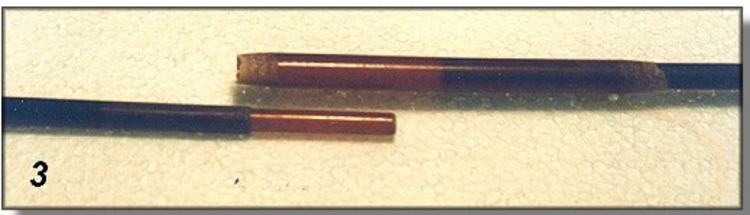
I once dropped a 2x4 from a rafter in the garage and it broke my pitchin' rod ( 18" from the tip) and my grass rake (12" from the tip). It was much easier to just repair these instead of new builds. I've made probably about a dozen repairs like this over the years. I will use the internal and external stints like Ralph outlines in the article @MickD suggested. That being said, I have also had a couple inches of the tip broke off a few rods that pretty much ruined the rod. These were typically faster tipped, shorter rods. The I.D. was too narrow for an internal stint.
-
The grips are what make a custom rods...having that assembly down is super critical. How to shim extra length, making mods to the seat. I love the look you got there...it just speaks "kick-azz".
-
I agree, but keep an open mind. My brother once brought me a rod to "fix". Well...seeing nothing inherently wrong with it, I removed the foregrip, split gripped the handle and removed the weight system in the back. This did not go over well...
-
These are just the musings of an old guy... I never really considered balance in a fishing rod from the "state of equilibrium". It's more like the right reel with the right rod (with the right guides and handle length). For example: I wouldn't put a Phluegar President 20 on an 8'-foot spinning rod. (I actually wouldn't put a Phluegar reel on anything anymore since the anti-reverse switch is gone.)
-
Micheal...have you looked at Gauges? Gauges on the App Store
-
As far as adding weight goes... If the rod really "begs for it" I would use burl cork on the back end and maybe swap the guides for lighter ones.
-
Since we typically are holding a reel in our hand (fulcrum point), I fail to see how the reel itself would affect the balance any...if at all.
-
Lynn...first let me make a correction. The measurements I mistakenly called grams were actually 1/10ths of a gram. I took a cup that looked like it was already at 5cc (old epoxy mix). I added 4/10g resin and 3/10g hardener...and I swear it still looked like 5cc 🤣. Any way, it was still enough to put a second coat on a rod with seven guides and some trim areas. If I had a rod with a longer decorative wrap I would probably just double it. My initial foray with the finish was for some lures. For what its worth...I'm one of those guys who typically mixes 1/2cc each of mix.
-
I ran into @Blue Raider Bob on Lake Cheatham.