
Team9nine
Super User
-
Joined
-
Last visited
Everything posted by Team9nine
-
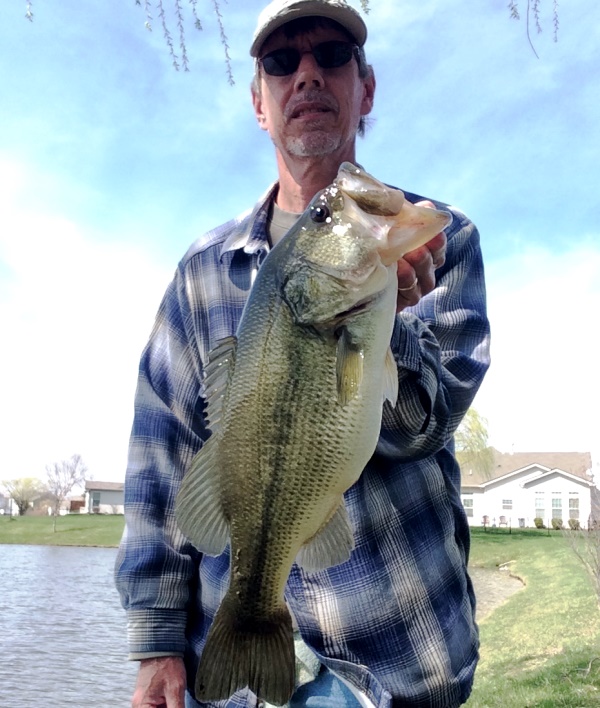
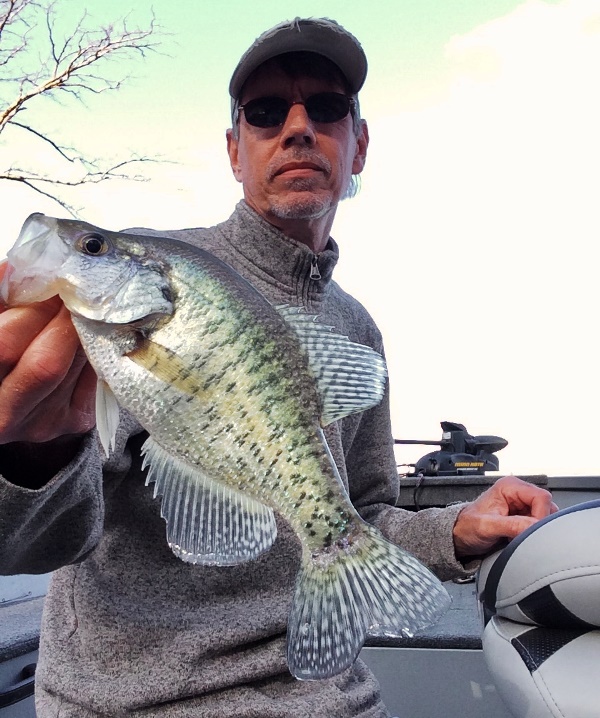
Too windy to get the boat out today, with steady winds at 20+ gusting to 30 mph, but I caught several chunking cranks and jerkbaits from the bank instead. This one is the best I've caught from this little lake - on a HJ08 tossed on 6'6" ML with Curado G and 8# fluoro.
-
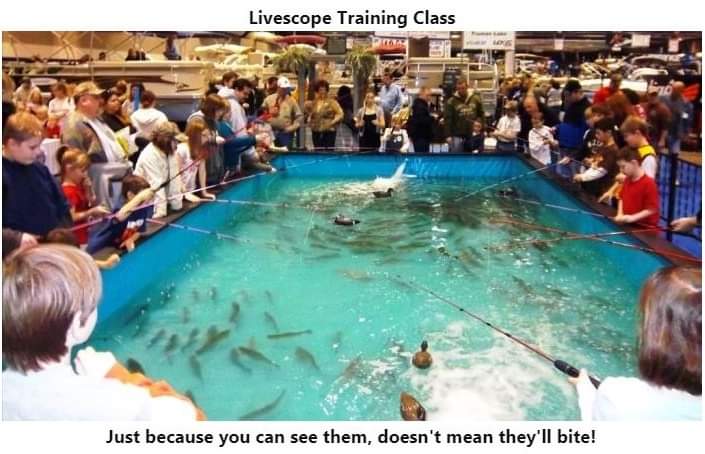
I try and explain that very thing to all the kids (and adults) coming through the gate at the trout pond, too - just because you can see them doesn’t mean they’ll bite. It’s not as easy as you think
-
Crappie populations due tend to be cyclical, but not on a regularly set schedule. Seems like about a 3-5 year cycle in my parts, with some lakes more dramatic than others. Fishing pressure, which is usually tied directly to harvest with crappie, probably plays some role. They also tend to have a shorter lifespan than fish like bass, so they tend to grow quick, but you also lose year classes because of it.
-
Another braid/leader guy here. You always miss a few with enough bites, but never enough to be concerned about - but I don’t use circle hooks either. Scientifically proven to be half as efficient as non-circle hooks with only minimal conservation benefits and near equal mortality rates. In your case, it seems plausible the lack of stretch might be decreasing the hooking efficiency further by moving the hook through the mouth too fast to develop the proper bite and rotation, but that's just speculation. Either ditch the hooks or go back to straight YZH.
-
St. Croix 6’6” ML-F with a Curado “G” or similar letter reel - lol - with 8# InvizX.
-
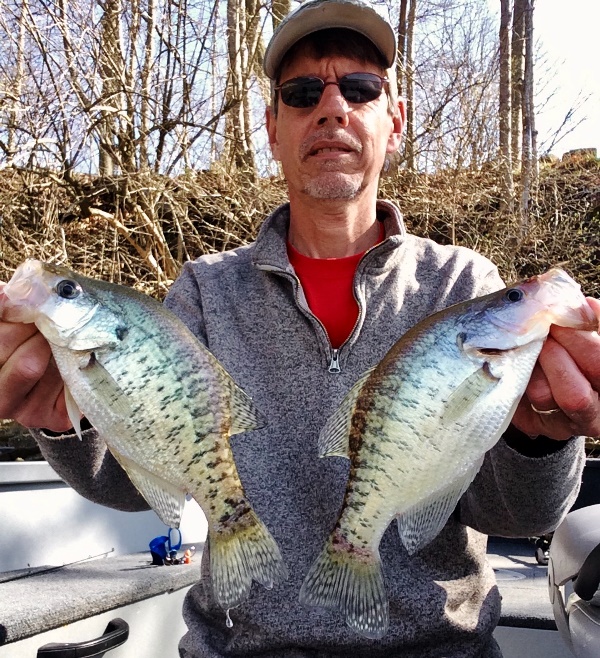
Been doing a lot of deep water crappie fishing. Our reservoir fish stay in their winter haunts usually through the end of March. It's always fun fishing jigs on light line in 20 to 35 foot depths. Went yesterday and as expected, the deep schools are starting to break up. Still managed some nice fish while battling 20-25 mph wind gusts, but a lot of the fish have left and started their wandering ways toward the shallows. We've also had a lot of rain, and the water visibility was about 4 inches, so you had to hit them right on the head to get bit. Will likely start chasing the bass more now until the crappie settle down again in another month after they start staging around their spawning areas. Here's a few pics from yesterday's trip:
-
You’re right, but you’re talking about multiple different factors that all just happen to be playing together at the same time. There is drag setting as relates to spool diameter (how much line on the reel at any given point in time); there is “drag” on the line based on length of cast and how a fish moves; drag as relates to rod action and rod angle during a fight; there is elasticity and hooking force; there is distance vs bite detection; line diameter vs all these things; and others. You can create equations to probably solve most of them, but I’m not sure what a Grand Unified Theory would look like. Might need @Deephaven or @fissure_man for those - lol.
-
That is more an example of the inherent stretch in line, esp. mono. The further away/the more line out, the weaker the force at the end of the line. It goes downhill fast, especially in water as opposed to your room demonstration. Same goes for bite detection.
-
No...the more line off the spool, the higher the drag pressure regardless of initial setting - and, of course, that’s not taking all the other variables into play which affect whether a line and knot will hold. There are obviously nuances involved based on things like line diameter, spool width, gear ratio, etc., but the technically correct answer is ‘No.’
-
My general observations over the years is that the moon definitely has a great influence...over anglers, more so than it does bass ? I pay some attention to it in the spring, mostly because that’s when the angler-science dichotomy seems greatest, and I’m always fascinated by it. Otherwise, the rest of the year - meh!
-
Never wetted one here, either....
-
Anything black nickel and needlepoint should move well. Not certain things like cutting points (Owners?) would be considered a needed upgrade on a spinnerbait, and traditional sliced points would likely be viewed as a step down in quality these days. Just talking out loud here...
-
And the Jetson’s said we'd all be flying around in cars by now ? It’s an interesting debate in the sport right now - has technology gone too far. Notable proponents on both sides of the fence. I’m standing on one side, feet firmly planted, but looking over the fence and wandering myself.
-
SI and DI are both better under power and moving. Consider them more as search tools. FFS is more a troll motor approach, once you are on a spot to actually look at and cast to fish and cover and watch your lure in relationship to both in realtime.
-
This is not difficult ^^ Just buy it and be done with it. Was out throwing HJ-10s yesterday on BC with 8# fluoro - no issues at all.
-
More and more, my casting outfits are getting treated just like my spinning outfits - lock’em down and fish. If I have to give line, I just use the thumb bar. Would love to see an A-R switch on my baitcasters ?
-
In general, side imaging is a thin beam that goes out almost 180 degrees to each side of the boat and works best while moving, usually 3-5 mph and shows things in high resolution to either side of you. Most commonly used off the back while driving, but some do use it off the troll motor. Down imaging is also a thin hi-res beam that focuses more underneath the boat, more similar to 2D. Again, most frequently used off the back of the boat while moving under power slowly. Forward Facing Sonar/Livescope/Active Target is a transducer that shoots a thin beam forward of it's location at a high frequency, most commonly off the troll motor, and is used to search for fish and objects by rotating and searching using the troll motor head or a separate pole installed up front. The main difference is the incredibly fast update rate that basically makes it a "live" refresh, like maybe watching an ultrasound of a baby where you can see everything moving in realtime. You can even watch your lures in relation to fish and cover objects on the screen as you work your baits, and see fish follow and hit them, or don't - lol. Doesn't work well with much speed or movement, and is more a point and shoot type application. SLight difefrences with each brands specific units, but this should give you a general idea. Very easy to YouTube any of these and see plenty of videos of each in action on the water.
-
Not sure if these are as small as the Keitech Tungsten Mono Spin Jig, but if so, they're much smaller than people realize. Look at the crappie plastics section for ideas. I've been using 1.5"-2" tubes, a 2" section of Roboworm tail, and a custom poured chunk (closest commercial is ISG Bambino Finesse Chunk). Hard to find something small enough that doesn't overpower these little guys.
-
Purists aside, while it's not my favorite way to chase crappie, I have caught quite a few nice ones over the years trolling cranks. A few of the guys around here are just about strictly crankbait trollers. Covers a good bit of water which you often need to do for open water schooling fish like crappie, especially in the summer. Like anything else, it can be as exact and scientific as any other method of fishing.
-
Kind of like the old Beta vs VHS days. I think I still have a couple magazines with articles arguing the merits of each when they were both on the scene together - debating which technology would win out ? The walleye guys were way ahead of the bass guys in this regard, which was why I always subscribed to their magazines and followed their tourney circuits.
-
-
-
Huh?
-
Two possibilities were given; The first is that you have both a barb and a hook point sitting on the other side of the membrane/esophogus that houses a lot of vital organs, and that twisting, turning, and just moving that hook around trying to get it free risks either of those points puncturing or lacerating a vital organ that would lead to death. In those cases, you would never see the bleeding, and death wouldn't be immediate, as the bass would swim away, only to die a short time later (<24 hrs) after bleeding out or infection. The second possibility was the old fence post/wooden stake analogy, whereby someone impaled by such an object can be perfectly fine and coherent as long as that object stays in place. It actually serves as a wedge that helps stop/block the bleeding, and that only when you remove the object does the blood have a chance to pour out of the wound and you bleed out and die. In the first study mentioned above, the approx. rate of death was lower than the smallmouth study, but still in the 35-45% range. In either case, not removing the hook and just cutting the line led to better outcomes, with mortalities in the 10-15% range after 10 days.
-
When I first learned the knot, I saw 5 up 5 down as the recommended wraps. However, Alberto Knie, who invented the knot over 25 years ago has a video out where he ties with 7 up 7 down, so that is probably why 7 and 7 is so popular. It's what I use the most when tying, though lately I've been playing with the Shin knot ("lazy Alberto"), a somewhat similar knot, with good success. FG is about the only other connecting knot I tie regularly. Just depends on what lines I'm connecting and for what species.