
bulldog1935
Super User
-
Joined
-
Last visited
Everything posted by bulldog1935
-
what he said
-
just for fun, sight-fishing long-nosed gar on fly rod. Takes a sharp hook for hook-up, and you only get a few, but it's a blast to watch them shoot 8-10' across the surface to attack your fly. If you do hook up, they make astounding aerials.
-
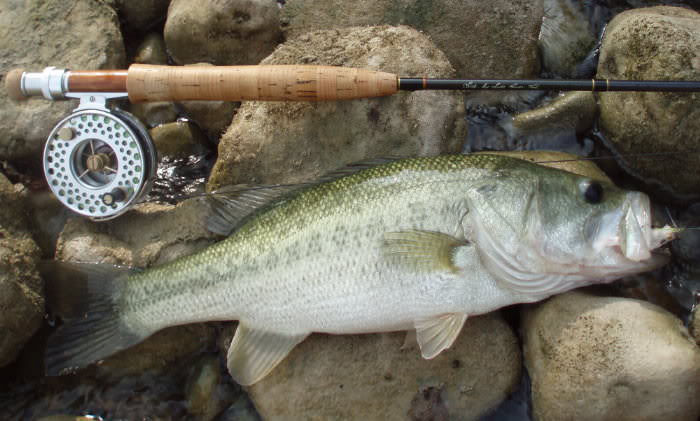
In the Pedernales headwaters one day, fly fishing for endemic bass (Texas brook trout), hooked a samsonite-size black buffalo - on a Tonka Queen cane rod w/ 1917 Hardy St. George. The fish porpoised continuously for 10 minutes, well into the backing, charged back in, still porpoising, and porpoised back out to the backing again before happily coming unhooked. It was a heck of a ride. Of course no photo of the fish, here's a photo of the rod w/ Texas brook trout. I've since sold both rod and reel, but did well in all, buying, fishing, and selling. And quite honestly, there's no such thing as a trash fish - try skipjack herring or even long-nose gar on a fly rod.
-
you see this much more with Tatsu (and other low memory fluorocarbons). Everyone posts that Tatsu is limp, but it's quite opposite - it's stiff and springy, and is going to be worse in larger diameters. Tatsu, Blue, both 10-lb, and 20-lb braid - taped down and held vertically
-
the spool is only a few mm deep - same can be said for spinning reels with braid-specific spools.
-
if you've never tried manual bail technique, you should eliminate that problem. Keep your free hand close to the bail, even feather the line with your fingertips (like thumbing a baitcaster). Close the bail with that free hand (never crank auto-close); turn with the rod to take up all slack before you begin retrieve. Wind knots are caused by loose line at the beginning of your retrieve. I spool braid to this extreme and have never cast a wind knot:
-
no, neither is this
-
no, I would guess a casting flaw in just the wrong place - statistical bad luck
-
not at all, but I'm sure its been thinned and cut out to extremes in design. The two stay fractures that are visible in the photo, the one on the right looks like progressive crack growth, covering about 1/4 of that cross section. The one on the left is final tearing (the chevrons). I'd still think the one on the top that you can't see went first. Reading the fingerprints of fracture has been my career - done it about 5000 times, and taught it in seminars. Creating stress-risers to shave weight is all too common - there's one on Shimano bicycle deraillers that has followed their design since the 70s. Not every one is going to break, but every one has reduced damage- and critical-flaw-tolerance that can kick them over the edge.
-
? I can't turn around without using it these days. As much as I hated differential equations, most recently used it to tie two different leftover quality braid pieces (about 50 yds) for backing this finesse braid.
-
Comparing spool capacity, line diameter is more important than line test. Here's a really good spool capacity calculator. The Advanced capacity calculator allows estimating capacity when stacking lines of two different diameters.
-
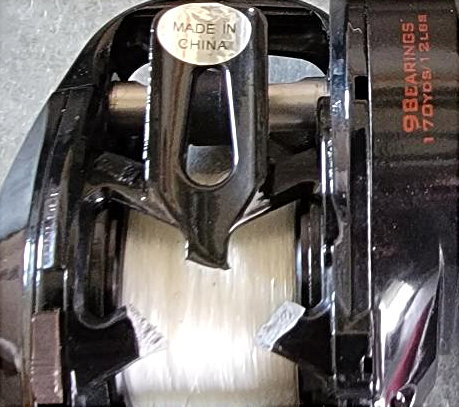
I don't know, I've seen so many broken alloy feet on 1930s Medalists, a broken reel foot doesn't seem crazy at all. What does seem crazy is how far the manufacturer went to lighten that already light metal reel foot. Looks like it started cracking at stress risers, where the thickness changes from too thin to thick.
-
Lakes have a way of creating their own wind - both by focusing prevailing wind along canyon walls, and simply the increasing sun driving evaporation. Look at your paddle situation this way - if you get a longer, better quality paddle, your shorter paddle will make a great back-up stashed in your hold.
-
in reality, the ipt is a more important measurement than the gear ratio, especially if you're going to compare different reels for a fishing niche. Both get over-thought - there's no reason to assume it's accurate to two significant digits, nor does it need to be in order to be a useful measurement for fishing, or even for spooling stacked lines - it's going to be close-enough if you're counting revs to fill your backing. Published spool capacities and line diameters aren't that accurate, either. you can also adjust the way the reel feels when fishing by adjusting handle pitch - longer handle has the effect of slowing down the reel and increasing torque through the gears, while shorter handle pitch has the effect of speeding up the reel.
-
The thing is, the tuber liveries are the local river economy during those months. Trout fishermen make up the winter economy. The two are partners together - two allied organizations, GRTU and WORD, donate to each others' river funds every year. GRTU fought a legal battle and won a Stakeholder share in the water authority for the coldwater fishery. The tubing liveries depend on summer river flow to survive just as much as the trout do. The trout also need to be left alone in s. Texas summers, and the holdovers find deep springs (been doing this long enough, I know all those springs...) And I do appreciate the humor.
-
I'm the opposite in the salt - sealed line rollers just keep the salt in. I swap all my Shimano line rollers for MTCW titanium with 2-BB and no seals - swap out the BBs every 4 years or so. titanium and 2 BB, vs. plated brass, rubber seals, nylon bushings and white lithium grease, from Ultegra to Stella
-
That bushing will be a standard size that you can upgrade with a bearing and a pair of shim washers - 630ZZ - 3x6x2.5mm ball bearing, + (2) 3 x 0.2 mm washers
-
we fish 12-lb fluoro inshore, or go to braid. you might prefer braid on spinning tackle, since it has zero line memory. The only people I know who fish 17-lb mono are in the surf.
-
that's the Standard Horizons HX 890 with DSC/GPS - boats/ships navigating with AIM can see you on their nav screen, and the Coast Guard can find you on their GPS. You can also find your buddies, and set up a "private" channel so others don't hear you talking about fishy spots. Each radio is registered to the boat hull through FCC/MMSI They offer both plug-in and wireless hands-free headsets. If all you want to do is talk, the SH HX40 is the smallest hand-held VHF made. SH also gets the nod for range least affected by ground-clutter interference. Looked for a photo of the one on my dad's center console, but don't have the photo. At least at the coast, all the boat-rescue service companies are always monitoring for "Pan, Pan" calls - dead motor, grounded.
-
we're always in range
-
Consider that you're in good company here. This seems more like an Introductions thread than general bass fishing, but that's ok. I got excited when I saw the title, about never growing up. If fishing doesn't bring out the kid in you, you're not doing it right. The "greats" I've fished with are every one infectious, and it's their kid-like exuberance that makes them so. I like to group myself in that description, as well.
-
Saw a kayak flight test one day on the interstate. Going the other way, a guy had his kayak in the truck bed with the nose propped up over the cab - guessing he used bungees for tie-down (v. smart people using cam straps). It launched pretty well at 70 mph.
-
Copolymer has been my choice with kid fishing, and YoZuri would be my choice with the Zebco. for 10 years, was buying Kamikaze copolymer from Oz, and my daughter could fish L/UL spinning tackle without assistance (she hates assistance). There are some really good low-memory fluorocarbons, but they're too thin to work well on Zebco. The low memory fluoros are also too springy for kids using spinning tackle - they jump off the spool.
-
Smooth acceleration - remember that all jerk in your cast is only backlash. I'll put in a vote for Lew's SP, even with tiny (PE#1) braid - the rig below is for 1/8 oz. But it's also not for inexperience. Going to big diameter line is the easy answer, but it also costs distance, and may not work at all with lighter lures. I would stick with 12-lb fluorocarbon, and did, until I couldn't remember a backlash. Here's Lew's very lightweight centrifugal brake. something else - you left out what you're trying to cast - casting heavy wind-slippery lures is much easier than light, wind-resistant lures. There are 3 types of backlash, and 4 types of brakes. The first is spool start-up overshoot. Centrifugal brakes deal with this the best. The second is wind backlash, which occurs in the middle of your cast as your lure is approaching its highest vertical point, and gravity is slowing it - mag brakes work best here - the same for wind and light lures. The last backlash is over-run after your lure hits the water - thumbs take care of this. The fourth brake type is spool tension, which is a constant load on the spool. While spool tension can brake all 3 types of backlash, it costs the most cast distance. DC brakes are basically a chip-controlled spool tension brake, modulating the spool tension throughout the cast. I've never fished one, but some have reported on the forum, they cost a bit of distance compared to centrifugal brakes and mag brakes. Without DC, you'll likely use a combination of spool tension and your added adjustable brake (centriugal or mag).
-
here's what I get, bro: @A-Jay