



Team9nine
Super User
-
Joined
-
Last visited
Everything posted by Team9nine
-
8+ on a pink blade bait
-
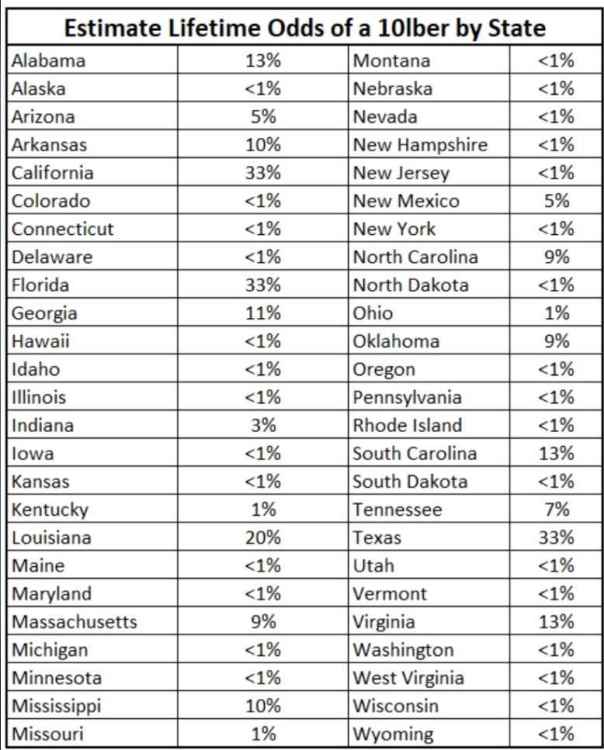
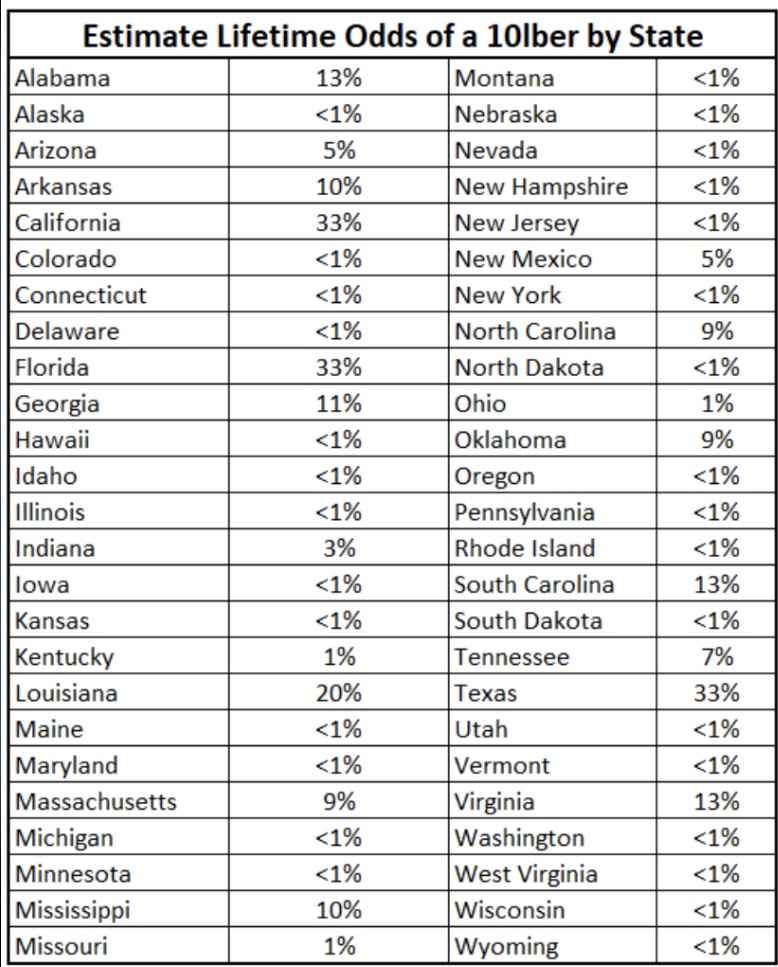
The one thing I've been thinking about in all this, and that is reflected in this table, is that the states with <1% odds are all states with no documented FL bass genes to my knowledge - all pure northern strain bass. What I'm really curious about is whether the big bass suspension phenomena, as witnessed by JJ and other FFS guys chasing these beasts, is a byproduct of the introgression of FL bass genes into the population. Certainly all the southern OK and TX lakes Josh has caught 10-pounders from have all been FL gene influenced. Can that same behavior be documented and capitalized on in a pure northern strain bass fishery? Could Josh catch a 10 lb bass in a non-FL gene based lake somewhere else in the country using the same FFS suspended bass program? Would love to see him try to shed some light on this possible behavioral difference.
-
Ask and ye shall receive ?
-
I really had to think about this one because every bait will catch a fish no matter how gimmicky. Even the few low productivity baits I own like the Musky Jitterbug and larger Whopper Plopper I've at least caught one bass on - lol. Then it dawned on me. The ONE bait I can't ever remember catching a single fish on - even getting a single bite on - that I threw enough to give more than a fair shot was the LuckyCraft LVR/LV50 lipless rattlebait. I bought two, red craw and green craw. They looked great. I've caught a ton of fish on their cranks and jerks, so I thought these would be solid. NOPE. NOT-A-SINGLE-FISH. Gave the red one away. Think I still have the green one for some unknown reason
-
Try 6# InvizX or Tatsu to start and see if it will get you the strength you need for the presentations you want to try. Another recommendation is to use it (fluoro) on a larger size spinning reel (2500/3000) of some sort as that will help with handling. Try to avoid the little 1000 size reels, etc. with the tiny spools. I've been using fluoro for 10 years now and have never once used line conditioner. Not saying it wouldn't help, it's just not a necessity, IMO, if your setup is good from the beginning. I once landed a 44# flathead fished on straight 8# Seaguar InvizX on a spinning outfit with shaky head. Took over 1 hour to land, but that gives you an idea of what a good fluoro setup is capable of handling.
-
As always, Seaguar InvizX and Tatsu are the brand standard-bearer for all-around fluoro line manageability and performance at the two ends of the price spectrum. In your case, I would personally bump up to 10# or slightly higher due to the way they rate lines (fluoro is always to the low side vs mono/copoly). However, in the end, it’s not whether fluoro has come a long way, but whether your casting skills have.
-
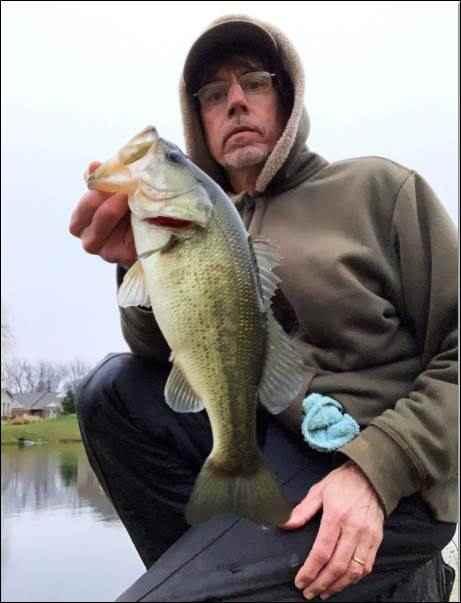
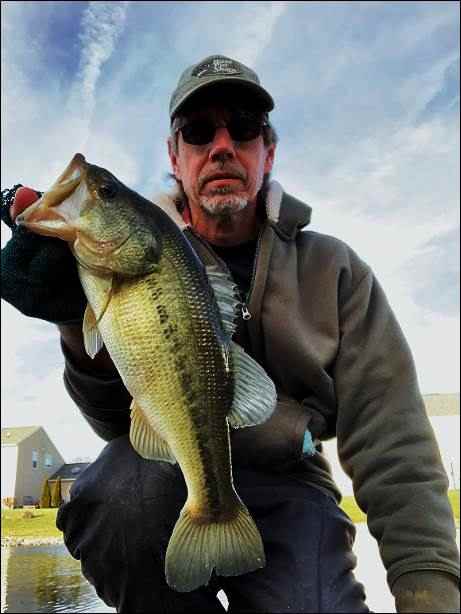
Was able to get out on the 1st and the 4th and catch a few fish each trip to start off 2022. If the wind dies at all (been gusting 20-30 all day), we'll lock up for a bit and fishing will come to an end. Single digit lows and highs in the upper teens for the next two days. I'm good though and can hang until Feb. with hopes of getting a day of at least semi open water then. Never know in Indiana, but much better than many years back when we used to be locked out Dec-Feb most years with solid ice.
-
May be fine for small crankbaits, 1/4 oz and less, and mostly shallower water (and shallower diving baits), but have to believe this experiment ends up bad in more situations than not. There’s just a lot that doesn’t add up here; under-rating of fluoro vs nylon, braid to leader knot, direct tie knot strength, excessively long leader, loss of hook setting power, etc. Maybe more specifics on your cranks and depths involved would answer some of these concerns. As you just mentioned, you’ll just have to try it and see how it works. Maybe in your situation it will work out fine. Update us sometime down the road when you finally get a bunch of time and fish under your belt with it.
-
Literally "straightening" might be a little hard to do unless you simply abuse a hook, but certainly "opening up" a standard worm or jig hook isn't nearly as hard you might think. I have it happen quite frequently. If you want to test this idea out, simply attach some frogging braid (65#) to whatever hook/jig you want, put on a good pair of leather gloves, and then wrap the braid around your gloved hand securely. Next, simply insert your hook into the eye of any standard 10# or 15# anchor and lift it off the ground. Hooks with inherently weak designs like EWG and Kahle style will easily bend out in most standard diameters. Even a lot of round bend hooks will start to open up. Superline hooks, as well as things like 2X/3X hooks hold up pretty well. Another big factor is whether the hook actually penetrated and the fish (and pressure) is actually down in the bend of the hook like it's supposed to happen. This doesn't always happen though. If the pressure is actually centered at the hook point because the hook hit bone and didn't actually penetrate, it is considerably easier to open up a hook because the leverage changes rather dramatically. Most anglers probably never reach any of these thresholds because they set their drags at 2#/3#/5# like you're supposed to, and as such, those higher pressures never actually materialize. Lock your drag down though so the pressure can build up, especially with any superline/braid, and you'll be opening up standard hooks pretty regularly, even with fluoro/mono leaders.
-
Alwine wrote two books, "Lunker Lore" and "High Percentage Fishing." I believer @WRB was part of one of those books, or at least spoke with Mr. Alwine. I believe the numbers are just a statistical extrapolation based on catch records and data accumulated throughout the country as a whole. He has stated that some of the statistics in his book come from "40,000 (data points) I already have... which mostly comes from clubs/tournaments/big bass programs." His books were published fairly recently, but before the popularity of FFS, which is really a very recent phenomena in the bass world. As such, one interesting aspect of this is how a tool like FFS can potentially skew the data/odds in your favor, witness Josh Jones. Based on my own research I did when running my website, and a piece I wrote on how truly rare 5 lb. bass are, I think the chart at least gives a decent set of numbers to ponder reflecting this. Back in December 2006, I examined tournament reports from six states, which consisted of 18,000 tournaments and four million angling-hours of competition, and concluded that the average time that it took the anglers in these tournaments to catch a five-pound bass was 495.5 hours. That data was assembled just a few years after the largemouth bass virus had affected many of the southern tourney waters (primarily 1998-2002). I later looked at more recent data (2008-2010) for these same states, and the fisheries had rebounded somewhat. It still took on average 148, 189, and 288 hours to catch a five-pound bass in Alabama, Oklahoma and Mississippi, respectively. Additionally, data showed it took about 106 hours to catch a bass over 20-inch (4.5 pounds) in Kansas, and 211 hours to catch a bass over four pounds in Tennessee.
-
Ned's not a pro. That's my excuse, and I'm sticking with it
-
Between flatworms, Jackhammers, Whopper Ploppers and RES’s, you’ll probably catch everybody here. Even I own 1 of those 4 ? Probably a few Rojas Spro frog guys here, too. Might have to go back to the Hank Parker Classic Spinnerbait and Guido Bug to catch a few of the old timers though ?
-
I don’t have a single one - them are smallmouth baits ?
-
Fish don’t live in boxes, and so they aren’t all magically transported from one location to another en masse. That said, with enough time on a waterbody, you will see the same routes taken in general, year after year, as fish move in and out during phases like pre-spawn/spawn/post-spawn. There will also be areas along this route that fish tend to congregate at/on. So you tend to learn where they’re coming from, and where they’re headed to. The trick is to then try and figure out at just what stage in that process the fish are during your day on the water. Everyone has their own system for doing this. Just know that generally, there will be fish all along these routes, constantly coming, going and pausing based on weather and water conditions. If you don’t find them biting in one area, move further in or out along that route and keep searching. If you’re not even certain of the routes the fish take, then your time would be better spent learning this via map study and spending a lot of time on the water fishing and eliminating locations and areas in an intelligent manner.
-
In my neck of the woods, that switch usually happens around 50 deg (bracket 48-52). That is main body/primary creek mouth temps. This typically corresponds to about the first week of April here. There are no absolutes though, and weather patterns leading up to that point can affect this. Bottom line; if water temps are under 48, I search clearer water. If over, esp. into the low 50s, I lean toward murkier. Fish will be caught out of both though.
-
Wow - That's ridiculous. Horrible conditions for stripers. Any that didn't die from temperature and oxygen will end up dead on your line after a brief fight in those conditions. Might as well not even waste money stocking them.
-
-
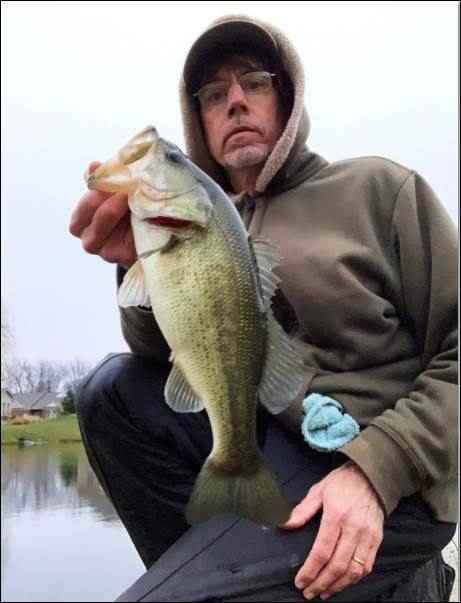
I can easily do all 5 of those listed techniques and more with a single finesse outfit. I only carry one rod at all times, and changing time between baits would be minimal in nearly all cases. I go with a Shimano Clarus 6’6” ML/F with braid to leader setup (typically 10/6 or 14/8). You could probably also fit all the lures/tackle in a single box (3600). I operate all year from the bank using this basic format.I read it as 90 degree surface temps at the deepest part of the lake (dam?), which happens to be 98 feet deep - not 90 degrees at a depth of 98 feet. Combined with low oxygen levels, that would be a striper death sentence. They have to have a thermal refugia with adequate oxygen, which is usually a very limited space to begin with in southern waters.I’m kind of a human garbage disposal of fishing knowledge - lol. I take everything in, but have accumulated enough on-the-water experience, opinions and excess mental baggage, that it takes some doing to get me to change much with my current approach, including tackle. Some pro switching to some new product line isn’t going to cut it for me - ever. That said, when I want to know the “juice” on anything related to the techniques and baits the pros are using, or something I should really be checking out, I simply ask Wheeler.Ask and you shall receive - you’ve now been recommended every line option available to man - lol. Decide wisely ? On a more serious note, I’m the reciprocal of@A-Jay, that being 75% fluoro on casting gear and 25% braid with mono/fluoro leader on spinning gear - the spinning gear being used with smaller and lighter jerkbaits like the smaller Husky Jerks, which are pond favorites.I've caught so many bass over the years fishing the open areas of partially frozen over lakes like that one. Mine aren't frozen yet, so had to go out again today and try and get that first 2022 bass of the year. Managed a handful of bites, landing several, though nothing near as big as yesterday. Mission accomplished though...
 Guessing mine would fall under 'approach,' too. Very guilty of being a multi-species fisherman. One of my favorite sayings is, 'Don't fight the bite." As such, if I'm out bass fishing and a school of white bass erupts, I'm all over it. Or if the bass aren't biting, I'll pull out the crappie gear and spend the rest of the day chasing slabs. So this exact thought hit me this past week, but I'm going to try and only carry gear and setups for a single species while out on the boat with the hope that if I headed out planning to target bass, then that's what I'll live or die trying to catch. Same for any other trips and species. Most of my boat trips are between 3 and 5 hours, and I often end up spending an hour doing this, a couple more doing that, and before long the day is over. The positive is that I never truly blank on a trip because I can always switch to something else and catch a few of something. But so many times I came off the water and felt like I didn't spend enough time focusing on what I intended to catch in the first place...basically feeling like it was a somewhat wasted trip - and next year (this year) I've already decided will be a bass year, especially bigger bass (targeting). For me, 2021 was the year of the crappie.1/16 oz mushroom head jig and a Z-man Finesse WormZ.




Important Information
We have placed cookies on your device to help make this website better. You can adjust your cookie settings, otherwise we'll assume you're okay to continue.