cidgrad96
Members
-
Joined
-
Last visited
Everything posted by cidgrad96
-
Just using "traditional" as a term - call it whatever you want. Maybe "concept" spacing is the right term. But you are using a totally different set of guides - therefore different need for spacing then the concept charts. I don't use that spacing. Each builder has their own way and that's what makes us unique and provides different results. I know the feedback I get - so it works. I don't use high framed guides if possible (casting only - spinning different story) but have had ones where I had no choice but to use at least one. I do the same - Blank under full load and space so the line is not dropping below the top of the blank. I then go a step further to make sure the line won't drop below once torque is added. I talk with a few other builders using only size 3.5 LSGs and they use the same number of guides I do. I've casted their rods and they work phenomenally well. They too are looking at 30" out for butt guides. Maybe some of it is the difference in blanks. Dunno.
-
Flech - good point! I've built so little lately on a traditional set up - all "full sized" guides" - I forget sometimes to give a true comparison. I've been building with micros since the beginning of last year and haven't looked back. I don't even stock enough "full sized" guides to build a rod! If I did space out "full size" guides with a longer distance between reel and butt guides, it would change the picture and I would probably need more micros in comparison. Using length +1, if you're going 30" to the butt guide, 8 guides is probably too many even with full size guides IMO. (Saying this without testing!) I bet you could probably loose a guide from the length +1 depending on size, etc. I guess most folks I've talked to never want/think to go more than the roughly 19"- 22" with the butt guide because that's the "traditional" set up that basically uses the length+1 for determining number of guides. (Thinking Fuji Concept type spacing here) Side note: One thing I never see anyone mention either - spacing charts from the manufacturers often have you use more guides... why would they have you use fewer? It helps them sell more guides!!! Alex
-
I disagree. I don't use +3 more micros and I can promise the performance (casting and fish fighting) is outstanding with an on top build. Example - a 7'9" rod - Following "traditional" rules of thumb, you'd use 9 guides... I use 10 with micros. A 7' rod I may use 9 guides, but that is only 1 more than "traditional". This is regarding a casting build, not a spin rod. I highly recommend reading the series of M&M posts on rodbuilding.org prior to starting with micros. I drafted a volume specifically regarding the spacing of micros - http://rodbuilding.org/read.php?2,285706,285752#msg-285752. Lots of good information in there from several experienced builders. Leaders can cause trouble going through some of the smallest micros. Before you scrap the micros, I'd also suggest trying to tie your leader on at the spool... yes you may have a 7'+ leader... but see how that casts using the micros. You may notice a difference in having them pass through all the guides as opposed to starting in the middle of the set up. You can also lighten EVA by reaming it. Just because it stretches doesn't mean you can't ream it. - Alex
-
I rarely use the burl - but good to know it's different now. Scott's a good guy and has really taken a lot on buying Fishsticks, the former products made by Lamar, launching some new lines, and still running some other things. It would make my head spin! I keep that post by Andy printed and let folks read it. The whole thing can be viewed here http://rodbuilding.org/read.php?2,156787,page=1 - there's a whole lot more detail past what ReelM. posted. Pretty complex stuff but very informational. Doesn't even touch on the whole multi modulus thing either! Andy's a great guy. I had problems learning to do finish back when I first started and worked with me and in very short time I had beautifully even finish and it seemed so easy with his guidance!
-
What kind of worm and weight - shakey head is going to need something different than a carolina rig - but they are both worms! Personally I would suggest the Batson RX6s if this is your first build. Good variety of blanks, modest cost, and pretty good performance. They aren't high end stuff, but good nonetheless. Batson sells them under their "Forecast" line of blanks.
-
Cork vs eva - personal preference really. Weight is about the same. EVA probably lasts longer. Good quality cork is expensive, while eva is MUCH more price conscious. EVA shapes just as easy as cork. I shape it on a lathe, but you can do it by hand or on a drill. I'd recommend shaping it first then putting it on the rod - don't have to cut it off if you mess it up. The drywall screen sandpaper does great sanding EVA because the particles pass through. Regular sandpaper gets clogged but I do use that for finishing up. I go to 400 grit and that's a nice finish, but if you have some 1500 - now that is smooth stuff! I've been working with micros since late 2007/early 2008. All my bass and inshore (redfish/trout) builds are only these now. Advantages to micro guides: - weight savings - especially key because you are losing weight towards the tip of the rod - better line control so I see longer casts - less tangles on deck and in the rod locker - goes in rod locker easier - less guide to bend, so better durability (think bend a 6" piece of metal vs 3" - which bends easier?) Hope this helps. Feel free to drop me a line anytime.
-
RX8+ is a lot more expensive. Great blank though. Easy comparison between a RX8 and a RX8+ with same stats - 7', 10 - 17# line, 1/4 - 3/4 oz lure RX8 - $117 RX8+ - $217 That is retail price on the blank only. To translate what Karry said into simple terms - the RX8 has some fiberglass in it to give it strength and it is mulitmodulus (made of different types of graphite fibers).
-
Try a couple drops of acetone. May increase time to dry though.
-
Per Karry Batson: "The RX8+ has crushed graphite fiber scrim as well as a proprietary fiber lay out for hoop strength. This is correct! The RX8 does not have a crushed graphite fiber scrim. The RX8+ is made in the USA The RX8 is made in China featuring modules positioning of RX8 and RX7 graphite materials."
-
I'm not using an autoclave or vacuum bagging and this is more than hard enough for the intended purpose and can be done rather inexpensively.
-
Hey Reel - Thought the RX8+ was made by St Croix. My understanding was the RX8 is made overseas. Maybe that changed?
-
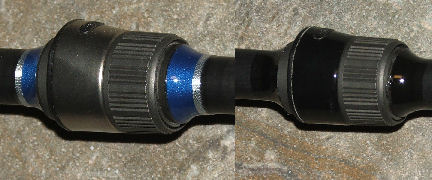
I agree that attention to detail is a big difference between handmade and homemade rods. With all due respect there is more than one way to skin a cat. My personal method is to use an epoxy ramp. It may weigh slightly more, but we're talking maybe a gram of difference for something that is totally customizable and will last the life of the rod. Winding checks can be subject to dry rot with prolonged exposure as with any rubber product. I also like the smooth taper as it feels comfortable against a finger if you palm a reel with a finger on the rod. I attached a picture to show two epoxy ramp versions. One is pigmented epoxy (black) and the left side is an epoxy ramp with a thread wrap to match the rest of the rod. Epoxy ramps can be learned very quickly and easily using a little 5 min epoxy. I'd be glad to help anyone who wants to learn how to do this. Another easy option is Batson makes winding checks that are the same OD as a size 16 reel seat. These checks have different inside diameters to elimate the need for stretching one, but still retaining the proper 16.5mm outside diameter. Great match up and little work.

-
I've been really happy with the XTools scale. It's a little more, but seems to grip fish good and the weight seems to be more accurate than some of the others I have bought in the past.
-
My apologies. Not aimed at you, although I am sure it came across that way. I should phrase things better. Really meant it as an across the board comment and mainly to keep your mind open to options. First time I told a guy I used salmon blanks as jig rods - he balked - until he fished it one time. Different tune then. But it does really take learning and experimenting and as a buyer - trusting the builder.
-
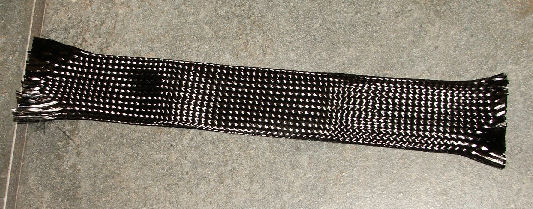
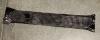
carbon fiber. it's a tube (tube is flat in this picture). Think like the finger traps you played with as a kid. You push it (expand) and slide it over the grip core, pull it tight and it conforms to the shape. I then laminate it with an epoxy and then there are a few different techniques to get the surface I want. Hardest part to me is getting the fibers to stay straight when you first cinch it down. Using this stuff you don't have a seam.
-
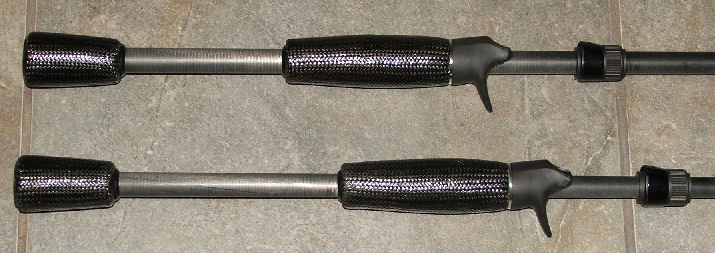
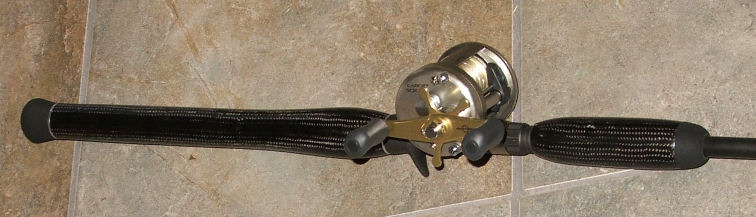
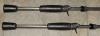
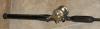
I do carbon skinned grips. It's basically a laminate set up over a foam core. I guess you could do it over cork. I'd seal the cork first if that is your base. I'm using carbon weave tubing, so I imagine you'd need to be creative with the seam. Sounds like you got some experience there! Here's a couple examples. The top two have a bumpy texture and the bottom one is smooth. I prefer the look of the smooth but the feel of the textured. Never had any problems with wear, slipping, or anything like that. Very durable.
-
The stuff he builds looks very nice and CTS blanks are good stuff. The CTS blanks are built little differently and perform a little differently - so not really fair to compare them to one particular line. I can say that certain models IMO outperformed other comparable blanks, including GLXs. I believe the EBT844 for worm/jig and the EX6103 and 6102 for shakey head. It still comes back to the builder making the right blank selection for the task. So you need to have confidence in your builder since he/she will probably be making that decision. CTS does have a variety of factory finishes - something most other rod companies don't do. Not a bad thing because it's more variety and the finish should be under the factory warranty. Head's up - they are made in New Zealand. Here in the states it can be 6 weeks to get a particular blank in a special color. Not sure what this guy has set up. He may be able to get a quicker turn around. Figure part of that build price is a nice little shipping fee from NZ to Mex. I wouldn't tie myself to buying only an EBT blanks (see example above for shakey). If the builder knows the line of blanks well enough, he can identify other models that work well and sometimes surpass the performance of the intended "bass model" blank. IMO too many custom bass builders keep themselves in the "mag bass blank" box. Some of my best bass rods have come from blanks intended for applications other than bass - salmon, inshore, etc.
-
Can you link where you found it and maybe what rod lines? Might help us figure out the marketing mumbo jumbo.
-
Hammer - really about the best test in the store is probably the"voice box method" Retiredbosn posted. There's the run it down a piece of paper test, rub it across the carpet test.... list goes on. Nothing is a fair duplicate for line/reel on and dragging a jig or whatever IN THE WATER. If you are watching pennies, spend your bigger $ on feel rods (jig, shakey, worm, drop shot, etc). You can get by with lower grade rods for moving baits. True action - bend it. What I find best is to hold it about 45 deg and have someone pull the tip. You can tell backbone and action better (to me) than pressing against the floor. You're also holding the rod more like you would fishing it. Buying by specs is a great approach. It's just hard for me to illustrate a difference without putting rod in hand. Just know you will notice differences between various brands and if you can compare side by side, that's even better. Retired - I abandoned concept spacing after about my second rod. I found all rods, even the same model by the same manufacturer flex differently. The vast majority of blanks are hand rolled, so if a human does it, there is room for deviation. Most folks won't notice, but I may have 5 of the same exact same blank sitting here waiting to be built. I notice differences. So I static test and space. Not to mention all my bass and inshore rods get micro guides, and there's no spacing templates for that. (I've been building exclusively on micros since June of last year - started with micros before that - have a lot of trial and error in there!) You can't go wrong with static testing the blank. I think too many "custom" builders use templates (personal opinion - every one has one right?). To me it gives the same results as a factory rod - it's generic factory spacing. I also don't really tie myself to a set number of guides (although I can pretty generally say what a blank needs from experience). I static space them, and what comes out is what that particular blank needs. I believe this gives my rods similar construction - it helps maximize the potential of the blank and that's the construction I want. Every builder is different and you have to do what yields the results you want. Kudos for supporting your local tackle shop too. Those guys need all the help they can get.
-
AMEN about the resins! But this also comes back to buyers not knowing what really goes into making a rod blank. You commented minimum of 9 guides on a 6'. What size rings? What type of guides? Is this with equidistant spacing? What kind of spacing for the butt guide? If you are using size 6 single foots... my take is that's 2 guides too many on a 6' rod. Micros, maybe, but I usually don't get into 9 micro guides until at least a 6'6" rod - mainly on 7' and longer. 7'6"+ usually take 10 micros. I believe adding extra guides is a negative. You're decreasing rod sensitivity any time you needlessly add weight, which includes too many guides. You are also altering the natural flex of the rod through the addition extra thread wraps and rod finish. The only benefit I could see in two extra guides is keeping the line more parallel when the rod is under load. On a 6' rod, 7 guides does a pretty good job of keeping the line on the right path - even under load. I'll also through this out... if through handle construction is so important (which I personally believe in), explain why the majority of high end japanese rods actually have handle kits and not through handle construction. Granted a lot of this is subject to personal opinion as finding quantitive data to prove this is difficult. I just know the results I get using what I mentioned.
-
Dang Muddy.... "...the perch actually swam a small distance before going belly up " is that catch and release? Ok here's one a buddy posed to me that I wondered and this post reminded me. You catch a dink... big momma comes up and slams it. You end up hooking big momma too. Legit hook inside the mouth (say a treble in the jaw or something). Because big momma hit the dink you already had hooked on a lure, is she a legal fish? Would that be considered fishing with live bait? I couldn't answer... it was a good question.
-
North Fork may be new, but it's old folks. Look at the name of governing agent: http://www.secstate.wa.gov/corps/search_detail.aspx?ubi=602907686 http://www.secstate.wa.gov/corps/search_detail.aspx?ubi=602840913
-
Dan - The email sent by Merrick Tackle was real (announcing the blanks). Now they could have jumped the gun. Who knows there. The lawsuit is real. Link to lawsuit: http://dockets.justia.com/docket/court-cacdce/case_no-2:2008cv07197/case_id-429695/ There's a few other things going on as well, but I don't know of anything to back them up - so just rumors/gossip.
-
check out barlowstackle.com Some stuff is a little cheaper there it seems.
-
If I remember right, the reason for tying to the split ring is so the bait can have a "free-er" movement. I think I read that somewhere. I could be very wrong.